
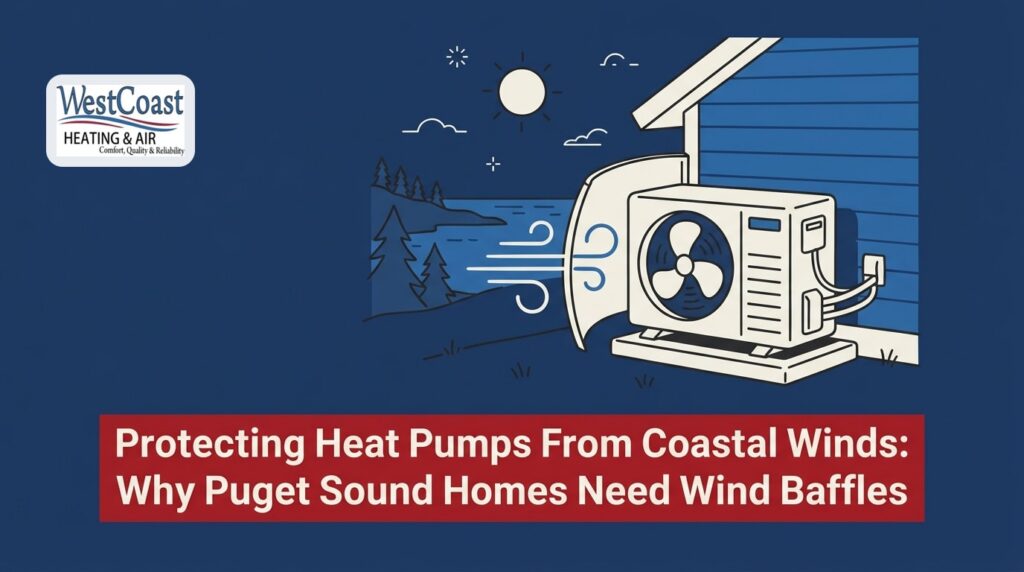
Bracing for November: The Reality of Coastal Winds on Your Heat Pump
Here in Puyallup and the surrounding Puget Sound communities, the November pre-winter storm season is closing in fast, bringing heavy rain and aggressive, sustained gusts off the water. If you rely on an outdoor HVAC unit to keep your home warm, protecting heat pumps from coastal winds is a critical step before the weather turns severe. Standard installations are designed for average conditions, leaving exposed units vulnerable to the intense wind loads common along the waterfront.
At WestCoast Heating & Air, our technicians frequently see the aftermath of severe weather on unprotected equipment. If you need help evaluating your system’s readiness, our heat pump maintenance services can ensure you are fully prepared, including comprehensive strategies for preventing weather damage to your outdoor HVAC unit.
Many homeowners assume that a brand-new, high-efficiency heat pump is invincible straight out of the box. A pattern we see often is that high-velocity coastal winds whipping off the water strike outdoor HVAC units with tremendous force. This creates an immediate decision point for property owners: determine if a standard heat pump setup can survive the winter, or recognize that structural protection is required to maintain heating efficiency.
Understanding the Coastal Wind Threat
To understand why this matters, you have to look at how these systems operate. An outdoor unit needs to pull ambient air through its metal fins to extract heat. When a 40-mph gust slams directly into the face of that unit, it disrupts the precisely engineered airflow. The fan fights against the incoming pressure, the internal temperatures fluctuate wildly, and the system struggles to perform its basic functions.
| Installation Type | Wind Exposure | System Impact During Storms |
|---|---|---|
| Standard Inland Setup | Blocked by trees and neighboring houses | Normal operation; minimal airflow disruption |
| Unprotected Coastal Setup | Direct, unobstructed gusts off the water | Severe fan strain; frequent defrost failures |
| Protected Coastal Setup | Shielded by an engineered wind baffle | Consistent airflow; reliable indoor heating |
As the November pre-winter storm season escalates, leaving a unit exposed on a bluff or shoreline often leads to sudden breakdowns right when you need heating the most. Addressing this vulnerability now prevents emergency service calls later.
How High-Velocity Winds Disrupt the Defrost Cycle
One of the most destructive impacts of high wind on Puget Sound coastal and bluff-facing properties occurs during the heat pump’s defrost cycle. In our experience responding to winter no-heat calls, this disruption is a primary culprit. To understand the disruption, you first have to understand what the system is trying to accomplish when temperatures drop.
The Normal Defrost Process
During normal winter operation, condensation naturally forms on your outdoor unit’s coil. When the temperature hovers near freezing, that condensation turns to frost. If left unchecked, this frost would completely encase the unit in ice, blocking all airflow. To prevent this, your system periodically enters a “defrost cycle.” It temporarily reverses its operation, sending hot refrigerant back outside to warm up the coil and melt the accumulated ice. Once the coil is clear, the system switches back to heating your home.
The Wind Disruption Factor
The problem arises when strong, sustained winds hit the unit during this critical melting phase. The physics are straightforward: the wind strips the heat away from the outdoor coil before it can successfully melt the ice. It is exactly like blowing on a hot cup of coffee to cool it down. The system is generating heat to thaw itself, but the coastal wind carries that heat away instantly.
Because the ice never fully melts, the system’s sensors detect that the coil is still frozen. This triggers a frustrating and inefficient loop:
- Incomplete thawing: The base layer of ice remains on the coil, acting as an insulator that blocks heat transfer.
- False defrost cycles: The system continuously tries to defrost itself, spending more time trying to melt ice than it does heating your living room.
- Severe frost buildup: Moisture continues to freeze on top of the old ice, eventually turning the outdoor unit into a solid block of frozen metal.
The Solution for Continuous Comfort
When the defrost cycle is compromised, your indoor heating efficiency plummets drastically. The unit runs nonstop, consuming massive amounts of electricity, yet the house still feels cold. Protecting the unit from direct wind shear is the only way to allow the defrost cycle to reach the required temperature. Finding the best HVAC setup for Western Washington weather means accounting for these exact thermodynamic challenges and ensuring your equipment can actually perform the tasks it was designed to do.
The Mechanical Strain on Your Outdoor Fan Motor
Beyond the thermodynamics of freezing coils, coastal winds inflict severe physical punishment on the moving parts of your system. The outdoor fan motor is the workhorse of your heat pump, tasked with pulling massive volumes of air through the unit. On Puget Sound coastal and bluff-facing properties, our installation crews at WestCoast Heating & Air often find this motor in a tug-of-war with Mother Nature.
Fighting the Wind Resistance
Your heat pump’s fan blade is pitched to move air in a specific direction at a specific speed. When a direct blast of wind hits the unit head-on, it creates immense static pressure against the blade. The wind physically slows down the fan, and in extreme gusts, it can even force the blade to stop spinning entirely.
Because the system’s electrical board is telling the motor to maintain its speed, the motor begins pulling more electrical current to fight the wind resistance. This is known as high amp draw. The motor works exponentially harder, generating excess internal heat. Over time, this constant strain leads to premature wear on the bearings and eventual motor burnout.
System Shutdowns and Safety Switches
Modern heat pumps are equipped with internal safety mechanisms to prevent catastrophic failure. When the wind restricts the fan from exhausting air properly, the internal pressure of the refrigerant spikes rapidly.
Signs your system is experiencing severe mechanical wind strain include:
- Unusual noises: A loud humming or grinding sound from the outdoor unit as the motor fights resistance.
- Short cycling: The system turns on, runs briefly, and abruptly shuts off before heating the house.
- Tripped breakers: The excessive amp draw from a struggling motor can trip your electrical panel’s breaker.
- Complete lockout: The system shuts down entirely and requires a professional reset.
Severe airflow disruption triggers the system’s high-pressure limit switches. When the pressure gets too high, the switch trips, causing the unit to shut down entirely to protect the compressor from exploding. While this safety feature saves your equipment, it leaves you without heat in the middle of a storm.
Why Standard Clearances Fall Short on the Puget Sound
When you read a heat pump installation manual, you will see specific requirements for “clearances”—the minimum distance the unit must be placed away from walls, fences, and vegetation. These manufacturer out-of-the-box clearances are designed for average, inland conditions where the primary concern is simply allowing enough ambient air to circulate.
The Coastal Micro-Climate Difference
Standard clearances assume a relatively calm environment. However, bluff-facing homes experience unobstructed wind loads that significantly exceed standard regional averages. When you combine the sustained wind patterns of Puget Sound bluffs with the driving rain that accompanies late fall storms, our team knows that a standard 12-inch wall clearance offers zero protection.
The wind accelerates as it moves over the water and up the bluff, slamming directly into the unit. Driving rain is pushed horizontally into the electrical compartments and fan housing. In these micro-climates, relying on standard inland installation guidelines is a recipe for premature equipment failure.
Designing for Resilience
This is where deep local expertise in Western Washington weather patterns becomes critical. A successful installation requires custom, micro-climate resilience planning rather than a one-size-fits-all approach. It requires evaluating the dominant wind direction, the topography of the property, and the specific exposure of the equipment pad.
Instead of just placing the unit on the ground and walking away, our professionals design a setup that accounts for extreme weather variables. This level of customized planning is a core part of prepping your heat pump for Pacific Northwest weather. By acknowledging that your property exists in a severe micro-climate, you can implement the structural defenses necessary to keep the system running smoothly year after year.
What is a Wind Baffle and How Does It Work?
The most effective, structurally sound solution for protecting equipment on exposed properties is a wind baffle. As the November pre-winter storm season approaches, our technicians highly recommend adding this specific component as the best way to secure your system’s reliability.
Defining the Wind Baffle
A wind baffle is a specialized structural shield, typically made of galvanized steel or heavy-duty aluminum, designed to block direct wind from entering the outdoor unit’s coil and fan area. It is specifically engineered to fit the exact dimensions of your heat pump model.
Unlike a solid wall or a dense row of shrubs, a wind baffle does not choke the system. It works by redirecting high-velocity wind around the unit while leaving specific gaps—usually at the bottom or sides—allowing the system to draw in the ambient air necessary for the compressor to function. It breaks the force of the gust without restricting the volume of air the fan needs to pull.

Why Makeshift Barriers Fail
Homeowners sometimes attempt to build their own windbreaks using plywood, tarps, or solid fencing built too close to the unit. This is highly dangerous for the equipment. Makeshift barriers often accidentally suffocate the unit by trapping exhausted cold air, causing the system to recycle its own exhaust. This plummets efficiency and can destroy the compressor.
A true wind baffle is an engineered solution. It is tested to ensure it provides the exact balance of wind deflection and air intake required by the specific tonnage of your heat pump.
Manufacturer Requirements for High-Wind Installations
Installing a wind baffle isn’t just a good idea for Puget Sound coastal and bluff-facing properties—it is often a strict requirement laid out by the engineers who designed the equipment. Top manufacturers, including industry leaders like Mitsubishi and Daikin, explicitly address high-wind applications in their technical engineering manuals.
Protecting Your Warranty
Manufacturers understand the physics of wind disruption better than anyone. Their manuals clearly state that units installed in areas with sustained high winds must be fitted with approved wind guards or baffles. Failing to protect a unit from sustained coastal winds can sometimes impact system longevity and even jeopardize your warranty standing. If a compressor fails due to continuous high-pressure lockouts caused by wind shear, and the required baffle was never installed, the repair might not be covered. Additionally, maintaining strict manufacturer compliance is often a prerequisite if you plan to take advantage of generally applicable energy rebates or federal tax credits for qualifying heat pump installations.
The Importance of Professional Load Calculations
Proper installation of these baffles requires professional load calculation and mounting. You cannot simply screw a piece of sheet metal into the side of the unit. The baffle itself acts like a sail; when a 50-mph gust hits it, that force is transferred directly to the unit and the mounting pad.
Professionals must ensure that the unit is securely anchored to withstand these severe storm forces. This involves heavy-duty tie-downs, reinforced concrete pads, and precise mounting hardware. This structural integrity is a vital component of protecting heat pumps from extreme weather and flooding. The goal is to ensure the unit, the baffle, and the pad act as one solid, immovable structure against the storm.
Evaluating Your Property’s Wind Exposure Before Winter
Before the November pre-winter storm season fully sets in, take the time to evaluate your property’s specific vulnerability. Assessing your risk now allows you to make an informed decision about upgrading your system’s defenses before the freezing temperatures arrive.
Assessing Your Risk Factors
Walk outside and look closely at where your outdoor unit is positioned. Use this checklist to identify key risk factors:
- Unobstructed water views: If you can see the Sound clearly from the unit’s location, the wind can hit it without interruption.
- Bluff placement: Units situated near the edge of a drop-off receive intensified updrafts and accelerated gusts.
- Lack of natural barriers: An absence of sturdy, distant trees or neighboring structures to break the wind’s momentum.
- Historical shutdowns: A history of the unit shutting down, struggling to heat, or tripping breakers during previous winter storms.
Spotting Signs of Previous Strain
You should also look for physical signs of previous wind strain. During windy days, listen for unusual fan noises, such as a struggling motor or a rattling cabinet. Watch the coil during freezing weather; excessive ice buildup that resembles a thick armor rather than a light frost is a clear indicator that the wind is disrupting the defrost cycle.
Secure Your Heating System Before the Next Coastal Storm
If your property checks any of these boxes, standard out-of-the-box clearances are likely insufficient. We highly recommend scheduling a professional assessment with our team at WestCoast Heating & Air to determine if retrofitting a wind baffle is necessary for your specific location. Taking proactive steps now ensures you have a clear, structurally sound solution in place. By prioritizing protecting heat pumps from coastal winds, you guarantee that your home remains warm, efficient, and comfortable no matter how hard the winter storms blow.
Frequently Asked Questions
Does wind affect heat pump performance?
Yes, sustained high winds severely impact how a heat pump operates. Strong gusts can physically slow down the outdoor fan motor, causing it to overwork and draw excess power. Additionally, wind strips heat away from the outdoor coil during the winter, making it incredibly difficult for the system to extract ambient heat or melt accumulated ice.
Do I need a wind baffle for my heat pump?
If your unit is exposed to direct, unobstructed winds—such as on a coastal bluff or an open shoreline—a wind baffle is highly recommended by our HVAC professionals and often required by manufacturers. The baffle deflects the wind’s force while allowing the necessary ambient air to reach the system. Homes in sheltered, inland neighborhoods typically do not require this level of protection.
Why is my heat pump freezing up in the wind?
High winds disrupt the heat pump’s automatic defrost cycle. When the system tries to melt frost off its outdoor coil, the wind acts like a rapid cooler, stripping the heat away before the ice can thaw. This causes the system to become trapped in a continuous loop of incomplete defrosting, leading to massive ice buildup.
Should I cover my heat pump during a storm?
You should never cover an actively running heat pump with a tarp, blanket, or custom fabric cover. Covering a running unit suffocates it, preventing it from pulling in the air it needs to function, which can quickly destroy the compressor. Engineered wind baffles are the only safe way to protect a running unit from severe weather.
Can strong winds permanently damage the outdoor fan motor?
Yes, constant wind resistance forces the fan motor to work significantly harder to turn the blade. This excessive strain generates high internal heat and causes the motor to pull too much electrical current. Over time, this constant battle against the wind leads to premature bearing wear and complete motor burnout.