
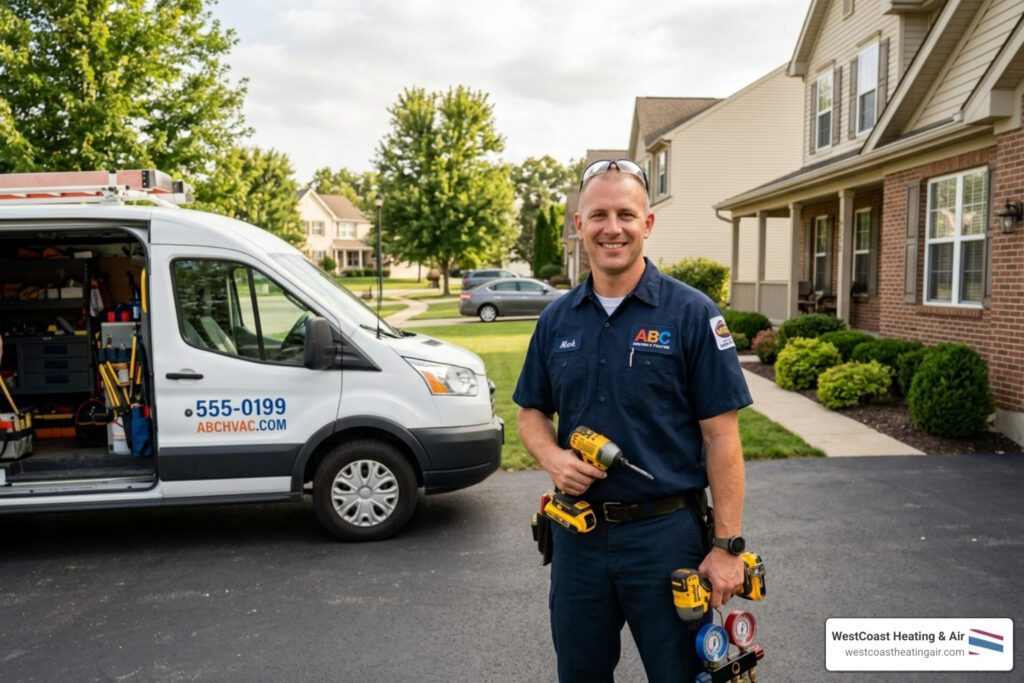
Essential Credentials for Choosing a Trusted Local HVAC Provider
Choosing a trusted local HVAC provider is one of the most important decisions you’ll make as a homeowner — and getting it wrong can cost you far more than just money.
Quick answer: How to choose a trusted local HVAC provider
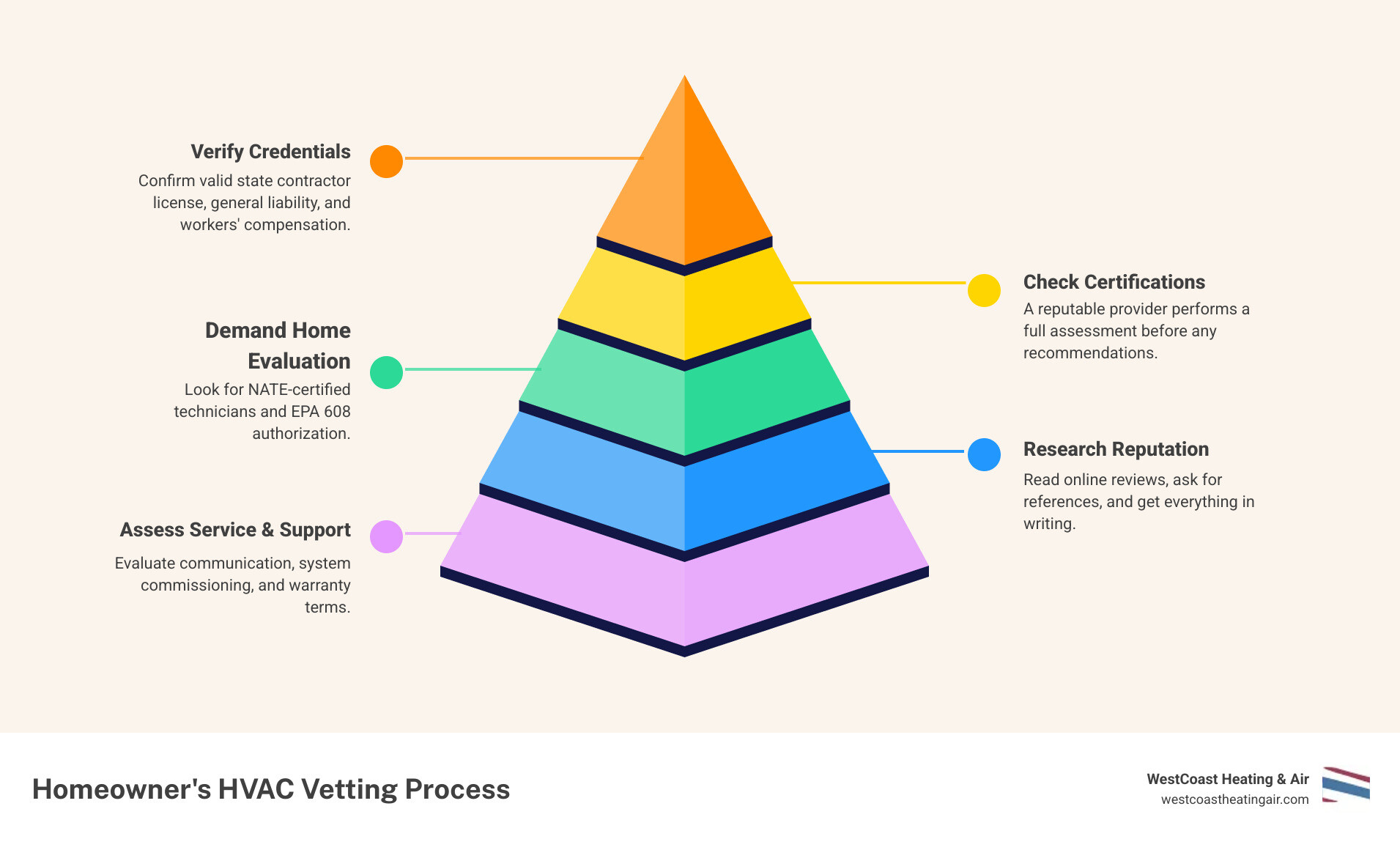
- Verify credentials — Confirm a valid state contractor license, general liability insurance, and workers’ compensation coverage
- Check certifications — Look for NATE-certified technicians and EPA 608 authorization
- Demand a home evaluation — A reputable provider performs a full assessment before recommending any system
- Research their reputation — Read reviews across multiple platforms and ask for references from recent jobs
- Get everything in writing — Insist on an itemized estimate, permit confirmation, and clear warranty terms
- Ask about commissioning — A trustworthy contractor tests and documents system performance after every installation
- Evaluate communication — How they treat you before the job is a reliable indicator of how they’ll treat you after
With over 140,000 residential HVAC companies operating across the United States, the options can feel overwhelming. Yet according to the Better Business Bureau, confirming credentials is the single most important step in the entire selection process. That’s because not every residential contractor who shows up with a service van has the training, tools, or integrity to do the job right. A third-party study found that nine out of ten new HVAC systems installed by licensed residential companies still had energy deficiencies — meaning even a licensed contractor isn’t automatically a good one. The difference between a comfortable home and a costly headache often comes down to knowing exactly what to look for before anyone sets foot in your house.
I’m Michael Smith, owner of WestCoast Heating & Air in Puyallup, Washington, and after a 30-year career with Boeing followed by hands-on work in the residential HVAC industry, I’ve seen what separates a trustworthy local pro from one who leaves homeowners with regret — and choosing a trusted local HVAC provider starts with knowing the right questions to ask. In this guide, I’ll walk you through every step of the vetting process so you can make a confident, informed decision.
When you begin your search for a residential contractor in the Puget Sound area, the first hurdle isn’t just finding someone who can do the work; it’s finding someone who is legally and ethically prepared to stand behind it. In Washington, the Department of Labor & Industries (L&I) sets strict standards, but it is up to you to verify them.
A state HVAC license is more than just a piece of paper. To even apply for the 10-hour state HVAC test, an individual must have a minimum of five years of experience with a licensed company. This exam covers everything from local codes and fuel types to Manual J load calculations and electrical safety. Furthermore, once they have that license, they must complete at least 10 hours of continuous education every single year to stay current with evolving technology and safety standards.
Beyond the license, insurance is your primary shield. If a technician is injured on your property or accidentally causes damage to your home, you could be held liable if the company lacks proper coverage. Always ask for proof of:
- General Liability Insurance: Protects your property from damage.
- Workers’ Compensation: Protects the workers (and you) in case of an on-site injury.
- Bonding: Provides a level of financial consumer protection.
If a residential contractor hesitates to provide these numbers or tells you they “work under someone else’s license,” consider it a major red flag. For more details on what to look for in our specific region, see our guide on Finding Reliable Heating and Air Services in Puyallup.
Verifying Technical Certifications
While state licensing is the legal baseline, professional certifications tell you about the technician’s actual skill level. The “gold standard” in our industry is N.A.T.E. (North American Technician Excellence). This is the only nationally recognized, third-party certification program for individual technicians. It requires a minimum of 16 credit hours of continuing education every two years to maintain.
Additionally, any technician handling refrigerants must have an EPA 608 certification. This is a federal requirement under the Clean Air Act. When choosing a trusted local HVAC provider, ask if their team is NATE-certified. This ensures the person working on your system understands the manufacturer’s specifications and the complex physics of modern climate control.
Why Local Experience Matters When Choosing a Trusted Local HVAC Provider
A company based in the Midwest might know furnaces, but they don’t necessarily understand the unique challenges of the Pacific Northwest. Our climate—with its damp, cold winters and increasingly hot, dry summers—puts specific stresses on heat pumps and air conditioners.
A local provider knows the specific permit requirements for cities like Tacoma, Sumner, or University Place. They understand that a system installed in a 1920s home in Steilacoom requires a different approach than a new build in Orting. Local pros have a community reputation to uphold; they can’t just disappear if a problem arises. They are your neighbors, and their kids likely go to the same schools as yours. This accountability is a powerful motivator for quality work.
Evaluating the Home Assessment and Installation Process
One of the biggest mistakes a homeowner can make is accepting a quote over the phone without an on-site visit. Every home is a unique ecosystem. A reputable Residential Heating and Cooling Company will spend one to two hours at your home before ever talking about specific equipment.
This assessment should include:
- Manual J Load Calculation: This is a mathematical way to determine exactly how much heating and cooling your home needs. It considers square footage, insulation R-values, window placement, and even which direction your house faces.
- Duct Inspection: Your ducts are the “veins” of your system. If they are leaky, undersized, or poorly insulated, even the most expensive unit will perform poorly.
- Airflow Measurement: Checking the static pressure ensures the system won’t “suffocate” once installed.
A “bigger” system isn’t better. An oversized unit will “short cycle,” turning on and off too frequently, which leads to uneven temperatures, high humidity, and early equipment failure.
The Importance of Equipment Commissioning
The most critical part of an installation happens after the equipment is bolted down. This is called commissioning. Think of it like a flight check before a plane takes off. A third-party study revealed a staggering statistic: 75% of newly installed air conditioners had an incorrect refrigerant charge.
Proper commissioning includes:
- Nitrogen Leak Testing: Pressurizing the lines to ensure no leaks exist.
- Vacuum Pulling: Using a micron gauge to ensure the lines are dehydrated and free of non-condensables (aiming for 500 microns).
- Performance Data Collection: Measuring temperature splits, amp draws, and refrigerant pressures to set a baseline.
- Safety Protocol Check: Verifying gas pressures and venting for furnaces or electrical connections for heat pumps.
Without a commissioning report, you have no proof the system is actually doing what the manufacturer promised.
Red Flags to Avoid When Choosing a Trusted Local HVAC Provider
As you interview companies, keep an eye out for these warning signs:
- Subcontracted Labor: If the people installing your system aren’t W2 employees of the company you hired, there is a lack of oversight. Subcontractors are often paid “piece-rate” (per job), which incentivizes speed over quality.
- Missing Tools: If a technician shows up without digital gauges, a vacuum pump, or a combustion analyzer, they are guessing, not measuring.
- Vague Quotes: A “lump sum” bid that doesn’t list model numbers, AHRI match-up numbers, or the scope of work is a recipe for hidden costs later.
- No Permits: If they suggest skipping the permit to save money, walk away. Permits ensure a third-party inspector verifies the safety of the electrical and gas work.
Assessing Reputation and Long-Term Support
Reputation is more than just a star rating. When choosing a trusted local HVAC provider, you need to look for patterns. Do they respond to negative reviews with professionalism? Do they have long-standing ties to the community?
| Feature | Professional Standard | Common Deficiency |
|---|---|---|
| Load Calculation | Manual J performed for every home | “Rule of thumb” based on square footage |
| Refrigerant Charge | Measured by subcooling/superheat | “Beer can cold” (guessing by touch) |
| Ductwork | Sealed with mastic and tested | Left leaky or uninsulated |
| Vacuum Pump | Pulled to under 500 microns | “Purged” with refrigerant (illegal/damaging) |
| Permits | Always pulled and inspected | Encouraged homeowner to skip |
Checking the Better Business Bureau and local community groups in places like Spanaway or Roy can give you a clearer picture than Yelp alone. You can also see how we compare to other Top Rated Heating and Air Conditioning Companies in Tacoma.
Warranties and Maintenance Plans
A warranty is only as good as the company that provides it. Most manufacturers offer a 10-year parts warranty, but that doesn’t cover the labor to fix it. A trusted provider should offer a clear labor guarantee—usually at least one to two years for new installations.
Furthermore, ask about maintenance plans. Regular tune-ups are often required to keep your manufacturer’s warranty valid. These plans should include priority support, meaning if your furnace fails on the coldest night of the year in SeaTac, you aren’t stuck at the bottom of the list.
Professional Communication and Service Standards
How a company communicates during the estimate process is a “trailer” for how they will handle a repair. Are they punctual? Do they wear shoe covers and use drop cloths to protect your floors? Do they take the time to educate you on how to change your filters and use your new thermostat?
At WestCoast Heating & Air, we believe customer education is just as important as the mechanical work. If you don’t understand how your system works, you can’t maximize its efficiency.
Frequently Asked Questions about Residential HVAC Contractors
What licenses should a residential contractor have in Washington?
In Washington, a residential contractor must have a general contractor license (prefixed with “WESTCH” for us, for example) and an electrical license (06A or 06B) to handle the wiring of HVAC equipment. They must also be bonded and insured. You can verify these on the Washington L&I website.
Why is a comprehensive home evaluation necessary?
Because your neighbor’s house isn’t your house. Even if the floor plans are identical, factors like window coatings, attic insulation levels, and duct integrity vary wildly. Without an evaluation, you risk buying a system that is either too small to keep you comfortable or too large to run efficiently.
How do I verify a technician’s expertise?
Ask to see their NATE certification card and their EPA 608 card. A professional technician will be proud to show you their credentials. You can also ask about the company’s internal training program—reputable residential companies invest in their team’s skills year-round.
Conclusion
Choosing a trusted local HVAC provider doesn’t have to be a gamble. By focusing on technical credentials, demanding a thorough home evaluation, and insisting on a documented commissioning process, you can ensure your home remains a sanctuary of comfort for years to come.
At WestCoast Heating & Air, we’ve spent over 20 years serving our neighbors in Puyallup, Tacoma, University Place, and throughout the Puget Sound. As a family-owned business, we don’t believe in “one-size-fits-all” solutions. We specialize in customized system design and take the time to educate every homeowner we serve. Whether you are in Sumner, Steilacoom, or Spanaway, we are committed to providing the top-quality service you deserve.
Ready to experience the difference that measurement and integrity make? Contact our Residential Heating and Cooling Company today to schedule your comprehensive home evaluation. We look forward to helping you find your perfect HVAC match.