
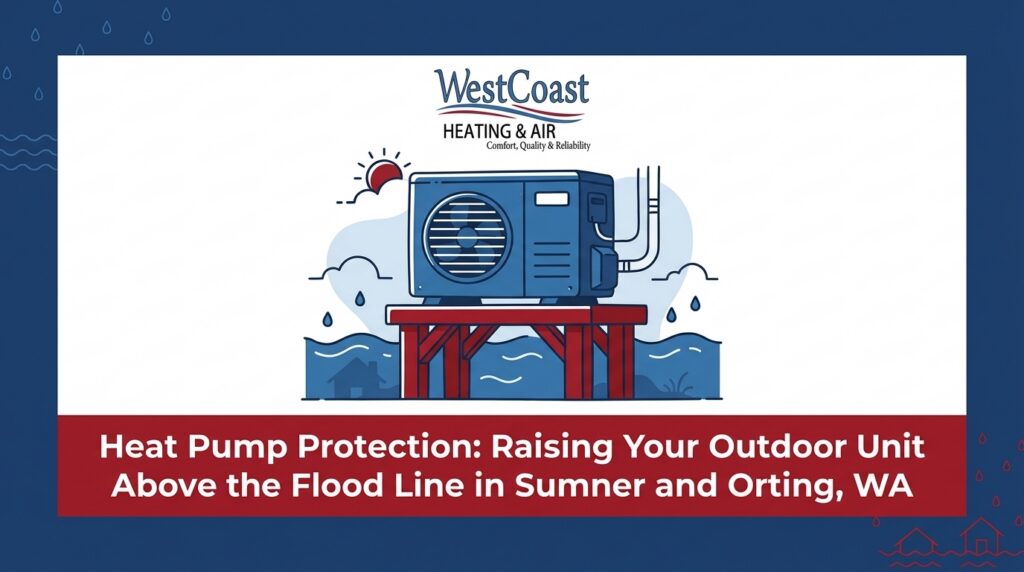
The Rising Threat to HVAC Systems in the Puyallup River Valley
If you live near the river, raising your outdoor heat pump above the flood line in Sumner and Orting is a critical priority before the heavy autumn rains arrive. Your outdoor unit is built to handle typical Pacific Northwest drizzle, but it is not designed to sit in standing water. Every year, homeowners in the valley face the sudden reality of rising water levels that threaten ground-level mechanical equipment. Assessing whether your existing or planned equipment sits safely above potential floodwaters is a major decision point for protecting your home’s comfort system. Proactive elevation is not just an optional upgrade; it is a foundational component of climate-ready HVAC care in our region.
For comprehensive support, scheduling professional heat pump maintenance services ensures your system is evaluated for both performance and environmental safety.
Understanding the Topographical Funnel
Living near the Puyallup and Carbon rivers offers beautiful scenery, but it also means dealing with a unique geographical reality. The valley topography acts as a natural funnel for heavy Pacific Northwest autumn rains. When heavy precipitation hits the surrounding foothills, that water rapidly makes its way down into the basin. This interaction between sustained rainfall and valley topography means water levels can rise around your foundation much faster than they would in higher-elevation neighborhoods.
Many homes in the Sumner and Orting valley flood zones were built with standard ground-level concrete pads for their air conditioners and heat pumps. While this practice works perfectly fine on a dry hill, it leaves valley equipment highly vulnerable. A sudden surge in the local water table can easily submerge the lower few inches of a heat pump, leading to catastrophic electrical and mechanical failure. Identifying this risk early is the first step toward safeguarding your heating system before the weather turns severe.
Why Sumner and Orting Face Unique High Water Tables
The challenges homeowners face in the valley go far beyond generic Pacific Northwest rain concerns. While residents in Seattle or Tacoma might worry about clogged gutters or moss on the roof, properties situated in the Puyallup River Valley deal with hyper-local water table issues. The soil in this basin frequently reaches maximum saturation during the wet season. Once the ground can no longer absorb water, even a moderate rainstorm can lead to localized flooding risks.
Overbank Flooding vs. Standard Rain Pooling
There is a significant difference between a puddle forming in your yard and a rising water table. Overbank flooding occurs when the nearby rivers exceed their capacity, pushing water outward and upward through the soil. This creates a high water table where water effectively seeps up from the ground, rather than just falling from the sky. Because of this, standard ground-level installation practices used in higher elevations simply do not apply here.
Navigating these severe localized risks requires a deep understanding of the flood plains in Pierce County. Our hyper-local expertise in valley geography means we frequently see the aftermath of systems installed without regard for the water table. If you are planning a new heat pump installation, recognizing these topographical challenges ensures your equipment is positioned for longevity rather than urgent replacement.
| Environmental Factor | Generic PNW Rain Risks | Sumner & Orting Valley Risks |
|---|---|---|
| Primary Threat | Surface pooling and rust | High water tables and overbank flooding |
| Soil Saturation | Moderate drainage | Complete saturation; standing water |
| Equipment Risk | Cosmetic weathering | Total submersion and electrical shorting |
| Standard Pad Viability | Usually sufficient | High risk of sinking or flooding |
Navigating Base Flood Elevation (BFE) for Mechanical Equipment
Protecting your heat pump isn’t just about guessing how high the water might rise; it involves specific regulatory guidelines. The Federal Urgent Management Agency (FEMA) and local Pierce County building codes define a metric known as Base Flood Elevation (BFE). The BFE represents the anticipated height that floodwaters have a one percent chance of reaching or exceeding in any given year. For homeowners in designated flood zones, this number is a critical benchmark.
Legally and structurally, mechanical equipment must sit above this anticipated flood line. This regulation exists to prevent hazardous electrical shorts, environmental contamination, and total equipment failure during a natural disaster. Because the BFE varies significantly depending on your exact elevation and proximity to the river, a one-size-fits-all approach does not work. The BFE requirements dictate the specific structural approach needed for each individual property.
Why Professional Assessment is Non-Negotiable
Determining your property’s precise BFE and executing the appropriate elevation strategy requires professional assessment, not DIY guesswork. A licensed contractor will pull the local flood maps, evaluate your home’s foundation, and calculate the exact clearance needed to keep your system safe and code-compliant. This level of precision is part of creating the best HVAC setup for Western Washington weather.
Attempting to elevate a heavy, high-voltage piece of machinery on your own can lead to severe safety hazards, compromised refrigerant lines, and code violations. Local inspectors look closely at mechanical elevations in the Sumner and Orting valley flood zones, making it vital to have the work performed by professionals who understand the intersection of HVAC requirements and municipal flood regulations.
The Shortcomings of Standard Concrete Pads in Saturated Soil
The Problem: Most outdoor heat pumps are installed on standard, pre-cast concrete pads resting directly on the dirt. These pads are designed to provide a level surface on stable, dry ground. However, in the Puyallup River Valley, the ground is rarely stable or dry during the winter months.
The Cause: During prolonged saturation periods typical of PNW winters, the soil beneath these pads degrades. Silt and clay become effectively liquified under the constant barrage of rain. A standard outdoor heat pump is heavy—often weighing over 200 pounds. When you place that much weight on a small concrete footprint over saturated mud, physics takes over. The soil shifts, compresses, and washes away, removing the structural support the pad relies on.
The Solution: As the ground gives way, standard pads begin to sink, tilt, or crack. A tilted heat pump causes severe operational issues: the internal fan can become unbalanced, the compressor oil fails to circulate properly, and the refrigerant lines connecting the unit to your house are placed under immense physical stress. To prevent this slow-motion disaster, homeowners must transition away from basic poured pads and invest in engineered structural supports that can withstand the unique soil conditions of the Sumner and Orting valley flood zones.
The Hidden Danger of Refrigerant Line Stress
When a concrete pad sinks into muddy soil, the heat pump drops with it. However, the copper refrigerant lines and electrical conduit connecting the unit to your home are fixed in place. As the unit sinks, it pulls downward on these lines. Over time, this tension can cause the copper lines to kink or rupture entirely, releasing refrigerant into the atmosphere and leaving you without heating or cooling. Upgrading to a structurally sound elevation method eliminates this risk by keeping the unit permanently stable, regardless of how soft the soil becomes.
Professional Structural Solutions for Heat Pump Elevation
When it comes to raising your equipment safely above the flood line, there are several code-compliant methods available. Choosing between stands, brackets, or platforms requires a contractor who understands specific Pierce County structural requirements, as the right choice depends on your home’s architecture and your specific Base Flood Elevation.
- Heavy-duty pump stands: These are engineered metal frames that provide significant ground clearance while remaining highly stable. Unlike standard pads, pump stands feature adjustable, wide-footed legs that can be anchored securely, keeping the unit high and dry even if minor surface pooling occurs.
- Wall-mounted brackets: For maximum flood protection, securing the unit directly to the home’s structural framing completely bypasses ground soil issues. These heavy-duty steel brackets keep the heat pump elevated several feet in the air, ensuring that rising water tables and saturated silt never touch the equipment.
- Elevated concrete platforms: When dealing with extremely heavy equipment or multiple units, custom-built, reinforced masonry structures are sometimes required. These platforms are engineered to exceed local BFE requirements and are deeply footed into the ground to prevent shifting.
- Extended equipment legs: For properties that only require minor elevation adjustments (such as staying above standard snow accumulation or very shallow pooling), factory-approved extended legs can be added to the unit.
It is important to reiterate that these methods require licensed professional installation. A technician must ensure the unit maintains perfect structural integrity, proper vibration isolation, and safe electrical connections during the elevation process.

Protecting Your Investment: Submersion and Voided Warranties
Ignoring the flood line carries steep financial risks. Heating and cooling systems are significant investments, and manufacturers outline strict guidelines regarding environmental damage. If you read the fine print on standard HVAC manufacturer warranty guidelines, you will find a nearly universal rule: warranties are voided if the outdoor unit is submerged in floodwater.
Manufacturers take this stance because floodwater is rarely just water. It is a corrosive mixture of mud, agricultural runoff, and debris. When this water breaches the outer casing of your heat pump, the internal damage is immediate and severe. Silt coats the delicate aluminum fins of the condenser coil, permanently destroying its ability to transfer heat. Debris gets lodged in the fan motor assembly, and the sensitive electrical control boards instantly short out upon contact with water.
Professional Elevation as an Insurance Policy
Once a unit has been submerged, it is almost never safe to simply dry it out and turn it back on. The internal corrosion will cause continuous breakdowns, and the compromised electrical components pose a severe fire hazard. Because flood damage is excluded from the manufacturer’s warranty, the homeowner is left entirely responsible for the cost of a full system replacement.
Positioning your equipment above the base flood elevation serves as an insurance policy for the lifespan of the system. By keeping the unit out of harm’s way, you protect your warranty status and ensure your equipment reaches its full expected lifespan. Partnering with a company that provides reliable heating and air services ensures your system is evaluated for these specific environmental risks before disaster strikes.
Why Early Autumn is the Critical Window for Flood Mitigation
Timing is everything when it comes to flood preparation in the Pacific Northwest. Historical data indicates that the highest rainfall and flood risks in the Puyallup River basin occur from October through January. This makes September pre-rainy season preparation the critical window for executing structural upgrades.
Waiting until the soil is already saturated makes structural installations significantly more difficult. Pouring concrete footings, leveling heavy-duty pump stands, or anchoring wall brackets is a straightforward process when the ground is dry and stable in early autumn. Once the valley soil turns to mud in November, the logistics of safely elevating a heavy heat pump become far more complex and time-consuming.
Securing Uninterrupted Winter Comfort
Homeowners should schedule professional elevation assessments before urgent weather events strike. The last thing you want is to be scrambling for an HVAC contractor while the river is cresting and your heat pump is actively taking on water. By taking action in September, you ensure that when the heavy winter storms arrive, your heating system remains high, dry, and fully operational. Connecting this pre-season preparation to your winter heating strategy guarantees uninterrupted comfort for your family, no matter what the weather does in the valley.
Frequently Asked Questions
Why does my heat pump need to be elevated in a flood zone?
Elevating your heat pump protects the sensitive electrical and mechanical components from water damage. When floodwaters rise, they carry mud and debris that can instantly short out control boards and destroy the compressor. Keeping the unit above the water line ensures it continues to operate safely during heavy rain events.
How high should a heat pump be off the ground in Sumner and Orting?
The exact height depends on your property’s specific Base Flood Elevation (BFE) as determined by FEMA and local building codes. A licensed professional must assess your property’s topography to calculate the precise clearance needed. In some valley locations, this may require raising the unit several feet off the ground.
Can you raise an existing heat pump, or only a new installation?
Existing heat pumps can absolutely be raised, though the process requires safely disconnecting the unit, installing the new structural support, and reconnecting the system. A licensed HVAC technician will pump down the refrigerant, elevate the equipment onto a stand or bracket, and ensure all lines are properly reattached and tested.
What happens to my warranty if flood water reaches my heat pump?
Virtually all major HVAC manufacturer warranties are voided if the outdoor unit is submerged in floodwater. Manufacturers consider submersion to be environmental damage rather than a factory defect. If your unit is flooded, you will likely be responsible for the full cost of repairs or replacement.
Do I need a permit to elevate my HVAC unit above the base flood elevation?
Yes, modifying the structural support and electrical connections of an HVAC system typically requires a permit to ensure compliance with local building codes. A professional HVAC contractor will handle the permitting process and ensure the elevation meets all county safety and BFE requirements.
Are wall-mounted brackets better than pump stands for flood protection?
Wall-mounted brackets offer superior flood protection because they completely bypass the ground, securing the unit to the home’s framing far above the water table. However, pump stands are highly effective for moderate elevation needs and are often preferred if the home’s exterior walls cannot support the weight of the unit.