
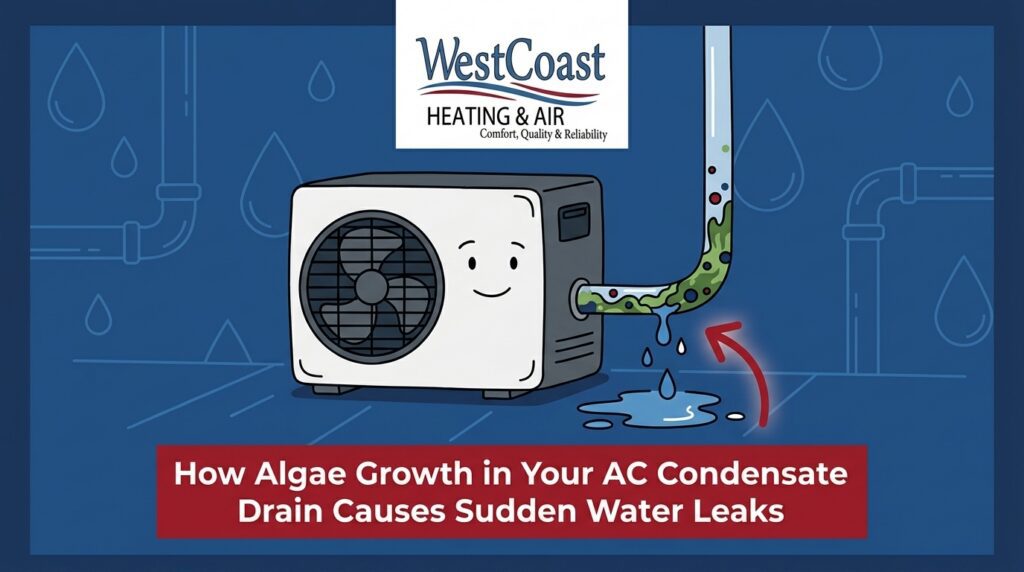
That Sudden Ceiling Stain Isn’t a Mechanical Failure
Your ceiling drywall is suddenly bubbling, and a steady drip of water is threatening to ruin your hallway floor. Understanding how algae growth in your AC condensate drain causes sudden water leaks is the crucial first step to stopping the damage before it spreads. Homeowners often assume a sudden indoor water leak means a hidden plumbing pipe burst or a major mechanical air conditioning component shattered under pressure. However, when these leaks occur during the late summer dog days, the reality is usually biological, not mechanical.
Every central air conditioning system features a condensate drain line. This narrow plumbing pipe plays a vital role in removing excess moisture from your home. As your system cools the air, it also dehumidifies it, pulling water vapor out of your living space. This water has to go somewhere. If the pathway becomes blocked, that water ends up in your ceiling, down your walls, or pooling on your floors. Recognizing this as a biological blockage requires shutting the system down immediately to halt water production.
For comprehensive guidance on maintaining your heating and cooling system, or if you need reliable AC repair right now, our team is ready to help.
The Hidden Role of Your Condensate Drain
To understand why this happens, you have to look at the anatomy of your indoor air handler. Located inside your home—often in an attic, crawlspace, or utility closet—the indoor unit houses an evaporator coil. This coil gets incredibly cold during operation. As warm indoor air blows across it, moisture condenses on the cold metal, much like water droplets forming on a cold glass of iced tea on a hot August afternoon.
Those droplets drip down into a shallow metal or plastic tray called the condensate drain pan. From there, gravity pulls the water down a narrow PVC pipe (the condensate drain line) and safely channels it outside your home. When this system works perfectly, you never even think about it. But when biological intruders take over, this simple gravity-fed system becomes a major liability.
The Biological Mechanism: Why Algae Thrives in Your AC
Residential air conditioners pull massive amounts of humidity from the air, producing anywhere from 5 to 20 gallons of condensate water daily during peak operation. That is the equivalent of a small bathtub filled with water moving through a pipe no wider than a golf ball every single day. This water flows continuously into a dark, damp drain pan and through that narrow PVC pipe, creating a unique micro-environment right inside your house.
Algae and other biological growth thrive in dark, wet environments, especially when temperatures sit perfectly between 77 and 86 degrees Fahrenheit. After months of heavy cooling, these lines become the perfect incubator for rapid biological expansion. The water dripping off your evaporator coil is not sterile; it carries microscopic airborne spores, dust, and organic matter that slipped past your air filter.
Mechanical vs. Biological AC Issues
It helps to understand the difference between a mechanical failure and a biological blockage. Here is a breakdown of how they differ in origin and solution:
| Issue Type | Common Causes | Typical Symptoms | Required Solution |
|---|---|---|---|
| Mechanical Failure | Worn belts, failed capacitors, cracked coils, broken blower motors. | Loud grinding noises, warm air blowing from vents, system refusing to turn on. | Part replacement, electrical repair, or refrigerant recharge by a technician. |
| Biological Blockage | Algae blooms, mold growth, bacterial slime, trapped organic dust. | Sudden water leaks, musty odors, gurgling sounds, float switch tripping. | Professional suction, line flushing, and algaecide treatment. |
By late summer, the dark, warm, and constantly wet conditions inside that PVC pipe have provided everything algae needs to multiply exponentially. It anchors itself to the inner walls of the plumbing and begins to build a sticky, dense matrix that slowly chokes off the flow of water.
The Late-Summer Tipping Point in the Pacific Northwest
The Problem: Unlike year-round humid climates in the deep south, the Pacific Northwest experiences a unique weather pattern. We often enjoy mild, manageable weather for much of the year, punctuated by sudden, intense late-summer heatwaves. At WestCoast Heating & Air, our team typically sees a massive spike in urgent calls right as August arrives in Puyallup WA. The temperature spikes, the humidity often climbs right along with it, and this catches many homeowners off guard as they prep for the back-to-school season.
The Cause: These late-summer heatwaves cause AC units to run continuously. Instead of cycling on and off for a few hours a day, your system might run virtually non-stop to keep your home comfortable. This maximizes condensate production. The sudden spike in moisture, combined with intense attic heat radiating down into the air handler cabinet, accelerates the algae bloom. A biological presence that was just a minor, unseen buildup in July suddenly explodes into a massive obstruction.
The Solution: What was a manageable situation reaches a critical tipping point by late August. The only way to combat this specific regional climate challenge is through proactive line clearing and preventative maintenance before the late-summer heatwaves hit. Recognizing how the Puyallup WA climate specifically impacts your indoor equipment helps you stay one step ahead of a messy ceiling leak.
From Minor Buildup to Overflowing Drain Pan
The transition from a perfectly functioning air conditioner to a flooded ceiling does not happen overnight. It is a progressive biological process that builds quietly until it suddenly fails. Here is exactly how algae growth in your AC condensate drain causes sudden water leaks, step by step:
- The Initial Slime Formation: Algae starts as a thin, harmless-looking slime on the inner walls of the condensate pipe. At this stage, water still flows freely over the top of the biological layer, and you will notice no changes in your system’s performance.
- The Debris Trap: As the algae thickens, it becomes incredibly sticky. It begins to trap microscopic dust, dirt, and pet dander that flow out of the air handler. Even with a good air filter, tiny organic particles make it through and feed the growing biological mass.
- The Gelatinous Plug: The combination of algae, water, and organic debris creates a dense, gelatinous plug. This mass expands until it completely blocks the narrow PVC drain line. It acts like a cork in a wine bottle, sealing the pipe entirely.
- The Pan Overflow: With nowhere to go, the 5 to 20 gallons of daily condensate back up into the drain pan. Once the water breaches the rim of the shallow tray, it overflows directly onto the floor, ceiling, or drywall below, causing immediate and severe water damage.
Taking steps to prevent mold with HVAC maintenance is one of the most effective ways to stop this four-step process from ever reaching the overflow stage.

Early Warning Signs Before the Ceiling Damage Occurs
Fortunately, your air conditioning system usually gives you a few subtle clues that a biological blockage is forming before the water breaches the drain pan. Catching these signs in August can save your drywall and flooring from significant damage.
- Musty, swamp-like odors: Often referred to in the industry as “dirty sock syndrome,” a strong, damp smell coming from your air vents when the AC kicks on is a primary indicator of biological growth in the indoor unit.
- Pooling water or damp spots: If you notice moisture around the base of your indoor air handler unit, the pan may already be overflowing slowly.
- The AC system suddenly shutting itself off: Modern units are equipped with a drain pan float switch. If water rises too high, this safety feature trips and cuts power to the thermostat to prevent a flood.
- Gurgling sounds: A struggling drain line will often produce a bubbling or gurgling noise coming from the condensate pipe or indoor unit as water tries to push past a partial algae clog.
Why the Float Switch Matters
The float switch is your home’s last line of defense against an algae-induced flood. It is a small, buoyant device seated inside the drain pan. As water levels rise abnormally high due to a clog, the float lifts. Once it reaches a certain height, it triggers an electrical cutoff switch that instantly shuts down the outdoor compressor. This stops the evaporator coil from producing more condensation. If your system suddenly goes dead during a hot August afternoon and the thermostat screen is blank or unresponsive, a tripped float switch is a highly likely culprit.
Immediate Actions: Shut It Down and Step Away
If you spot a leak, or if you suspect your float switch has tripped due to an algae blockage, the first and only step is to turn off the thermostat immediately. Switching the system to “off” stops the cooling cycle, which halts condensate production entirely. This is the fastest way to prevent further water from pouring into your ceiling.
It is vital that you do not attempt to clear a severe biological clog yourself. In our years serving Pierce County, we’ve seen countless homeowners try pouring bleach or vinegar down the access pipe—a common internet myth that can cause serious harm. Harsh chemicals like bleach do not dissolve a dense gelatinous algae plug; they simply kill the top layer, which can cause the mass to solidify or push deeper into the plumbing line, making it much harder to extract.
Furthermore, sticking stiff wires, plumbing snakes, or coat hangers into the PVC pipe is highly dangerous. PVC piping, especially in hot attics, becomes brittle over time. Shoving a metal wire blindly through the elbows and joints of the pipe often cracks the plumbing, turning a simple drain clearing into a costly pipe replacement and causing water to leak inside the walls.
Professional intervention is required to safely extract the biological matter using specialized suction and clearing tools. When you call a professional, you get a respectful crew equipped to handle the job properly. In our experience repairing AC units across Puyallup WA, we’ve found that homeowners who call us at the first sign of a leak save themselves from costly drywall repairs. Just recently, our WestCoast Heating & Air technicians helped a local family who woke up to a flooded hallway; we were able to safely extract the dense algae plug and restore their cooling without damaging their delicate PVC piping. You can expect that same level of reliable, customer-focused care when dealing with a sudden water leak. If you are facing a backed-up system right now, reaching out for urgent HVAC repair is the safest way to restore your comfort.
Professional Prevention for Future Summers
A cleared line is only a temporary fix if the environment inside the air handler remains hospitable to algae. If the underlying conditions aren’t addressed, the biological bloom will simply return the following August. Routine professional maintenance is the key to breaking this cycle.
During a comprehensive tune-up, technicians do much more than just check the refrigerant levels. They actively treat the drain pan with specialized algaecide tablets. These tablets sit in the water tray and slowly dissolve over several months, releasing compounds that make it impossible for algae and bacteria to take root. Technicians also flush the condensate lines proactively, using high-powered vacuums and low-pressure nitrogen blowouts to clear out any minor buildup before the peak heat hits.
Working with expert local HVAC technicians who understand the specific humidity challenges of Pacific Northwest summers ensures your system receives thorough, targeted preventative maintenance. Consistent care ensures the system manages moisture effectively without putting your home at risk. If you want to get ahead of the next heatwave, scheduling urgent AC maintenance or a routine tune-up is the best way to keep your drain lines clear and your home dry.
Frequently Asked Questions
Why is my AC leaking water suddenly in late summer?
Sudden leaks in late summer are usually caused by an algae bloom blocking the condensate drain line. After months of heavy cooling, the dark, damp environment inside the AC unit allows biological growth to rapidly expand. Once the line is fully blocked, the condensation backs up and overflows the drain pan.
What causes algae in AC condensate lines?
Algae grows in condensate lines because the environment provides everything it needs: constant moisture, darkness, and warm temperatures. Airborne spores and microscopic organic dust bypass the air filter and settle in the damp PVC pipe. When temperatures sit between 77 and 86 degrees, these spores multiply into a thick, gelatinous blockage.
Can a clogged AC drain cause permanent water damage?
Yes, a clogged AC drain can cause severe structural damage if left unchecked. A typical system produces gallons of water a day, which can quickly ruin drywall, warp hardwood floors, and damage ceiling joists. Promptly shutting off the unit is the best way to limit the extent of the water damage.
How do professionals stop algae from growing in the AC drain line?
Professionals use specialized suction tools and nitrogen pressure to completely extract existing biological blockages safely. To prevent future growth, they place slow-dissolving algaecide tablets directly into the drain pan. These treatments keep the water sterile and stop algae from anchoring to the PVC walls.
Why shouldn’t I use bleach to clear my AC drain line?
Bleach does not dissolve a thick, gelatinous algae clog; it only kills the superficial layer. Pouring bleach into the line can actually cause the mass to harden or slide deeper into the pipe, making professional extraction much more difficult. Additionally, bleach can corrode the metal components of your indoor air handler.
What is the float switch in my AC drain pan?
The float switch is a critical safety device designed to prevent indoor flooding. It sits inside the condensate drain pan and floats upward if water begins to pool due to a clog. Once the water reaches a dangerous level, the switch trips and automatically shuts off the air conditioner to stop further condensation.
Understanding how algae growth in your AC condensate drain causes sudden water leaks gives you the power to act quickly when trouble strikes. By recognizing the early warning signs and shutting your system down before the pan overflows, you can protect your home from extensive damage. Always rely on a professional to clear biological blockages safely, ensuring your system operates smoothly and your home stays perfectly dry.