
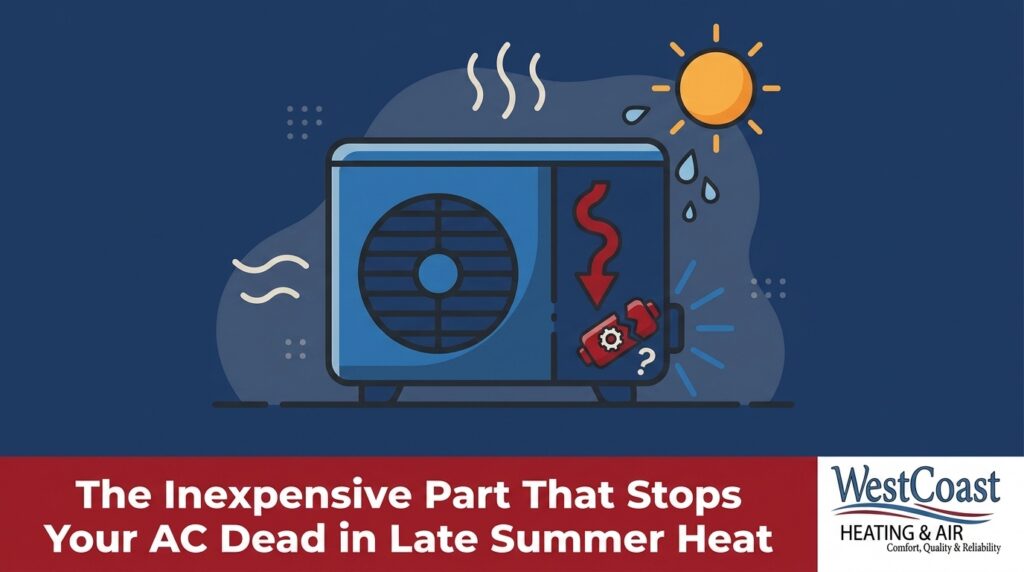
When Your AC Quits in the Late Summer Heat: The Usual Suspect
Here in Puyallup, our technicians at WestCoast Heating & Air have noticed August is only getting hotter, and your air conditioning system has been working overtime since early June. The inexpensive part that stops your AC dead in late summer heat is usually a small component you might never have heard of. You walk into your living room, check the thermostat, and notice it is set to cool, but the house is steadily getting warmer. The system is running, but nothing is happening. This sudden disruption during the intense August late-summer heat is incredibly frustrating, especially when you rely on your AC to keep your family comfortable as the kids head back to school.
If you want to prevent these sudden breakdowns, staying on top of routine AC maintenance is your best defense.
In our experience responding to end-of-season cooling urgent situations, the usual suspect behind this sudden failure is a small, cylindrical device located inside your outdoor condenser unit known as the dual-run capacitor. While the part itself is small enough to hold in one hand, its failure brings the entire cooling process to a complete halt. Homeowners often panic, assuming the entire air conditioner needs to be replaced, but our team frequently finds that a dead system is simply the result of this single exhausted component.
When this happens, you will typically notice a few immediate symptoms:
- Warm airflow: Your indoor vents are blowing room-temperature air instead of crisp, cold air.
- Strange outdoor noises: The outdoor unit makes a distinct buzzing sound but does not fully turn on.
- Unresponsive fan: The large fan blades at the top of the outdoor unit remain completely still.
- Frequent cycling: The system tries to start, shuts down immediately, and tries again a few minutes later.
Because these symptoms can also point to more severe mechanical issues, we highly recommend a professional diagnosis to ensure other components haven’t been affected by the sudden stop.
The Unsung Hero: What a Dual-Run Capacitor Actually Does
The Problem: Your air conditioner’s compressor and condenser fan motor require a massive surge of electricity to start up. This initial draw is far more power than your home’s standard electrical grid can supply in a single, instantaneous spike. If the motors tried to pull that much raw power directly from your electrical panel, they would stall out and trip your circuit breakers every time the thermostat called for cooling.
The Cause: To bridge this gap between what the motors need and what the house can provide, the system relies on stored energy. Without a dedicated energy reserve, the heavy internal components simply cannot overcome their own resting weight to begin spinning.
The Solution: The dual-run capacitor acts like a giant, high-capacity battery. It stores electrical energy while the system is off and releases it in a powerful, continuous jolt to kickstart the equipment. It is called a “dual-run” capacitor because it powers two separate motors simultaneously: the compressor (which pumps the refrigerant) and the condenser fan (which blows exhaust heat away from the unit).
The Toll of Constant Cycling
Every single time your air conditioner turns on in Puyallup WA, the capacitor rapidly discharges its stored energy and then continuously feeds a steady electrical current to keep the motors running smoothly. Once the cooling cycle finishes, the capacitor recharges for the next round. This constant charging, discharging, and recharging makes it a high-wear component.
Over time, the internal materials degrade from the sheer volume of electrical work. If you notice your system struggling to start or taking longer than usual to kick on, do not ignore it. Our technicians always warn that ignoring a struggling capacitor is one of the most common signs of a true urgent HVAC problem, as a weak capacitor forces your motors to work much harder to compensate.
Why Sustained Heat Spikes Cause Sudden Capacitor Failure
Air conditioning systems in the Pacific Northwest are not always conditioned for prolonged, heavy cooling loads. Historically, our region enjoyed milder summers, meaning local equipment was rarely pushed to its absolute limits for weeks on end. Today, when sudden August heat spikes hit, our WestCoast Heating & Air dispatch board lights up because these systems are highly susceptible to failure.
The primary enemy of any electrical capacitor is heat. Your dual-run capacitor is filled with a specialized dielectric fluid that helps regulate its internal temperature and maintain its ability to store an electrical charge. Extreme ambient heat from the sun beats down on the metal cabinet of your outdoor unit, combining with the intense internal operating heat generated by the compressor.
Understanding Thermal Fatigue
When the August late-summer heat sets in and temperatures stay high into the evening, your air conditioner runs continuously. This lack of a cool-down period leads to a condition known as thermal fatigue. The dielectric fluid inside the capacitor begins to break down, lose its insulating properties, and expand.
While age certainly plays a factor—most capacitors we replace have a standard lifespan of several years—a sudden heatwave is usually the catalyst that pushes an older, weakened capacitor over the edge. The internal pressure builds up until the component physically deforms or shorts out entirely. Because the capacitor is responsible for keeping the fan and compressor moving, its failure immediately stops the cooling process, leaving your home exposed to the climbing outdoor temperatures.
Auditory Warnings: What a Dying AC Capacitor Sounds Like
Our team at WestCoast Heating & Air often meets homeowners who are proactive about their home comfort. For instance, one local customer reached out last spring when they needed to equip their home with a new AC system. They were doing some comparison shopping and ultimately appreciated our friendly crew delivering exactly what was quoted. Upgrading to a properly sized, modern system—perhaps even taking advantage of generic energy rebates or federal tax credits that may apply to qualifying installations—is a great way to handle heavy summer loads. But if you are running an older unit, you need to know how to listen for trouble before it leaves you stranded.
You can often diagnose a struggling capacitor just by standing next to your outdoor unit and listening carefully. Based on countless service calls, here is exactly what we advise you to do if you suspect a problem:
- Listen for the hum: The classic symptom of a failed capacitor is a distinct, rhythmic humming or buzzing sound coming from the outdoor condenser unit. This sound is the motor trying to start but failing because it lacks the necessary electrical “kick” from the capacitor.
- Check the fan movement: Look at the top of the unit. If you hear the ac condenser humming but fan not spinning, the capacitor has likely dropped its charge. In some cases, the fan might be spinning very sluggishly, barely moving air.
- Shut down the system: If you hear this buzzing sound, go to your indoor thermostat immediately and turn the cooling system to the “OFF” position. Leaving it running while the motors are stalled will cause severe electrical damage.
- Call for professional help: Once the system is safely powered down, reach out to schedule reliable AC repair. One of our technicians can safely test the electrical draw and replace the component.
As HVAC professionals, we must stress: never try to push the fan blades with a stick to jump-start the motor. While this old trick sometimes gets the fan moving, it ignores the fact that the compressor is still starving for power, which can lead to a catastrophic breakdown.
Visual Clues: How to Safely Spot a Bulging Capacitor
If you want peace of mind while waiting for one of our technicians to arrive in Puyallup WA, there is a safe, non-invasive way to check the physical condition of your dual-run capacitor. You do not need any tools, and you should never attempt to open the metal service panel on the side of the unit.
Instead, grab a strong flashlight and look down through the protective metal grate at the top or side of the outdoor condenser unit. The capacitor looks like a silver, metallic cylinder, roughly the size of a soda can, with several wires attached to the top. When you are looking for bulging dual run capacitor symptoms, pay close attention to the flat top of the cylinder where the wire terminals connect.
A healthy capacitor has a perfectly flat top. A failed or failing capacitor will often bulge upward, resembling a mushroom dome. In severe cases of thermal fatigue we see in the field, you might even see a thick, oily fluid leaking down the sides of the cylinder. If you spot this mushroom-like bulge, you have found your culprit.
The Danger of DIY High-Voltage Repairs
It is critical to understand that you must never attempt to replace this part yourself. Capacitors are designed to store massive, lethal amounts of electrical energy. Even when the main power to the air conditioner is completely shut off at the breaker box, our electricians know that a capacitor can hold a dangerous electrical charge for days.
Only licensed HVAC professionals have the specialized insulated tools and training required to safely discharge the stored energy, test the microfarad readings, and wire the new component correctly. Visual confirmation through the grate is strictly for your own understanding while you wait for a professional to handle the high-voltage work.

The Domino Effect: Protecting Your Compressor from Burnout
The Problem: When homeowners hear the humming sound of a bad capacitor, we find they sometimes leave the thermostat set to cool, hoping the system will eventually push through and start working. Leaving the system running with a bad capacitor forces the compressor to overwork in a desperate attempt to start without its required energy boost.
The Cause: An electric motor that is receiving power but cannot spin enters a state called “locked rotor.” During a locked rotor event, the motor pulls an enormous amount of electricity—far more than it is designed to handle continuously. This creates intense, rapid heat buildup inside the compressor. Because the August late-summer heat is already punishing the unit, this internal heat spike can quickly melt the protective insulation off the copper windings inside the motor.
The Solution: The absolute best thing you can do is turn the thermostat off immediately. By shutting down the power, you prevent the compressor from burning out. We regularly show our customers the difference in severity when comparing the two components side by side:
| Component | Role in the System | Impact of Failure | Repair Complexity |
|---|---|---|---|
| Dual-Run Capacitor | Stores energy to kickstart motors | System hums, fan stops, blows warm air | Fast, straightforward component swap by a pro |
| AC Compressor | Pumps refrigerant through the home | Total system death, potential chemical contamination | Major mechanical undertaking, often requires full replacement |
By scheduling urgent AC maintenance the moment you notice the symptoms of a bad capacitor, you protect the heart of your cooling system. A simple, cost-effective part swap saves you from facing a massive mechanical replacement.
Frequently Asked Questions About AC Capacitor Failure
How do I know if my AC capacitor is blown?
The most reliable signs of a blown capacitor are a distinct buzzing sound from the outdoor unit and an outdoor fan that refuses to spin. Inside your home, you will likely notice the AC blowing warm air in summer because the compressor cannot circulate the refrigerant. If you look through the outdoor unit’s protective grate with a flashlight, you might also see the top of the silver capacitor bulging upward like a mushroom.
What causes an AC capacitor to fail?
Extreme heat is the number one cause of capacitor failure. High ambient temperatures combined with the heat generated by the running air conditioner cause the internal dielectric fluid to break down and lose its ability to hold a charge. Age, power surges, and continuous running without a break during a heatwave also contribute heavily to thermal fatigue and eventual failure.
What does a bad AC capacitor sound like?
A bad AC capacitor typically produces a rhythmic humming, buzzing, or clicking sound from the outdoor condenser unit. This noise happens because the electrical relay is sending power to the motor, but the motor cannot start without the stored energy from the capacitor. If you hear this sound, you should turn off your system immediately to prevent motor burnout.
Can an AC run with a bad capacitor?
No, an air conditioner cannot properly run with a bad capacitor. While the indoor blower fan might still circulate warm air through your vents, the outdoor compressor and condenser fan will not be able to start. Leaving the system on while the capacitor is dead will force the compressor to overheat, which can lead to permanent, catastrophic damage.
How long does it take a professional to replace a dual-run capacitor?
One of our licensed HVAC technicians at WestCoast Heating & Air can typically replace a dual-run capacitor in under an hour once we arrive at your home. The process involves safely discharging the old capacitor, removing it, wiring the new component correctly, and testing the system’s electrical draw. Because it is a standard part, most professionals carry a variety of sizes on their service trucks for immediate replacement.
Restore Your Home’s Comfort Safely and Quickly
A failed dual-run capacitor is a highly common, quickly resolvable issue when handled by a professional. You do not have to suffer through the end-of-season heat just because a single, inexpensive part has reached the end of its lifespan. If you suspect your capacitor is struggling, the safest and smartest move is to schedule a professional inspection immediately.
At WestCoast Heating & Air, our fast, local urgent response times in Pierce County ensure that homeowners aren’t left sweltering when a quick component swap is all that is needed. We understand that a dead AC in August is often just a failed dual-run capacitor, and our team is here to help you get your home cooling again safely. If your system is humming but not cooling, turn it off and reach out to us today—we will handle the high voltage so you can get back to enjoying a comfortable home.