
Why Is That One Upstairs Bedroom Impossible to Keep Cool?
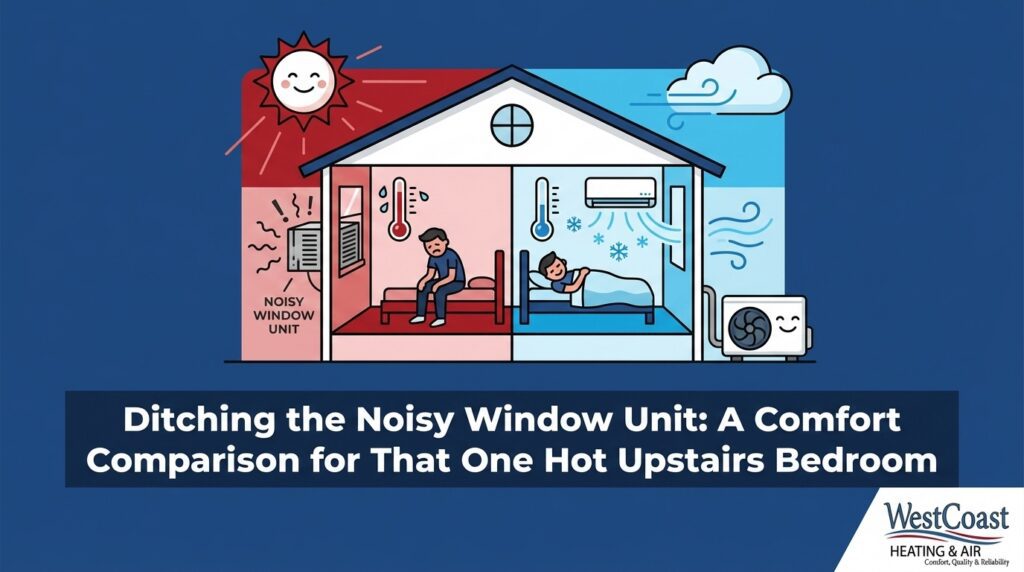
Are you wondering why your second floor feels like a sauna, even when the rest of the house is perfectly comfortable? At WestCoast Heating & Air, we hear this complaint from homeowners all summer long. Ditching the Noisy Window Unit: A Comfort Comparison for That One Hot Upstairs Bedroom is a decision many homeowners face when the existing cooling setup simply cannot keep up with the demands of the season. When July peak summer heat sets in, that single upper-level room often becomes unbearable. You find yourself trapped in a frustrating cycle: enduring the loud, rattling noise of a temporary window air conditioner, or turning it off and sweating through the night.
This localized heat trap is a common architectural challenge we see every day, and solving it requires more than just pushing more air through your existing vents. If you are tired of compromising on your sleep quality, exploring dedicated heating and cooling services is the logical next step. Upgrading from a noisy, inefficient window box to a permanent single-zone mini-split system transforms how that specific room feels, sounds, and functions.
Many homeowners assume that a hot upstairs bedroom is just a quirk of their house that they have to live with. However, our team knows that relying on a window unit is merely a band-aid solution that introduces its own set of problems, from excessive noise to poor energy efficiency. As Pacific Northwest afternoon heat spikes rapidly overwhelm standard window units, it becomes clear that a more robust, targeted cooling strategy is necessary. Evaluating the long-term comfort of a ductless mini-split against the status quo gives you a clear path forward to reclaim your bedroom.
The Stack Effect: How Heat Behaves in Multi-Level Architecture
To understand why that one bedroom stays stubbornly hot, we have to look at the physics of airflow within a multi-story home. The primary culprit is a phenomenon known as the stack effect. Warm air is naturally less dense than cold air, causing it to rise continuously through the structural cavities, stairwells, and open spaces of your home. By the time the afternoon sun hits its peak, all that accumulated thermal energy has gathered on the second floor.
The Impact of Radiant Heat
In many of the Puyallup WA two-story homes our technicians service, the stack effect is compounded by radiant heat transferring directly from the roof. Your attic absorbs massive amounts of solar radiation throughout the day. Even with adequate insulation, a significant portion of that heat radiates downward through the ceiling into your upper bedrooms. A standard window unit, which only cools the small pocket of air immediately in front of it, simply lacks the capacity to overcome this constant, heavy heat load pressing down from above.
The Return Air Problem
Another major structural hurdle our team frequently encounters is the lack of proper ventilation. Central HVAC systems rely on a balanced cycle of supply and return air. Unfortunately, we consistently find that many older two-story homes were built without adequate return vents on the second floor. This means your central air conditioner can push cold air upstairs, but it has no way to pull the hot, stagnant air back down into the system to be conditioned. The cold air simply falls back down the stairs, leaving the upper bedrooms sweltering.
Because the central system cannot effectively circulate air on the second floor, homeowners often look for supplemental cooling. While a window unit seems like an easy fix, fixing uneven home temperatures with mini-splits provides a permanent, architectural solution. A ductless system operates independently of your home’s central ductwork, directly targeting the trapped heat in that specific room without relying on non-existent return vents.
Noise Levels and Sleep Quality: Decibels Matter
When you are trying to sleep during July peak summer heat, the acoustic environment in your bedroom is just as important as the temperature. Window units are notorious for their disruptive noise profiles. Because all the mechanical components—the compressor, the fan, and the motor—are housed in a single box sitting right in your window, the sound vibrates directly into your living space.
To put this into perspective, we measure sound in decibels (dB). A typical window air conditioner operates between 50 and 60 decibels. This is roughly equivalent to having a loud, animated conversation running continuously at the foot of your bed. In contrast, the ductless mini-splits we install are engineered to separate the noisy compressor, placing it outside the home, while the indoor air handler operates at a whisper-quiet level.
| Cooling System | Average Noise Level (Decibels) | Real-World Sound Equivalent | Impact on Sleep Quality |
|---|---|---|---|
| Standard Window Unit | 50 – 60 dB | Loud conversation or running refrigerator | High disruption; frequent waking from compressor cycling. |
| Single-Zone Mini-Split | 19 – 32 dB | Rustling leaves or a quiet library | Minimal disruption; promotes deep, uninterrupted rest. |
The continuous drone of a window unit is only half the problem. The real sleep disruption comes from the compressor’s harsh “kick-on” cycle. Every time the thermostat registers that the room has warmed up, the window unit violently shudders to life, creating a sudden spike in noise that pulls you out of deep REM sleep. A mini-split eliminates this jarring mechanical noise, allowing you to enjoy uninterrupted rest during the hottest parts of the year.

Temperature Consistency: Inverter Technology vs. Compressor Cycling
Beyond the noise, the actual quality of the cooling provided by these two systems is vastly different. The discomfort you feel with a window unit is largely due to its outdated on/off compressor cycling. Traditional window units only operate at one speed: 100% capacity. When the room gets hot, they blast freezing air until the thermostat is satisfied, then shut off completely. This creates a frustrating rollercoaster of temperature spikes—the room feels drafty and freezing for twenty minutes, then slowly becomes stifling and humid until the unit kicks on again.
The Inverter Technology Difference
Ductless mini-splits utilize advanced inverter technology, which fundamentally changes how the system delivers comfort. Instead of turning on and off, an inverter-driven compressor acts like the accelerator pedal in a car. It smoothly ramps up power to reach the desired temperature quickly, and then gently scales back its energy usage to maintain that exact temperature continuously.
During July peak summer heat, our clients consistently tell us this continuous, even cooling is a game-changer for an upstairs bedroom. Because the mini-split never shuts down completely, there are no hot and cold spikes, no sudden drafts, and no dead zones in the corners of the room. The system constantly monitors the room’s thermal load and makes micro-adjustments to the fan speed and cooling output.
Furthermore, inverter technology prevents the equipment from being overworked. A window unit constantly battling the afternoon sun is prone to freezing up or burning out its motor from the strain of starting and stopping dozens of times a day. A mini-split simply hums along at a low, efficient speed, effortlessly managing the heat load while keeping the room’s climate perfectly stable.
Indoor Air Quality and the Wildfire Smoke Factor
When evaluating cooling solutions for an upstairs bedroom, many homeowners overlook the critical impact on indoor air quality (IAQ). A window air conditioner inherently compromises the structural integrity of your home’s thermal envelope. By design, you must leave the window partially open to accommodate the unit, filling the gaps with flimsy accordion panels or foam weatherstripping. It is nearly impossible to create a perfect, airtight seal around a temporary window box.
The Window Seal Vulnerability
This compromised seal is a significant liability, especially in the Puyallup WA two-story homes we visit. Every gap around a window unit acts as a direct pathway for outdoor air infiltration. Humidity, pollen, exhaust fumes, and outdoor allergens easily seep into your bedroom. More importantly, when local summer wildfire smoke blankets the region, our technicians see firsthand how those tiny gaps allow hazardous particulate matter to drift directly into the space where you sleep. A window unit’s basic mesh filter is designed only to catch large dust bunnies; it does absolutely nothing to filter out microscopic smoke particles or airborne pollutants.
Advanced Filtration in Sealed Systems
A ductless mini-split, on the other hand, is a completely sealed system. The installation requires only a small, three-inch hole through the exterior wall to connect the refrigerant lines, which is then thoroughly insulated and sealed against the elements. The window remains shut and locked, preventing any outdoor air infiltration entirely.
Because the mini-split recirculates and conditions the existing indoor air, it provides a highly controlled environment. Modern ductless air handlers are equipped with advanced, multi-stage filtration capabilities that actively scrub the air as it passes through the unit. This protects your indoor air quality from outdoor pollutants and smoke, ensuring that the air you breathe while sleeping is clean, healthy, and properly dehumidified.
Security, Aesthetics, and Reclaiming Your Window
Removing a bulky window unit from your upstairs bedroom offers benefits that go far beyond temperature control. The physical presence of a window AC introduces several lifestyle and structural drawbacks that a permanent ductless installation resolves immediately.
- Eliminating Security Vulnerabilities: Leaving a ground-floor or easily accessible second-story window unlocked and propped open for an AC unit creates a clear security risk. Intruders can easily push the unit inward to gain access to the home. A mini-split allows you to keep your windows securely locked year-round.
- Restoring Natural Light: Window units block a significant portion of the glass, casting shadows and making the bedroom feel dark and cramped. Reclaiming that space allows natural sunlight to brighten the room, making it feel larger and more inviting.
- Improving Exterior Aesthetics: From the outside of your home, a heavy metal box dripping condensation down the siding is an eyesore. Many homeowners in Puyallup WA two-story homes find that removing these units instantly improves the property’s curb appeal.
- Ensuring HOA Compliance: Many Homeowner Associations have strict rules against the use of visible window air conditioners due to their negative impact on neighborhood aesthetics. Permanent, low-profile ductless installations are generally favorable for HOA compliance and can even positively impact your home’s valuation.
- Regaining Functional Ventilation: On mild, breezy days when you don’t need air conditioning, a window unit prevents you from simply opening the window to enjoy fresh air. A mini-split restores the full, functional use of your window whenever you want it.
Evaluating the Long-Term Value of a Ductless Upgrade
While a window unit is a cheap, temporary fix, upgrading to a single-zone mini-split is a long-term investment in your home’s efficiency and your personal comfort. The value proposition becomes clear when you look at the dramatic differences in energy consumption. Mini-splits boast exceptionally high SEER (Seasonal Energy Efficiency Ratio) ratings, often operating at twice the efficiency of a standard window box. Because they utilize inverter technology and avoid the energy-heavy compressor start-ups, they deliver significantly more cooling output per watt of electricity consumed.
Furthermore, targeted, single-zone cooling reduces the strain on the rest of your home’s central HVAC system. Instead of constantly cranking down the main thermostat—and overcooling the downstairs living room just to make a dent in the upstairs heat—you can let the central system run efficiently while the mini-split handles the heavy lifting in the bedroom. Additionally, generic federal tax credits and local utility rebates may apply to qualifying high-efficiency heat pump installations, making the upgrade more accessible. Be sure to check with your utility provider or tax professional for current incentive programs.
The key to maximizing this long-term value is professional sizing and installation. Local PNW weather expertise is required to ensure the single-zone unit is perfectly sized for the specific heat load of the room. If a unit is too large, it will short-cycle; if it is too small, it will run constantly without keeping the room cool. Recently, one local Puyallup homeowner reached out to our WestCoast Heating & Air team during a brutal July heatwave because their window unit was entirely overwhelmed. Our technicians arrived promptly, performed a precise load calculation, and installed a properly sized mini-split that instantly transformed the stifling bedroom into a comfortable retreat. That same level of expert assessment is exactly what is required to correctly size a cooling system for a stubborn upstairs bedroom during peak summer heat.
Frequently Asked Questions About Upstairs Cooling Solutions
Are mini splits quieter than window air conditioners?
Yes, they are significantly quieter. Mini-splits separate the noisy mechanical compressor, placing it outside the home, while only the quiet air handler operates indoors. The result is whisper-quiet operation—often as low as 19 decibels—compared to the loud, disruptive hum and rattling of a standard window unit.
Can a single-zone mini split cool a hot upstairs bedroom effectively?
Yes, they are specifically designed for targeted cooling in difficult spaces. They overcome the stack effect by providing dedicated, high-capacity cooling directly to the hottest room in the house. Their inverter technology maintains exact temperatures without the need to overcool other areas of the home.
Do mini splits use less electricity than window units?
Yes, due to their higher SEER ratings and advanced inverter technology, they are far more efficient. They avoid the massive energy spikes associated with the constant on/off cycling of window units. This provides considerably more cooling output per watt of electricity consumed.
Does a window AC let in outside air and smoke?
Yes, it is nearly impossible to perfectly seal a temporary window unit. The gaps around the accordion panels allow outside air, humidity, pollen, and wildfire smoke to enter the bedroom. Ductless systems, however, require only a small sealed hole in the wall, keeping outdoor air and pollutants safely outside.
Why is my upstairs bedroom so much hotter than the rest of the house?
Heat naturally rises to the upper levels of a home due to the stack effect. Additionally, roofs absorb and radiate solar heat directly into top-floor rooms. Because many Puyallup WA two-story homes lack sufficient return air vents on the second floor, central AC systems struggle to pull that hot air back down to be cooled.
Ready to Reclaim Your Comfort and Get a Better Night’s Sleep?
Enduring a noisy, inefficient window unit is no longer a necessary part of summer. When July peak summer heat makes your upstairs bedroom unbearable, you deserve a solution that actually works without keeping you awake at night. Upgrading to a single-zone mini-split provides the quiet, consistent cooling required for a truly restful night’s sleep, while protecting your indoor air quality from outdoor smoke and allergens.
If you are ready to stop battling the thermostat and want to explore a permanent comfort solution for your home, contact our team at WestCoast Heating & Air today. We provide clear, objective evaluations of your cooling needs, giving you a practical framework to justify the upgrade and finally enjoy a consistently comfortable bedroom.