
The prompt Fan Fallacy During Peak Summer Heat
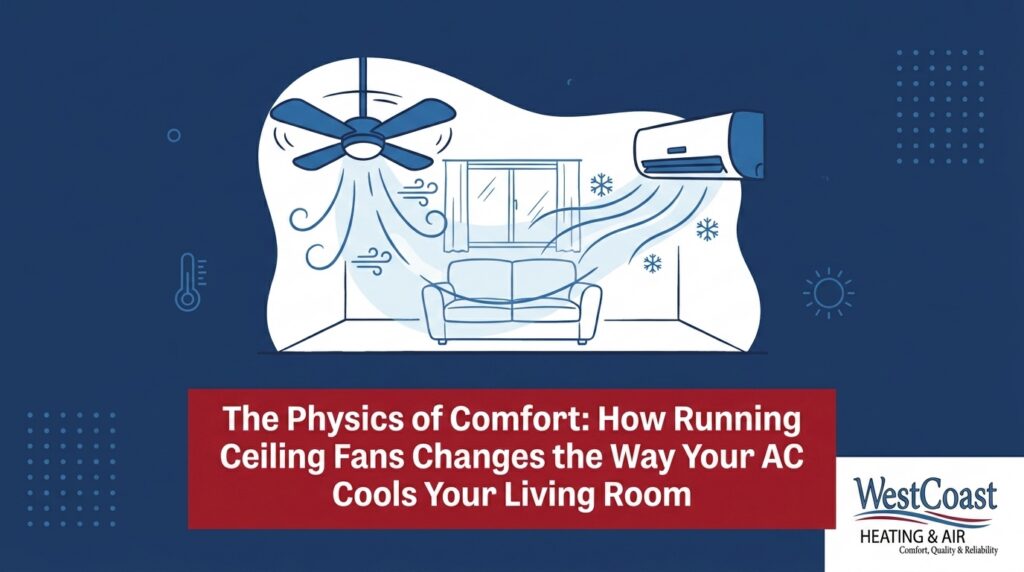
Your air conditioner is working overtime to fight off the July peak summer heat, yet the ceiling fan in your empty living room has been spinning on high since breakfast. This is a common pattern we see: homeowners leaving fans running continuously in unoccupied spaces, hoping to give their struggling cooling system a break. However, understanding exactly how running ceiling fans changes the way your AC cools your living room is the key to achieving actual energy efficiency. Simply leaving a fan on does not lower the temperature of the room, and it might even be working against your primary cooling equipment.
For complete home climate control, pairing smart fan usage with our comprehensive cooling services ensures you stay comfortable without overworking your system. The core decision point for any homeowner is learning how ceiling fans actually interact with human biology and ambient air. Once you understand the physics behind the breeze, you will know exactly when to run your fans, when to turn them off, and how to adjust your thermostat to maximize your comfort.
The Illusion of a Cooler Room
Many people assume that because a room feels cooler when the fan is running, the actual temperature of the air has dropped. This is the prompt fan fallacy. A ceiling fan does not contain any refrigerants, compressor coils, or cooling mechanisms. It simply moves existing air around the space. If the air in your living room is 78 degrees, a ceiling fan will simply push 78-degree air in a circular pattern. To truly master your home’s climate control, you have to separate the concept of ambient room temperature from the concept of perceived human comfort.
The Science of the Wind-Chill Effect on Human Skin
To understand why fans make us feel cold without changing the room’s temperature, we have to look at the science of the wind-chill effect. Ceiling fans cool people, not rooms. When air moves rapidly across your skin, it accelerates the evaporation of moisture. Because evaporation is a cooling process, this rapid moisture loss draws body heat away from your skin, making you feel significantly cooler than the actual temperature of the room.
The biological response: Your body is constantly releasing a microscopic layer of sweat, even when you are not actively exercising. In stagnant air, that moisture evaporates slowly. When a ceiling fan introduces a steady breeze, that evaporation speeds up dramatically. This is exactly why a home in Puyallup WA can sit at a warm 78 degrees, yet feel perfectly comfortable to the people sitting directly under the fan.
Ambient Temperature vs. Perceived Temperature
It is crucial to recognize that the ambient temperature of the room remains completely unchanged by the fan’s airflow. A thermometer placed on your coffee table will read the exact same number whether the fan is on or off. Here is a breakdown of how the wind-chill effect alters your perception compared to reality:
| Condition | Actual Thermometer Reading | What Your Skin Feels (Perceived) |
|---|---|---|
| AC set to 78°F, Fan OFF | 78 degrees | 78 degrees (Stagnant, warm) |
| AC set to 78°F, Fan ON (High) | 78 degrees | 74 degrees (Breezy, comfortable) |
| AC set to 74°F, Fan OFF | 74 degrees | 74 degrees (Cool, but high energy use) |
Because feeling cooler does not equate to the room actually being cooler, running a fan in a room where nobody is sitting provides absolutely zero cooling benefit. The wind-chill effect only works if there is human skin present to feel the breeze.
The Hidden Heat: Why Empty Rooms Actually Get Warmer
One of the most counterintuitive facts about ceiling fans is that running them in an empty room actually wastes energy and adds physical heat to your home. Every ceiling fan operates using an electrical motor. Like all electrical appliances, fan motors generate physical heat while operating. While a single fan motor does not produce as much heat as a space heater, leaving it running continuously during a July peak summer day slowly introduces unnecessary thermal energy into your living space.
The ripple effect on your AC: When you leave a fan running in an unoccupied room, that motor heat slowly increases the ambient temperature near the ceiling. Eventually, this subtle temperature rise forces your air conditioner to work harder to remove the added heat. Instead of helping your AC, the forgotten fan is actively working against it. Ensuring your AC runs efficiently also requires proper airflow, which is why following a reliable guide to filter replacement timing is just as important as managing your fan usage.
The Golden Rule of Ceiling Fans
To stop wasting electricity and inadvertently heating your empty rooms, you must adopt a simple habit. Treat your ceiling fans exactly like your light switches. Follow these basic guidelines to protect your cooling system:
- Turn it on when you enter: Enjoy the immediate wind-chill effect when you sit down in the living room.
- Turn it off when you leave: If the room is empty, the fan is only cooling the furniture—and furniture does not sweat.
- Monitor multiple rooms: Make a habit of checking bedrooms and guest rooms to ensure fans aren’t spinning uselessly behind closed doors.
Strategic Thermostat Adjustments for Maximum Efficiency
Now that you understand the wind-chill effect, you can use it to your financial advantage. The ultimate goal of pairing a ceiling fan with your air conditioner is to save energy without sacrificing a single degree of personal comfort. By leveraging the fan’s breeze, you can safely adjust your AC settings to reduce the workload on your primary cooling unit.
The recommended strategy: The U.S. Department of Energy recommends a specific thermostat temperature offset (e.g., raising 2-4 degrees) when you are in a room with an active ceiling fan. Because the fan makes you feel up to 4 degrees cooler, you can raise the thermostat by that exact amount and your body will not notice the difference. Your air conditioner, however, will notice a massive reduction in strain.
Executing the Offset Strategy
Implementing this strategy requires a deliberate sequence of steps to ensure your home remains comfortable during the hottest parts of the day. Follow this sequential process:
- Establish your baseline comfort: Determine the temperature you normally set your AC to when relying entirely on the air conditioner (for example, 74 degrees).
- Activate the ceiling fan: Turn the fan on to a medium or high setting while you are occupying the room.
- Apply the offset: Manually raise your thermostat by 2 to 4 degrees (moving it from 74 degrees to 78 degrees).
- Reset when leaving: When you leave the house or the room, turn the fan off. If you will be gone all day, leave the thermostat at the higher, energy-saving temperature.

Direction Matters: Counterclockwise Rotation for Summer Cooling
To successfully pull off the thermostat temperature offset (e.g., raising 2-4 degrees), your ceiling fan must be spinning in the correct direction. The physical angle of the fan blades determines whether the air is pushed down toward the floor or pulled up toward the ceiling. During the summer months, your ceiling fan must spin counterclockwise.
The physics of the downdraft: When the blades spin counterclockwise, their angled pitch scoops the air and forces it straight down into the center of the room. This creates the high-velocity downdraft necessary to evaporate moisture on your skin and trigger the wind-chill effect. If your fan is spinning clockwise, it pulls cool air up from the floor and pushes it out against the walls. This updraft is useful in the winter for mixing warm air trapped at the ceiling, but it will completely ruin your summer cooling strategy.
How to Verify Your Fan’s Direction
Many homeowners run their fans backward for years without realizing it. Before the next heatwave hits, take a moment to verify your fan’s rotation using these simple checks:
- The visual check: Stand directly under the fan and look up. The blades should be moving from the top right to the top left (counterclockwise).
- The feeling test: Turn the fan on high. If you do not feel a strong, direct breeze hitting your face while standing directly beneath it, the fan is likely spinning the wrong way.
- The switch location: Look for a small toggle switch on the side of the motor housing. Make sure the fan is completely powered off and stopped before flipping this switch to reverse the direction.
Timing Your Cooling Strategy for Valley Heat Spikes
Contextualizing your fan and AC strategy for local weather patterns is essential for maintaining comfort. In our region, we experience mild summers with distinct afternoon heat spikes in the valley. This specific climate reality makes optimal AC and fan pairing absolutely crucial. If you wait until the late afternoon to start cooling your home, your air conditioner will be fighting a losing battle against the rapidly climbing outdoor temperatures.
The pre-cooling advantage: Because morning temperatures in Puyallup WA are generally mild, you can give your AC a head start. By slightly over-cooling your house during the mid-morning hours, you build a buffer of cold air inside the home. When the sharp afternoon heat spike hits, you can raise your thermostat, turn on your ceiling fans, and rely on the wind-chill effect to keep you comfortable while your AC takes a much-needed rest during the hottest part of the day.
A Daily Schedule for Valley Heat
To protect your AC from unexpected breakdowns during peak hours, follow this daily rhythm:
- Morning (7 AM – 11 AM): Set the thermostat to your preferred cool temperature. Let the AC run easily while outdoor temperatures are low.
- Midday (11 AM – 2 PM): Close blinds and curtains on south-facing windows to block radiant solar heat.
- Afternoon Peak (2 PM – 6 PM): Apply your 2-4 degree thermostat offset. Turn on ceiling fans only in the rooms you are actively using. Let the fans do the heavy lifting for your personal comfort.
Maximizing Your AC’s Baseline Performance
While ceiling fans are incredible tools for localized comfort, they are ultimately only supplementary. Your primary air conditioning unit must be functioning efficiently to remove the actual heat and humidity from your home. Fans cannot compensate for an undersized, failing, or poorly maintained cooling system. If your AC is struggling to keep the ambient temperature at a reasonable level, no amount of wind-chill will make your home comfortable.
The value of professional diagnostics: Providing trusted local expertise to help Pacific Northwest homeowners maximize their home comfort and energy efficiency is about looking at the whole picture. For example, one local homeowner recently needed a complete home AC installation during the spring and sought out multiple quotes. They ultimately chose a team that provided the best value through thorough system diagnostics, resulting in a custom-fitted system installed by a friendly, respectful crew. That level of baseline performance is what allows fan strategies to actually work. If you suspect your system is falling behind, securing reliable AC repair before the peak heat arrives is essential.
Signs Your AC Needs More Than a Fan
If you notice any of the following symptoms, your baseline cooling performance is compromised, and adjusting your ceiling fans will not solve the root problem:
- Constant running: The AC never cycles off, even when the sun goes down.
- Warm airflow: The air coming from your vents feels lukewarm instead of crisp and cold.
- High indoor humidity: The air in your home feels heavy, sticky, and damp, indicating the AC is not properly dehumidifying the space.
- Uneven cooling: One room is freezing while the living room remains uncomfortably hot, regardless of fan usage.
Frequently Asked Questions
Does running a ceiling fan actually help the AC?
The short answer is yes, but only if you adjust the thermostat. Running a ceiling fan creates a wind-chill effect that makes you feel cooler, allowing you to raise the AC temperature without losing comfort. If you leave the thermostat at the same setting, the fan does not help the AC and simply uses additional electricity.
Should I leave my ceiling fan on all the time?
No, you should always turn ceiling fans off in empty rooms. Fans cool people, not spaces, by evaporating moisture on human skin. Leaving a fan running prompt in an unoccupied room wastes energy and introduces unnecessary motor heat into the house.
Do ceiling fans actually lower room temperature?
Ceiling fans do not lower the ambient temperature of a room at all. A thermometer will read the exact same temperature whether the fan is running or not. The cooling sensation is entirely a biological response to moving air accelerating the evaporation of sweat on your body.
Which direction should a ceiling fan spin with AC?
During the summer, your ceiling fan should spin counterclockwise. This direction pushes air straight down into the room, creating the high-velocity downdraft needed for the wind-chill effect. Spinning the fan clockwise will pull cool air up and push warm air down, defeating the purpose.
How much energy does a ceiling fan use compared to air conditioning?
A ceiling fan uses a tiny fraction of the electricity required by a central AC unit. While a central air conditioner can draw thousands of watts to power its compressor and blower, a standard ceiling fan typically uses between 30 and 50 watts. This massive difference is why using a fan to offset your AC by a few degrees results in significant energy savings.
Optimize Your Home Comfort This Season
Understanding the physics of the wind-chill effect gives you a definitive rule for when to run your fans and how to set your thermostat. By combining smart fan usage with a well-maintained air conditioner, you can survive the hottest summer days with ease. If you want to ensure your system is ready to handle the peak heat, contact our HVAC team today. We are here to help you understand how running ceiling fans changes the way your AC cools your living room, ensuring your equipment operates at peak efficiency all season long.