
The Panic of a 3-Second Ignition Shutdown
You wake up on the first chilly September morning, turn up the thermostat, and listen to the familiar sequence of your heating system kicking on, only to find yourself searching for how a dirty flame sensor prevents your gas furnace from staying lit. The inducer motor whirs, the ignitor glows bright orange, and the burners roar to life with a rush of heat. But instead of steady, comforting warmth, the entire system abruptly clicks off just three seconds later. At WestCoast Heating & Air, our team fields countless calls from panicked Puyallup residents who assume this sudden 3-second ignition shutdown means their entire unit has suffered a catastrophic, expensive failure.
Before you start worrying about replacing the whole system, securing professional gas furnace maintenance or scheduling targeted gas furnace repair in Puyallup is the best way to understand that this immediate shutdown is actually a built-in safety mechanism working exactly as intended.
Modern heating systems are designed with strict safety protocols to prevent unburned gas from accumulating inside your home. When the burners ignite, the control board demands immediate proof that a fire is actually present. If it does not receive that proof within a tiny fraction of a moment, it shuts the gas valve down completely. In the vast majority of these early-season failures, we find that your furnace is not broken; it is simply operating under the command of a sensor that is doing its job a little too well. Understanding the mechanical sequence behind this safety feature transforms a moment of panic into a straightforward decision to schedule a professional pre-season tune-up.
What Exactly is a Furnace Flame Sensor?
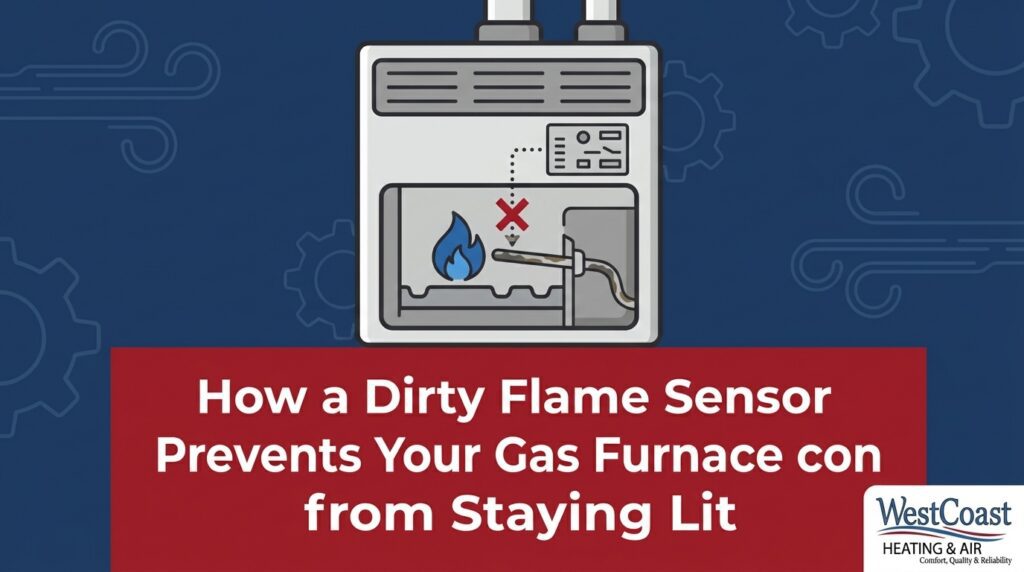
To understand why your heating system is acting up, you first need to know what this component looks like and where it lives. A furnace flame sensor is a remarkably simple-looking device: it is a thin, metallic rod—usually bent at a slight angle—mounted securely on a ceramic base. This rod is positioned directly in the path of the burner flames, usually on the burner furthest away from the ignitor assembly.
Its primary function is exactly what its name implies: it confirms that a fire is present when the gas valve is open. In older heating systems, this job was handled by a standing pilot light and a thermocouple. However, modern electronic ignition systems are much more efficient and do not waste fuel keeping a pilot light burning prompt. Instead, they rely on this metallic rod to act as the final, critical checkpoint in the ignition sequence before the blower motor engages to distribute warm air throughout your home in Puyallup WA.
The Safety Checkpoint
The stakes for this component are incredibly high. Without a functioning flame sensor, a furnace could theoretically open its gas valve, fail to ignite the fuel, and proceed to pump raw, highly combustible gas into your ductwork and living spaces.
- It does not generate heat: A common misconception is that the sensor helps light the furnace. It does not. The ignitor handles the lighting; the sensor only acts as a monitor.
- It acts as a gatekeeper: If the sensor does not detect a flame, the control board will immediately cut the power to the gas valve.
- It protects your home: This rapid shutdown is what keeps a minor ignition failure from becoming a major safety hazard.
Because it sits directly in the fire, the sensor is exposed to extreme temperature fluctuations and the chemical byproducts of combustion, making it highly susceptible to environmental interference over time.
The Microamp Signal: How Your Furnace Detects a Flame
The way a flame sensor actually detects fire is a fascinating piece of practical physics called flame rectification. Flames are not just hot gases; they are actually ionized plasma, which means they can conduct a very small amount of electricity. Your furnace uses this scientific principle to create a foolproof safety loop.
- The alternating current is sent: When the thermostat calls for heat and the gas valve opens, the furnace control board sends a continuous, low-voltage alternating current (AC) to the metallic rod of the sensor.
- The flame completes the circuit: When the burners ignite and engulf the rod in fire, the ionized gases in the flame act as a bridge. The electrical current travels through the flame to the grounded metal chassis of the burner assembly.
- The current is rectified: As the electricity passes through the flame, the physical properties of the fire convert (or “rectify”) the alternating current into a direct current (DC).
- The microamp signal is measured: The control board constantly measures this returning DC current. A clean, properly functioning sensor generates a signal between 1 and 10 microamps (a microamp is one-millionth of an ampere).
- The threshold triggers action: The control board requires a minimum baseline signal to keep the gas valve open. If the board receives less than 0.5 microamps of electrical current, it assumes there is no fire and triggers the 3-second ignition shutdown sequence immediately.
This microamp signal is incredibly delicate. Because the electrical current is so small, even a microscopic barrier between the metal rod and the flame can disrupt the flow of electricity, causing the control board to panic and shut the system down.

Why Does Carbon Buildup Happen During the Off-Season?
If the sensor is just a metal rod, why does it stop working? The answer lies in the environmental conditions inside your HVAC system, especially during the long months when the heating system sits idle. Normal combustion is mostly clean, but it is never perfectly clean. Trace amounts of microscopic carbon and soot are natural byproducts of burning natural gas or propane.
When the furnace is running daily during the winter, these trace amounts slowly accumulate on the rod. However, the real trouble begins during the summer cooling season. In our years of servicing HVAC systems across the region, we’ve found that Puyallup’s damp climate and indoor humidity during the off-season create the perfect environment for airborne particles to settle. As your air conditioner runs, summer dust, pet dander, and microscopic debris circulate through the ductwork and settle on the idle furnace components, including the slightly sticky, carbon-coated flame sensor.
When you finally turn the system on during that first cold snap, the burners ignite and instantly bake that accumulated summer dust and carbon directly onto the metal rod. This creates a microscopic, hardened insulating layer. Because the electrical current required for flame rectification is so tiny, this baked-on insulation is more than enough to block the microamp signal from reaching the control board. This is precisely why your furnace smells like burning dust on the first chilly morning and why our technicians see the system often shut down immediately after that initial test run.
Recognizing the Symptoms: Is It the Flame Sensor or Something Else?
Not every heating failure is caused by a dirty sensor, which is why accurate symptom recognition is vital. The hallmark symptom of a flame sensor issue is highly specific: the burners light fully, burn strong and blue for a few seconds, and then audibly click off. The inducer motor may continue to run to clear the combustion gases, but the heat stops completely.
Just last season, our WestCoast Heating & Air team responded to a Puyallup homeowner who experienced this exact lockout situation during a bitter winter cold snap. After their furnace completely shut down during the evening, they reached out for an after-hours urgent call. Our technician arrived quickly, bypassed the guesswork, diagnosed the lockout mode, and fixed the furnace on the spot so the family did not freeze during the repair.
When a furnace experiences a 3-second ignition shutdown multiple times in a row, the control board goes into “lockout mode.” After three failed ignition attempts, the furnace shuts down completely for an extended period (usually an hour or more) to ensure absolute safety. Resetting the power to the furnace will clear the lockout, but if the sensor is dirty, the system will just fail three times and lock out again.
| Symptom Observed | Likely Mechanical Cause |
|---|---|
| Burners light for 3 seconds, then shut off completely. | Dirty or failing flame sensor blocking the microamp signal. |
| System clicks, but burners never ignite at all. | Bad ignitor, faulty gas valve, or interrupted gas supply. |
| Furnace runs for 10-15 minutes, blows hot air, then shuts off early. | Overheating due to a severely clogged air filter or blocked vents. |
| Blower motor runs constantly, but air is cold. | Thermostat set to “On” instead of “Auto,” or pilot/ignition failure. |
Why You Should Never Attempt a DIY Flame Sensor Cleaning
When faced with a furnace that refuses to stay lit on the first chilly September morning, many homeowners turn to the internet for quick fixes. You will find countless videos and articles suggesting that you can simply pop the sensor out and scrub it clean with emery cloth, steel wool, or sandpaper. This is incredibly risky advice that we regularly see lead to permanent damage and expensive part replacements.
The dangers of abrasive materials: Sandpaper is coated in silica. When you rub silica against the metal rod, microscopic grains get left behind. The moment the furnace fires up, the intense heat of the burner melts that silica directly into a glass-like glaze over the sensor. Glass is a perfect electrical insulator, meaning the microamp signal will be permanently blocked, and the sensor will be completely ruined.
The problem with deep scratches: Even if you avoid silica, materials like steel wool or heavy grit emery cloth leave deep, microscopic scratches in the metal rod. These gouges dramatically increase the surface area of the rod, providing the perfect textured grip for new carbon and dust to cling to. A sensor cleaned aggressively will get dirtier much faster, leading to repeated breakdowns.
The fragility of the ceramic base: The metal rod is housed in a delicate white ceramic insulator. This ceramic prevents the microamp electrical current from grounding out against the furnace frame before it reaches the flame. If you apply too much pressure while attempting a DIY cleaning and crack that ceramic base—even a hairline fracture—the electrical signal will short out, and the furnace will never stay lit.
Tampering with the safety mechanisms of a gas appliance is never recommended and can easily void manufacturer warranties. Instead of risking permanent damage, relying on urgent gas furnace repair ensures the component is handled safely and correctly.
Professional Diagnostics: The Definitive Solution for Ignition Failures
Because the ignition sequence relies on invisible electrical currents, guessing at the problem is a waste of time. Professional technicians do not guess; they measure. This commitment to precision is the definitive solution for any heating failure.
When a WestCoast Heating & Air technician arrives at a home in Puyallup WA, they approach a short-cycling furnace with specialized diagnostic tools. To confirm a dirty sensor, our technician disconnects the single wire leading to the rod and connects a highly sensitive multimeter in series with the circuit. When the furnace fires up, the multimeter reads the exact microamp draw passing through the flame.
If the reading is below 0.5 microamps, the technician knows the signal is blocked. If the reading is strong but the furnace still shuts down, we know the sensor is perfectly fine and the fault actually lies within a failing control board or a grounding issue in the chassis. This precise measurement prevents unnecessary parts replacement and ensures the actual root cause is addressed.
In our experience, this level of professional exactness is a hallmark of quality service. Whether we are fabricating custom fittings for a furnace system in a local commercial shop or diagnosing a residential lockout, the WestCoast Heating & Air team applies that same prompt, accurate diagnostic capability to electrical faults. Professional pre-season maintenance includes safely cleaning the sensor with specialized, non-abrasive materials designed specifically for HVAC components, restoring the proper electrical connection without leaving behind destructive scratches or silica dust.
Frequently Asked Questions About Furnace Ignition Problems
Why does my furnace ignite and then shut off immediately?
This is usually a built-in safety response triggered by a failure to detect a flame. When the burners ignite, the flame sensor has a 3-second window to send a microamp electrical signal back to the control board. If that signal is blocked by carbon buildup or dust, the control board assumes the gas is not burning and shuts the system down immediately to prevent raw gas from flooding your home.
How do you know if your furnace flame sensor is dirty?
The most reliable indicator is a specific short-cycling pattern where the furnace clicks on, the flames burn strong for exactly three to four seconds, and then the system completely shuts down. You may also notice the furnace attempting this sequence three times in a row before going silent for an hour or more in lockout mode. A professional technician can confirm this by measuring the microamp electrical output with a multimeter.
Will a furnace run with a bad flame sensor?
No, a furnace will not continue to run if the sensor is bad, dirty, or broken. Because it is a primary safety mechanism, the control board requires constant, uninterrupted proof of a flame to keep the gas valve open. Without that proof, the system will always default to a mandatory safety shutdown to protect the household from unburned gas accumulation.
What happens when a flame sensor goes bad?
When the component completely fails—often due to a cracked ceramic insulator or severe degradation of the metal rod—it can no longer conduct the necessary electrical current through the flame. The furnace will initiate its startup sequence, open the gas valve, ignite the burners for a few seconds, and then shut down. It will repeat this cycle until the control board initiates a hard lockout.
How often should a furnace flame sensor be professionally cleaned?
It should be inspected and professionally cleaned once a year as part of standard pre-season heating maintenance. Having a technician clear away the summer dust and microscopic carbon buildup in the early fall ensures the sensor has a clean surface to read the microamp signal reliably throughout the heavy winter heating season.
Can a dirty flame sensor cause my furnace to blow cold air?
Indirectly, yes. If the furnace goes into a hard lockout after failing to detect a flame three times, the burners will remain off, but the thermostat might still command the blower motor to run to circulate air. Because the burners are deactivated by the safety lockout, the blower will push unheated, room-temperature air through your vents, which feels cold to the touch.
Restore Your Peace of Mind Before Winter Arrives
Experiencing a 3-second ignition shutdown on the first chilly September morning can certainly be stressful, but it is ultimately a sign that your heating system’s safety features are actively protecting your home. A furnace that shuts down to prevent unburned gas accumulation is doing exactly what it was engineered to do. The microscopic layer of summer dust and carbon that blocks the vital microamp signal is a natural consequence of the off-season, not a sign of a failing furnace.
Understanding this mechanical sequence removes the panic from the equation. The best way to ensure reliable, uninterrupted heat is to clear away that off-season buildup before the freezing weather sets in. Schedule a professional diagnostic check and tune-up with WestCoast Heating & Air today to restore your system’s electrical connections, bypass the risks of DIY tampering, and guarantee a warm, comfortable home all winter long.