
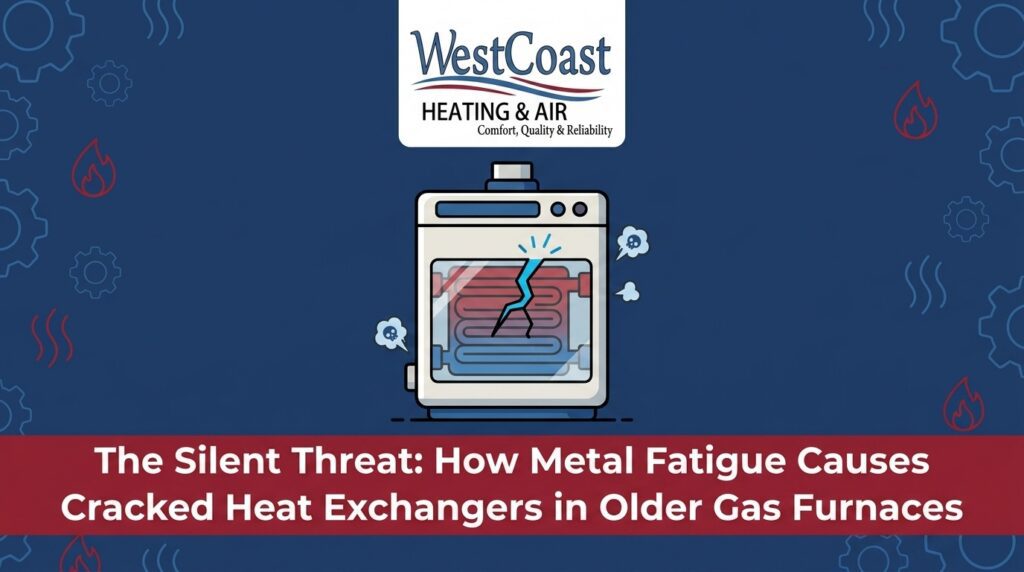
The Hidden Risks Lurking in Aging Heating Systems Before Winter Hits
The September pre-heating season is officially here, and before the first major freeze arrives, homeowners must address the hidden danger of a cracked heat exchanger in older gas furnaces. At WestCoast Heating & Air, we frequently remind our Puyallup neighbors that while your heating system may have performed adequately at the end of last spring, months of dormancy followed by the sudden demand of autumn weather can expose critical, invisible wear and tear. Older gas furnaces do not simply fail overnight; they develop microscopic flaws deep within their core components that are entirely invisible to the naked eye.
The most crucial decision point for any homeowner with an aging system is evaluating its structural integrity before continuous winter operation begins. Waiting until the system breaks down on a freezing night leaves you vulnerable to both sudden heating loss and severe safety hazards. For comprehensive peace of mind, scheduling professional gas furnace maintenance is the most effective way to uncover these hidden risks before the heavy lifting of winter truly begins.
The Stakes of Pre-Season Evaluation:
- Safety first: Identifying microscopic metal fractures prevents dangerous combustion gases from entering your living space.
- System reliability: Catching structural wear early prevents catastrophic system failures during peak winter demand.
- Performance efficiency: A structurally sound system operates cleanly, efficiently, and exactly as the manufacturer intended.
Understanding the Core: What Does a Heat Exchanger Actually Do?
To understand why a compromised heating system is so dangerous, you first have to understand the first-principles mechanics of how your home stays warm. The heat exchanger is the absolute heart of your heating system. It serves as the critical, impenetrable barrier between the combustion chamber—where volatile natural gas burns at extreme temperatures—and the blower motor, which distributes breathable air throughout your home in Puyallup WA.
When your thermostat calls for heat, the furnace ignites fuel inside the heat exchanger. This component, typically made of stamped steel or aluminized steel, rapidly heats up to hundreds of degrees. Simultaneously, the blower fan activates, pushing cold indoor air across the outside of the extremely hot metal. The heat transfers through the metal wall, warming the air before it travels through your ductwork. Because the metal barrier remains perfectly sealed, the toxic exhaust gases created by the burning fuel never mix with the air your family breathes.
If that barrier fails, the entire safety mechanism of the furnace is defeated. A breach means that the controlled environment where combustion happens is now connected to the ventilation system of your home. Understanding this fundamental role makes it clear why an aging, untested system requires professional gas furnace repair or evaluation to ensure that this vital barrier remains completely intact under extreme operating conditions.
The Extreme Operating Environment
The environment inside a furnace cabinet is incredibly hostile. The metal barrier must withstand:
- Rapid temperature spikes: Going from room temperature to hundreds of degrees in a matter of seconds.
- Corrosive byproducts: The natural combustion process produces moisture and trace chemicals that can slowly corrode metal over decades.
- Constant airflow pressure: The blower motor exerts continuous static pressure against the exterior walls of the metal tubes or clamshells.
The Physics of Metal Fatigue in Older Furnaces
The failure of an aging heating system is rarely a result of poor manufacturing; rather, it is the unavoidable result of physics and time. The core issue is thermal expansion and contraction. When metal is heated to extreme temperatures, its molecules vibrate rapidly, causing the material to physically expand. When the heating cycle ends and the metal cools, it contracts back to its original shape.
In the Pacific Northwest, our cold, damp winters demand five to six months of continuous heating cycles. A furnace may cycle on and off dozens of times a day. Over the course of 15 to 20 years, our team at WestCoast Heating & Air has seen firsthand how this metal barrier undergoes tens of thousands of these violent expansion and contraction cycles. This constant movement inevitably leads to metal fatigue, much like bending a paperclip back and forth until it eventually snaps.
This fatigue manifests as microscopic, invisible cracks along the weakest points of the metal—usually the crimped seams, the sharp bends, or the dimpled areas of the clamshell. Because this is a structural inevitability in aging systems, understanding HVAC lifespans in the Northwest is critical. By the time the September pre-heating season arrives in a furnace’s fifteenth year, the likelihood of metal fatigue has increased exponentially.

The Lifecycle of a Heat Exchanger
| Age of Furnace | Structural Condition of Metal | Risk Level |
|---|---|---|
| Years 1–10 | Metal retains high elasticity; easily handles thermal expansion. | Very Low |
| Years 11–15 | Elasticity decreases; molecular stress begins at seams and bends. | Moderate |
| Years 15–20+ | Severe metal fatigue; microscopic stress fractures develop into cracks. | High to Critical |
Carbon Monoxide: The Severe Danger of a Compromised Barrier
When metal fatigue finally breaches the barrier, the resulting safety hazard is severe. The primary danger is carbon monoxide (CO), a colorless, odorless, and tasteless gas produced by the incomplete combustion of natural gas. Under normal, safe operating conditions, this toxic byproduct is safely vented out of your home through the flue pipe. However, when microscopic cracks exist, the dynamics of the system change entirely.
Because the blower fan pushes air across the outside of the metal at a high velocity, it creates complex pressure differentials. As the metal heats up and the microscopic crack widens, the turbulence from the blower can disrupt the draft inside the burner. This disruption can force carbon monoxide and other dangerous combustion byproducts out of the combustion chamber and directly into the home’s ductwork. From there, the toxic gas is distributed into every room of the house.
The Centers for Disease Control and Prevention (CDC) and the Consumer Product Safety Commission (CPSC) have published strict guidelines regarding the severe health risks of indoor carbon monoxide exposure. Prolonged exposure to even low levels of CO can cause headaches, dizziness, nausea, and confusion, while high levels can be fatal in a matter of minutes. The risk increases incrementally over time in Puyallup WA homes; a hairline fracture in October will widen with continued use, pushing more CO into the home by January. Taking proactive steps to prevent furnace carbon monoxide leaks is not just a maintenance task—it is a critical life-safety requirement.
Warning Signs You Shouldn’t Ignore (And Why You Shouldn’t Wait for Them)
While a severely compromised system will eventually show physical symptoms, relying on these signs is incredibly dangerous. Early-stage microscopic cracks produce absolutely zero visible or olfactory symptoms. Standard store-bought CO detectors are designed to sound an alarm only when carbon monoxide levels reach a high, immediately life-threatening threshold—they often will not alert you to the low-level, chronic exposure caused by a hairline fracture during the September pre-heating season.
By the time physical symptoms appear, the breach is massive, and combustion is severely impaired. Just this past summer, our team at WestCoast Heating & Air received a call from a local property owner whose existing furnace issues at their rental properties needed a thorough diagnosis. Our technicians were able to properly identify the underlying problems and complete the repairs, ensuring the system was safe and ready long before winter arrived. Waiting for obvious signs of failure puts occupants at unnecessary risk.
Physical Symptoms of Advanced Wear
If you notice any of the following late-stage indicators, shut off your heating system immediately and contact a professional:
- Soot around the registers or furnace cabinet: Black, powdery soot indicates that the fuel is not burning cleanly due to draft disturbances caused by a structural breach.
- Unusual odors when the system kicks on: A strong, acrid smell similar to formaldehyde often accompanies incomplete combustion and exhaust leakage.
- Changes in burner flame color: A healthy gas flame should be a steady, crisp blue. A yellow, dancing, or lazy flame indicates that the fuel-to-oxygen ratio is incorrect, often because blower air is pushing through a crack and disrupting the burner.
- Visible corrosion or rust flakes: Rust accumulation on the floor of the furnace cabinet is a strong indicator that moisture from the exhaust is corroding the metal from the inside out.
Why Visual Inspections Fall Short: The Necessity of Combustion Analysis
A common misconception is that a technician can simply shine a flashlight into a furnace and definitively declare the metal barrier safe. This visual-only approach falls drastically short of true safety standards. Heat exchangers are designed with complex, serpentine curves and deep clamshell dimples to maximize surface area. Hairline fractures almost always occur in the deepest, most inaccessible bends of the metal, making them entirely invisible to the naked eye, even with an inspection mirror.
The only definitive, scientifically sound method to confirm system safety is through professional combustion analysis. This technology-driven diagnostic tool measures the exact chemical composition of the exhaust stream. A licensed professional inserts a specialized probe into the flue pipe while the system is running. The analyzer reads the precise levels of oxygen (O2) and carbon monoxide (CO) in parts per million (PPM).
During a routine appointment recently, one of our clients requested a comprehensive evaluation of their older heating system. Our WestCoast Heating & Air technicians serviced the furnace using advanced diagnostic tools and even installed an ozone air scrubber unit to improve indoor air quality, providing honest, evidence-based recommendations rather than a high-pressure sales pitch. This is the difference between guesswork and science. If a crack exists, the moment the blower fan kicks on, it will push extra oxygen through the crack and into the combustion chamber. The combustion analyzer will immediately register a sudden spike in O2 and a corresponding spike in CO. This change in flue gas composition definitively proves a breach, regardless of what can or cannot be seen with a flashlight.
Because these diagnostics involve handling volatile gases, measuring trace chemicals, and understanding complex pressure dynamics, proper testing requires specialized equipment and rigorous training. Homeowners should never attempt DIY diagnostics. Scheduling a professional furnace tune up in Puyallup WA ensures that your system receives an honest, evidence-based evaluation, protecting your home from silent threats before the cold sets in.
Frequently Asked Questions
Why do furnace heat exchangers crack?
Furnace heat exchangers crack due to metal fatigue caused by thousands of thermal expansion and contraction cycles. Every time the furnace heats up, the metal expands, and when it cools, it contracts. Over 15 to 20 years, this constant movement weakens the metal at its seams and bends, eventually causing microscopic stress fractures.
What are the symptoms of a cracked heat exchanger in a furnace?
Early-stage cracks have no visible symptoms, making them highly dangerous. In advanced stages, symptoms include soot buildup around the furnace, a strong formaldehyde-like odor, and a burner flame that burns yellow and dances instead of remaining a steady blue. If you see these late-stage signs, the unit should be shut down immediately.
How does a cracked heat exchanger cause carbon monoxide leaks?
A cracked heat exchanger breaks the sealed barrier between the toxic combustion exhaust and the breathable air in your home. When the blower fan activates, it changes the pressure dynamics inside the cabinet, which can push carbon monoxide out of the combustion chamber, through the crack, and into your ductwork to be distributed throughout the house.
Can a cracked heat exchanger be repaired safely?
No, a cracked heat exchanger cannot be safely patched, welded, or sealed. Because the metal expands and contracts violently during operation, any temporary repair will quickly fail and release dangerous gases. The only safe and code-compliant solution is to replace the entire heat exchanger component or upgrade the furnace entirely.
How dangerous is a cracked heat exchanger?
A cracked heat exchanger is extremely dangerous because it can introduce carbon monoxide into your living space. Carbon monoxide is a colorless, odorless, and tasteless gas that can cause severe illness, long-term neurological damage, and even death. It is considered a critical life-safety failure that requires immediate professional intervention.
How often should an older gas furnace be tested for carbon monoxide leaks?
An older gas furnace should be tested for carbon monoxide leaks at least once a year, ideally during the early fall before the heavy heating season begins. A licensed professional should perform a comprehensive combustion analysis, as visual inspections alone cannot detect the microscopic cracks that cause early-stage leaks.
Protecting Your Home Before Winter Arrives
Understanding the hidden danger of a cracked heat exchanger in older gas furnaces is the first step in protecting your household from the silent threat of carbon monoxide. Metal fatigue is an unavoidable reality of aging systems, but exposure to toxic gases is completely preventable. By relying on clear, first-principles science and professional combustion analysis, you can ensure your heating system is structurally sound. Schedule your comprehensive pre-season evaluation today to secure the safe, reliable warmth your home needs this winter.