
Getting the right size HVAC for your Pacific Northwest home is one of the most important decisions you’ll make as a homeowner in the Puget Sound region — and it’s one that’s easy to get wrong.
Here’s a quick answer to help you get started:
To properly size an HVAC system for a Pacific Northwest home:
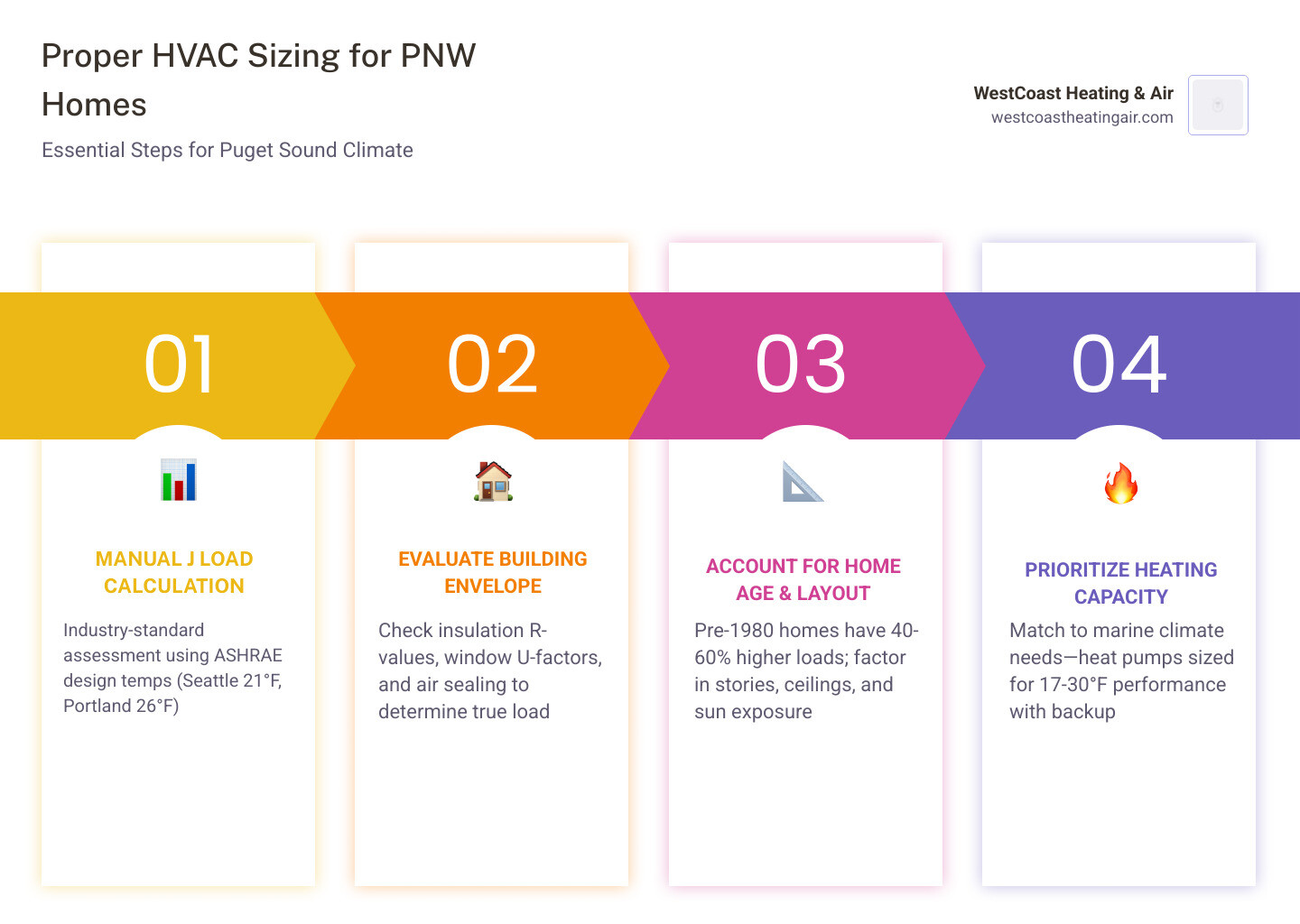
- Schedule a Manual J load calculation with a licensed HVAC professional — this is the industry standard, not a rule of thumb
- Account for your home’s building envelope — insulation R-values, window U-factors, and air sealing all shift your load significantly
- Use local ASHRAE design temperatures — Seattle’s heating design temp is 21°F; Portland’s is 26°F
- Factor in your home’s age and layout — pre-1980 homes can have 40–60% higher heating loads than a modern code-built home of the same size
- Match your system to heating needs first — in our marine climate, heating load drives sizing more than cooling load
Many homeowners assume that bigger always means better — or that matching the old unit’s size is safe. Neither is true. An oversized system short-cycles, fails to control humidity, and wears out faster. An undersized one runs constantly and never quite keeps up. Both cost you more in the long run.
The Pacific Northwest’s mild but damp climate creates a unique set of sizing challenges that generic online calculators and square-footage rules simply can’t account for.
I’m Michael Smith, owner of WestCoast Heating & Air in Puyallup, and after building deep expertise in the heating and cooling needs of Western Washington homes, I’ve made getting the right size HVAC for your Pacific Northwest home a cornerstone of how we serve our customers. In this guide, I’ll walk you through exactly what goes into a proper sizing decision so you can make a confident, informed choice.
Why is proper HVAC sizing so important for my home in the Puget Sound?

When we talk about “size” in the HVAC world, we aren’t talking about the physical dimensions of the box sitting outside your house. We are talking about capacity—the system’s ability to move heat. In the Puget Sound, where we deal with everything from damp, 40-degree rains to sudden summer heatwaves, that capacity needs to be “just right.”
Proper sizing is the foundation of energy efficiency. If your system is correctly matched to your home’s needs, it runs for the optimal amount of time to reach your thermostat setting. This balance ensures your equipment lasts longer because it isn’t starting and stopping constantly. Most importantly, it ensures your indoor comfort is consistent. You won’t have that “clammy” feeling in the summer or “cold spots” in the winter.
Understanding Why is an Oversized Air Conditioner Problematic? is the first step in avoiding a very expensive mistake.
The dangers of an oversized system
In our experience serving neighbors in Tacoma and SeaTac, we often find systems that are way too big for the space. This leads to short-cycling, where the unit turns on, blasts the house with air, and shuts off before it can actually complete a full cycle.
Short-cycling is a comfort killer. Because the air conditioner or heat pump doesn’t run long enough, it never gets a chance to pull the moisture out of the air, leading to high humidity indoors. It also causes massive mechanical wear on the compressor and fan motor. Imagine driving your car by flooring the gas and then slamming on the brakes every 30 seconds—that’s what an oversized HVAC system does to its internal parts.
The risks of an undersized system
On the flip side, an undersized system is just as frustrating. During a cold snap in Puyallup or a heatwave in SeaTac, an undersized unit will run constantly without ever reaching the set temperature. This leads to inadequate cooling or heating, sky-high energy bills, and extreme stress on the system. In the summer, an undersized AC unit can even lead to frozen coils, as the system tries too hard to keep up with a load it wasn’t built to handle.
What is a Manual J calculation and why do I need one for my Seattle or Portland home?
If you’ve ever wondered What is BTU Measurement and Why Does it Matter?, the answer lies in the Manual J load calculation. This is the “gold standard” engineering process we use to determine exactly how many BTUs (British Thermal Units) your home needs to stay comfortable.
A Manual J isn’t a guess. It’s a detailed report that looks at the “physics” of your house. It considers the direction your home faces, the type of insulation in your walls, the number of windows you have, and even the number of people living in the home.
Getting the right size HVAC for your Pacific Northwest home using Manual J
To get an accurate result, we use specific ASHRAE design temperatures. These aren’t the record-breaking extremes (like the 108°F heat dome of 2021), but rather the temperatures that our region stays at for 99% of the year.
For example, in the Seattle area, the heating design temperature is typically 21°F. In Portland, it’s closer to 26°F. We size your system to handle these temperatures efficiently. If we sized every home for a once-in-a-century 10°F night, the system would be massively oversized for the other 364 days of the year, leading to the short-cycling issues we mentioned earlier.
Why “rules of thumb” fail Washington homeowners
You might hear a contractor say, “Oh, you’ve got a 2,000-square-foot house? You need a 4-ton unit.” This is the “1 ton per 500 square feet” myth, and it’s a recipe for disaster.
Square footage is only one piece of the puzzle. Two homes in University Place could both be 2,000 square feet, but if one was built in 1920 with single-pane windows and the other was built in 2024 with high-efficiency insulation, their HVAC needs will be completely different. Relying on BTU for House Size without a professional calculation often leads to buying a system that is 50% larger than necessary.
Getting the Right Size HVAC for Your Pacific Northwest Home
Our marine climate is unique. We have high humidity, mild winters, and increasingly warm summers. This means we have to balance “sensible” cooling (lowering the temperature) with “latent” cooling (removing moisture).
| Home Size | Built Pre-1980 (Low Insulation) | Built 2021+ (High Efficiency) | Recommended System Type |
|---|---|---|---|
| Under 1,500 sq. ft. | 30,000 – 45,000 BTU | 18,000 – 24,000 BTU | Ductless Mini-Split or Small Heat Pump |
| 1,500 – 2,500 sq. ft. | 45,000 – 70,000 BTU | 30,000 – 45,000 BTU | Standard Air-Source Heat Pump |
| Over 2,500 sq. ft. | 70,000+ BTU | 45,000 – 60,000 BTU | Zoned Heat Pump or Dual-Fuel System |
How building vintage affects getting the right size HVAC for your Pacific Northwest home
Building vintage is perhaps the biggest “hidden” factor in getting the right size HVAC for your Pacific Northwest home. If you live in a classic Craftsman in Tacoma or a mid-century home in Steilacoom, your home’s “envelope” likely leaks a lot of air.
Research shows that a 2,000-square-foot home built to pre-1980 standards can have a heating load 40–60% higher than a home built to modern 2021 energy codes. When we perform an assessment, we look closely at your insulation levels. A home with a “leaky” envelope (high air infiltration) might require a much larger system just to keep up with the heat escaping through the attic and crawlspace.
Sizing for heat pump performance in Western Washington
Heat pumps are the “superstars” of the PNW, but sizing them requires expertise. Unlike a furnace, a heat pump’s capacity changes as the outdoor temperature drops.
In places like Puyallup and Orting, we generally size heat pumps to handle the full heating load down to about 30°F. Below that, we often look at “low-ambient” or cold-climate heat pumps that can maintain their capacity even when it hits 17°F. For many homeowners, a “dual-fuel” system—a heat pump paired with a high-efficiency gas furnace—provides the perfect balance of efficiency and “toasty” warmth during those rare Puget Sound freezes.
How do insulation and home layout change the size of the system I need?
Your home’s “envelope”—the walls, roof, and floor—acts like a thermos. If the thermos is cracked, your coffee gets cold. In HVAC terms, if your insulation is poor, your “load” goes up.
We often recommend homeowners look at air sealing and insulation before they even pick a system size. A simple blower door test can identify where air is leaking. If you seal those leaks, you might be able to drop down a full size in equipment, saving you money on the initial purchase and every month on your utility bill. This is also where Air Balancing: The Art of Avoiding Hot and Cold Spots comes into play, ensuring that once you have the right size unit, the air actually gets where it needs to go.
How layout affects getting the right size HVAC for your Pacific Northwest home
The “shape” of your home matters just as much as the square footage.
- Multi-story homes: Heat rises. If you have a two-story home in Sumner, your upstairs will naturally be hotter. This often requires “staged” equipment or Furnace Zone Control Systems to keep both floors comfortable.
- Open plans: Large, vaulted ceilings create a huge volume of air that needs to be moved, which can increase the required BTU capacity.
- Ceiling height: A room with 12-foot ceilings has much more air to condition than one with 8-foot ceilings, even if the floor space is the same.
The role of windows and orientation
Windows are essentially “holes” in your insulation. We look at the U-factor (how well the window prevents heat loss) and the SHGC (Solar Heat Gain Coefficient).
If you have a home with massive south-facing windows in Spanaway, you’re going to have a huge “solar gain” in the summer. That means your cooling load will be much higher than a neighbor with a shaded, north-facing home. During a Manual J calculation, we actually measure the glass area and its orientation to ensure your AC can handle that afternoon sun.
Which energy-efficient systems work best for our unique marine climate?
In 2026, the options for efficient home comfort are better than ever. When we look at getting the right size HVAC for your Pacific Northwest home, we prioritize systems that can “throttle” their output.
- Variable-Speed Heat Pumps: These are the gold standard. Instead of being “all on” or “all off,” they can run at 25% or 50% capacity. This solves the over-sizing problem because the system can adjust itself to the exact needs of the moment.
- Ductless Mini-Splits: Perfect for older homes in Steilacoom or Roy that don’t have ductwork. They are incredibly efficient and allow for room-by-room “zoning.”
- High-Efficiency Furnaces: If you prefer gas, look for an AFUE rating of 95% or higher.
If your current system is struggling, it’s worth checking the Signs It’s Time to Upgrade Your HVAC System to see if a more modern, correctly sized unit could save you money.
Preparing for your professional assessment
When we come out to your home in Puyallup or Tumwater, you can help the process go faster by having a few things ready:
- Floor plans or basic measurements of your rooms.
- Information on your insulation (if you know what’s in the attic or walls).
- Your recent utility bills, which help us see how your current system is performing.
Knowing What to Expect During an HVAC Replacement can help lower the stress of the process. Our goal is to educate you, not just sell you a box.
Local rebates and incentives in 2026
Properly sizing an efficient system doesn’t just save you on monthly bills; it also qualifies you for significant savings upfront. Thanks to the Inflation Reduction Act and local Washington state programs, there are often thousands of dollars available in federal tax credits for high-efficiency heat pumps.
Additionally, local utilities like Puget Sound Energy (PSE) often offer rebates for homeowners who upgrade to premium, correctly sized equipment. We stay up-to-date on all these programs to ensure our customers in Pierce and Thurston counties get every penny they deserve.
Frequently Asked Questions about PNW HVAC Sizing
What size HVAC do I need for a 2,000 sq. ft. home in Seattle?
There is no single answer, but for a modern, code-built home, the heating load is typically between 25,000 and 40,000 BTU/h. However, if it’s an older home with original windows, that number could jump to 60,000 BTU/h or more. This is why a Manual J calculation is non-negotiable!
Can I just use the same size as my old furnace?
We strongly recommend against this. Many older systems were oversized by 50–100% because “fuel was cheap” and contractors wanted to avoid “no-heat” calls. Also, if you’ve added new windows or insulation since that old unit was installed, your home’s needs have changed.
Why is my upstairs always hotter than my downstairs?
This is usually an airflow and sizing issue. It could mean your system doesn’t have the “static pressure” to push air to the second floor, or that you need a multi-stage system that can run longer at a lower speed to balance the temperatures. You might also need to look at 10000 BTU Air Conditioner Measurements for specific rooms or consider 30000 BTU Furnace options for smaller zones. If you’re curious about the terminology, you can read more about BTU Cooling Meaning to understand how these numbers affect your comfort.
Conclusion
Getting the right size HVAC for your Pacific Northwest home isn’t just about picking a number out of a hat—it’s an engineering task that requires local expertise. At WestCoast Heating & Air, we’ve spent over 20 years helping our neighbors in Puyallup, Tacoma, Spanaway, and throughout the Puget Sound find the perfect balance of comfort and efficiency.
We don’t believe in “one-size-fits-all” solutions. Every home we visit in University Place or Orting gets a customized design based on its unique layout and your family’s needs. We take the time to educate you on your options because a well-informed homeowner is a happy one.
Don’t leave your comfort to chance or “rules of thumb.” Let us help you do it right.
Schedule your professional sizing assessment with WestCoast Heating & Air today!