
Is Closing Vents in Unused Rooms Really Saving You Energy?
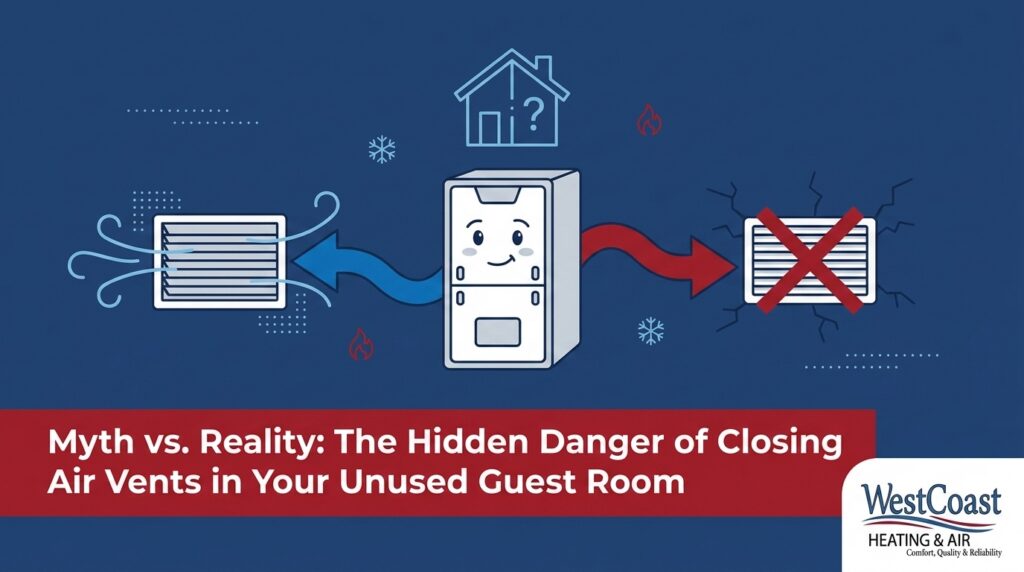
Have you ever wondered about the hidden danger of closing air vents in your unused guest room to cut down on cooling costs? It is a common question we hear from homeowners in Puyallup WA, especially when the late-summer heat arrives and utility bills start to climb. The concrete problem is that restricting airflow in a single room does not actually reduce your air conditioner’s overall workload. Instead, this common habit actively increases static pressure inside your ductwork and places severe strain on your system’s blower motor. The decision you face as a homeowner is whether a perceived drop in your daily energy usage is worth risking an expensive, premature blower motor failure right when you need your system the most.
Properly caring for your equipment means understanding how whole-home airflow is balanced from the day it is installed. If you are focused on maintaining your heating and cooling system, avoiding unnecessary mechanical strain is the first step to preventing a breakdown or the sudden need for gas furnace repair in Puyallup.
The Physics of Static Pressure in Modern HVAC Systems
To understand why shutting a vent causes so much trouble, you have to look at how central forced-air systems are designed. Your heating and cooling equipment is holistically balanced to push a very specific volume of conditioned air through a specific amount of ductwork. When a professional installs a system, they calculate the exact size of the blower motor needed to move air throughout your entire home.
The garden hose effect: Static pressure is simply the resistance to airflow within your duct system. Think of your ductwork like a garden hose and the blower motor as the water spigot. If you turn on the spigot, water flows freely out the end. If you place your thumb over half the opening, the water does not stop flowing from the source. Instead, the pressure builds up dramatically behind your thumb, forcing the water to spray harder and stressing the hose itself. Closing a vent does not tell your air conditioner to produce less cold air; it simply forces the exact same amount of air into a much smaller distribution area.
As local educators, our goal is to translate complex physics into actionable advice that protects your long-term investment. By understanding static pressure, you can avoid the common pitfalls that lead to preventable repairs during the August late-summer cooling season.
| System Metric | With All Vents Open | With Guest Room Vents Closed |
|---|---|---|
| Static Pressure | Remains balanced and within manufacturer specifications. | Spikes significantly, creating resistance inside the ductwork. |
| Airflow Volume | Moves freely across the evaporator coil for optimal cooling. | Slows down, preventing the system from removing enough heat. |
| Motor Strain | Operates at a normal, energy-efficient baseline. | Motor works harder to push against the trapped air. |
| Energy Efficiency | Maximum efficiency; cools the home in standard cycles. | Decreased efficiency; longer run times and higher electricity use. |
The Illusion of Room-by-Room Control
Many homeowners believe that standard HVAC systems operate like light switches—if you turn one off, you save the power it would have used. However, standard central systems lack the mechanical ability to dynamically adjust their cooling capacity based on a single closed register. Closing vents disrupts the careful equilibrium established during the original system installation. The blower motor continues to push the same cubic feet per minute (CFM) of air, but now it has fewer avenues to release that air into your living spaces. This illusion of control ultimately works against the equipment’s fundamental design.
Why Closed Vents Push Blower Motors to the Breaking Point
Modern heating and cooling systems utilize electronically commutated motors (ECM) to circulate air. These variable-speed motors are highly efficient and are designed to maintain a constant, steady airflow regardless of minor fluctuations in the system. However, this advanced technology becomes a liability when you intentionally block vents.
The RPM spike: When static pressure spikes from closed vents in an unused guest room, an ECM detects the resistance. Because it is programmed to maintain a specific airflow volume, the motor will automatically ramp up its rotations per minute (RPMs) to fight the blockage. It works harder, spins faster, and draws significantly more electricity to overcome the artificial barrier you created. This completely debunks the savings myth: because the motor is overexerting itself, it actually consumes more electricity, negating any perceived savings on your utility bill.
One Puyallup WA homeowner reached out during the summer when their eight-year-old system failed completely. The root cause traced back to previous poor installation and severely restricted airflow that overworked the equipment over time. A technician provided an honest evaluation, found the compounding issues, and replaced the system before the next heat wave. This is a typical pattern we see: whether it is incorrect sizing or artificially restricted airflow from closed vents, forcing a system to work harder than designed drastically shortens its lifespan.

The Domino Effect of Restricted Air
The strain does not stop at the blower motor. Restricted airflow creates a dangerous domino effect that threatens the most expensive components of your air conditioner. If you notice these symptoms, your system is likely suffering from high static pressure:
- Frozen evaporator coils: Cold air fails to move across the indoor coil efficiently. Without enough warm return air passing over the cold refrigerant, the condensation on the coil freezes solid into a block of ice.
- Liquid slugging: A frozen coil prevents refrigerant from converting from a liquid to a gas. If liquid refrigerant travels back to the outdoor compressor, it can destroy the compressor valves—a fatal failure for the system.
- Short cycling: The system overheats from the strain and shuts itself down prematurely, turning on and off rapidly without ever actually cooling your home.
The Late-Summer Tipping Point for AC Breakdowns
HVAC equipment accumulates significant wear and tear over weeks of sustained operation. By the time the August late-summer cooling season arrives, your air conditioner has already logged hundreds of hours of intense labor. The capacitors have endured high heat, the contactors have engaged thousands of times, and the blower motor has been spinning almost daily since June.
During the warm August days in Puyallup WA, air conditioning systems are already working at peak capacity. Adding artificial static pressure to a system that has been running constantly is highly risky. It is often the exact tipping point that turns a fatigued, but functioning, blower motor into a completely dead one.
The urgency of opening vents: If you currently have vents closed in a guest room, office, or basement, the best thing you can do for your system’s longevity is to walk through your house and open them fully. Relieving that pressure gives an overworked system a much-needed break. Preventative care now prevents urgent, after-hours diagnostic calls when the system finally gives up on the hottest afternoon of the year.
Cumulative Wear and Tear
Systems are most vulnerable at the tail end of the cooling season. A blower motor that easily survived the moderate temperatures of early summer might fail spectacularly in late August if forced to push against closed vents. The cumulative heat degradation combined with a sudden spike in static pressure is a recipe for total mechanical failure.
The Unseen Cost: Increased Duct Leakage and Wasted Energy
Even if your blower motor manages to survive the added strain, closing vents still costs you money in ways you cannot easily see. The ductwork running through your attic, crawlspace, or walls is rarely perfectly airtight. Duct systems are assembled in sections, sealed with mastic, tape, and mechanical fasteners.
The science of duct leakage: Studies from organizations like the Lawrence Berkeley National Laboratory have shown that closing vents in a central forced-air system can increase duct leakage by 10 to 15 percent. When you close a vent, the increased static pressure has to go somewhere. The trapped air pushes relentlessly against the seams and joints of your ductwork. Over time, this pressure forces conditioned air out of tiny gaps that would otherwise remain relatively sealed under normal operating pressures.
This means you are paying to air condition your 120-degree attic, your damp crawlspace, or the empty cavities inside your walls instead of your living spaces in Puyallup WA. The wasted energy from this forced duct leakage far outweighs any theoretical savings you might get from closing off a single guest room. You are essentially throwing cold air away before it ever reaches the rooms you actually use.
Smarter Ways to Control Your Home’s Airflow
If your goal is to manage temperatures in unused rooms without damaging your HVAC system, there are safe, mechanically sound ways to achieve it. The first rule is always to keep your vents open to ensure proper static pressure and protect the blower motor during the August late-summer cooling season. If you still have uneven temperatures, consider these professional solutions:
- Leave interior doors open: Along with opening all floor and ceiling registers, keep the doors to unused rooms open. This allows air to circulate back to the central return vent, preventing pressure buildup inside individual rooms.
- Schedule a ductwork inspection: If a room is naturally too hot or too cold, the issue is often related to undersized ducts, crushed flex duct, or disconnected runs in the attic—not a lack of system capacity.
- Install window treatments: Use blackout curtains or thermal blinds in the unused guest room to block solar heat gain, naturally keeping the room cooler without altering your system’s airflow.
Professional Air Balancing
Instead of closing vents at the end of the duct run, technicians can adjust dampers located at the plenum (where the ductwork meets the furnace). Air balancing regulates airflow safely closer to the source. This ensures the blower motor still moves the correct volume of air while redirecting it evenly throughout the home, eliminating hot and cold spots without dangerous pressure spikes.
True Zone Control Upgrades
If you genuinely want different temperatures in different parts of your house, upgrading to furnace zone control systems is the correct path. A properly installed zoning system uses motorized dampers inside the ductwork, controlled by dedicated thermostats in each zone. Crucially, a true zone system includes a bypass damper that safely relieves static pressure when a zone is closed. This allows for genuine energy savings in unused rooms without putting any equipment strain on the blower motor.
For persistent hot or cold spots in isolated rooms like a sunroom or over-garage bonus room, fixing uneven home temperatures with mini-splits offers targeted climate control. Ductless systems operate independently from your central unit, allowing you to turn them off completely when the guest room is empty without altering your main home’s static pressure.
Frequently Asked Questions About Home Airflow and Vents
Does closing vents save money on AC?
No, closing vents does not save money on your air conditioning bills. It actively increases static pressure inside your ductwork, causing modern ECM blower motors to work harder and consume more electricity. Over time, this added strain can actually raise your energy bills while decreasing the overall lifespan of your heating and cooling equipment.
Can closing air vents damage my AC?
Yes, closing air vents can cause significant damage to your air conditioning system. The increased resistance forces the blower motor to overwork, which frequently leads to premature motor failure. Additionally, it restricts airflow enough to cause the indoor evaporator coil to freeze solid, which can send liquid refrigerant back to the compressor and destroy it.
How many vents can I safely close in my house?
HVAC professionals recommend keeping all vents completely open at all times. Closing even one or two vents in a guest room alters the system’s static pressure and disrupts the balanced airflow it was carefully designed to maintain. If a room is too cold, it is better to partially deflect the air rather than closing the louver entirely.
Can closing air vents cause the AC to freeze up?
Yes, closed vents are a leading cause of frozen air conditioners. When airflow is restricted by closed vents, there isn’t enough warm return air passing over the indoor evaporator coil. Without that heat exchange, the condensation on the coil freezes solid, eventually encasing the entire unit in ice and stopping all cooling.
Why is my AC blowing hard in some rooms and not others?
Uneven airflow is often caused by ductwork issues, improper system sizing, leaky duct joints, or a lack of professional air balancing. Closing vents in other rooms is not the correct solution and will only mask the underlying issue while straining the motor. A professional duct inspection is required to find the true bottleneck.
Are there safe ways to stop cooling an unused guest room?
The safest method to stop cooling an unused room is installing a professional zone control system with bypass dampers. This technology allows you to stop airflow to specific rooms without dangerously increasing static pressure on the blower motor. Alternatively, a ductless mini-split provides independent temperature control for single rooms.
Protect Your HVAC Investment Before the Season Ends
The final verdict is clear: keep your air vents open to protect your blower motor and ensure your system operates at peak efficiency. Trying to outsmart a holistically balanced HVAC system by shutting registers only leads to unnecessary mechanical strain, increased duct leakage, and the very real threat of a breakdown during the August late-summer cooling season.
If you are struggling with uneven cooling, hot spots, or airflow concerns in Puyallup WA, address the root cause professionally rather than resorting to DIY vent closures. Reach out to an expert to schedule an inspection for late-summer AC diagnostics or gas furnace repair in Puyallup to keep your home comfortable and your equipment safe.