
The Myth of the Set-and-Forget Schedule During Late Summer Heat
A common misconception among homeowners is that a standard programmable thermostat is enough to guarantee indoor comfort, as long as you punch in the right daily schedule. When we explain Why We Recommend Smart Thermostats Over Traditional Programmable Models for Variable PNW Summers, we always start by addressing this exact myth. The fundamental flaw in traditional programmable models is their absolute reliance on the clock. They operate under the assumption that every single Tuesday afternoon in late August will feature the exact same weather conditions.
The concrete problem arises when you come home to a sweltering house because your rigid schedule couldn’t adapt to an unseasonably hot afternoon. Your thermostat waited until 5:00 PM to kick on, completely ignoring the fact that the outdoor temperature spiked hours earlier. This leaves you facing a critical decision: continue battling an inflexible system, or upgrade to a weather-integrated smart thermostat that actively pre-cools your home based on real-time data. For homeowners looking to build a comprehensive Pacific Northwest cooling guide strategy, modernizing your controls is the first step. If you are considering upgrading your HVAC system, pairing it with a smart thermostat ensures you are actually getting the efficiency you paid for, especially during those notorious August heat spikes and the back-to-school transition.
Why Rigid Schedules Fail the Puyallup Valley Afternoon Heat Test
The regional climate dynamics in Western Washington create a unique challenge for standard HVAC controls. In the Puyallup WA area, weather is rarely a steady, predictable curve. We frequently experience rapid afternoon temperature shifts driven by the complex interplay between intense inland heating and sudden marine air pushes from the coast. A traditional programmable thermostat is completely blind to these atmospheric changes. It only knows what time it is, meaning it will execute the exact same cooling protocol on a mild 72-degree day as it does on a blistering 95-degree afternoon.
This creates a massive “catch-up” problem for your cooling equipment. When a rigid thermostat finally initiates its scheduled cooling cycle late in the afternoon, the ambient indoor temperature has already reached an uncomfortable peak. The air conditioner or heat pump must now work twice as hard, running continuously at maximum capacity to strip the accumulated heat out of the air and the physical structure of the house. Unpredictable weather shifts catch standard thermostats off guard constantly. One local customer reached out to us when their furnace broke during an after-hours call, risking freezing inside the home due to a sudden, extreme temperature drop. While that specific event was a urgent heating problem, the exact same unpredictability applies to our summer heat waves. If your system cannot react to sudden environmental changes, you will always be one step behind the weather.
The Limits of Time-Based Cooling
Time-based cooling is inherently flawed because it lacks environmental awareness. A standard programmable unit forces you to guess what the weather will do when you set your weekly schedule on Sunday night.
- Wasted energy on mild days: If the afternoon turns out to be overcast and cool, your system will still run its scheduled cycle, wasting electricity to cool an already comfortable house.
- Insufficient cooling on hot days: If an unexpected heat wave rolls in, the system remains in its daytime setback mode, allowing the indoor temperature to climb to unbearable levels before you return home.
- Constant manual overrides: Homeowners end up walking over to the wall unit to manually adjust the temperature constantly, completely defeating the purpose of having a programmable schedule in the first place.
The Mechanics of Weather-Responsive Pre-Cooling
To understand the true value of a smart upgrade, you have to look at the mechanics of weather-responsive pre-cooling. Pre-cooling is a proactive strategy where the thermostat initiates the air conditioning cycle before the ambient indoor temperature rises to uncomfortable levels, specifically targeting the hottest parts of the day. Unlike a standard thermostat that waits for the indoor sensor to register a high temperature, a smart model actively pulls data from local weather APIs to anticipate incoming heat.
By monitoring the local forecast, the smart thermostat knows that the outdoor temperature is projected to spike by 2:00 PM. Instead of waiting for the house to get hot, the algorithm triggers the cooling system at 1:00 PM. This gradual, proactive approach reduces the immediate strain on the HVAC compressor. Running the system at a lower, steady capacity before the peak heat hits is vastly more efficient than forcing it to sprint at full blast during the hottest hour of the day. This is especially crucial during late August heat spikes, when the afternoon sun is relentless.
How Weather API Integration Changes the Game
The integration of live weather data completely transforms how your HVAC system operates. The process relies on continuous digital communication rather than static timers.
- Continuous local monitoring: The smart thermostat maintains a constant connection to local weather stations, tracking real-time temperature, humidity, and forecast data.
- Algorithmic anticipation: The internal processor analyzes the incoming data against your home’s historical cooling patterns, calculating exactly how long it takes your specific system to lower the temperature.
- Dynamic cycle adjustment: If high humidity is detected, the system may run longer, slower cycles to prioritize dehumidification, ensuring the air feels cooler and more comfortable.
- Proactive initiation: The cooling cycle begins preemptively, staying ahead of the rapid temperature climb rather than reacting to it after the fact.
Side-by-Side: Smart vs. Traditional Programmable Thermostats
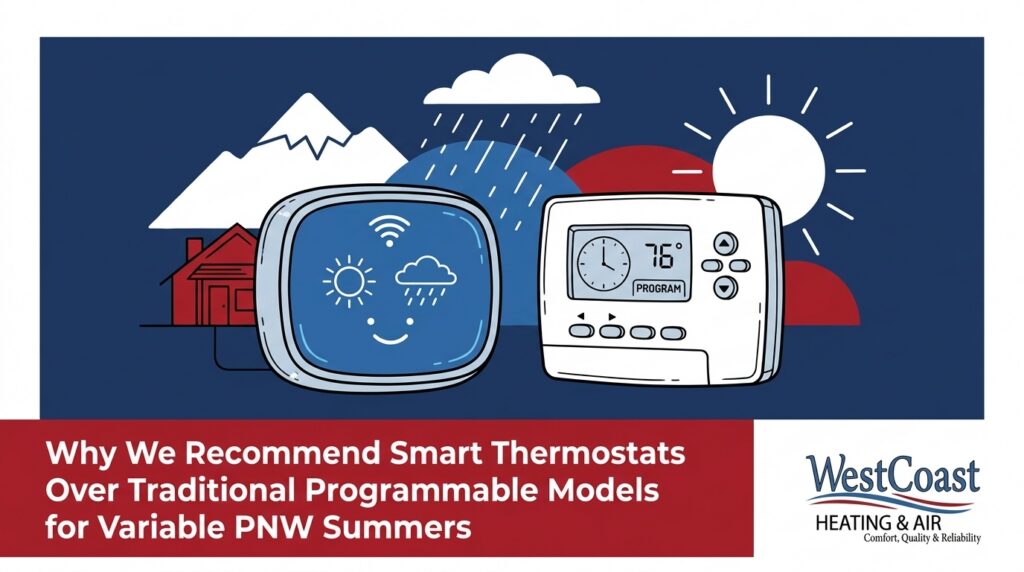
When evaluating your options for managing Puyallup WA summers, a direct comparison reveals exactly where standard models fall short. The difference comes down to proactive intelligence versus reactive programming. A traditional unit is essentially a digital clock wired to a switch, while a smart thermostat functions as a dedicated environmental control computer for your home.
| Feature | Traditional Programmable Thermostat | Weather-Integrated Smart Thermostat |
|---|---|---|
| Reaction Time | Reactive: Waits until the indoor temperature exceeds the set limit, or the clock hits a specific hour. | Proactive: Anticipates heat spikes using local weather forecasts and begins pre-cooling early. |
| Data Inputs | Static: Relies entirely on manual user input and a basic internal clock. | Dynamic: Utilizes Wi-Fi weather APIs, indoor humidity sensors, and mobile geofencing. |
| User Control | Manual: Requires physical interaction at the wall unit to override schedules or make adjustments. | Remote: Allows comprehensive control, scheduling, and monitoring via smartphone apps from anywhere. |
| Cooling Efficiency | Fixed: Uses rigid daytime setbacks that often result in massive energy spikes during “catch-up” periods. | Algorithmic: Continuously adjusts cycle lengths and start times to optimize compressor efficiency and reduce wear. |
The stark contrast in efficiency is why rigid setbacks are no longer the recommended standard. When your system has to fight against a fully overheated house, it consumes significantly more power. The dynamic adjustments made by smart algorithms ensure your equipment runs in its most efficient operating window, protecting the hardware while maintaining consistent comfort.

Understanding Heat Retention in Puget Sound Homes
To fully grasp why pre-cooling is so vital, we have to look at how homes in our region are actually constructed. Historically, many older homes in Western Washington were built with a heavy focus on heat retention to combat long, damp winters. They often feature architecture designed to capture solar gain and lack the deep cooling insulation found in Sunbelt states. Furthermore, many neighborhoods lack the strategic, mature shade trees necessary to block harsh afternoon sunlight.
This architectural history leads to a pronounced “thermal mass” effect. Thermal mass refers to the ability of heavy materials—like drywall, hardwood floors, structural framing, and even your large furniture—to absorb and store heat energy. During a Puyallup WA summer afternoon, the sun beats down on your home, and that heat transfers through the envelope. If the air conditioning is off, the physical structure of your house absorbs that thermal energy. Once a PNW home gets hot, it traps that heat, radiating it back into the living spaces well into the evening, long after the sun has gone down.
Pre-cooling directly combats the thermal mass effect. By introducing cool air into the home before the peak afternoon heat arrives, the smart thermostat prevents the walls and floors from absorbing that thermal energy in the first place. You are cooling the structure, not just the air. As local experts at WestCoast Heating & Air, we understand how Puget Sound weather patterns interact with regional architecture. We know that standard schedules fail because they allow the thermal mass to overheat. For homeowners looking for the best HVAC setup for Western Washington, combining a high-efficiency heat pump or air conditioner with a weather-aware smart thermostat is the most effective way to manage this structural heat retention.
Dynamic Cooling for the Back-to-School Transition
Late summer introduces a specific lifestyle challenge that standard programmable thermostats handle poorly: the back-to-school transition. Throughout July and early August, your home is likely occupied during the day. However, when the transition hits, houses are suddenly left empty during the peak heating hours of the afternoon. Leaving a traditional programmable thermostat on its “summer vacation” schedule means you are paying to aggressively cool an empty house.
Conversely, manually setting a massive daytime setback to save money leads right back to the catch-up problem when the family returns at 4:00 PM. Smart thermostats solve this dilemma flawlessly through geofencing and motion sensors. Geofencing utilizes the location services on your family’s smartphones to create a virtual perimeter around your property. When the last phone leaves the boundary, the thermostat automatically enters an energy-saving away mode. When the first phone crosses back into the boundary on the way home, the system initiates the cooling cycle so the house is comfortable the moment you walk through the door.
This technology also settles the long-standing debate over turning off the AC when leaving home. Completely powering down the system is highly inefficient because of the thermal mass effect we discussed earlier. Smart models manage this efficiently by allowing the temperature to drift up slightly—saving energy—while still running minimal cycles to prevent the structure from completely overheating. They strike the perfect balance between conservation and comfort during those unpredictable August heat spikes and back-to-school schedule changes.
Verified Efficiency and Reducing Your Cooling Workload
Upgrading your control system isn’t just about convenience; it is a measurable investment in the longevity of your equipment. Data from ENERGY STAR and the U.S. Department of Energy consistently verifies that smart thermostats provide superior cooling efficiency through their advanced algorithms. By replacing static timers with dynamic, responsive controls, you actively reduce the total workload placed on your air conditioner or heat pump.
Reducing the “catch-up” strain is critical for your compressor. The compressor is the heart of your cooling system, and forcing it to run at maximum capacity for hours on end during the hottest part of the day accelerates mechanical wear and tear. Pre-cooling allows the compressor to operate in shorter, more manageable cycles during milder morning or early afternoon hours. This proactive approach extends the lifespan of the entire HVAC system. One local customer recently contacted us for a non-urgent issue requiring diagnosis; we scheduled an appointment within a few days, thoroughly diagnosed the problem, fixed the immediate needs, and established a proactive plan for future spring maintenance. Pairing that level of proactive mechanical care with an intelligent smart thermostat guarantees your system operates with minimal strain.
Additionally, modernizing your controls often qualifies you for various incentives. While programs change frequently, generic energy rebates, federal tax credits, or local utility incentive programs may apply to qualifying smart thermostat and high-efficiency heat pump upgrades. We always advise readers to verify current programs locally with their utility provider. Beyond hardware upgrades, taking steps to reduce cooling costs—such as utilizing thermal curtains, sealing ductwork, and keeping up with annual maintenance—works hand-in-hand with your new smart thermostat to deliver verified efficiency during the late summer heat.
Upgrade Your Cooling Strategy Before the Next Heat Wave
Surviving a variable PNW summer requires adaptability, not just a rigid timer on the wall. The unpredictable nature of Puyallup WA weather means that relying on a static schedule will inevitably leave you sweating through an unexpected afternoon heat spike. By upgrading to a weather-responsive smart thermostat, you empower your HVAC system to anticipate the heat, pre-cool your home’s thermal mass, and operate at peak efficiency.
We understand that navigating new technology can feel overwhelming, but we want to reassure you that upgrading your thermostat is a straightforward, seamless process when handled by local experts. The transition requires minimal disruption to your home and immediately modernizes how you manage your indoor climate. When homeowners ask Why We Recommend Smart Thermostats Over Traditional Programmable Models for Variable PNW Summers, the answer is simple: your comfort should adapt to the weather, not the clock. We encourage you to explore your HVAC upgrade options today to ensure consistent, efficient comfort before the next heat wave hits.
Frequently Asked Questions
Are smart thermostats worth the upgrade for Washington homes?
Yes, they are highly beneficial for managing our unique regional climate. Washington homes often experience rapid temperature shifts and lack deep cooling insulation, making proactive climate control essential. A smart thermostat adjusts to these sudden changes automatically, improving comfort and reducing energy waste compared to standard models.
What is the main difference between a programmable and smart thermostat?
The primary difference lies in how they gather data to make decisions. A programmable thermostat only follows a strict time-based schedule entered manually by the user. A smart thermostat connects to Wi-Fi, monitors local weather forecasts, tracks your location via your smartphone, and dynamically adjusts the temperature based on real-time conditions.
Can smart thermostats predict the weather to adjust cooling?
Yes, they actively pull forecast data from local weather APIs. By continuously monitoring upcoming temperature spikes and humidity levels in your specific zip code, the thermostat can adjust its cooling cycles preemptively, ensuring your home stays ahead of sudden afternoon heat waves.
Why is my house hot in the afternoon even with a programmable thermostat?
This happens because rigid schedules often utilize daytime setbacks that wait too long to initiate cooling. If your thermostat is programmed to turn on at 5:00 PM, the physical structure of your house has already absorbed hours of afternoon heat. The system then struggles to overcome that accumulated thermal mass, leaving the house uncomfortably warm.
What is thermostat pre-cooling and how does it save energy?
Pre-cooling is the process of lowering the indoor temperature before the hottest part of the day arrives. It saves energy by running the air conditioner during milder hours when the equipment operates more efficiently. This prevents the system from having to run at maximum capacity during peak afternoon heat, reducing overall compressor strain.
Do smart thermostats work with older HVAC systems in the PNW?
In most cases, yes, smart thermostats are compatible with existing furnaces, air conditioners, and heat pumps. However, older systems may require the installation of a “C-wire” (common wire) to provide continuous power to the Wi-Fi unit. A professional technician can easily assess your current wiring and integrate the new smart control seamlessly.