
How Tacoma Public Utilities Incentives for Efficiency Can Lower Your Energy Bills
Tacoma Public Utilities incentives for efficiency are available right now to help homeowners, renters, and landlords make meaningful upgrades — without paying full price out of pocket. Whether you’re looking to replace an aging heating system, seal up drafts, or cut water waste, TPU offers several ways to make those residential projects more affordable.
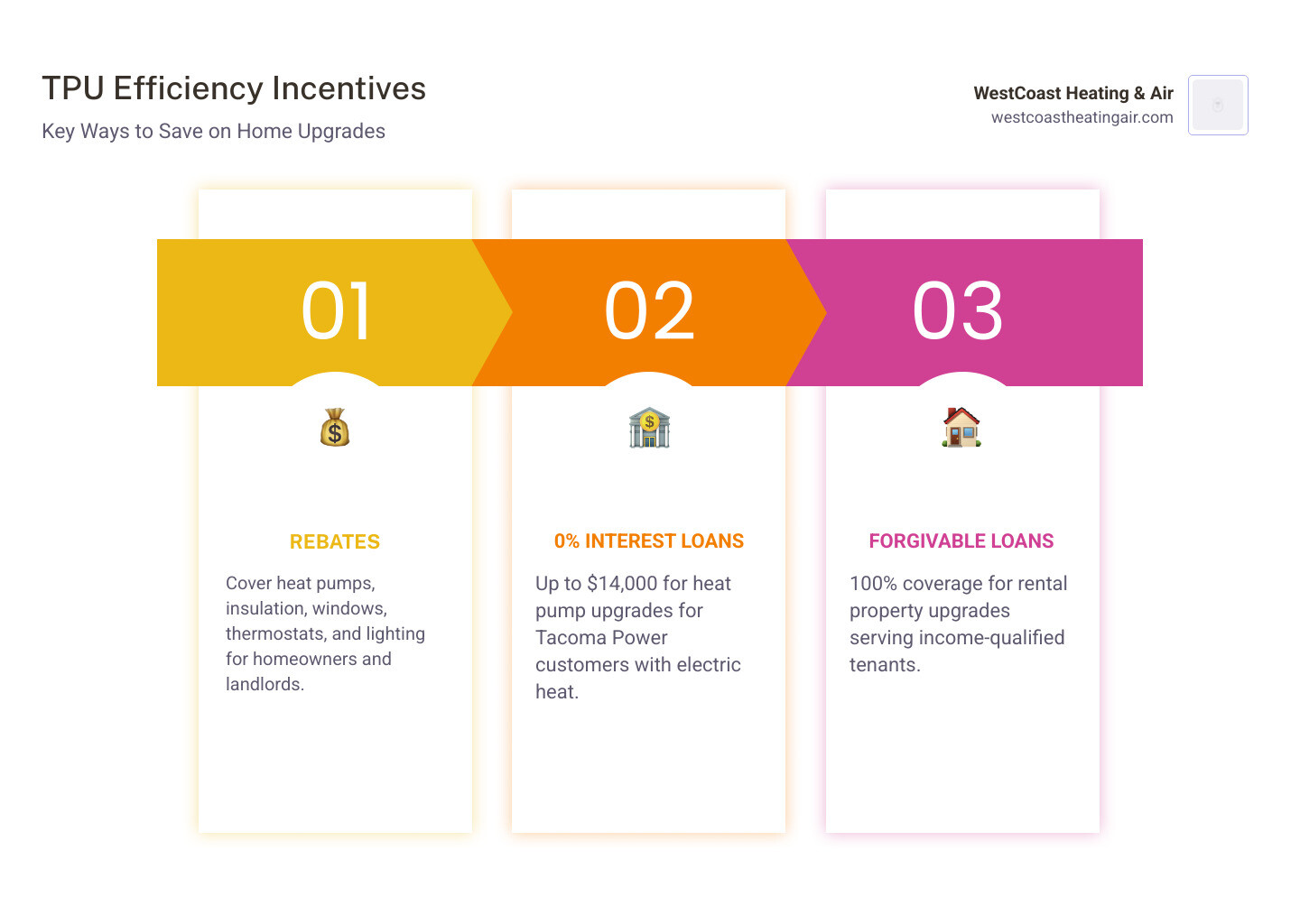
Here’s a quick look at what’s available:
| Incentive Type | What It Covers | Who It’s For |
|---|---|---|
| Rebates | Heat pumps, insulation, windows, thermostats, lighting | Homeowners and landlords |
| 0% Interest Loans | Heat pump upgrades (up to $14,000) | Tacoma Power customers with electric heat |
| Deferred Loans | Weatherization upgrades | Income-qualified households |
| Bill Credits | EV charger installation | Residential customers |
| Forgivable Loans / Split Grant | Full rental property upgrades | Landlords with income-qualified tenants |
The range of upgrades that qualify is broader than most people realize — from central heat pumps and attic insulation all the way to smart irrigation systems and high-efficiency showerheads. And for rental property owners serving lower-income tenants, there are options that can cover 100% of project installation costs.
That’s real money back in your pocket, before you even factor in the long-term savings on your monthly utility bills.
I’m Michael Smith, owner of WestCoast Heating & Air, and after 30 years at Boeing followed by hands-on work in the residential HVAC industry across the Pacific Northwest, I’ve helped many local homeowners navigate Tacoma Public Utilities incentives for efficiency to find the right system upgrades that make financial sense. In this guide, I’ll walk you through everything you need to know — from which programs you likely qualify for to how to avoid the common mistakes that can slow down or disqualify your application.
Tacoma Public Utilities Incentives for Efficiency: What Homeowners Can Apply For
TPU offers a wider mix of residential incentives than many people expect. Instead of one generic rebate, there are several program types designed around the upgrade, the home, and in some cases the household income.
For Tacoma-area homeowners, these incentives can include:
- Rebates for qualifying energy-efficient equipment and home improvements
- 0% interest loans for certain heat pump upgrades
- Deferred loans for income-qualified weatherization work
- Utility bill credits for some home electrification-related upgrades, such as EV charging
- Discounts or program pathways tied to approved participating contractors
Eligible improvements commonly include:
- Central heat pumps
- Ductless heat pumps
- Hybrid water heaters
- Insulation
- Window replacement
- Duct sealing
- Duct insulation
- Smart thermostats
- Thermostats for electric wall or baseboard heat
- LED lighting
- Smart irrigation
- EV charger installation
- Water-saving showerheads and similar conservation measures
In plain English: TPU is not just helping with “big residential HVAC stuff.” It also supports the smaller fixes that chip away at waste month after month.
Who these Tacoma Public Utilities incentives for efficiency are designed for
Most TPU residential efficiency programs are aimed at:
- Tacoma Power customers
- Homes inside TPU’s service territory
- Households using electric heat for certain equipment incentives
- Owner-occupied homes
- Some rental homes and small rental properties
- Income-qualified households for specific loan or weatherization options
For loan-based programs, payment history may matter. For income-qualified programs, TPU may ask for household income documentation. For rental-property incentives, tenant income and property size can also affect eligibility.
If there is one rule we always tell homeowners to remember, it is this: eligibility is program-specific. A home may qualify for one TPU incentive but not another.
The main types of TPU efficiency incentives available
Here is how the main TPU incentive categories generally work:
- Rebates: These reduce your out-of-pocket cost after installing qualifying equipment or completing approved upgrades.
- 0% interest loans: These spread payments over time for eligible projects, especially heat pump upgrades.
- Deferred loans: These help income-qualified households complete efficiency improvements now and repay later under program rules.
- Bill credits: These appear directly on your utility account after an approved qualifying installation.
- Contractor-linked incentives: Some TPU programs require or strongly prefer participating contractors to protect quality and eligibility.
That variety is helpful because homeowners do not all start from the same place. Some need the biggest monthly savings. Others need help with upfront affordability. Some just want to stop heating the attic and the outdoors at the same time.
Which home improvements commonly qualify
The upgrades TPU most often supports fall into three buckets:
- Heating and hot water
- Central heat pumps
- Ductless mini-splits
- Hybrid water heaters
- Building shell improvements
- Attic, floor, or wall insulation
- Windows
- Duct sealing
- Duct insulation
- Controls, water, and efficiency add-ons
- Smart thermostats
- Electric wall or baseboard thermostats
- LED lighting
- Smart irrigation
- EV charger credits
- Showerheads and water-saving kits
For many homes in Tacoma, the best savings come from combining more than one category. A heat pump works even better in a home with decent insulation and tighter ducts.
Heat Pump Rebates and Loans: The Most Valuable TPU Upgrades for Many Homes
If your home still relies on electric resistance heat, a heat pump is often the single most impactful efficiency upgrade available. TPU notes that heat pumps can reduce electricity use for heating by about 25% to 50% compared with electric resistance systems. That is a big jump in efficiency without sacrificing comfort.
For a deeper look at local upgrade planning, see our Affordable Heat Pump Installation Tacoma Guide and our article on the Advantages of Upgrading to a High-Efficiency Heat Pump.
Tacoma Public Utilities incentives for efficiency on central heat pumps
A central heat pump is a ducted system that heats and cools the whole home through existing ductwork. It is usually a strong fit when:
- The house already has ducts in good condition
- You want one system for whole-home comfort
- You are replacing electric forced-air heating
- You want both heating and air conditioning from the same system
TPU residential programs commonly focus on qualifying replacements rather than brand-new new-construction scenarios. In other words, incentive programs are generally designed to improve existing homes, not subsidize a brand-new house build.
For central heat pump projects, homeowners may need to follow TPU equipment standards, use approved installation pathways, and complete paperwork and possible inspections before the incentive is finalized.
Ductless heat pumps vs. central heat pumps: what’s the difference?
A ductless heat pump, often called a mini-split, uses one or more indoor heads connected to an outdoor unit. It does not require traditional ductwork. That makes it especially useful for homes with:
- Electric wall heaters
- Baseboard heat
- Room additions
- Converted garages
- Uneven temperatures between rooms
- No existing ducts
A central system, by contrast, is better for homes that already have a duct network and want whole-home distribution from one indoor air handler.
Here is a simple comparison:
| Feature | Central Heat Pump | Ductless Heat Pump |
|---|---|---|
| Uses ductwork | Yes | No |
| Best for | Whole-home heating and cooling | Zoned comfort or homes without ducts |
| Common replacement | Electric forced-air furnace | Baseboard, wall heat, or spot heating |
| Comfort style | One connected system | Room-by-room control |
| Installation impact | Best when ducts are usable | Great for homes without ducts |
Neither is automatically “better.” The better option is the one that fits your home’s layout, existing equipment, and comfort goals.
If you want to compare options in more detail, our ductless heating guide for Tacoma and our article on the best high-efficiency heating options for your home can help.
What rebates, loans, and requirements apply to heat pump projects
For many Tacoma homeowners, heat pump incentives are the headline item because they can combine immediate and long-term value:
- TPU offers rebates for qualifying heat pump projects
- Tacoma Power offers 0% interest loans for heat pump upgrades
- Those loans can cover up to $14,000 of project cost
- Eligibility often depends on being a Tacoma Power customer with electric heat
- Equipment must meet TPU program requirements
- Installation may need to be completed by a participating or otherwise qualifying contractor
- Documentation, permit records, and post-install verification may be required
A few important notes:
- Do not assume every heat pump qualifies.
- Do not start work before required approvals if the program says pre-approval is needed.
- Do not assume a replacement in new construction or a major addition will be eligible.
- Do not throw away paperwork. Utility programs love paperwork almost as much as heat pumps love Tacoma’s climate.
At WestCoast Heating & Air, we help homeowners match the right system to the home’s layout first, then line that up with TPU rules so the project has the best chance of qualifying cleanly.
Other Residential TPU Incentives That Can Cut Energy and Water Waste
Heat pumps get a lot of attention, but they are not the only worthwhile TPU-supported improvements. Some homes lose savings through a collection of smaller problems: weak insulation, leaky ducts, old thermostats, silent plumbing leaks, or wasteful watering habits.
Weatherization and shell improvements that may qualify
Weatherization upgrades help your home hold onto conditioned air. That means your home HVAC system does less work to keep you comfortable.
TPU commonly supports improvements such as:
- Attic insulation
- Floor insulation
- Wall insulation
- Window replacement
- Duct sealing
- Duct insulation
These upgrades can improve:
- Comfort
- Indoor temperature consistency
- Draft reduction
- Residential HVAC performance
- Overall energy use
TPU’s general efficiency guidance also notes attic insulation should be substantial, with recommended attic insulation thickness often around 18 to 20 inches. That does not mean every home needs the same solution, but it shows how often under-insulated attics are still a problem.
Smart home and water-saving upgrades homeowners should not overlook
Not every useful TPU incentive involves a major construction project. Depending on the program, homeowners may also find support for:
- Smart thermostats
- Thermostats for electric wall or baseboard heaters
- LED lighting
- EV charger bill credits
- Smart irrigation tools
- Efficient showerheads
- Free or low-cost water-saving kits
These upgrades are easy to underestimate because they are smaller. But better controls and lower water waste can produce steady savings, especially when combined.
For example:
- Smart thermostats can improve control and reduce unnecessary heating
- LED lighting lowers electric use and lasts longer than older bulbs
- Smart irrigation reduces overwatering
- Efficient showerheads cut hot water use as well as water use
- EV charger credits can make electrification more practical for homeowners
Why smaller fixes can still deliver meaningful monthly savings
This is where the numbers get surprisingly interesting.
According to TPU-related efficiency guidance:
- Replacing an older toilet with a high-efficiency model can save up to 2,400 gallons of water per month
- That can reduce annual water costs by about $78
- Fixing common household water leaks can reduce a water bill by around 10% each year
- A silent toilet leak can waste roughly 50 to 500 gallons per day
- In some cases, that kind of leak can add around $50 per month in water and sewer charges
- Proper irrigation design for a 1,000-square-foot lawn can cut monthly watering costs from about $13.82 to $6.41
- Energy-efficient washing machines may use about 10 gallons per load versus about 40 gallons for older models
So yes, a hidden toilet leak can quietly cost you real money while acting innocent. Homes are sneaky like that.
Income-Qualified Rental Property Incentives for Homes With Eligible Tenants
Although this guide focuses on homes, rental housing is part of TPU’s residential efficiency picture too. TPU offers a specialized program for smaller rental properties serving income-qualified tenants.
Who qualifies for income-qualified rental property incentives
This program is generally designed for:
- Rental properties with four or fewer units
- Properties in Tacoma Power’s service area
- Tenants whose household income is at or below 80% of Area Median Income
- Landlords willing to follow program rules tied to rent and participation
This matters because the program is built not just around energy savings, but around preserving affordability for tenants.
What upgrades are covered for qualifying rental properties
Eligible rental-property improvements can include:
- Insulation
- Central heat pumps
- Ductless heat pumps
- Duct sealing
- Window replacement
- Hybrid water heaters
- Smart thermostats
- Certain necessary repairs required to make the efficiency work possible
That last point is important. In some cases, TPU may help address related repair needs if those repairs are necessary to complete the approved energy upgrade.
How the forgivable loan and split grant/loan options work
TPU’s income-qualified rental incentives stand out because they can cover 100% of project installation costs through two main pathways.
Option 1: Forgivable loan
- Covers the full project amount
- Loan is forgiven over a five-year period
- Landlord must keep annual rent increases below 6% during that five-year term
- If the property is sold before forgiveness is complete, the prorated remaining amount becomes due
Option 2: Split grant and loan
- 30% of the project is provided as a grant
- 70% is provided as a 0% interest loan
- The loan term is seven years
- This option does not require a credit check based on the research provided
These are unusually strong incentives because they address the biggest barrier landlords often face: upfront capital.
The rental property application process step by step
For qualifying small rental properties, the process generally looks like this:
- Contact TPU to begin tenant qualification.
- Verify that tenant income meets the program limit.
- Schedule an energy audit to define the recommended scope of work.
- Get bids from at least two Tacoma Power participating contractors.
- Submit the application and bids for utility review.
- Wait for a formal notice to proceed before starting work.
- Complete installation and required permits.
- Finish the post-project inspection.
- Provide annual rent reporting if required under the loan terms.
This is one of those programs where following the sequence matters. Starting too early can create problems.
How to Apply, Combine Programs, and Avoid Common Eligibility Mistakes
Even strong incentives can fall apart if the paperwork or timing goes sideways. The good news is that most TPU application issues are preventable.
How to apply for Tacoma Public Utilities incentives for efficiency without delays
A simple application roadmap looks like this:
- Choose the upgrade you want to explore.
- Review the TPU program rules for that specific improvement.
- Confirm that your home, equipment type, and utility account qualify.
- Gather required documents, such as bids, invoices, and account information.
- Use a participating contractor when the program requires it.
- Submit forms on time and include all requested backup documentation.
- Wait for any required approval or notice to proceed.
- Complete the installation, permits, and final verification.
When homeowners call us early, before equipment is selected and before work begins, the process is almost always smoother.
Restrictions that can disqualify a project
Some of the most common issues that can derail a TPU incentive include:
- New construction when the program only covers existing homes
- Using the wrong contractor
- Installing non-qualifying equipment
- Missing application deadlines
- Starting work before required pre-approval
- Being outside TPU service territory
- Missing permits or incomplete inspection records
This is why we encourage homeowners to treat incentive rules as part of the project, not an afterthought.
How to combine TPU incentives with federal tax credits and other savings programs
In many cases, TPU incentives may be combined with federal tax credits, which can make a major upgrade much more manageable overall.
A practical strategy is usually:
- Confirm the local utility incentive first.
- Keep all invoices, AHRI or product documentation, and permit records.
- Apply for the TPU rebate or loan based on local program rules.
- Use the remaining eligible amount and equipment documentation when preparing for federal tax-credit filing.
If you are exploring a heat pump, start with our guide to Inflation Reduction Act Benefits for Washington Homeowners. It explains how federal incentives may stack with local utility programs.
As always, tax credits are subject to IRS rules, so homeowners should keep records and consult a tax professional when needed.
Frequently Asked Questions About Tacoma Public Utilities Incentives for Efficiency
What is the best TPU incentive to start with if your home has electric resistance heat?
For many homeowners, the best place to start is a heat pump evaluation. If you currently heat with electric baseboards, wall units, or electric forced air, a heat pump often delivers the biggest efficiency improvement. TPU’s heat pump rebates and 0% loan options can make that upgrade especially attractive.
If your home does not have ducts, a ductless heat pump may be the logical starting point. If it has usable ducts and you want whole-home comfort, a central heat pump may be the better fit.
Do renters or landlords need a participating contractor for TPU incentive programs?
Often, yes. Many TPU programs either require or strongly favor participating contractors. This helps ensure the equipment, installation method, and paperwork all align with program rules. It is especially important for rental-property incentive programs, where bids from participating contractors may be required before TPU issues approval.
Who should homeowners contact next for help with Tacoma Public Utilities incentives for efficiency?
For TPU program questions, the most direct next step is to contact a TPU energy advisor through Tacoma Public Utilities’ official rebates resources.
That is the best resource for confirming current eligibility, paperwork requirements, and any recent program updates.
If you are planning a heat pump or ductless upgrade and want help understanding the residential HVAC side of the decision, we can help you sort through the equipment options, home layout considerations, and financing path before you move forward.
Conclusion
TPU offers real opportunities for Tacoma homeowners and small rental-property owners to improve comfort, reduce waste, and lower utility bills. The best-fit incentive depends on your home and goals:
- Heat pump rebates and 0% loans for major electric-heating upgrades
- Weatherization help for insulation, ducts, and windows
- Water-saving and smart-control incentives for smaller monthly savings
- Specialized rental-property options for landlords serving income-qualified tenants
If you want to move forward, here is a good next-step checklist:
- Confirm you are in Tacoma Power’s service area
- Identify the upgrade you want to prioritize
- Check whether pre-approval is required
- Ask whether a participating contractor is required
- Save all bids, invoices, permits, and product documents
- Review TPU’s official rebates resources for current program details
And if you are considering a heat pump or ductless system for your home, our team at WestCoast Heating & Air can help you evaluate the right system design, explain likely incentive pathways, and walk you through available financing options.
The short version: if TPU is willing to help pay for a smarter, more efficient home, it is worth taking that help.