
Why Improperly Sized HVAC Systems Are Quietly Destroying Your Equipment
How improperly sized systems shorten equipment life comes down to one simple idea: your HVAC works best when it’s matched to your home — not too big, not too small.
Here’s a quick breakdown:
| Sizing Problem | What Happens | Result |
|---|---|---|
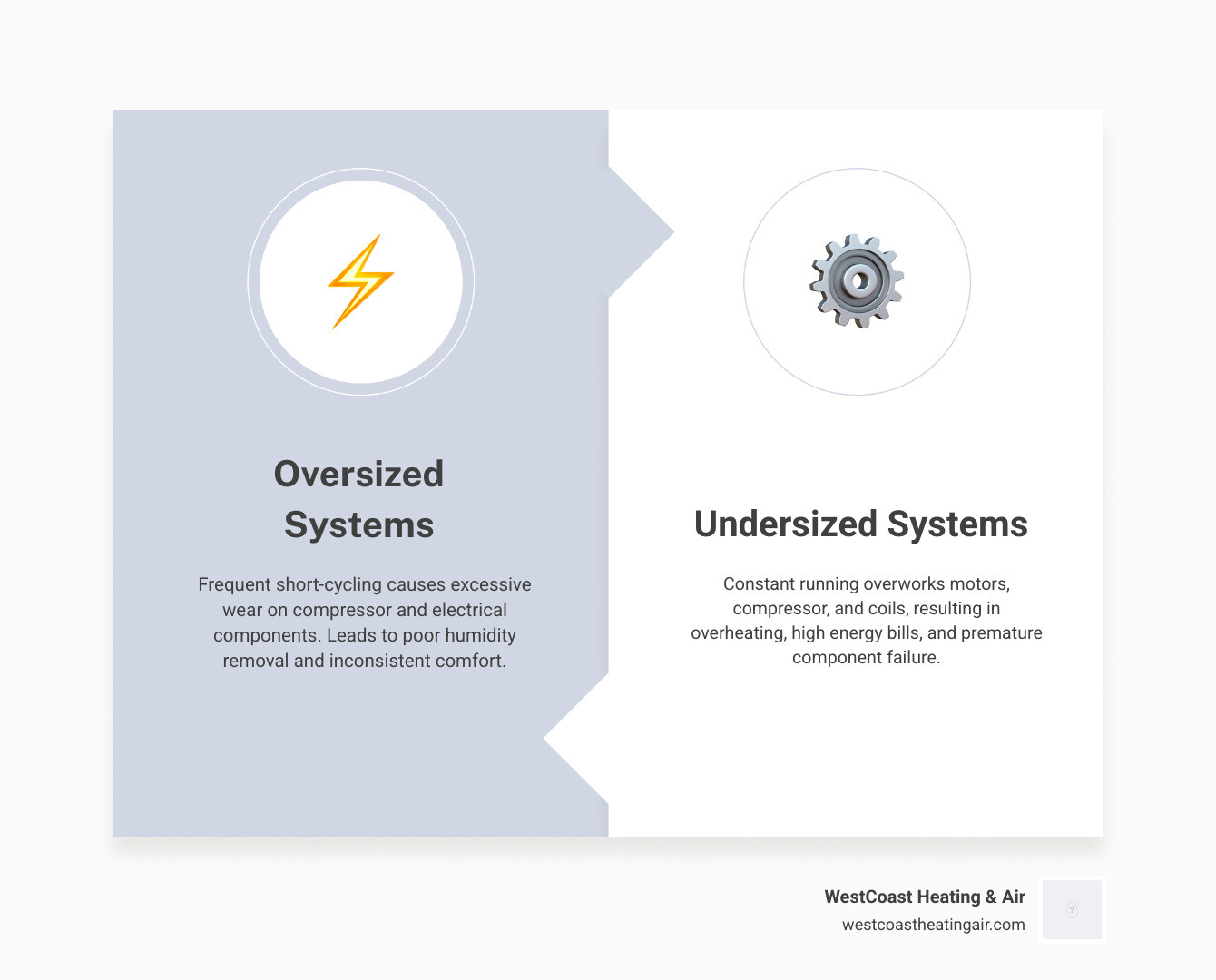
| Oversized system | Short cycles on and off constantly | Compressor and electrical components wear out fast |
| Undersized system | Runs nonstop trying to keep up | Motors, compressors, and coils overheat and fail early |
| Either extreme | Components under abnormal stress | Lifespan cut from 15-20 years down to 8-10 years |
Most homeowners assume that HVAC lifespan is mostly about maintenance — and yes, regular tune-ups matter. But sizing is just as critical, and it’s a mistake that gets made far more often than you’d think. According to industry data, over 60% of residential HVAC systems are incorrectly sized, and the damage that causes builds quietly over months and years before it becomes an expensive problem.
An oversized system might cool your home fast, but it never runs long enough to do its full job — and all those rapid start-stop cycles put extreme stress on the most expensive parts inside your equipment. An undersized system never gets a break, running flat-out for hours and burning through components from sheer overwork. Neither scenario ends well for your wallet or your comfort.
If you live in the Puyallup area, this is especially relevant. The Pacific Northwest’s mix of damp winters, warm summers, and unpredictable shoulder seasons means your HVAC system needs to be precisely matched to your home’s actual load — not a rough estimate based on square footage alone.
I’m Michael Smith, owner of WestCoast Heating & Air in Puyallup, and after decades of hands-on problem-solving — first at Boeing and now in residential HVAC — I’ve seen how improperly sized systems shorten equipment life and leave homeowners stuck with repair bills that should never have happened. In this guide, I’ll walk you through exactly what goes wrong, which components take the hardest hit, and what you can do to make sure your system is built to last.
What Does Improper Sizing Mean for Your Home?

When we talk about HVAC “size,” we aren’t talking about the physical dimensions of the unit sitting in your backyard. We are talking about its capacity to move heat. This is measured in BTUs (British Thermal Units). Understanding what is BTU measurement and why it matters is the first step in protecting your investment.
In April 2026, as we look at modern home standards, the old “rule of thumb” of simply matching BTU for house size based on square footage is officially obsolete. A 2,000-square-foot home in Puyallup has vastly different needs than the same sized home in University Place if one has vaulted ceilings, southern-facing floor-to-ceiling windows, or superior spray-foam insulation.
Proper sizing requires a Manual J calculation. This is a detailed professional audit that accounts for:
- Local climate zones (the specific humidity and temperature swings of the Puget Sound).
- Insulation levels in your attic and walls.
- The orientation of your home relative to the sun.
- The number of occupants and heat-generating appliances.
If a contractor walks into your home and gives you a quote based only on your square footage without looking at your windows or insulation, they are guessing. And in the HVAC world, a guess is a recipe for a system that dies years before its time.
How improperly sized systems shorten equipment life: The Oversized Unit
It sounds logical: “If a 3-ton unit is good, a 4-ton unit must be better, right? It’ll cool the house faster!” In reality, why an oversized air conditioner is problematic is one of the most common hard lessons homeowners learn.
An oversized system is like a sprinter trying to run a marathon by sprinting for 10 seconds and then stopping for a minute. It reaches the temperature set on your thermostat so quickly that it never completes a full, healthy cycle. This leads to terrible humidity control, leaving your home feeling “cool but clammy.” More importantly, it creates massive mechanical stress.
How improperly sized systems shorten equipment life through short cycling
Short cycling is the “silent killer” of HVAC equipment. Every time your system starts up, it requires a massive “startup current”—roughly 6 to 10 times the electricity it uses while running normally.
In a properly sized system, you might see 6 to 8 starts per day. In an oversized, short-cycling system, that number can skyrocket to 30 or 50 starts daily. That is a 400% to 600% increase in wear events. If you’ve ever asked yourself, “Is my AC running efficiently?” and noticed it turns on and off every few minutes, your compressor is likely taking a beating. This constant electrical hammering wears out contactors and puts immense stress on capacitors, leading to premature failure of the most expensive parts in the cabinet.
Vulnerable components in oversized systems
Oversized systems don’t just hurt the AC; they kill furnaces too. When a furnace is too large for the ductwork, it can overheat rapidly. This leads to the heat exchanger expanding and contracting too violently, which eventually causes cracks. Gas heater safety depends on an intact heat exchanger; a cracked one is a major carbon monoxide risk.
Furthermore, in modern inverter-based systems, oversizing can prevent the unit from ever reaching its “oil return mode.” These systems need to run at certain speeds to ensure oil circulates and lubricates the compressor. If it only ever “ramps down” because it’s too big for the space, the compressor can literally starve for oil and seize up.
The Undersized Struggle: Why Constant Running is a Killer
On the flip side, we have undersized systems. This usually happens when a home has been remodeled or if a contractor tried to save money by installing a unit with lower capacity. If you find yourself thinking, “My heat pump isn’t warm enough,” you might be dealing with a capacity deficit.
An undersized unit has to run continuously to try and reach the thermostat setting. On a hot July day in Sumner or Spanaway, an undersized AC will run prompt without a break. This isn’t just a way to increase cooling costs; it’s a death sentence for the fan motors and compressor.
How improperly sized systems shorten equipment life by overworking components
When a system runs without stopping, it enters a state of thermal overload. Components that are designed to have “rest cycles” to cool down stay hot.
| Feature | Properly Sized System | Undersized System |
|---|---|---|
| Daily Runtime | 8–12 hours (in cycles) | 18–prompt (continuous) |
| Component Rest | Regular intervals to cool | Little to none |
| Lubrication | Balanced oil flow | Potential friction from heat |
| Coil Condition | Clean and dry between cycles | Prone to freezing/ice buildup |
Continuous operation leads to fan motor burnout and compressor overheating. Because the system is always “chasing” the temperature, the evaporator coil can drop below freezing, leading to a block of ice that further chokes the system. This stress frequently leads to refrigerant leaks as copper lines vibrate and weaken under the constant pressure. If you need to identify heat pump problems, look for a unit that never seems to take a breath.
Financial and Warranty Impacts of Incorrect Sizing
The most painful part of how improperly sized systems shorten equipment life is the financial hit. A standard, well-sized HVAC system should last 15 to 20 years. When sizing is wrong, that lifespan is often cut in half, forcing a premature upgrade in just 8 to 10 years.
There is also a hidden trap: The Manufacturer’s Warranty.
Most major HVAC brands require that the system be installed according to specific manufacturer specifications. This includes having a documented load calculation (Manual J) and an AHRI certificate that proves the indoor and outdoor units are a matched, properly sized set. If your system fails at year seven due to a burnt-out compressor caused by chronic short cycling from oversizing, the manufacturer may deny your warranty claim. They view improper sizing as an “installation fault,” not a factory defect.
This is why we often recommend replacing the AC and furnace at the same time. It ensures the entire “ecosystem” of your home’s air is matched and protected by a valid warranty.
Steps to Ensure Your Puyallup Home Has the Right Fit
So, how do you avoid this nightmare? It starts with the data. When you are preparing for an HVAC replacement, your contractor should perform two critical steps:
- Manual J Audit: This determines exactly how much heat your home loses in the winter and gains in the summer.
- Manual S Selection: This ensures the equipment selected actually matches that load based on local Puyallup design temperatures (not just the “nominal” rating on the box).
We also look at your ductwork. You can have the perfect “sized” unit, but if your ducts are too small to handle the airflow, the system will still behave like it’s improperly sized. This is where air balancing comes in, ensuring every room in your Steilacoom or Tacoma home gets the exact amount of air it needs without stressing the blower motor.
Frequently Asked Questions
Can an improperly sized system void my manufacturer warranty?
Yes. Manufacturers like Daikin, American Standard, and Mitsubishi Electric expect their equipment to be installed within specific parameters. If a system fails because it was grossly oversized (causing short cycling) or undersized (causing constant running), and there is no AHRI documentation to prove a proper match, the manufacturer can—and often will—deny the claim. Professional heat pump maintenance can catch these issues, but it’s better to get the sizing right from day one.
How much longer does a correctly sized system last?
On average, a correctly sized system will last 5 to 10 years longer than an improperly sized one. While a mismatched unit might struggle to reach year 10, a perfectly fitted system can easily glide to year 20 with regular tune-ups. You’ll also face far fewer urgent repair calls during that lifespan.
What is the most common sign of an oversized system?
The most obvious sign is short cycling. If your AC or furnace turns on, blasts air for 5 to 8 minutes, and then shuts off—only to turn back on 10 minutes later—it is likely oversized. Another red flag is a “clammy” feeling in the summer; the unit is cooling the air but isn’t running long enough to remove moisture. This is why a furnace tune-up is so important; we can measure these cycles and tell you if your equipment is under too much stress.
Conclusion
At WestCoast Heating & Air, we don’t believe in “one size fits all.” Whether you are in Roy, SeaTac, or right here in Puyallup, your home deserves a customized system design that meets 2026 efficiency standards and respects the long-term health of your equipment.
Don’t let a “guess-timate” shorten your system’s life and drain your bank account. Our family-owned team brings over 20 years of local expertise to every installation, ensuring your home stays comfortable for the next two decades, not just the next two seasons.
Contact our residential heating and cooling company for a professional sizing assessment today and make sure your HVAC system is the perfect fit for your home.