
Why Knowing How Often Should You Service Your HVAC System Could Save You a Costly Breakdown
How often should you service your HVAC system is one of the most important questions a homeowner can ask — and the short answer is this:
| System Type | Recommended Service Frequency | Best Timing |
|---|---|---|
| Central Air Conditioner | Once per year | Spring (March-May) |
| Gas Furnace | Once per year | Fall (September-November) |
| Heat Pump | Twice per year | Spring & Fall |
| Ductless Mini-Split | Twice per year | Spring & Fall |
For most Puyallup homeowners, that means scheduling two professional tune-ups per year — one in spring before cooling season, and one in fall before heating season. At a minimum, every HVAC system should be professionally serviced at least once annually.
Here is why this matters: a well-tuned HVAC system can use 10-30% less energy than a neglected one. Skipping routine service does not just risk a breakdown — it quietly drives up your utility bills and shortens the life of a system that can cost thousands to replace.
Imagine your air conditioner stopping on the hottest day in July. A technician arrives and tells you the evaporator coil was completely clogged, refrigerant was low, and a capacitor was on the verge of failure — all things that a routine maintenance visit would have caught and corrected. That scenario plays out in homes across the Pacific Northwest every summer, and it is almost entirely preventable.
I’m Michael Smith, owner of WestCoast Heating & Air in Puyallup, and after three decades of hands-on problem-solving work — first at Boeing and now in the HVAC industry — I’ve seen how answering the question of how often should you service your HVAC system correctly can mean the difference between a system that lasts 20 years and one that fails in 10. In this guide, I’ll walk you through everything you need to know to keep your home comfortable and your system running efficiently year-round.
How Often Should You Service Your HVAC System for Peak Performance?
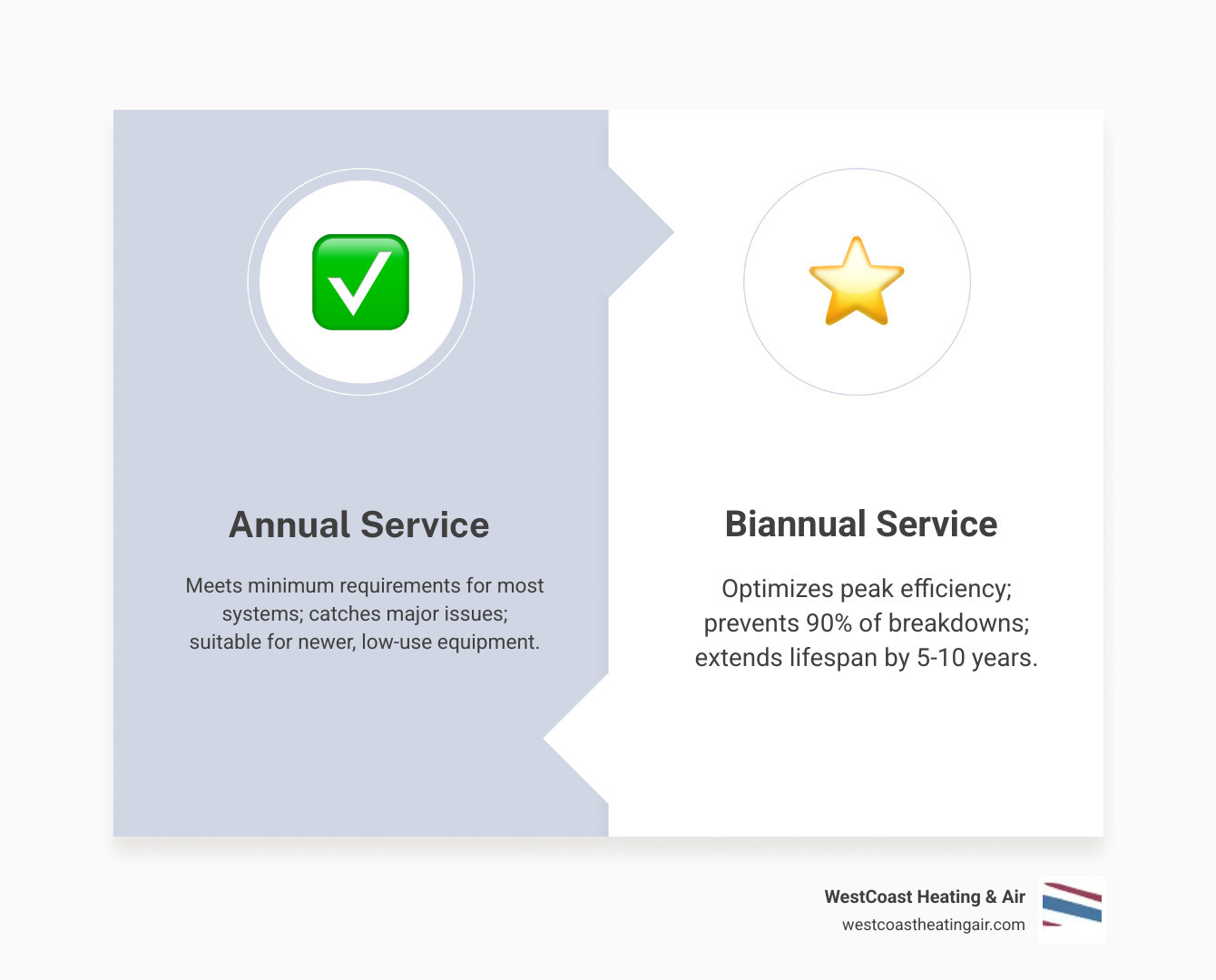
When we talk about peak performance, we aren’t just talking about the system turning on when you flip the switch. We are talking about efficiency, safety, and reliability. The “gold standard” in our industry is a biannual schedule. This means having a professional technician visit your home twice a year: once in the spring to prep your cooling system and once in the fall to ensure your heating system is ready for the Puget Sound winter.
You might wonder, “If my system is only a few years old, do I really need to worry about how often should you schedule an HVAC tune-up?” The answer is a resounding yes. Most HVAC manufacturers actually require proof of annual professional maintenance to keep your equipment warranty valid. If a major component like a compressor or heat exchanger fails and you haven’t had the unit serviced, the manufacturer may deny your claim.
Beyond the warranty, preventive care is about catching the “small stuff” before it becomes “big stuff.” A loose wire or a failing capacitor is a quick, inexpensive fix during a scheduled tune-up. If left alone, that same failing capacitor can cause your blower motor to burn out, leaving you with a much larger headache. By sticking to a regular schedule, you ensure your system operates at the high efficiency levels it was designed for, which keeps your monthly utility costs as low as possible.
How Often Should You Service Your HVAC System Based on Equipment Type?
Not every home in Tacoma or Puyallup uses the same setup, and different systems have different needs.
- Gas Furnaces: These require an annual safety check every fall. Because furnaces involve combustion and venting, a professional needs to inspect the heat exchanger for cracks and ensure there are no carbon monoxide leaks. You can learn more about how often should you get your furnace service to keep your family safe and warm.
- Air Conditioning: Standard central AC units need a spring “clean and check.” We focus on cleaning the outdoor condenser coils, which can improve cooling efficiency by up to 40%.
- Heat Pumps: Because heat pumps work year-round to both heat and cool your home, they work twice as hard as a furnace-only or AC-only system. We highly recommend heat pump maintenance services in Puyallup WA twice a year to handle the constant demand.
- Ductless Mini-Splits: These are incredibly efficient, but their small filters and indoor blowers can clog quickly with dust. Regular ductless heating maintenance in Puyallup WA ensures the indoor air handlers remain mold-free and the outdoor inverter runs smoothly.
Environmental Factors and How Often Should You Service Your HVAC System
In the Pacific Northwest, our environment plays a huge role in how hard your system has to work. If you live in an area like Orting or Sumner, you know that spring pollen from alder, cedar, and birch trees can coat everything in a yellow film. That same pollen gets sucked into your HVAC system.
Other factors that might require you to service your system more frequently include:
- Pets: Shedding hair and dander are the number one enemies of indoor coils and filters.
- Indoor Dust: High-traffic homes or those near construction zones accumulate debris faster.
- Usage Patterns: If you have someone home all day and the system runs prompt, it will need more frequent attention than a home that stays empty during work hours.
Understanding the importance of seasonal filter changes and airflow optimization is vital here. When airflow is restricted by environmental debris, your system strains to breathe, which spikes your energy bills by 5-15% and puts unnecessary wear on the blower motor.
Why Seasonal Timing Matters for Your Home Comfort
Timing is everything. We recommend scheduling your tune-ups during the “shoulder seasons”—spring and fall. Why? Because you want to find out if there is a problem before the first heatwave hits SeaTac or the first freeze reaches University Place.
Scheduling early ensures system readiness. If we find a part that needs replacing in October, we can fix it while the weather is still mild. If you wait until the first snow, you might be stuck in a long queue for urgent repairs when every HVAC company in Pierce County is slammed with calls.
Furthermore, why you need a furnace tune-up in Pierce County goes beyond just avoiding a cold night. Pre-season maintenance allows us to calibrate your thermostat and check your ductwork for leaks. Did you know that duct leaks can waste 20-30% of your conditioned air? Sealing those leaks and tuning the system can result in significant utility savings, often paying for the cost of the maintenance visit in just one season.
Professional Maintenance vs. DIY Homeowner Tasks
While we recommend a professional visit twice a year, there are several things you can—and should—do as a homeowner to keep things running smoothly between our visits.
| Task | Who Should Do It? | Frequency |
|---|---|---|
| Air Filter Replacement | Homeowner | Every 1-3 Months |
| Clear Debris from Outdoor Unit | Homeowner | Monthly |
| Inspect Vents for Obstructions | Homeowner | Monthly |
| Clean Evaporator & Condenser Coils | Professional | Annually |
| Check Refrigerant Levels | Professional | Annually |
| Inspect Electrical Connections | Professional | Annually |
| Flush Condensate Drain Lines | Professional | Annually |
The most critical DIY task is the air filter. Understanding what happens if you don’t get an air filter change is essential; a clogged filter is the leading cause of system failure. It restricts airflow, causes the coils to freeze, and can even lead to a cracked heat exchanger in your furnace.
You can also help by keeping the area around your outdoor unit clear. Make sure there is at least two feet of clearance from shrubs, weeds, or stored items. This allows the unit to “breathe” and release heat effectively. However, tasks involving high-voltage electricity, combustible gas, or pressurized refrigerant should always be left to a NATE-certified professional to ensure safety and compliance with local codes.
Signs Your System Needs Immediate Attention
Sometimes, your system won’t wait for your scheduled appointment to tell you something is wrong. If you notice any of the following “red flags,” you should call for service immediately, regardless of when your last tune-up was.
- Strange Noises: Squealing, banging, or rattling sounds often indicate a loose belt, a failing motor bearing, or debris in the blower housing.
- Uneven Temperatures: If the living room is a sauna but the bedroom is an icebox, you may have ductwork issues or a failing zone damper. For Tacoma homeowners, why professional AC maintenance is a breeze is often because we can balance that airflow during a routine visit.
- Rising Utility Bills: An unexplained spike in your energy bill usually means your system is working harder than it should to achieve the same results.
- Frequent Cycling: If your unit turns on and off every few minutes (short-cycling), it could be overheating or have a faulty sensor.
- Foul Odors: Musty smells can indicate mold in the drain pan, while “burning” smells could signal electrical issues.
In areas like Spanaway, keeping your system in top shape is the key to staying comfortable. Regular Spanaway AC maintenance keeps your home chilled and thrilled because it prevents these symptoms from turning into a total system shutdown.
Frequently Asked Questions about HVAC Maintenance
How often should I change my air filters?
We recommend a monthly inspection. If the filter looks gray or you can’t see light through it, replace it. While some high-efficiency pleated filters are rated for 90 days, homes with pets, smokers, or high dust levels in Roy or Steilacoom may need a change every 30 days.
Factors that affect your filter’s life include:
- MERV Rating: Higher MERV ratings (8-11) trap more particles but can clog faster.
- Pet Ownership: Fur and dander accumulate quickly.
- Home Occupancy: More people moving around stirs up more dust.
- Construction: Nearby roadwork or home renovations will load a filter in days.
What is the difference between maintenance and repair?
Think of maintenance like an oil change for your car—it’s preventive care designed to keep things running and catch wear early. An inspection is a diagnostic look at the system, while a tune-up involves active cleaning and adjustment. Repair is corrective action taken after a component has already failed. Our goal is to use maintenance to ensure you rarely ever need a repair.
Does maintenance really extend the system’s lifespan?
Absolutely. A well-maintained HVAC system typically lasts 15-20 years. A neglected system often fails between 10-12 years. By reducing wear and tear on major components like the compressor and blower motor, and by keeping coils clean to prevent strain, you can add 5 to 7 years of life to your equipment. That’s a massive return on investment when you consider the cost of a full system replacement.
Conclusion
At WestCoast Heating & Air, we believe that a comfortable home starts with a reliable, efficient HVAC system. As a local, family-owned company in Puyallup, we bring over 20 years of experience to every home we visit across Pierce County, from Tumwater to Sumner. Our commitment to customized system design and customer education means we don’t just fix your unit—we help you understand how to get the most out of it.
We pride ourselves on using top-quality products and providing service that is backed by deep local expertise. Don’t wait for the next extreme weather event to find out if your system is up to the task. Schedule your residential service today and let us give you the peace of mind that comes with a professionally maintained home.