
Understanding the Central HVAC vs Ductless System Comparison
The central hvac vs ductless system comparison comes down to one core question: does your home work better with conditioned air pushed through ducts, or delivered directly to each room without them? Here is a quick breakdown to help you decide at a glance:
| Factor | Central HVAC | Ductless Mini-Split |
|---|---|---|
| Best for | Homes with existing ductwork | Homes without ducts, additions, problem rooms |
| Energy efficiency | Up to 26 SEER (duct losses reduce real-world performance) | Up to 35 SEER2 (no duct losses) |
| Zoning | Whole-home, single thermostat (zoning possible but costly) | Built-in room-by-room control |
| Installation disruption | High if new ductwork needed | Minimal (3-inch wall hole) |
| Air distribution | Centralized via ductwork | Direct to each room |
| Indoor air quality | High-MERV filtration possible | Multi-stage filtration, but smaller filters |
| Noise | Moderate indoors | As low as 19 decibels indoors |
| Lifespan | 12-15 years | 15-20 years |
| Ideal home type | Large homes, new builds, existing duct systems | Older homes, additions, ADUs, garages |
Most homeowners in the Pacific Northwest assume central HVAC is the default choice. But that assumption can quietly cost thousands of dollars in energy waste. According to the U.S. Department of Energy, central air systems can lose up to 30% of their conditioned air through leaky or poorly insulated ductwork – meaning nearly a third of what you pay to heat or cool your home may never reach the rooms where you need it. In Puyallup, where winters are damp and summers are increasingly warm, that kind of inefficiency adds up fast.
Ductless mini-splits have changed the math for a lot of homeowners. No ducts means no duct losses. Add inverter-driven variable-speed compressors and room-by-room temperature control, and you have a system that can outperform a traditional central setup in both efficiency and comfort – especially in homes where installing ductwork would mean tearing into walls or ceilings.
That said, neither system is universally better. The right answer depends on your home’s structure, how you use your space, and what you already have in place.
I’m Michael Smith, owner of WestCoast Heating & Air in Puyallup, and after years of helping Pacific Northwest homeowners navigate exactly this kind of decision, the central hvac vs ductless system comparison is one of the most common – and most misunderstood – conversations I have with homeowners. Let’s walk through what actually matters so you can make the right call for your home.
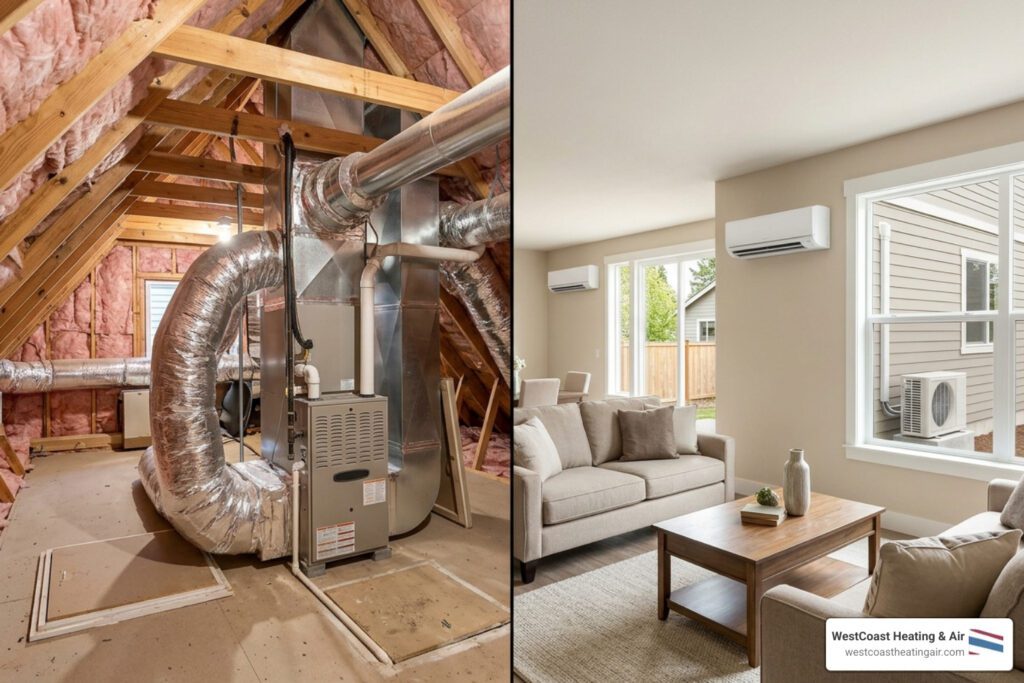
To truly weigh your options, we need to look under the hood of how these systems actually move heat. While both use the same basic principles of refrigeration, their physical footprint in your Puyallup home couldn’t be more different.
A traditional central system is essentially a “whole-house” solution. It relies on a large indoor unit—often a Gas Furnace or a high-efficiency air handler—located in a basement, closet, or attic. This unit is connected to an outdoor condenser. The indoor unit uses a powerful blower to push air through a network of hidden metal or flexible tubes (ducts) that terminate at vents in every room. When you think of Air Conditioning, this is likely the “invisible” system you’re picturing.
In contrast, Ductless Heating and Cooling systems (often called mini-splits) do away with the “middleman” of ductwork. Instead of one giant indoor unit, we install small, sleek “heads” directly on the walls of the rooms you want to climate control. These indoor units are connected to an outdoor compressor by small refrigerant lines and electrical wiring.
The fundamental trade-off we often discuss with homeowners in Tacoma and University Place is one of “uniformity versus control.” Central HVAC treats your home as one single environment. Ductless systems treat it as a collection of individual zones. For some, the “hidden” nature of central vents is an aesthetic must-have. For others, the ability to turn off the AC in the guest room while keeping the master bedroom at a crisp 68 degrees is the ultimate luxury.
Efficiency and Performance in the Pacific Northwest
In our neck of the woods, efficiency isn’t just about saving money; it’s about how a system handles the unique moisture and temperature swings of the Puget Sound. This is where the central hvac vs ductless system comparison gets interesting.
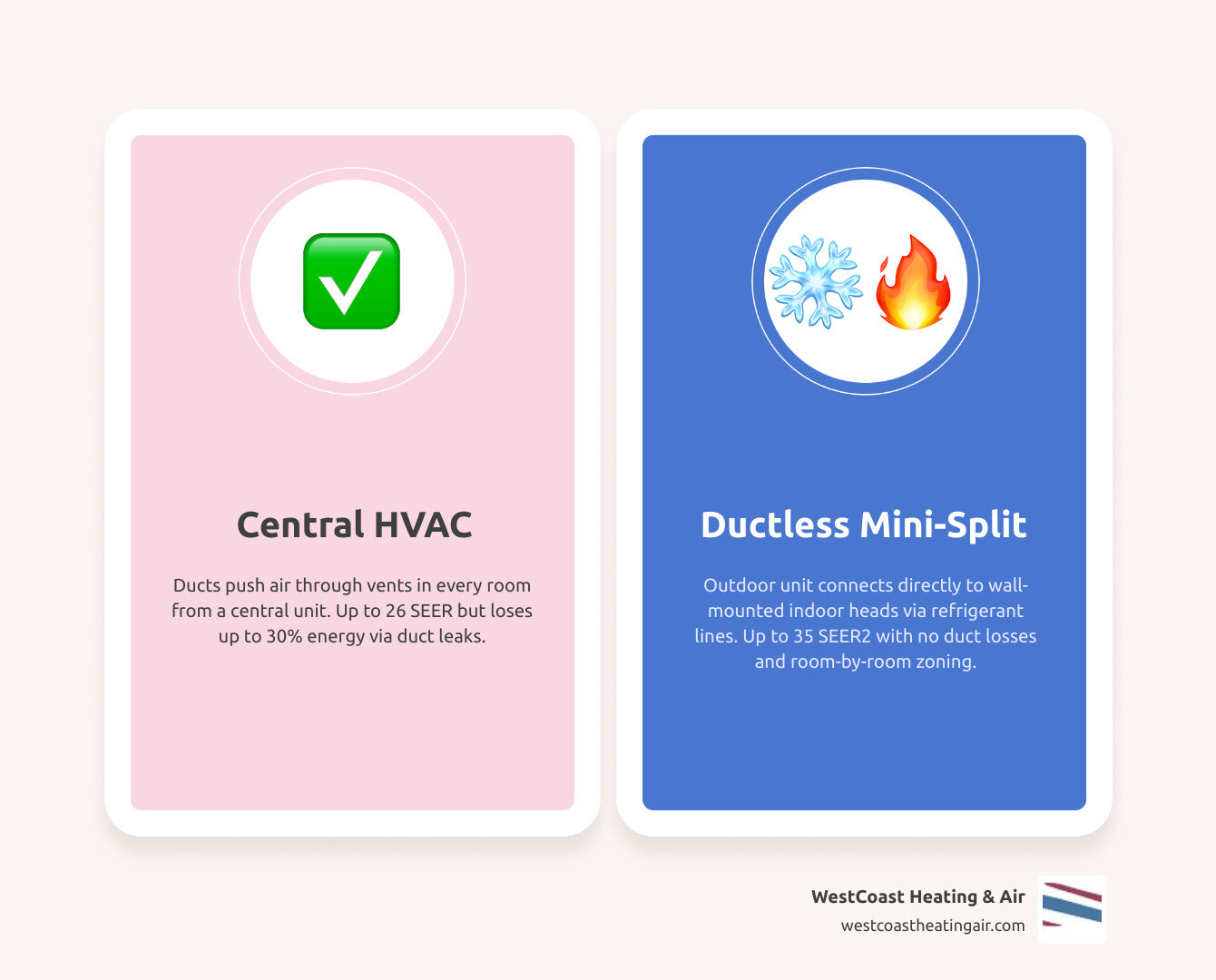
When we look at a Heat Pump, we have to talk about duct loss. Imagine buying a gallon of milk, but 30% of it leaks out of the jug before you get home. That is exactly what happens with many central systems. Leaky, unsealed, or poorly insulated ducts in unconditioned spaces like crawlspaces or attics are energy vampires. The U.S. Department of Energy estimates that duct losses account for more than 25% to 30% of a cooling system’s energy use.
Ductless systems are the undisputed champions of efficiency because they deliver air directly into the living space. There is nowhere for the energy to escape. Furthermore, most modern ductless units utilize inverter technology. Traditional central systems often operate like a light switch—they are either 100% on or 100% off. This “all-or-nothing” approach leads to uncomfortable temperature swings and high energy spikes. Inverter-driven, variable-speed compressors work more like a dimmer switch, slowing down or speeding up to maintain a perfectly steady temperature.
To explore more about these high-tech options, check out our guide on The Best High-Efficiency Heating Options for Your Home.
How can I maximize SEER2 ratings with a central HVAC vs ductless system comparison in Puyallup?
If your goal is the lowest possible utility bill in Roy or Spanaway, you need to look at SEER2 (Seasonal Energy Efficiency Ratio 2) ratings. As of April 2026, the technology has pushed the boundaries of what’s possible.
While high-efficiency central systems typically top out around 26 SEER, ductless mini-splits can achieve staggering ratings of up to 35 SEER2. This massive gap exists because ductless systems don’t have to fight the static pressure of ductwork and can utilize more precise variable-speed motors.
Maximizing your rating involves more than just picking a number on a box, though. It requires a proper Manual J load calculation—something we prioritize at WestCoast Heating & Air—to ensure the system is perfectly sized for your square footage. An oversized system will “short-cycle,” turning on and off too frequently, which kills efficiency and fails to dehumidify our damp PNW air. If you’re noticing your current system struggling, it might be one of the Signs It’s Time to Upgrade Your HVAC System.
Comfort, Zoning, and Indoor Air Quality
We’ve all experienced “thermostat wars.” One person is freezing in the kitchen while another is sweltering in the upstairs office. In a central HVAC setup, this is often caused by poor Air Balancing: The Art of Avoiding Hot and Cold Spots. Central systems rely on a single thermostat, usually located in a hallway, to make decisions for the entire house.
While you can install Furnace Zone Control Systems for central air—using motorized dampers inside the ducts to direct air—it is often a complex and expensive retrofit.
Ductless systems provide “zoning by default.” Every indoor head has its own thermostat and remote (or smartphone app). This allows for incredible precision. If you have a sunroom in Sumner that gets hit by the afternoon heat, you can crank the AC in just that room without freezing out the rest of the family.
Indoor air quality is another major factor. Central systems are excellent for whole-home filtration because they can accommodate thick, high-MERV filters that scrub the air as it circulates. However, if your ducts are dirty, they can actually become a source of dust, allergens, and mold spores. Ductless units feature multi-stage filtration in each head, which is great for trapping localized pet dander and pollen, but they do require more frequent maintenance—usually a quick rinse of the filters every few weeks.
Is tailoring comfort easier through a central HVAC vs ductless system comparison for my home?
For many of our neighbors in Steilacoom and Orting, “comfort” also means peace and quiet. If you are sensitive to noise, the ductless system is likely your winner. Because the noisy compressor is outside and the indoor units use ultra-quiet fans, many heads operate at just 19 decibels. To put that in perspective, a whisper is about 30 decibels. You can literally have a unit running in a nursery or a home office and forget it’s even there.
Beyond noise, the ability to customize the temperature in each room is a game-changer for multi-generational homes. To learn more about how this works in practice, read about the Ductless Heating Benefits for the Modern Home.
Matching the System to Your Home’s Structure
Your home’s “bones” often make the decision for you. If you live in a historic home in North Tacoma with plaster walls and no crawlspace, installing a central HVAC system can be a nightmare. It requires “dropping” ceilings or building soffits to hide the ducts, which can ruin the architectural integrity of an older house.
This is where ductless systems shine as a “non-invasive” solution. All we need is a small three-inch hole in the exterior wall to pass the refrigerant and power lines through. We can often have a multi-zone system up and running in a day or two with almost no construction mess.
We also see a lot of success with a hybrid HVAC approach. Many homeowners in Puyallup keep their existing central furnace for the main floor but install a ductless mini-split for a new home addition, a finished basement, or a detached ADU (Accessory Dwelling Unit). This allows you to expand your living space without overtaxing your main system. If you are looking at your current setup and wondering about the next step, consider these Furnace System Upgrades.
Frequently Asked Questions about Home Cooling
Can a ductless system effectively cool my entire house?
Absolutely. While many people think of mini-splits for just one room, modern multi-zone outdoor compressors can support up to eight indoor units. This allows us to design a system that covers every bedroom, the living area, and even the kitchen. It provides full-home coverage with the added benefit of independent control.
Which system is quieter for a home office or bedroom?
Ductless systems are significantly quieter indoors. Central systems often have a “whoosh” of air noise and the sound of the blower motor echoing through the vents. Ductless indoor units are engineered for library-quiet operation, making them the preferred choice for bedrooms and home offices where concentration is key.
How often do I need to maintain these systems?
Both require an annual professional tune-up to stay in peak shape. However, the DIY maintenance differs. Central systems need a filter change every 1–3 months. Ductless systems have permanent, washable filters that should be rinsed every 2–4 weeks, especially during high-use seasons. Keeping up with this is one of the best ways to avoid the Signs It’s Time to Upgrade Your HVAC System prematurely.
Conclusion
Choosing between a central system and a ductless one isn’t about finding the “perfect” technology—it’s about finding the perfect fit for your home and your lifestyle in the Puget Sound.
At WestCoast Heating & Air, we specialize in residential comfort and don’t believe in one-size-fits-all solutions. Whether you are in University Place, Roy, or SeaTac, our team focuses on customized residential system design and homeowner education. We want you to understand exactly why a specific system will (or won’t) work for your floor plan. With over 20 years of local experience, we’ve seen every type of home layout the Pacific Northwest has to offer.
If you’re ready to end the thermostat wars and see if Ductless Heating and Cooling is the right move for your Puyallup home, give us a call. We’re here to help you breathe easier and live more comfortably, one zone at a time.