
What to Expect During an Emergency Service Call: A Quick Guide for Homeowners
What to expect during an emergency service call depends on the type of emergency, but for residential HVAC situations, the process almost always follows a clear sequence that every homeowner should understand before a crisis hits.
Here is what typically happens, from your first call to the final system check:
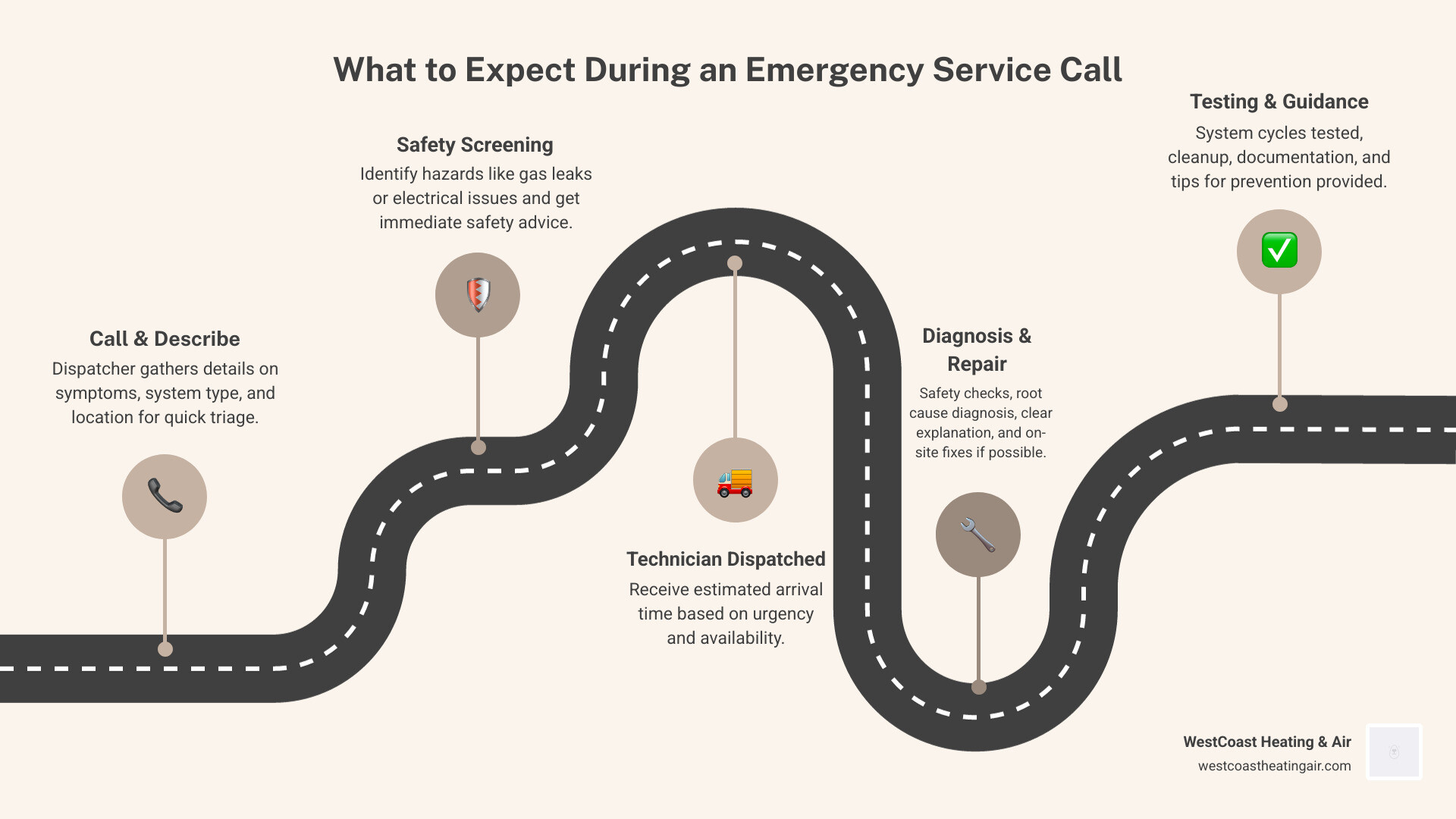
- You call and describe the problem – A dispatcher gathers key details about your system, symptoms, and location.
- Safety screening happens first – The dispatcher identifies whether there is an immediate hazard (gas smell, burning odor, electrical issue) and advises on any urgent safety steps.
- A technician is dispatched – You receive an estimated arrival window based on urgency and technician availability.
- The technician arrives and inspects – They start with safety checks before touching anything, then diagnose the root cause.
- Findings are explained in plain language – You hear exactly what is wrong, what the repair options are, and what happens next.
- Repairs are completed or stabilized – If parts are available, the fix happens on the spot. If not, a temporary solution keeps you safe until the full repair is done.
- Post-repair testing is performed – The technician runs the system through cycles to confirm it is working safely and correctly.
- You receive documentation and next-step guidance – A good technician leaves you with a clear record of what was done and what to watch for going forward.
When heat or air conditioning fails during extreme weather, the uncertainty of not knowing what comes next can be just as stressful as the breakdown itself. Knowing the process in advance helps you stay calm, make faster decisions, and get your home back to a safe, comfortable temperature without second-guessing every step.
I’m Michael Smith, owner of WestCoast Heating & Air in Puyallup, and after 30 years solving complex problems at Boeing followed by years of hands-on residential HVAC work across the Pacific Northwest, I’ve guided countless local homeowners through exactly what to expect during an emergency service call. In this guide, I’ll walk you through every stage of the process so you know what’s happening, why it’s happening, and how to make the most of your technician’s visit.
Identifying a True Residential HVAC Emergency

In places like Tacoma, Steilacoom, or Puyallup, the weather can turn on a dime. But how do you know if your system failure is a “call right now” emergency or something that can wait until Monday morning? Identifying a true emergency is the first step in the “Check, Call, Care” framework.
A true residential HVAC emergency typically involves an immediate risk to your home’s safety or a threat to the health of your family. For example, if your furnace quits when temperatures are dropping toward freezing, you aren’t just looking at a cold night—you’re looking at the risk of burst pipes and serious health concerns for children or seniors. If you find yourself in this situation, seeking 24-Hour Gas Furnace Repair in Tacoma WA is a necessity, not a luxury.
Other red flags that require immediate professional attention include:
- Gas Odors: If you smell “rotten eggs,” this is a critical safety hazard.
- Burning Smells: An electrical “fishy” or ozone smell can indicate melting wires or a failing motor.
- Loud Mechanical Noises: Banging, screeching, or metal-on-metal grinding often means a component is about to fail catastrophically.
- Electrical Sparking: Any visible sparks or smoke from your unit or thermostat.
- Extreme Heat: During a summer heatwave in Spanaway or Roy, a broken AC can lead to heat exhaustion. In these cases, it’s time for emergency AC maintenance in Tacoma WA to restore a safe indoor environment.
What to Expect During an Emergency Service Call: The Initial Contact
When you pick up the phone to call us, the person on the other end isn’t just a receptionist—they are a trained dispatcher performing “triage.” Much like an emergency room, we prioritize calls based on the severity of the situation.
To help us get to you faster, have the following information ready:
- The Symptoms: Is the system blowing room-temperature air? Is it making a specific noise? Is the thermostat display blank?
- The History: When did the problem start? Have you had recent maintenance?
- Safety Status: Are there any smells or sounds we should know about before arrival?
- Location Accuracy: Confirm your address and any specific instructions for finding your home in areas like Orting or Sumner.
During this call, we conduct a safety screening. If you report a gas smell, we will instruct you to evacuate and contact the gas company immediately. If the issue is a standard breakdown, we will provide an arrival window. For those in Puyallup, our emergency gas furnace repair guide explains how we mobilize quickly to address these specific heating failures. Similarly, for homeowners with modern systems, our emergency ductless heating repair Tacoma guide outlines how we handle specialized equipment during off-hours.
Preparing Your Home for the Technician’s Arrival
While you wait for us to arrive, there are a few things you can do to speed up the repair process. Every minute we spend moving boxes or searching for a crawlspace access is a minute taken away from fixing your system.
- Clear the Path: Ensure there is a wide, well-lit path to both your indoor unit (furnace/air handler) and your outdoor unit (condenser/heat pump).
- Secure Your Pets: Even the friendliest dog can get stressed by a stranger with a tool bag. For their safety and ours, please keep pets in a separate room.
- Check the Basics: Before we arrive, double-check your thermostat batteries and your circuit breaker. It might sound simple, but a tripped breaker is a common culprit.
- Unlock Gates and Doors: If your unit is behind a locked fence or in a detached garage, ensure we have access.
- Gather Documentation: If your system is under warranty, having those papers handy can be very helpful.
By preparing your space, you’re helping us provide emergency furnace care in Puyallup more efficiently. If you’re unsure where to start, our Tacoma emergency furnace maintenance guide offers a checklist for maintaining a service-ready mechanical room.
On-Site Diagnosis and the Repair Process
Once our technician arrives at your home in University Place or SeaTac, the real work begins. We don’t just start swapping parts; we follow a systematic diagnostic process.
The Safety Inspection
First, we check for carbon monoxide leaks, gas leaks, and electrical faults. Safety is never rushed. We want to ensure that the environment is safe for both your family and our team before we begin technical diagnostics.
Root Cause Analysis
We use specialized tools to test components like capacitors, motors, and sensors. We look past the symptoms to find the “why.” For example, a frozen AC coil might be the symptom, but the root cause could be a clogged filter or a refrigerant leak. This level of detail is a standard part of what to expect during an HVAC replacement or a major residential repair visit.
Explaining the Findings
We believe in customer education. We will explain exactly what failed in plain language—no technical jargon meant to confuse you. We’ll show you the failed part if possible and explain how it affects the rest of the system. Whether it’s a same-day heat pump repair in Tacoma or a furnace fix, you’ll be fully informed before any work starts.
| Feature | Temporary Stabilization | Permanent Repair |
|---|---|---|
| Goal | Restore basic safety/minimum heat | Restore full system efficiency |
| Timeline | Immediate/Same-day | Dependent on part availability |
| Parts | Universal or bypass components | OEM-specific components |
| Reliability | Short-term solution | Long-term manufacturer standard |
In some cases, especially on frigid nights, we may need to perform an emergency heat pump installation in Puyallup if the old unit is beyond safe repair.
Post-Repair Testing and Future Prevention
A repair isn’t finished just because the air is blowing warm again. We perform rigorous post-repair testing to ensure the system cycles correctly and all safety limits are functional.
Testing and Cleanup
We verify that the system starts, runs, and shuts down as intended. We also check for stable electrical draws and proper airflow. Once the technical work is done, we clean our work area. We respect your home and aim to leave it exactly as we found it—just much more comfortable.
Preventing the Next Emergency
After the immediate crisis is over, we’ll talk about how to prevent it from happening again. This often includes:
- Maintenance Plans: Regular tune-ups are the best way to catch small issues before they become midnight emergencies.
- Filter Education: We’ll show you exactly which filter to use and how often to change it.
- Air Quality Checks: Sometimes, recurring system issues are linked to poor indoor air quality or duct issues.
For our neighbors in Spanaway, we often recommend same-day gas furnace maintenance to keep systems running smoothly through the damp PNW winters. If you’ve just had a ductless heating repair in Puyallup, we’ll provide specific tips for keeping those sensitive outdoor units clear of debris. And if you’re worried about the next cold snap, our same-day gas furnace repair Spanaway guide is a great resource for staying proactive.
Frequently Asked Questions about Emergency Repairs
What should I do if I accidentally call for emergency service?
Accidents happen—pocket dials or a child playing with the phone can trigger an emergency call. If you accidentally dial our emergency line, do not hang up. Stay on the line and simply explain that it was a mistake. This prevents our dispatchers from spending time trying to call you back or worrying that an actual emergency is occurring. If you realize your system is actually fine (perhaps a family member just turned the thermostat down), let us know immediately so we can reroute our technician to another family in need. This transparency helps us provide better emergency gas furnace installation in Puyallup for those who truly need it.
What to expect during an emergency service call for a heat pump?
Heat pumps are unique because they provide both heating and cooling. During an emergency call, we specifically look at the defrost cycle, which can fail and cause the outdoor unit to turn into a block of ice. We also verify the auxiliary “heat strip” function to ensure you have a backup heat source while we work on the primary compressor. If your system has stopped working entirely, our same-day heat pump repair solutions focus on restoring that balance. For those in Spanaway, we offer reliable ductless repair to handle the specific needs of mini-split systems.
What to expect during an emergency service call if I smell gas?
If you smell gas, our protocol is “Safety First.” We will instruct you to shut down the system, leave the house, and call the gas utility from a safe distance. Our technicians use sensitive leak detectors to find the exact source of the leak, whether it’s a cracked heat exchanger or a loose fitting. We will not turn the gas back on until the repair is verified and the home is properly ventilated. This is a critical part of our 24-hour gas furnace repair in Tacoma. If the system is unsafe to repair, we may discuss an emergency ductless heating installation as a safer, more modern alternative.
Conclusion
At WestCoast Heating & Air, we understand that an emergency service call is one of the most stressful experiences a homeowner can face. With over 20 years of local experience serving Puyallup, Tacoma, Spanaway, and the surrounding areas, we’ve built our reputation on customized system design and thorough customer education.
We don’t just fix machines; we take care of people. Whether you need a quick fix or a complete residential heating and cooling company to redesign your home’s comfort system, we are here to help. By knowing what to expect during an emergency service call, you can take control of the situation and trust that your home—and your family—are in expert hands.