
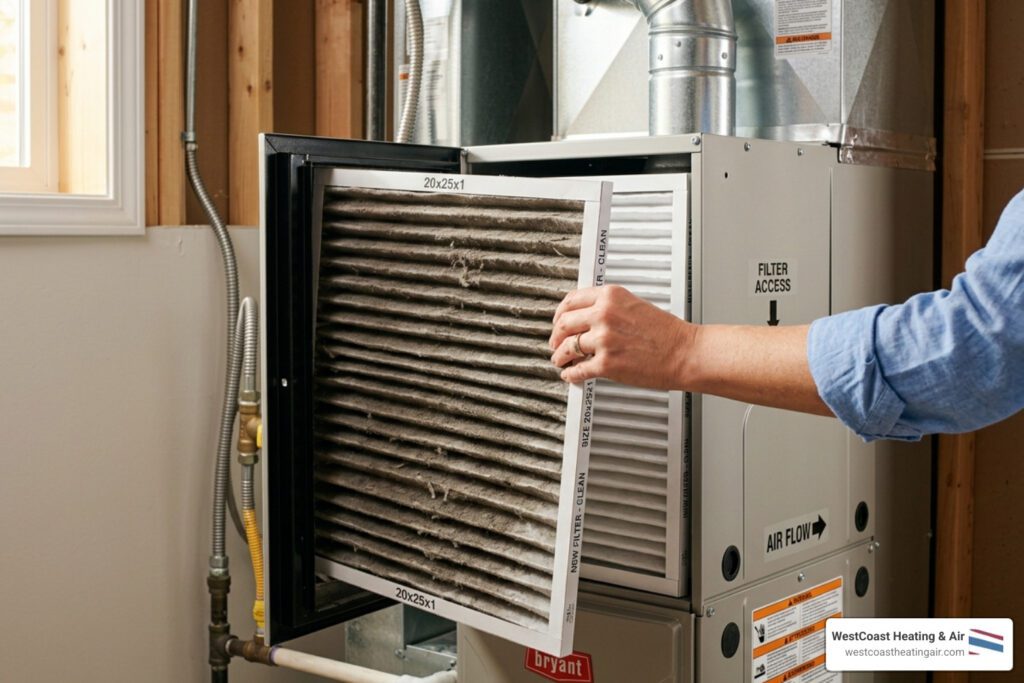
The Simple Answer: How Often Should You Change Your HVAC Air Filter?
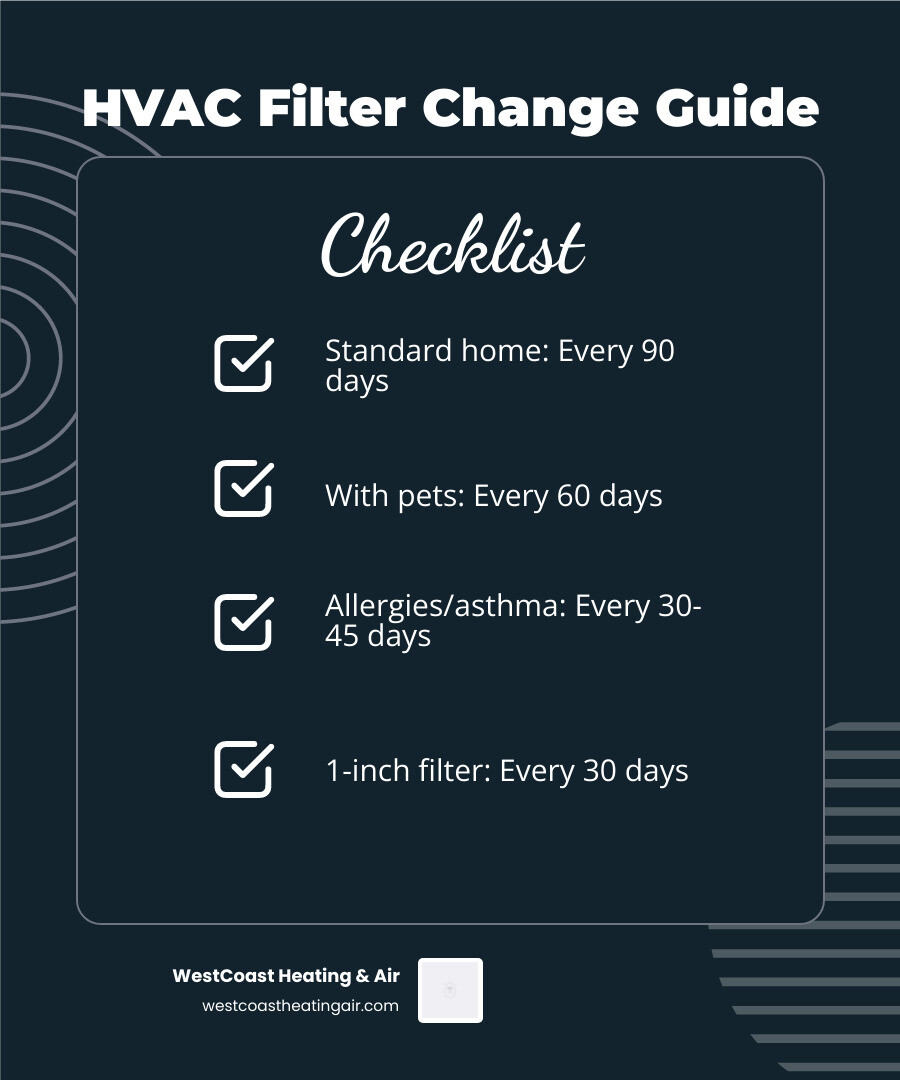
How often should you change your HVAC air filter depends on your filter type, home conditions, and usage — but here’s a quick-reference guide to get you started:
| Household Situation | Recommended Change Frequency |
|---|---|
| Standard home, no pets, no allergies | Every 90 days |
| One pet (cat or dog) | Every 60 days |
| Multiple shedding pets or allergies | Every 20–45 days |
| Allergy or asthma sufferers | Every 30–45 days |
| Vacation home or very light use | Every 6 months (inspect every 90 days) |
| 1-inch fiberglass filter | Every 30 days |
| 1-inch pleated filter | Every 30–90 days |
| 4-inch pleated filter | Every 6 months |
| 5-inch high-capacity filter | Every 12 months |
The bottom line: the more people, pets, and pollutants in your home — and the thinner your filter — the more often it needs to go.
Most homeowners don’t think about their HVAC air filter until something goes wrong — a spike in the energy bill, a musty smell from the vents, or an allergy flare-up that won’t quit. But your filter is quietly working when you need us, trapping dust, pet dander, pollen, and mold spores before they can circulate through your home or clog your system’s internal components. When it gets too full to do its job, your HVAC has to work harder, your air gets dirtier, and your equipment wears down faster — all from one overlooked piece of material that costs just a few dollars to replace.
Think of it this way: running your HVAC with a clogged filter is a bit like trying to breathe through a mask packed with dust. The system isn’t broken — it’s just suffocating. And according to the U.S. Department of Energy, swapping out a dirty filter can improve your system’s efficiency by as much as 5–15%.
I’m Michael Smith, owner of WestCoast Heating & Air in Puyallup, Washington — and after decades of hands-on problem-solving (including 30 years at Boeing before moving into HVAC), I’ve seen how something as simple as a neglected filter can snowball into costly repairs. In this guide, I’ll walk you through exactly how often you should change your HVAC air filter based on your specific home, lifestyle, and the unique demands of Pacific Northwest living.
How Often Should You Change Your HVAC Air Filter in Western Washington?
While the general rule of thumb is every 90 days, the reality of living in the South Sound means your schedule might look a little different. Our climate allows us to run our systems frequently, whether we are trying to escape a summer heat wave or staying cozy on a chilly, damp night.
In general, 1-inch filters are the “sprint runners” of the HVAC world; they fill up fast and usually need replacing every 30 to 90 days. If you have a 4-inch pleated filter, you’re looking at a “marathon runner” that can often last six months. High-capacity 5-inch filters, like the Lennox Healthy Climate CarbonClean 16, are the heavyweights, often lasting a full year before needing a swap. However, sticking to a rigid calendar can be a mistake. The Importance Of Seasonal Filter Changes Airflow Optimization cannot be overstated, as your system’s needs shift with the weather.
How often should you change your hvac air filter with pets?
We love our furry family members, but they are essentially walking “dust and dander” factories. Pet hair is heavy and can quickly mat across the surface of a filter, while microscopic dander particles lodge deep within the fibers. If you have a single cat or dog, we recommend a 60-day replacement cycle.
If you have multiple shedding pets, that window shrinks significantly. In these high-demand households, you should perform a 30-day inspection. You might find that your filter is saturated in as little as 20 to 45 days. Ignoring this leads to your system recirculating those irritants back into your living space, which isn’t good for you or your pets.
How often should you change your hvac air filter during peak usage?
During the height of summer or the peak of winter, your HVAC system works overtime. During a winter cold snap or a summer heat wave, your system might run 12 to 15 hours a day. More runtime equals more air passing through the filter, which means more debris is trapped in a shorter period.
During these peak seasons, we suggest checking your filter monthly. Even if you usually change it every three months, a high-usage month can clog it twice as fast. Proper maintenance during these times ensures you won’t be left without cooling when you need it most. For more on keeping your system ready for the workload, check out How Often Should You Get Your Furnace Service.
Factors That Accelerate Your Replacement Schedule
Not every home in the South Sound is the same. A small condo in University Place will have different filtration needs than a sprawling family home in Graham. Several hidden factors can turn a “standard” 90-day filter into a 30-day filter.
Impact of home size and occupancy
The more people living in a home, the more “indoor pollution” is generated. Humans naturally shed skin cells and hair, and larger households tend to have more movement, which kicks up settled dust. If you have more than four people in your home, your air filter is processing a significantly higher volume of aerosols and particles.
Furthermore, larger homes often have larger HVAC systems or multiple units. These systems move a massive volume of air to maintain comfort in every room. If your home is large, you’ll likely need to replace filters more frequently than a single occupant in a smaller space because the sheer volume of air being “scrubbed” is much higher. If you find your home is still dusty after a filter change, it might be time to ask How Often Do You Need Air Duct Cleaning.
Environmental factors in the South Sound
Our local environment plays a massive role in indoor air quality. South Sound homeowners face unique challenges:
- Wildfire Smoke: During fire season, ash and fine particulates can clog a filter in days.
- Agricultural Dust: If you live near the more rural areas of the county, seasonal harvesting can send clouds of dust toward your intake.
- Coastal Humidity: High humidity can sometimes lead to moisture getting trapped in filter media, which can encourage mold growth if the filter isn’t changed regularly.
- Urban Pollution: Homes near major highways like the I-5 or I-15 deal with higher levels of soot and tire rubber particles.
Staying on top of these environmental shifts is one of the 3 Easy Diy Hvac Upkeep Tasks Homeowners Can Do Between Professional Visits.
Understanding MERV Ratings and Filter Types
When you walk down the aisle at the hardware store, the options can be overwhelming. The most important number to look for is the MERV rating (Minimum Efficiency Reporting Value). This scale ranges from 1 to 16 for residential use, measuring how effectively the filter traps particles.
Filter Comparison Table
| Filter Type | MERV Rating | Particle Capture | Average Lifespan |
|---|---|---|---|
| Fiberglass | 1–4 | Large dust, lint | 30 days |
| Basic Pleated | 5–8 | Dust mites, pollen, mold | 60–90 days |
| High-Efficiency Pleated | 11–13 | Pet dander, smoke, bacteria | 30–90 days |
| HEPA | 14–16 | Viruses, microscopic allergens | 6–12 months |
For most South Sound homes, we recommend a MERV 8 to 11. This provides an excellent balance of air filtration without putting too much “static pressure” on your blower motor.
How often should you change your hvac air filter based on thickness?
Thickness is a major factor in longevity. A 1-inch filter has very little surface area, so it reaches its “dust-holding capacity” quickly. A 4-inch or 5-inch pleated filter is folded like an accordion. If you were to stretch that material out, it would cover a much larger area than a flat 1-inch filter. This extra surface area allows the filter to trap more debris while still allowing air to flow freely, which is why they can last six months to a year.
Washable vs. disposable filters
Washable filters are marketed as an eco-friendly, one-time purchase. While they do reduce waste, they come with a high maintenance burden. You must rinse them monthly and—crucially—let them dry completely before reinstalling. If you put a damp filter back into your dark HVAC system, you are essentially inviting mold to grow. Most professionals, including our team, generally find that high-quality disposable pleated filters offer superior filtration and fewer headaches for the average homeowner.
Signs Your Filter Needs Immediate Attention
Waiting for a specific date on the calendar isn’t always the best strategy. Your HVAC system will often tell you when it’s struggling. If you notice a “gray” or matted appearance on the filter, it’s already past its prime.
The light test and visual inspection
The “Light Test” is the gold standard for DIY inspection. Take your filter out and hold it up to a bright light source or a flashlight. Can you see light passing through the fibers? If the light is blocked or looks dim and muddy, the filter is clogged with microscopic debris and needs to be replaced.
When you install the new one, pay close attention to the airflow direction. There is an arrow on the frame that should always point toward the HVAC unit and away from the return duct. Installing it backward can actually damage the filter and reduce its effectiveness.
System performance red flags
If you ignore the visual signs, your system will eventually start to fail. Common red flags include:
- Longer Cycles: The system runs for a long time but the house doesn’t feel cool.
- Uneven Cooling: Some rooms are hot while others are cold because the air can’t reach the far vents.
- Musty Odors: Dust buildup on the coils can create a “dirty sock” smell.
- Frozen Coils: Restricted airflow causes the temperature of the evaporator coil to drop below freezing, turning it into a block of ice.
These issues are exactly What Happens If You Dont Get An Air Filter Change. If you’ve reached this point, it’s often a sign that you need to find out How Often Should You Schedule An Hvac Tune Up.
Frequently Asked Questions
Is it safe to run my HVAC without a filter?
In short: No. You can run it for a few minutes while you run to the store to grab a replacement, but never leave it running without one. The filter isn’t just for your lungs; it protects the expensive internal components of your system. Without a filter, dust coats the blower motor and coils, which can lead to a total system breakdown.
Do I need to turn off the system to change the filter?
Yes, we always recommend turning the system off at the thermostat first. If the fan is running while you pull the filter, the suction can pull loose dust and debris directly into the unit. It also makes it much easier to slide the new filter into place without it being sucked against the housing.
What MERV rating is best for South Sound homes?
For most residential systems in Western Washington, a MERV 8 to 11 is the “sweet spot.” It filters out the majority of common allergens like pollen and pet dander without being so thick that it “chokes” the airflow of a standard residential blower motor. If you have severe asthma, you might consider MERV 13, but you should consult a professional to ensure your system can handle the increased resistance.
Conclusion
Maintaining your HVAC system doesn’t have to be a chore, but it does require consistency. By understanding how often should you change your hvac air filter and adjusting that schedule for your pets, home size, and the Northwest climate, you are protecting your home’s most expensive appliance and your family’s health.
At WestCoast Heating & Air, we believe in customer education and top-quality service. Whether you’re in Tacoma, Sumner, or right here in Puyallup, we are here to help you optimize your home’s comfort. A clean filter is the first step toward a more efficient, longer-lasting HVAC system and lower energy bills.
If you’re concerned about your home’s air quality or want to ensure your system is operating at peak performance, Improve your home’s air with our Indoor Air Quality Services. Let our family-owned team bring our 20+ years of experience to your doorstep.