

Why Correct System Sizing Matters for Your Home — And Why Most Homeowners Get It Wrong
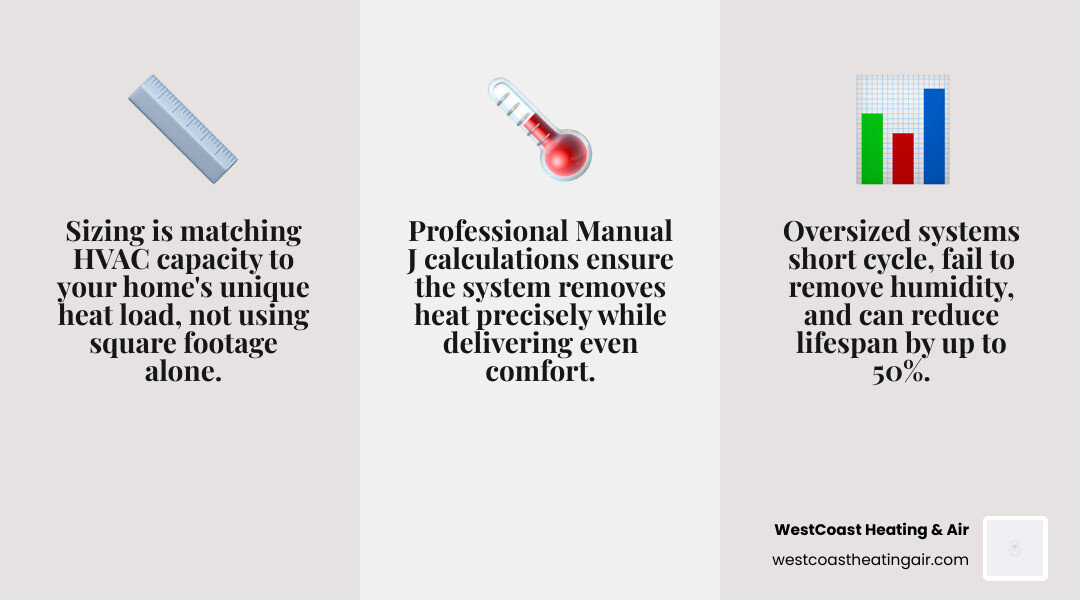
Why correct system sizing matters for your home comes down to one simple truth: a system that’s too big or too small will cost you more, comfort you less, and wear out faster than one that’s matched precisely to your home’s actual needs.
Here’s a quick summary of why sizing matters:
- Comfort: A properly sized system maintains even temperatures in every room
- Humidity control: Correctly sized systems run long enough to remove moisture from the air
- Energy efficiency: Right-sized equipment can use up to 30% less energy than an oversized unit
- Equipment lifespan: Short cycling from oversized systems can cut equipment life by up to 50%
- Air quality: Longer, steadier cycles improve air filtration and circulation
Despite how much this matters, the U.S. Department of Energy estimates that more than half of American homes have HVAC systems that are either too big or too small — quietly wasting energy and creating comfort problems that no thermostat adjustment can fix. Many homeowners in San Diego assume that a bigger, more powerful unit will cool their home faster and more effectively. In practice, the opposite is often true. An oversized system blasts air until the thermostat is satisfied, then shuts off — before it ever has a chance to pull humidity out of the air. The result is a home that feels cold and clammy at the same time.
I’m Michael Smith, owner of WestCoast Heating & Air, and after decades of hands-on problem-solving — including a 30-year career with Boeing before entering the HVAC industry — I’ve seen how understanding why correct system sizing matters for your home can be the single most important factor in achieving lasting comfort and efficiency. Whether you’re replacing an aging system or installing one for the first time, getting the size right before anything else is the foundation everything else is built on.
What HVAC System Sizing Really Means
When we talk about “sizing” an HVAC system, we aren’t talking about how much space the unit takes up in your side yard or attic. Instead, we are talking about its capacity to move heat. In the HVAC world, cooling isn’t the “addition of cold”; it’s the “removal of heat.”
Your home has a specific “load,” which is the amount of heat it gains in the summer and loses in the winter. Sizing is the process of matching a system’s output to that load. If the capacity doesn’t match the load, the system will struggle to keep you comfortable. Understanding What is BTU Measurement and Why Does it Matter? is the first step in seeing beyond the physical box and into the actual science of home comfort.
Why correct system sizing matters for your home starts with capacity, not equipment size
One of the biggest hurdles we face is the “bigger is better” myth. Many homeowners believe that a 5-ton unit is inherently “better” than a 3-ton unit because it has more power. However, HVAC equipment is designed to run in steady, long cycles.
When a system is right-sized, it reaches its peak efficiency after about 10 to 15 minutes of operation. If the capacity is too high for the space, the unit reaches the temperature setpoint too quickly and shuts down before it ever reaches that efficient “cruising speed.” This is why capacity matching is far more important than raw power.
How BTUs and tons are measured in residential heating and cooling
To understand sizing, you have to speak the language of the industry. We measure heat in BTUs (British Thermal Units). One BTU is roughly the amount of energy released by burning a single wooden match.
In residential cooling, we often use the term “tonnage.” This is a bit of a historical throwback to the days when people cooled buildings with actual ice. One ton of cooling capacity is equal to 12,000 BTUs per hour—the amount of heat required to melt one ton of ice over 24 hours.
When determining the BTU for House Size, we look at the total cooling and heating requirements. A 2,000-square-foot home might need a 3.5-ton or 4-ton unit, but that depends entirely on the home’s construction, not just the floor plan.
Why Correct System Sizing Matters for Your Home
Living in San Diego County, from the coastal breezes of La Jolla to the inland heat of El Cajon, we experience a wide range of microclimates. This makes why correct system sizing matters for your home even more critical. Proper sizing isn’t just about the temperature on the thermostat; it’s about the quality of the air you breathe and the amount you pay the utility company every month.

Why correct system sizing matters for your home in San Diego’s climate
Our local geography creates unique challenges. Coastal homes in Chula Vista or Carlsbad often deal with higher humidity and salt air, while homes in Santee or Escondido face intense afternoon sun and dry heat.
If you live near the coast, an oversized AC is your worst enemy. It will cool the house so fast that it never runs long enough to act as a dehumidifier. You end up with a house that is 72 degrees but feels like a damp cave. Conversely, an undersized system in the inland valleys will run 24/7 during a July heat spike and still fail to keep the living room below 80 degrees.
The comfort and efficiency benefits of a properly sized HVAC system
When we get the sizing right, magic happens. The system runs long, steady cycles that:
- Maintain a consistent temperature within 1 or 2 degrees of your setting.
- Pull up to 25 gallons of moisture out of your home on muggy days.
- Filter the air more effectively because air is constantly moving through the filtration system.
- Minimize the “stop-and-go” wear on the compressor, which is the most expensive part of your AC.
By Comparing the Cost and Comfort of Modern HVAC Systems, you’ll find that the most “efficient” unit on paper will perform poorly if it isn’t sized correctly for your specific square footage and insulation levels.
Problems Caused by an Oversized or Undersized System
To help you identify if your current system is failing you, we’ve put together a comparison of common symptoms.
| Feature | Oversized System | Undersized System |
|---|---|---|
| Cycle Length | Short (5-10 minutes) | Constant (Never stops) |
| Humidity | High / Clammy air | Varies, but usually dry |
| Energy Bills | High (due to start-up surges) | High (due to constant running) |
| Temperatures | Uneven (Hot/cold spots) | Consistently too warm/cold |
| Sound | Loud “whoosh” at start | Constant background hum |
Oversized HVAC problems: short cycling, humidity issues, and premature wear
Short cycling is the “silent killer” of HVAC efficiency. Every time your AC starts up, it uses a massive surge of electricity—much like a car uses more gas in stop-and-go traffic than on the highway. Why is an Oversized Air Conditioner Problematic? It’s because those frequent starts and stops rattle the components and lead to premature motor failure. Furthermore, since the air isn’t circulating long enough, you’ll often find that the master bedroom is freezing while the kitchen remains stuffy.
Undersized HVAC problems: nonstop operation and poor peak-season performance
An undersized system is like trying to cool a large home with a desk fan. It might feel okay on a mild May morning in Oceanside, but when the Santa Ana winds kick in, the system will lose the battle. Because it never reaches the set temperature, the compressor never gets a break. This leads to “burnout,” where the system effectively works itself to death years before it should.
Signs your current system may be the wrong size for your home
Are you wondering if your San Diego home is one of the 50% with an improperly sized system? Look for these red flags:
- The “Clammy” Factor: The air feels cold, but your skin feels sticky.
- Frequent Clicking: You hear the system kick on and off every few minutes.
- The Never-Ending Run: On a 90-degree day, the system starts at 10 AM and doesn’t shut off until midnight.
- Room Rivalry: The upstairs is 10 degrees warmer than the downstairs.
How Professionals Determine the Right Size for a Home
At WestCoast Heating & Air, we don’t guess. We use math. In the old days, many contractors used “rules of thumb,” like “one ton for every 500 square feet.” Today, with modern building materials and San Diego’s strict Title 24 energy requirements, those rules are obsolete.
Why Manual J is the standard for why correct system sizing matters for your home
The “Manual J” calculation is the industry-standard protocol developed by the Air Conditioning Contractors of America (ACCA). It is a comprehensive data-gathering process. We look at the “envelope” of your home to see how much heat moves in and out. This is the only scientific way to ensure your new system will actually do what we promise it will do.
The home factors that influence HVAC sizing decisions
When we perform a load calculation, we look at:
- Insulation: What’s in your attic and walls?
- Windows: Do you have dual-pane Low-E glass or old single-pane windows? (Low-E glass can reduce cooling loads by up to 50%!)
- Orientation: Which way does the house face? West-facing windows in San Diego act like giant heaters in the afternoon.
- Air Leakage: How much “conditioned” air is escaping through gaps in your ductwork or doors?
- Occupancy: How many people live there? Each human body adds about 250-400 BTUs of heat to the space.
Why replacing with the same size unit is often a mistake
“Just give me what I had before” is a dangerous request. If you’ve replaced your windows, added insulation, or even if your neighbor’s new tree now shades your roof, your home’s heat load has changed. Often, older systems were oversized by default. If we replace an old, oversized 5-ton unit with a new, high-efficiency 5-ton unit, you’ll still have all the same comfort problems.
Long-Term Benefits of Getting System Sizing Right
Investing the time to get the size right pays dividends for the next 15 to 20 years. It’s the difference between a home that is “tolerable” and a home that is a true sanctuary.
Better humidity control, steadier temperatures, and improved daily comfort
By staying in the “Goldilocks zone”—not too big, not too small—your system will maintain humidity between 30% and 50%. This prevents mold growth, protects your wood furniture, and makes 75 degrees feel much cooler than it would in a humid environment. You’ll also notice that the house is quieter because the system isn’t constantly “revving up” and “shutting down.”
How proper sizing supports long-term performance and smarter equipment choices
When a system is sized correctly, we can look at The Best High Efficiency Heating Options for Your Home, such as variable-speed heat pumps. These modern systems can “throttle” their output up or down, much like a dimmer switch on a light. However, even a variable-speed system needs a proper “max capacity” setting to function correctly within its design parameters.
Homeowner next steps before replacing or upgrading HVAC equipment
If you are ready to upgrade, don’t let a salesperson give you a quote over the phone based on your square footage.
- Request a Manual J: Ask specifically if they perform a professional load calculation.
- Check the Ducts: Ensure your existing ductwork can handle the airflow of the new unit.
- Seal the Envelope: Sometimes, adding $500 of attic insulation can allow you to buy a smaller (and less expensive) HVAC unit.
Frequently Asked Questions About HVAC Sizing
Can I size my HVAC system using square footage alone?
No. Two identical 2,000-square-foot homes in San Diego can have completely different needs. One might be a 1950s bungalow with no insulation and original windows, while the other is a 2020 build with high-efficiency everything. The older home might need 4 tons, while the newer one only needs 2.5 tons.
What if my home feels cool but still humid?
This is the classic sign of an oversized AC. The unit is powerful enough to drop the temperature quickly, but it shuts off before the evaporator coil has time to pull moisture out of the air. You likely need a smaller unit or a system with variable-speed technology.
Is a variable-speed system more forgiving if sizing is slightly off?
To an extent, yes. Because variable-speed systems can run at 40% or 100% capacity, they can compensate for minor sizing errors. However, you still shouldn’t use them as a “crutch” for poor planning. A properly sized variable-speed system is the ultimate in home luxury.
Conclusion
At WestCoast Heating & Air, we believe that your home deserves a custom-tailored solution. We aren’t just selling boxes; we are designing comfort. With over 20 years of experience serving San Diego County, we take pride in educating our customers so they can make the best decision for their families.
Getting the size right is the secret to a happy, healthy, and efficient home. If you’re ready to stop guessing and start experiencing true comfort, we are here to help.
More info about residential heating and cooling services