
Understanding HVAC maintenance frequency for pacific northwest homes
HVAC maintenance frequency for pacific northwest homes is something every Puyallup homeowner should understand before the next rainy season hits — and here’s the short answer:
Recommended Residential HVAC Maintenance Frequency for Pacific Northwest Homes
| System Type | Minimum Frequency | Ideal Schedule |
|---|---|---|
| Heat pump | Twice per year | Spring (Feb–Apr) + Fall (Sep–Oct) |
| Gas furnace | Once per year | Fall (Sep–Oct) |
| Central AC | Once per year | Spring (Feb–Apr) |
| Ductless mini-split | Once per year (professional) + monthly DIY filter cleaning | Spring or Fall + monthly |
| Older systems (10+ years) | Twice per year minimum | Spring + Fall |
| Homes with pets or allergies | Twice per year + more frequent filter checks | Spring + Fall + monthly inspections |
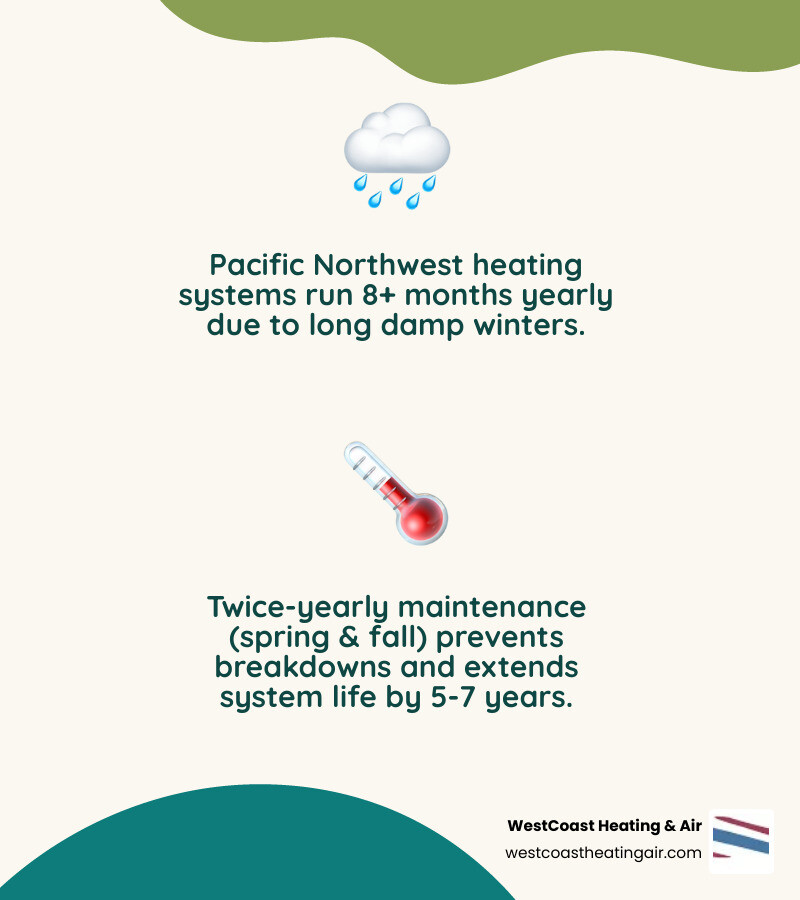
Your home’s HVAC system works harder in the Pacific Northwest than almost anywhere else in the country. The long, damp winters run heating systems for eight months or more. Wildfire smoke rolls through every summer. And heat events — like the record-breaking temperatures that topped 108°F across parts of Washington in 2021 — are pushing cooling systems to their limits just when they’re least prepared for it.
Most Washington residential HVAC professionals agree: once a year is the bare minimum, but twice a year is what actually protects your home’s system, your air quality, and your wallet. Every dollar you skip on maintenance has a way of turning into four dollars in repairs down the road.
I’m Michael Smith, owner of WestCoast Heating & Air in Puyallup, and after 30 years with Boeing followed by hands-on work in the residential HVAC industry, I’ve seen how the Pacific Northwest’s unique climate directly shapes the right hvac maintenance frequency for pacific northwest homes. In this guide, I’ll walk you through exactly what your system needs, when it needs it, and why the PNW demands a little more attention than the national averages suggest.
Why the PNW climate demands more frequent servicing
| Seasonal Stressor | Impact on Residential HVAC System | PNW Specific Risk |
|---|---|---|
| High Humidity | Biological growth and rust | Damp winters accelerate corrosion in outdoor units. |
| Wildfire Smoke | Clogged filters and fouled coils | Ash and particulates restrict airflow and damage motors. |
| Organic Debris | Airflow restriction | Moss, pine needles, and maple seeds clog condenser fins. |
| Temperature Swings | Component fatigue | Sudden heat domes strain systems that were previously idle. |
In the Pacific Northwest, our weather isn’t just “rainy”—it’s persistent. The constant dampness of a Spanaway winter creates a breeding ground for moss and corrosion. When moisture sits on your outdoor coils for months at a time, it can lead to premature pitting and refrigerant leaks. Furthermore, our lush greenery means pine needles and “helicopter” maple seeds are constantly trying to move into your outdoor unit.
Neglecting Winter Furnace Care in Sumner is particularly risky because the high moisture content in our air makes your system work harder to circulate heat. If your blower motor is struggling against a layer of PNW dust and dampness, it consumes significantly more energy—sometimes up to 25% more.
Impact of hvac maintenance frequency for pacific northwest homes on air quality
In April 2026, we are more aware of air quality than ever before. Wildfire smoke has transitioned from a “once-in-a-decade” event to an annual seasonal reality. When smoke fills the air in the South Sound, your home’s HVAC system is your primary line of defense.
Microscopic particulates from wood smoke can bypass standard, cheap fiberglass filters. This is why the Importance of Air Filter Changes cannot be overstated. During smoke events, a filter that usually lasts three months might clog in three weeks. If you haven’t kept up with your Air Duct Cleaning Frequency, those particulates can settle in your ductwork and recirculate long after the skies clear.
Key benefits of staying on schedule
We often tell our neighbors in Tumwater and Tacoma that maintenance isn’t a “cost”—it’s a hedge against inflation. The statistics are hard to ignore:
- Lower Utility Bills: A well-maintained system can save you up to 30% on your monthly energy bill. For heat pumps specifically, regular service can reduce energy consumption by 20 to 25 percent.
- Longer Equipment Life: On average, regular maintenance extends the lifespan of your furnace or AC by 5 to 7 years. In some cases, proactive care can help a system last 20 years instead of failing at year 12.
- Better Airflow: Post-cleaning, many systems deliver 10% to 46% more airflow. This means your home reaches the target temperature faster, and the system shuts off sooner, saving wear and tear.
- Warranty Protection: Most manufacturers require proof of annual professional maintenance to honor their warranties. If a major part fails and you can’t show service records, you might be footing the bill yourself.
Whether you’re looking for Benefits of Furnace Tune-Ups in Pierce County or specialized AC Maintenance in Spanaway, the goal is the same: efficiency and reliability.
DIY maintenance and warning signs
While professional visits are essential, you are the “first responder” for your home’s comfort. There are several DIY HVAC Upkeep Tasks you can handle to keep things running smoothly between our visits.
- The 30-90 Day Rule: Check your air filters every month. If you have pets (looking at you, Golden Retriever owners in Puyallup!), you’ll likely need to replace them every 30 days. If your home is pet-free, you might stretch it to 90 days.
- The Two-Foot Clearance: In the PNW, things grow fast. Make sure your outdoor unit has at least two feet of clear space on all sides. Trim back the rhododendrons and keep the “weed trees” from growing into the coils.
- Vent Check: Ensure your indoor registers aren’t blocked by furniture or heavy rugs. Seasonal Filter Changes & Airflow Optimization are only effective if the air actually has a path to move through your home.
Signs you need immediate service
Sometimes, you can’t wait for your scheduled fall visit. If you notice any of these “red flags,” call us immediately:
- Unusual Noises: Banging, screeching, or persistent rattling often indicate a mechanical failure in the blower or motor.
- Weak Airflow: If the air coming out of your vents feels like a tired sigh rather than a steady breeze, your system is struggling.
- Short Cycling: If the unit turns on and off every few minutes, it’s likely overheating or experiencing an electrical fault.
- Strange Odors: Musty smells can indicate biological growth in the drain pan, while “burning” smells could signal electrical issues.
Whether you need Gas Furnace Maintenance in Tacoma or are curious about your Furnace Service Frequency, listening to your home’s system is the best way to prevent a total breakdown.
Frequently Asked Questions about PNW Residential HVAC Maintenance
How often should I change my filters during wildfire season?
During active wildfire smoke events, you should check your filter every week. If it looks grey or ash-covered, change it immediately. Even high-efficiency MERV 13 filters can become “loaded” very quickly when the Air Quality Index (AQI) climbs into the unhealthy range. We recommend keeping 2–3 spare filters on hand during the summer months.
Does a heat pump need more service than a furnace in Washington?
Yes. Because a heat pump handles both the heating season (October–May) and the cooling season (June–September), it essentially does double the work of a standalone furnace. To ensure it switches between modes correctly and that the defrost cycle is working for our icy winter mornings, twice-yearly professional service is the responsible minimum.
Will skipping maintenance void my manufacturer warranty?
In many cases, yes. Most major brands like Trane, Lennox, and Carrier have fine print stating that the unit must be maintained by a licensed professional annually. If you experience a compressor failure in year seven but haven’t had a pro look at the unit since year one, the manufacturer may deny your claim for the replacement part.
Conclusion
At WestCoast Heating & Air, we’ve spent over 20 years serving our neighbors from University Place to Orting. We aren’t just technicians; we are members of this community who understand that a broken heater in a Washington winter isn’t just an inconvenience—it’s a safety issue.
By following the right hvac maintenance frequency for pacific northwest homes, you aren’t just checking a box. You are ensuring that your home remains a sanctuary of clean air and consistent warmth, regardless of what the weather decides to do. Our commitment to customized system design and customer education means we don’t just fix your system; we help you understand how to get the most out of it.
If it’s been more than six months since your last tune-up, or if you’ve noticed your energy bills creeping up, it’s time to get ahead of the season. Explore our Residential HVAC Services or reach out to our Puyallup office today to schedule your next visit. Let’s make sure your home stays comfortable all year long.