
Understanding Annual HVAC Maintenance and Its Components
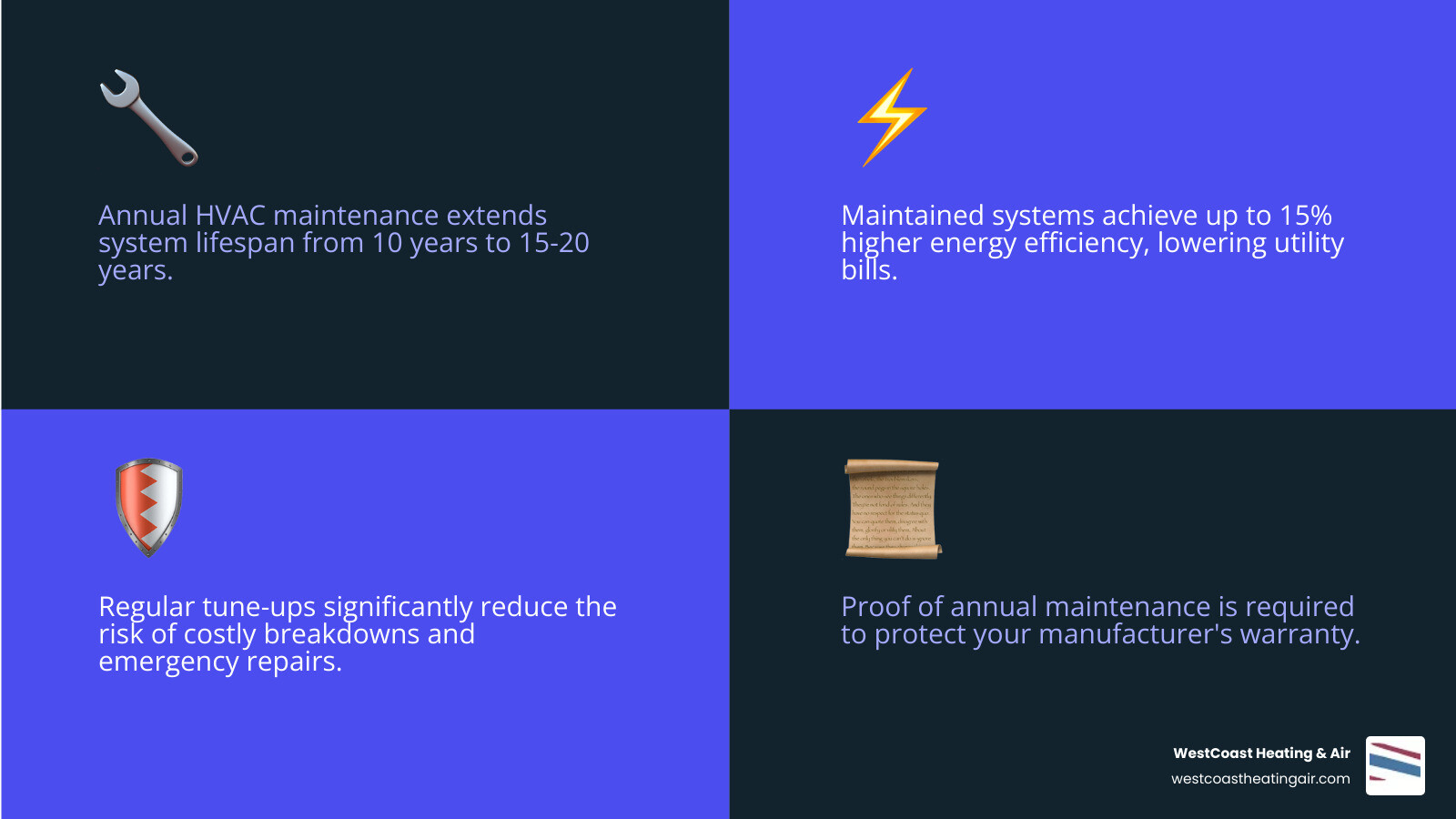
Annual HVAC maintenance is it worth it — and the short answer is yes, for most homeowners in Puyallup, WA. Here’s a quick breakdown of why:
Is Annual HVAC Maintenance Worth It?
| Factor | With Maintenance | Without Maintenance |
|---|---|---|
| System lifespan | 15-20 years | As little as 10 years |
| Energy efficiency | Up to 15% more efficient | Loses 1-5% efficiency per year |
| Breakdown risk | Significantly reduced | Much higher |
| Warranty status | Protected | Potentially voided |
| Indoor air quality | Improved | Declining over time |
Most homeowners don’t think about their HVAC system until something goes wrong — usually on the coldest night in January or the hottest afternoon in August. By then, a small, preventable issue has turned into an urgent problem repair or even a full system replacement. Regular annual maintenance is the difference between catching a worn capacitor for a fraction of the cost and replacing an entire compressor. It’s not just a nice-to-have — for many manufacturers, it’s a requirement to keep your warranty valid. Whether you’re dealing with a furnace, heat pump, or central AC in the Pacific Northwest, consistent upkeep keeps your system running reliably through every season.
I’m Michael Smith, owner of WestCoast Heating & Air in Puyallup — after 30 years in engineering with Boeing and years in the HVAC industry, I’ve seen how the question of annual HVAC maintenance is it worth it plays out for real homeowners, and the evidence consistently points in one direction. In this guide, I’ll walk you through everything you need to know to make a confident, informed decision for your home.
Imagine it is April 2026. The cherry blossoms are blooming in Puyallup, and the unpredictable Washington spring is in full swing. One day you need the heater; the next, you’re cracking a window. This is exactly when your HVAC system feels the strain of transitioning seasons.
Annual maintenance is often compared to a “doctor’s check-up” or an oil change for your car. You wouldn’t drive a vehicle for 100,000 miles without changing the oil, yet many homeowners expect their furnace or air conditioner to run for a decade without a professional look. At WestCoast Heating & Air, we view preventative care as the foundation of home comfort and system reliability.
So, what actually happens during a professional visit? It’s much more than just a quick glance. A comprehensive residential tune-up typically includes a 20- to 40-point inspection. Here are the heavy hitters:
- Filter Checks and Airflow: We ensure your system can breathe. The Importance of Seasonal Filter Changes & Airflow Optimization cannot be overstated; a clogged filter is the leading cause of motor burnout.
- Coil Cleaning: Both your indoor evaporator coil and outdoor condenser coil need to be clean to transfer heat efficiently. Dirt acts like an insulator, forcing the system to work twice as hard.
- Thermostat Calibration: We verify that when you set the dial to 70 degrees, your home actually reaches 70 degrees.
- Electrical Connections: We tighten terminals and measure voltage. Loose wires are a common cause of intermittent system failure and can even pose safety risks.
- Condensate Drains: Especially in our humid Pacific Northwest climate, we clear these lines to prevent water damage and mold growth inside your unit.
- Lubrication: We grease up moving parts to reduce friction, which keeps the system quiet and prevents mechanical wear.
By handling these tasks annually, we ensure your home remains a sanctuary of safety and comfort, regardless of the weather in University Place or Tacoma.
The Real Risks: What Happens If You Skip HVAC Maintenance?
When maintenance is ignored, the decline of your system isn’t usually sudden—it’s a slow, expensive “death by a thousand cuts.” If you’ve been wondering Why You Need a Furnace Tune-Up in Pierce County, consider the alternative: complete system neglect.
Without regular care, dust and debris build up inside the cabinet. This grime restricts airflow, which causes the blower motor to run hotter and longer than intended. Over time, this extra heat weakens the metal components. In a gas furnace, this can lead to the ultimate nightmare: a cracked heat exchanger. This isn’t just a repair issue; it’s a major safety hazard that can leak carbon monoxide into your living space.
The risks aren’t limited to traditional furnaces. If you utilize modern solutions like Ductless Heating Maintenance in Puyallup, WA, skipping service can lead to clogged condensate lines and failing sensors that leave you without heat exactly when the temperature drops in Roy or Orting.
The Cost of Neglect: A Comparison
| Feature | Maintained System | Neglected System |
|---|---|---|
| Typical Lifespan | 15–20 Years | 8–10 Years |
| Repair Frequency | Rare, minor adjustments | Frequent, urgent failures |
| Safety Status | Inspected for gas/CO leaks | High risk of undetected leaks |
| Air Quality | High (filtered and clean) | Poor (circulates dust/mold) |
| Energy Usage | Optimized and steady | Increases by 5% every year |
Statistics show that a well-maintained system can last up to 20 years, while a neglected unit might fail in just 10. Essentially, by skipping maintenance, you are paying for two HVAC systems in the time you should have only paid for one.
Annual HVAC maintenance is it worth it for your home’s efficiency?
Efficiency is the buzzword of the decade, but for a homeowner in Sumner or Steilacoom, it translates directly to the balance of your utility bill. Annual HVAC maintenance is it worth it when it comes to energy savings? The U.S. Department of Energy suggests that simply changing a dirty filter can improve efficiency by up to 15%. When you add in professional coil cleaning and motor lubrication, the savings multiply.
For Tacoma Homeowners: Why Professional AC Maintenance Is a Breeze, the focus is often on summer performance. An unmaintained AC unit loses about 5% of its efficiency every single year it goes without service. That means after just four years of neglect, your unit is consuming 20% more electricity to provide the same amount of cooling.
In the Pacific Northwest, many of us rely on heat pumps. Because these systems provide both heating and cooling, they work double-time compared to a standard furnace. Investing in Heat Pump Maintenance Services in Puyallup, WA ensures that the reversing valve and defrost cycles—critical for our damp, cold winters—are functioning perfectly. This optimization keeps your “peak performance” high and your environmental impact low.
Protecting Your Investment: Is annual HVAC maintenance worth it?
Your HVAC system is likely one of the most expensive appliances in your home, often ranging from $10,000 to $20,000 for a full installation in Washington State. Treating it with “preventative health” care is simply good stewardship of your investment. Beyond the monthly energy savings, there is the “peace of mind” factor. Knowing that a professional has cleared your system for the season allows you to sleep better when the winds start howling off the Sound.
Deciding if annual HVAC maintenance is worth it for older systems
If your system is creeping past the 10-year mark, you might be tempted to stop “throwing money at it.” However, this is actually when maintenance becomes more critical. Older systems are more prone to component wear, and early detection of a failing capacitor or a fraying belt can prevent a catastrophic breakdown that forces an urgent problem replacement.
When you ask How Often Should You Schedule an HVAC Tune-Up?, the answer for older systems is often “twice a year.” This allows us to keep a close eye on aging parts and ensure that your 15-year-old furnace can still handle a Spanaway winter. Many systems can reach that 20-year milestone if they are kept clean and properly tuned.
Protecting your manufacturer warranty: Is annual HVAC maintenance worth it?
This is the “fine print” that catches many homeowners off guard. Most major manufacturers—including brands like Trane, Lennox, and Carrier—require proof of annual professional maintenance to keep their 10-year parts warranties valid.
If your compressor fails in year seven, the manufacturer may ask for service records. If you cannot provide them, they can legally deny your claim, leaving you to foot a bill that could have been avoided. Regularly asking How Often Should You Get Your Furnace Service? and keeping those receipts is your best defense against expensive out-of-pocket part replacements.
Frequently Asked Questions about HVAC Maintenance
We hear a lot of questions from our neighbors in Tumwater and University Place. Here are the most common inquiries regarding residential service.
How often should HVAC systems be maintained (annual vs. biannual)?
Ideally, your system should be serviced twice a year. We recommend a “Spring Clean” for your air conditioner and Fall HVAC Maintenance: Prepare Your Home for the Autumn Cold for your heating system. If you have a heat pump, biannual service is highly recommended because the unit runs year-round. However, if you must choose just one, an annual comprehensive visit is the absolute minimum to ensure safety and warranty compliance.
What DIY maintenance tasks can homeowners handle themselves?
While we handle the technical stuff like refrigerant pressures and electrical testing, there are several things you can do to help:
- Filter Replacement: Change your filters every 1–3 months depending on pets and allergies.
- Debris Clearing: Keep at least two feet of clear space around your outdoor unit. Clear away fallen leaves, grass clippings, and snow.
- Vent Obstructions: Ensure furniture and curtains aren’t blocking your indoor return and supply vents.
- Thermostat Batteries: If your thermostat has batteries, change them once a year to avoid a “no-heat” call caused by a dead screen.
What signs indicate that your HVAC system needs maintenance?
Don’t wait for the annual date if you notice:
- Strange Noises: Squealing, banging, or grinding sounds.
- Uneven Temperatures: One room is a sauna while the other is an icebox.
- Rising Bills: A sudden spike in your energy costs without a change in usage.
- Frequent Cycling: The system turns on and off every few minutes.
- Weak Airflow: You can barely feel air coming out of the registers.
Conclusion
At WestCoast Heating & Air, we don’t just fix boxes; we provide customized system design and customer education to the families of Puyallup and the surrounding Pierce County area. With over 20 years of local experience, we know exactly what Washington winters and summers demand from your equipment.
Is annual HVAC maintenance worth it? When you consider the extended lifespan, the lower utility bills, the safety of your family, and the protection of your warranty, the investment pays for itself many times over. Don’t leave your comfort to chance this year.
Schedule your residential service today with our expert team and experience the top-quality service your home deserves.