
Why Uneven Home Temperatures Are More Common Than You Think
How ductless systems solve hot and cold spots is one of the most searched HVAC questions among homeowners — and for good reason. If you want the short answer, here it is:
Ductless mini-split systems eliminate hot and cold spots by:
- Delivering conditioned air directly to each room through individual wall-mounted units, bypassing ductwork entirely
- Giving you independent zone control so each room can be set to its own temperature
- Using inverter-driven compressors that continuously fine-tune output to maintain consistent comfort without temperature swings
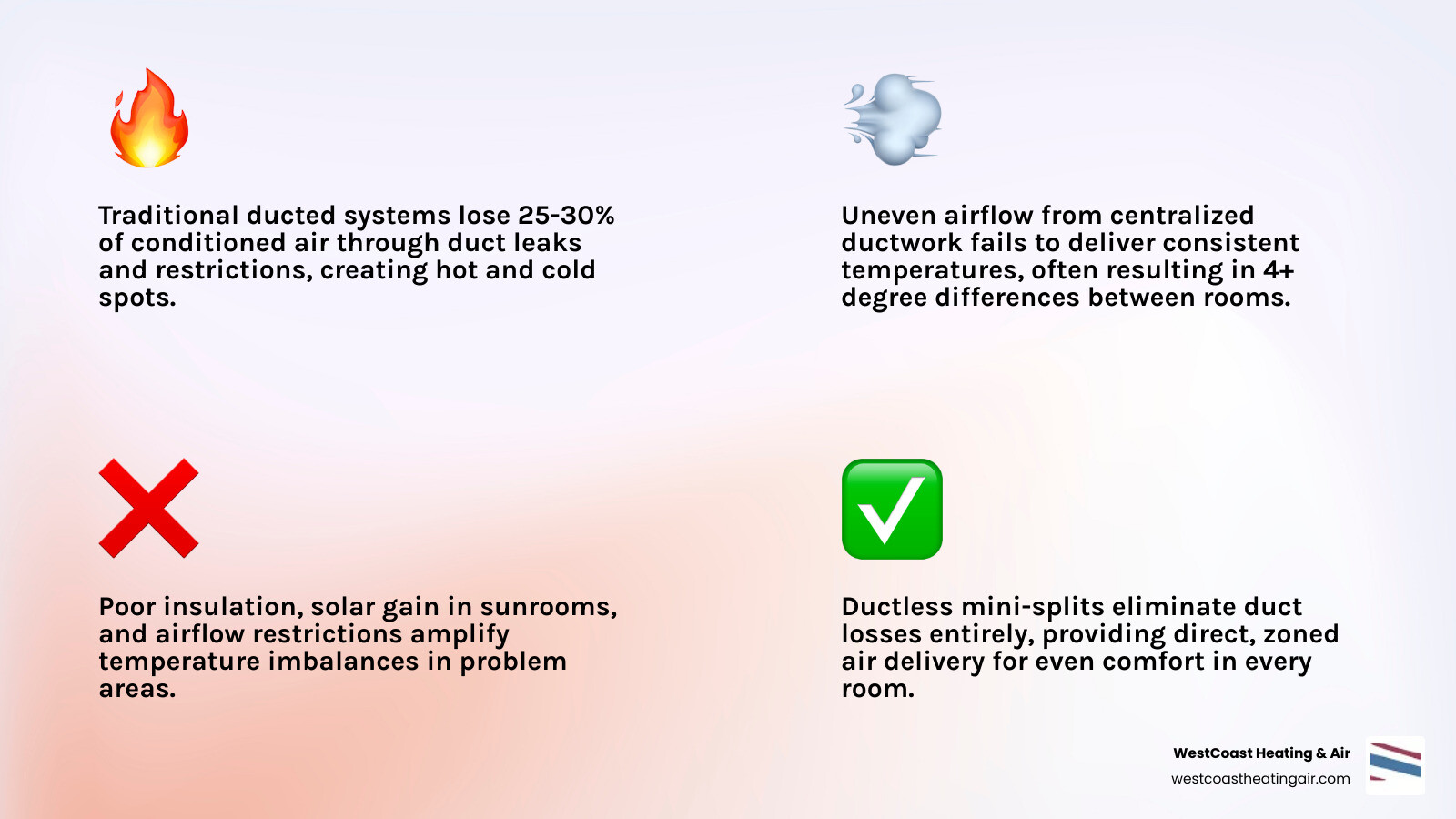
- Eliminating duct losses — traditional ducted systems waste 25–30% of conditioned air through leaks, while ductless systems lose none
- Targeting specific problem areas like sunrooms, rooms above garages, finished basements, and home additions where central HVAC falls short
Every home seems to have at least one room that just never feels right. Maybe it’s the upstairs bedroom that turns into a sauna every summer. Maybe it’s the finished basement that stays stubbornly cold no matter how high you crank the heat. These temperature imbalances — typically defined as a difference of more than four degrees between rooms — aren’t just annoying. They’re a sign that your current heating and cooling setup isn’t reaching every corner of your home effectively.
For many Puyallup homeowners, the frustration is familiar: you adjust the thermostat to fix one room, and suddenly another becomes unbearable. It’s a constant chase, and traditional HVAC systems often make it worse, not better.
The good news is there’s a targeted, energy-efficient fix — and it doesn’t require tearing into your walls or redesigning your ductwork.
I’m Michael Smith, owner of WestCoast Heating & Air, a residential HVAC specialist in Puyallup, and after a 30-year career at Boeing followed by years helping Pacific Northwest families find the right climate solutions, I’ve seen how ductless systems solve hot and cold spots more effectively than almost any other approach. In the sections ahead, I’ll walk you through exactly why these temperature problems happen and how a mini-split system can fix them for good.
Why Your Home Has Hot and Cold Spots
If you find yourself “baking like a cookie” in the kitchen while the living room feels like an icebox, you aren’t alone. Hot and cold spots are usually defined by a temperature difference of more than four degrees between different rooms. In our experience serving the South Sound area, from Tacoma to University Place, we’ve found several recurring culprits behind these uncomfortable zones.
One of the biggest factors is solar gain. Rooms with large, south-facing windows—like many sunrooms or master bedrooms—absorb massive amounts of heat during the day. Traditional central systems often can’t keep up with this localized heat without over-cooling the rest of the house. On the flip side, rooms located far away from the central furnace or air conditioner often suffer from airflow restrictions. By the time the conditioned air travels through thirty feet of ductwork to reach that back bedroom, it has lost much of its “oomph.”
Structural issues also play a massive role. Poor insulation in an attic or crawlspace allows heat to escape in the winter and seep in during the summer. Furthermore, Air Balancing The Art Of Avoiding Hot And Cold Spots is a delicate science that many older homes simply weren’t designed for. If your ductwork has leaks—and the average home loses 25-30% of its air through leaky ducts—the rooms at the end of the line will always be the ones that suffer most.
Finally, thermostat placement can be deceptive. If your thermostat is in a hallway that stays naturally cool, it won’t know that your upstairs office is currently 82 degrees. This “blindness” is a primary reason why central systems struggle to maintain a uniform temperature throughout a multi-story home.
How Ductless Systems Solve Hot and Cold Spots Through Zoning
The most effective way to handle a room that won’t cooperate is to stop treating the whole house as one big block of air. This is Ductless Heating And Cooling at its best. A ductless mini-split system consists of two main parts: an outdoor condenser unit and one or more indoor air handlers.
Instead of pushing air through a labyrinth of dusty metal pipes, these systems use slim refrigerant lines to deliver heating or cooling directly to the source. This allows for independent temperature control, or “zoning.” If you want your bedroom at 68 degrees for sleeping but want the home office at 72 degrees, you can do that without affecting any other part of the house.
One of the “secret weapons” of these systems is inverter technology. While a traditional furnace is either 100% on or 100% off (like a light switch), a ductless system works more like a dimmer switch. It uses state-of-the-art sensors to monitor temperature and humidity, making tiny adjustments to the compressor speed to maintain a perfectly steady climate.
| Feature | Traditional Central HVAC | Ductless Mini-Split Zoning |
|---|---|---|
| Air Distribution | Centralized via ducts | Distributed via local air handlers |
| Temperature Control | Single thermostat for whole home | Individual thermostats per zone |
| Energy Loss | 25-30% loss through duct leaks | 0% duct loss |
| Precision | High temperature swings | Constant, steady output |
| Installation | Invasive (requires ductwork) | Non-invasive (small wall hole) |
The Efficiency Advantage of Going Ductless
When we talk about how ductless systems solve hot and cold spots, we have to talk about the massive efficiency gains. Because there are no ducts, there are zero duct losses. This is a game-changer for homeowners in Tacoma and Puyallup looking to lower their utility bills.
According to industry data, ductless mini-split systems are up to 70% more efficient in heating than traditional baseboard heaters and 30% more efficient than window air conditioners. In fact, many homeowners find they save 30% or more on their monthly energy costs after making the switch. You can learn more about these specific perks in our guide on Ductless Heating Benefits For The Modern Home.
Beyond the savings, there is the “whisper-quiet” factor. Traditional systems can sound like a marching band when they kick on. A high-quality mini-split operates at around 19 dB—that’s quieter than a library or a soft whisper. You won’t even know it’s running; you’ll just notice that the room is finally comfortable. If you’re considering an upgrade, our Ductless Heating Installation Tacoma Guide provides a great roadmap for what to expect during the process.
Ideal Scenarios for Mini-Split Installation
While ductless systems can heat and cool an entire home, they are particularly effective as “problem solvers” for specific areas. We often see homeowners in Sumner and Spanaway use them to reclaim rooms they had previously abandoned during extreme weather.
Common “trouble zones” include:
- Finished Basements: These areas often feel clammy or damp. Ductless units offer excellent dehumidification alongside temperature control.
- Attic Conversions: Heat rises, making attics notoriously difficult to cool. A mini-split handles the load without stressing your main HVAC.
- Guest Rooms: Why pay to heat or cool a room that is only used twice a month? With a ductless system, you can keep it in “eco-mode” until guests arrive.
- Home Offices: With more of us working from home in SeaTac and Roy, having a dedicated, comfortable workspace is essential for productivity.
For those specifically in the planning stages, checking out the Best Ductless Heating Installation Tacoma Guide can help you identify which unit style—wall-mounted, floor-mounted, or ceiling cassette—fits your room’s aesthetic best. And remember, once installed, Ductless Heating Maintenance In Puyallup Wa is simple, usually involving just a quick monthly filter rinse.
How ductless systems solve hot and cold spots in home additions
When you add a new room to your house, your existing HVAC system is rarely sized to handle the extra square footage. If a builder simply “taps into” the existing ductwork, they often end up stealing air from the rest of the house, creating new cold spots where none existed before.
Ductless systems are the perfect solution for:
- Sunrooms and Solariums
- Rooms above the garage (which lack insulation from below)
- New bedroom wings
- Garage-to-living-space conversions
By choosing a mini-split for an addition, you preserve the structural integrity of your home (no need to cut large holes for ducts) and ensure the new space has its own independent climate zone.
How ductless systems solve hot and cold spots in older homes
Many historic homes in Steilacoom and North Tacoma were built long before air conditioning was standard. Retrofitting these homes with traditional ducts often means sacrificing closet space or lowering ceilings to hide bulky metal pipes.
Ductless systems are a “preservationist’s dream.” They require only a small, three-inch hole in the wall for the conduit. This compact design allows us to bring modern comfort to classic homes without destroying their architectural character. If you already have a system in an older home that isn’t performing, our Ductless Heating Repair Guide Puyallup Wa can help you determine if it’s time for a fix or a full upgrade.
Frequently Asked Questions about Ductless Solutions
How long do ductless mini-split systems typically last?
A well-maintained ductless mini-split system typically lasts 15 to 20 years. Because they use inverter technology, they experience less “wear and tear” from constant on-off cycling compared to traditional units. To reach that 20-year mark, we recommend professional annual inspections and monthly cleaning of the reusable filters.
Can a ductless system improve my indoor air quality?
Absolutely. Traditional ducts are notorious for collecting dust, pet dander, and allergens, which are then blown throughout your house every time the fan turns on. Ductless systems feature multi-stage filtration that catches these particles before they enter your room. Since there are no ducts to harbor mold or dust, the air stays significantly cleaner.
Are there tax credits available for ductless installation in 2026?
Yes! As of April 2026, homeowners can still take advantage of significant federal tax credits through the Inflation Reduction Act. Qualifying high-efficiency heat pump systems can earn you a tax credit of up to $2,000. Additionally, many local utility providers in the Puyallup and Tacoma areas offer instant rebates to encourage energy-efficient home upgrades.
Conclusion
At WestCoast Heating & Air, we believe no one should have to “ban” family members from certain rooms just because they’re too hot or too cold. Whether you’re dealing with a stubborn sunroom in Orting or an icy basement in University Place, we have the local experience to design a system that works for your specific home layout.
As a family-owned residential HVAC company with over 20 years of experience in the South Hill and Puyallup area, our priority is your comfort and education. We don’t just install equipment; we design solutions that make your home a “cozy paradise” year-round.
I’m looking to solve the hot and cold spots in my house. Who in Puyallup can help me design a custom ductless system?
We can! If you’re ready to say goodbye to temperature imbalances and high energy bills, Schedule your ductless consultation today with the experts at WestCoast Heating & Air. Let’s make every room in your home your favorite room.