
Is Ducted or Ductless HVAC Right for Your Puyallup Home?
A ductless vs ducted cost and comfort comparison comes down to a few key factors most homeowners don’t think about until they’re already replacing a system. Here’s a quick snapshot to help you decide:
| Factor | Ducted (Central) | Ductless (Mini-Split) |
|---|---|---|
| Best for | Homes with existing ductwork | Homes without ducts, additions, zones |
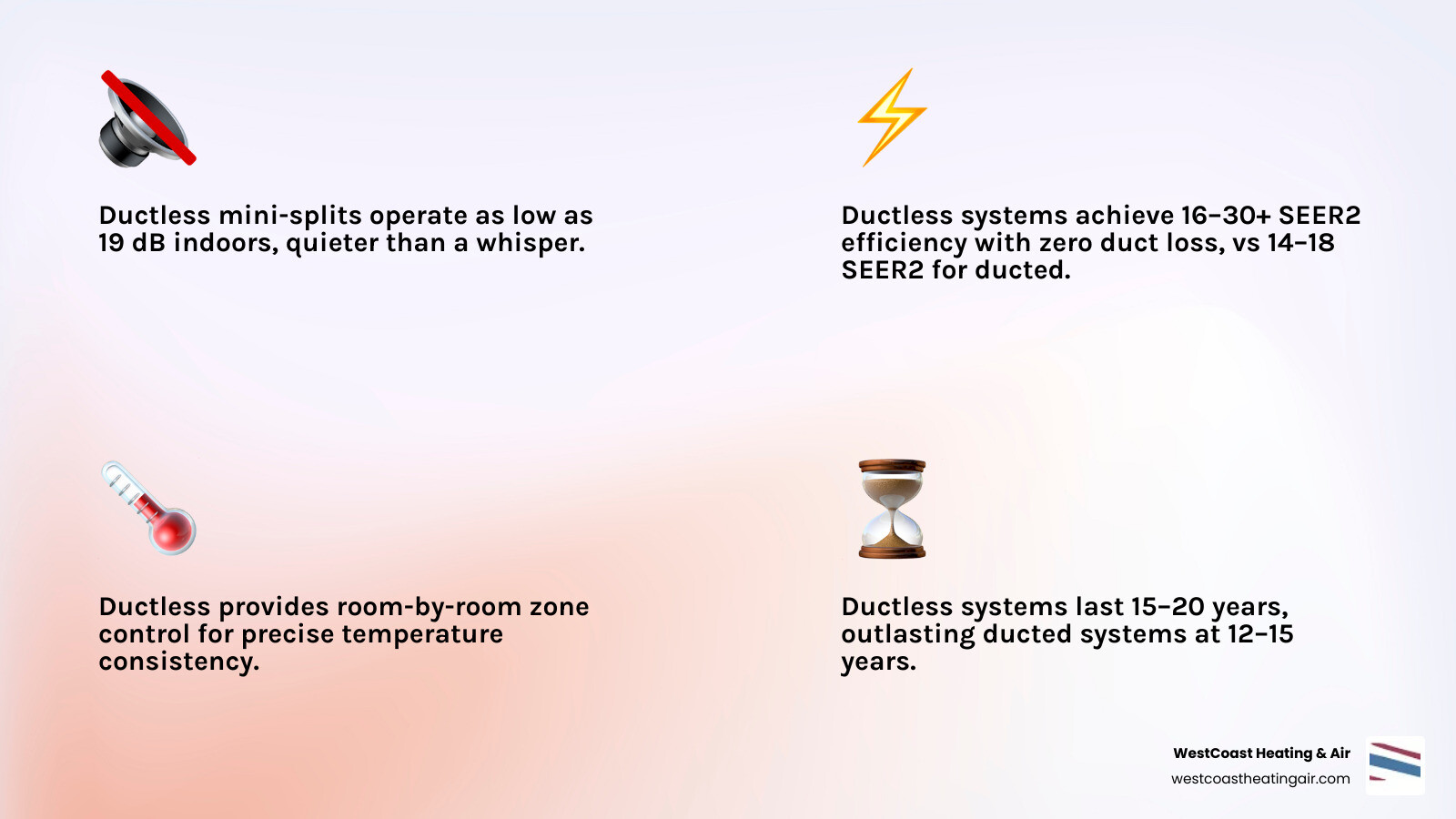
| Energy efficiency | 14–18 SEER2 (typical) | 16–30+ SEER2 |
| Duct energy loss | 20–30% of conditioned air lost | Zero duct loss |
| Comfort control | Whole-home, single thermostat | Room-by-room zone control |
| System lifespan | 12–15 years | 15–20 years |
| Noise level | Moderate (airflow through ducts) | Very quiet (as low as 19 dB indoors) |
| Ideal scenario | Good existing ductwork in place | No ductwork, additions, problem rooms |
Choosing the wrong system doesn’t just affect your comfort — it affects your energy bill every single month for the next 15 years. Homeowners in the Pacific Northwest often assume their existing setup is “good enough,” only to discover that leaky or aging ductwork is quietly draining efficiency and leaving rooms too hot or too cold. Whether you’re replacing an aging system or outfitting a new addition in Puyallup, this decision deserves a clear-eyed look at the full picture — upfront costs, long-term savings, comfort, and air quality all included.
I’m Michael Smith, owner of WestCoast Heating & Air in Puyallup, and after a 30-year career at Boeing followed by hands-on work in residential HVAC across the Pacific Northwest, I’ve helped hundreds of local homeowners work through exactly this ductless vs ducted cost and comfort comparison. In the sections ahead, I’ll walk you through everything you need to make a confident, informed decision for your home.
The Fundamental Differences: A Ductless vs Ducted Cost and Comfort Comparison
To choose the right system for your home in Tacoma or Puyallup, we first need to look under the hood. While both systems use the same basic physics of refrigerant to move heat, the way they deliver that comfort to your living room is entirely different.
A ducted system, often called central air, relies on a large indoor air handler (usually in a garage, basement, or attic) that pushes conditioned air through a network of metal or flexible tubes. It’s a “whole-house” approach. You set one thermostat, and the system works to bring the entire home to that temperature. If your home already has a sturdy, well-sealed duct network, this is often the most straightforward path.
On the other hand, Ductless Heating and Cooling systems—commonly known as mini-splits—skip the “middleman” of ductwork. Instead, a small outdoor unit connects directly to one or more indoor air handlers via thin refrigerant lines and electrical wiring. These indoor units are mounted on walls or ceilings in specific rooms.
The biggest technological leap here is inverter technology. While traditional ducted systems often operate like a light switch—either 100% on or 100% off—most ductless systems use variable-speed compressors. They ramp up or down precisely to match the heating or cooling load of the room. This prevents the “blast of air followed by silence” cycle, leading to much steadier temperatures. For many of our neighbors in University Place and Steilacoom, this precision is the deciding factor in their ductless vs ducted cost and comfort comparison.
Efficiency, Maintenance, and Long-Term Operational Value
When we talk about efficiency in 2026, we have to look at the new SEER2 and HSPF2 standards. These metrics measure how much cooling or heating you get for every dollar of electricity spent.
Ductless systems are the undisputed heavyweight champions of efficiency. While a high-end central Heat Pump might reach 20 SEER2, many ductless mini-splits easily soar past 30 SEER2. But the raw numbers don’t tell the whole story. The U.S. Department of Energy estimates that typical ducted systems lose 20% to 30% of their conditioned air through leaks, poor insulation, or conduction in the ducts themselves. Because ductless systems deliver air directly into the room, that energy waste is virtually eliminated.
Long-Term Savings and Incentives
The operational value of a system isn’t just about the monthly bill; it’s also about the help you get upfront. High-efficiency heat pumps often qualify for significant federal tax credits—sometimes up to $2,000—and various local utility rebates. Because ductless systems are inherently more efficient, they frequently sit in the highest tier for these incentives.
There’s also the matter of longevity. A well-maintained ductless system typically lasts 15 to 20 years, which is about 2 to 5 years longer than the average central AC unit. This is largely due to the inverter technology reducing the mechanical stress of constant on/off cycling.
Maintenance Requirements
Maintenance is a key part of any ductless vs ducted cost and comfort comparison. For ducted systems, you’re looking at changing a central filter every 1 to 3 months and potentially hiring a professional for duct cleaning every 3 to 5 years to maintain air quality. Ductless systems require a more “hands-on” approach from the homeowner; the small filters inside the wall units should be washed every month. However, you’ll never have to worry about cleaning or sealing ducts. For more on this, check out the Ductless Heating Benefits for the Modern Home.
Impact on Whole-Home Comfort and Indoor Air Quality
Comfort is subjective, but in the HVAC world, we measure it through temperature consistency, noise, and air quality.
Zone Control and Air Balancing
One of the most common complaints we hear from homeowners in Orting and Sumner is that the upstairs is sweltering while the downstairs is freezing. This is an issue of Air Balancing: The Art of Avoiding Hot and Cold Spots.
In a ducted system, achieving different temperatures in different rooms requires Furnace Zone Control Systems, which use motorized dampers inside the ducts. It’s effective but can be complex to install. Ductless systems have “zoning” built into their DNA. Each indoor unit has its own thermostat. If you want the guest room at 68 degrees but the home office at 72, a multi-zone ductless system handles it without breaking a print.
| Comfort Feature | Ducted System | Ductless System |
|---|---|---|
| Temperature Uniformity | Good for open floor plans | Excellent for specific rooms |
| Noise Levels | Noticeable “whoosh” of air | Whisper-quiet (19–30 dB) |
| Humidity Control | Centralized dehumidification | Superior localized moisture removal |
| Aesthetics | Hidden; only vents visible | Visible wall or ceiling units |
Air Quality and Noise
Ducted systems generally offer more robust filtration options, as they can accommodate thick, high-MERV filters or whole-home air purifiers. However, ducts can also become breeding grounds for dust and allergens if not maintained. Ductless units provide simpler filtration but avoid the “dust-blowing” associated with old ductwork.
As for noise, if you’ve ever had to turn up the TV because the AC kicked on, you’ll appreciate ductless technology. Indoor mini-split units often operate at decibel levels lower than a library whisper, whereas central systems involve the sound of air moving through metal pipes and the hum of a large central blower.
Frequently Asked Questions about Ductless vs Ducted Cost and Comfort Comparison
Which system offers better energy savings in a ductless vs ducted cost and comfort comparison?
In almost every scenario, a ductless system will offer better energy savings. This is due to three main factors: the lack of ductwork (eliminating 20–30% energy loss), the use of variable-speed inverter compressors that don’t waste power on “all-or-nothing” cycles, and the ability to turn off units in unoccupied rooms. Homeowners often see a 20% to 50% reduction in their heating and cooling costs after switching to ductless.
How does a ductless vs ducted cost and comfort comparison apply to home additions?
For additions like a finished basement in Spanaway or a new sunroom in Puyallup, ductless is almost always the winner. Extending existing ductwork is often expensive and can throw the rest of the house’s airflow out of balance. A single-zone ductless unit provides independent control and takes up zero floor space, making it a much faster and more cost-effective retrofit.
Which system provides superior indoor air quality?
It depends on your needs. Ducted systems allow for advanced whole-home filtration and humidity control systems (like UV lights or large-scale humidifiers). However, if your existing ducts are old, leaky, or dirty, they can actually decrease air quality. Ductless systems offer localized filtration and are easier to keep “clean” because there is no hidden pipework, but they typically can’t match the heavy-duty filtration power of a high-MERV central system.
Conclusion
At WestCoast Heating & Air, we don’t believe in “one-size-fits-all” solutions. Every home in Puyallup, Roy, or University Place has its own unique footprint and comfort challenges. Whether you decide that the invisible, whole-home power of a ducted system is right for you, or the ultra-efficient, zoned precision of a ductless system fits your lifestyle better, our goal is to ensure you understand the long-term impact of your choice.
With over 20 years of local experience, we pride ourselves on customized system design and customer education. We want you to feel confident that your investment will keep your family comfortable through every damp winter and smoky summer for years to come. As a Residential Heating and Cooling Company that treats every home like our own, we’re here to help you navigate the technical details and find the perfect fit.
Ready to see how these numbers look for your specific home? Schedule your consultation for ductless heating and cooling with our expert team today, and let’s bring real comfort back to your living space.