
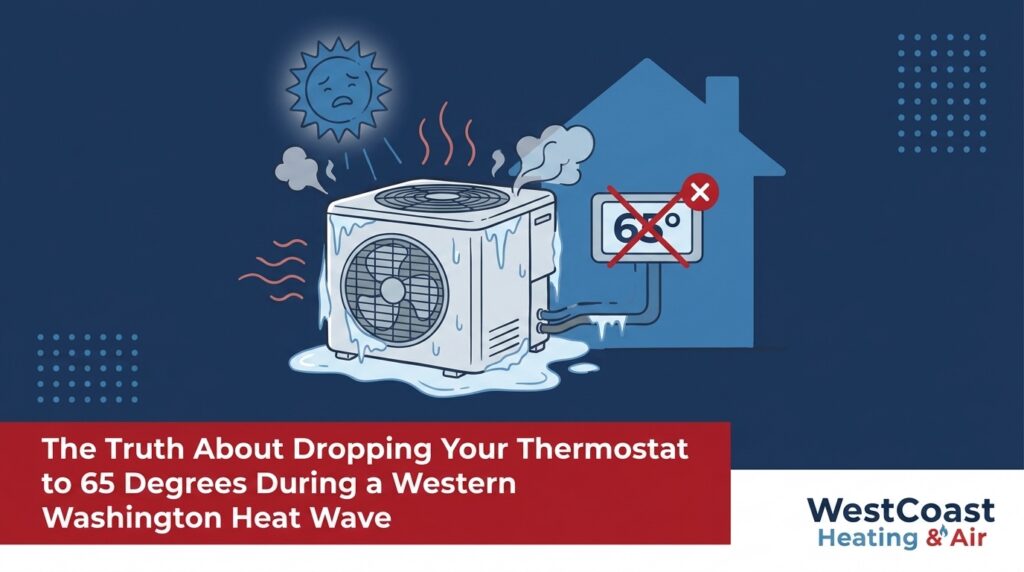
The 65-Degree Cooling Myth: Why Lowering the Thermostat Doesn’t Work Faster
Cranking your thermostat down to a freezing temperature does not force your air conditioner to blow colder air. The truth about dropping your thermostat to 65 degrees during a Western Washington heat wave is that it only forces your equipment to work longer, not faster. When a sudden, intense heat spike hits the region, our team at WestCoast Heating & Air notices a predictable pattern: the immediate reaction for many homeowners is to walk over to the thermostat and drop the target temperature as low as it goes. You feel hot, the house feels stuffy, and you want relief right now.
Here is the short answer from our seasoned technicians: No, dropping your thermostat to 65 degrees will not cool your home faster. A thermostat acts as an on/off switch, not an accelerator. Lowering the number simply tells the system to run continuously until it hits that target—a target it likely cannot reach during extreme weather. Understanding this mechanical reality is the first step in protecting your equipment. If you need help evaluating your system’s efficiency, you can always rely on our professional cooling services to keep your home comfortable.
Expectation vs. Mechanical Reality
| Homeowner Action | What You Expect to Happen | What Actually Happens |
|---|---|---|
| Dropping setting to 65 degrees | The AC blows faster and colder air instantly. | The AC blows the exact same temperature air, but runs continuously. |
| Leaving the system running all day at 65 | The house eventually becomes a frigid 65 degrees. | The system maxes out, overheats, and potentially freezes the indoor coil. |
| Setting it to a realistic 75 degrees | The house stays uncomfortably warm. | The system cycles properly, removes humidity, and maintains a comfortable climate. |
Your Thermostat is a Switch, Not an Accelerator
To understand why the 65 degrees setting fails, you have to look at how residential cooling equipment is built. In our experience working on hundreds of local systems, the vast majority of air conditioners use a single-stage compressor. “Single-stage” means the compressor has exactly one speed: 100% capacity. It is either completely on, or completely off. There is no “medium” setting, and there is certainly no “extra high” setting triggered by a lower thermostat number.
Think of your thermostat like a standard light switch, rather than the gas pedal in your car. If you walk into a dark room and flip the light switch, the bulb turns on at full brightness. Flipping the switch harder or faster does not make the room brighter. Your air conditioner operates on the exact same principle. When the indoor temperature rises above your set point, the thermostat sends a basic electronic signal: “Turn on.” The air conditioner then turns on at its one and only speed.
The Mechanics of a Single-Stage System
When that signal is sent, the system begins circulating chemical refrigerant between the indoor unit and the outdoor unit. This refrigerant absorbs heat from the air inside your home and dumps it outside. The air blowing out of your supply vents is generally about 15 to 20 degrees cooler than the air being pulled into your return vents. This cooling rate is fixed by the physical size of your equipment and the specific properties of the refrigerant.
Setting the thermostat lower does not change the temperature of the air coming out of the vents. It simply moves the finish line further away. If you set it to 65 degrees on a sweltering afternoon, you are demanding that the system run continuously for hours on end. This excessive strain leads to rapid wear and tear. If your system runs constantly but the house stays warm, contact our team to check your AC performance before a minor inefficiency turns into a major breakdown.

The 20-Degree Limit: What Air Conditioners Can Actually Achieve
The biggest hurdle your air conditioner faces during a peak July heat wave is a concept known in the HVAC industry as Delta-T, or temperature differential. Standard residential air conditioners are engineered to maintain roughly a 20-degree difference between the outdoor temperature and the indoor temperature. As we often explain to our customers, this is a hard limit based on the laws of thermodynamics and the physical capacity of standard residential equipment.
If the temperature outside is 80 degrees, your air conditioner can easily maintain a crisp 70 degrees inside. However, if a severe heat wave pushes the outdoor temperature to 95 degrees, the system’s realistic limit is about 75 degrees. If it hits 100 degrees outside, your indoor temperature will likely hover around 80 degrees, no matter how long the system runs.
Understanding the Heat Gain Battle
Why does this limit exist? Because cooling a home is a constant battle against heat gain. Your air conditioner is removing heat, but the sun, the outdoor air, your windows, your appliances, and even the people inside the house are constantly adding heat back in. When the outdoor temperature spikes 20 to 30 degrees above average, the rate of heat gain entering the house eventually matches the rate of heat removal provided by the AC.
Factors that accelerate heat gain during a heat wave:
- Direct solar radiation: Uncovered south- and west-facing windows act like magnifying glasses, pumping radiant heat directly into your living space.
- Attic temperatures: A poorly ventilated attic can easily reach 130 to 150 degrees, radiating heat down through the ceiling.
- Internal heat sources: Ovens, stovetops, dryers, and incandescent lighting add significant thermal load to the home.
- Air leaks: Gaps around doors and windows allow heavy, hot outdoor air to infiltrate the conditioned space.
When you set the thermostat to 65 degrees on a 95-degree day, you are asking the system to overcome a 30-degree differential. It cannot win that battle. The Department of Energy (DOE) recommends setting thermostats to 78 degrees in the summer for an optimal balance of comfort, energy efficiency, and equipment longevity.
Why Pacific Northwest HVAC Systems Max Out Faster
The 20-degree rule applies everywhere, but we see it hit particularly hard in Puyallup WA and Western Washington. To understand why our dispatch board fills up on peak summer days, you have to look at how local homes were built and how local HVAC systems are sized. Historically, homes in this region were constructed with one primary goal: keeping the cold, wet winter weather out. They were designed to trap heat.
Many older homes in the area lack the deep thermal envelopes—specifically the advanced attic insulation and dual-pane, low-E windows—found in traditionally hot climates like Arizona or Texas. When a severe summer heat wave strikes, these homes absorb and retain extreme heat rapidly. The building materials themselves heat up, creating a massive thermal load that the air conditioner must fight against.
The Reality of Local System Sizing
Furthermore, HVAC systems are sized based on historical climate data. When a professional installer calculates the required cooling capacity for a home (a process called a Manual J load calculation), they look at the average historical high temperatures for the specific region. They do not size the equipment for the single hottest day of the decade.
If an installer puts an oversized air conditioner in a home just to handle rare 100-degree days, that system will perform terribly during the normal 80-degree days that make up the bulk of our summers. An oversized system cools the air too quickly and shuts off before it has a chance to remove humidity, leaving the home feeling cold but clammy. Because our local systems are perfectly sized for moderate, typical summers, they max out their cooling capacity much faster during extreme spikes. This is exactly why your AC struggles during afternoon heat spikes.
The Dangers of Forcing Your AC to Run Continuously
Leaving your thermostat set to 65 degrees during a heat wave does more than just waste electricity; it actively damages your equipment. When an air conditioner runs continuously without its normal off-cycles, it is pushed beyond its intended design limits. A pattern we see often during July heat waves is that the most common and immediate consequence of this abuse is a frozen evaporator coil.
The evaporator coil is the indoor component of your AC system. It gets extremely cold as refrigerant expands inside it. Under normal operation, the system cycles off periodically, allowing any condensation on the coil to drip safely into the drain pan. When you force the system to run non-stop, that condensation never gets a chance to drain.
The Domino Effect of a Frozen Coil
A frozen coil is a cascading failure that usually follows a specific sequence of events:
- Continuous operation: The thermostat demands 65 degrees, so the system never shuts off.
- Temperature drop: The continuous flow of refrigerant causes the surface temperature of the indoor coil to drop below 32 degrees Fahrenheit.
- Ice formation: Normal humidity and condensation on the coil begin to freeze into a thin layer of frost.
- Airflow blockage: As the ice thickens, it blocks the narrow fins of the coil, restricting the warm return air from blowing over the cold metal.
- Complete freeze-up: Without warm air to absorb the cooling energy, the ice rapidly encases the entire coil and travels down the refrigerant lines.
Once the coil freezes, your system will blow warm air, or you may notice water pooling around the base of your indoor furnace or air handler as the ice slowly melts. Worse, a frozen coil can cause liquid refrigerant to flow backward into the outdoor compressor. Compressors are designed to pump gas, not liquid. This liquid “slugging” can instantly destroy the compressor, leading to a catastrophic and expensive failure. If you notice ice on your refrigerant lines or warm air coming from your vents, turn the system off immediately and seek reliable AC repair in Tacoma.
Frequently Asked Questions About Summer AC Settings
During a peak July heat wave, homeowners inevitably face the same frustrating cooling challenges. We have compiled the most common questions regarding thermostat settings and system performance to help you navigate extreme weather without damaging your equipment.
Does lowering the thermostat cool the house faster?
No, lowering the thermostat does not cool the house faster. A standard air conditioner operates at a single, constant speed regardless of the temperature setting. Setting the thermostat to 65 degrees simply tells the system to run continuously until it reaches that temperature, which it likely cannot achieve during a heat wave. Your system will remove heat at the exact same rate whether the thermostat is set to 75 degrees or 65 degrees.
What happens if I set my AC to 65 degrees in the summer?
If you set your AC to 65 degrees during the summer, the system will run non-stop, causing your energy bills to skyrocket and putting immense strain on the mechanical components. Because standard residential systems can only maintain about a 20-degree difference from the outside temperature, the AC will never reach 65 degrees on a hot day. This continuous running greatly increases the risk of freezing the indoor evaporator coil and burning out the outdoor compressor.
Why is my AC running continuously but not cooling?
If your AC is running continuously but not cooling, it is usually because the system has maxed out its Delta-T capacity, the evaporator coil has frozen, or the air filter is severely clogged. During extreme heat, the system may simply be unable to overcome the heat gain entering the home. However, if the air blowing from the vents feels warm, check the outdoor unit for ice on the copper lines. If you see ice, turn the system off immediately to let it thaw and check your air filter before restarting.
What should I set my thermostat to when it’s 95 degrees outside?
When it is 95 degrees outside, you should set your thermostat between 75 and 78 degrees. This respects the 20-degree temperature differential rule and ensures your system can actually reach the target temperature and cycle off. To stay comfortable at 78 degrees, use ceiling fans to create a wind-chill effect on your skin, which can make the room feel several degrees cooler without adding strain to your HVAC equipment.
How can I help my AC keep up during a heat wave?
You can help your AC keep up by minimizing the amount of heat entering your home during the hottest parts of the day. Close all blinds, shades, and curtains on south- and west-facing windows to block radiant solar heat. Avoid using heat-generating appliances like ovens, stoves, and clothes dryers until the late evening. Finally, ensure your HVAC air filter is completely clean, as restricted airflow will severely cripple the system’s ability to remove heat from the house.
Protect Your AC and Stay Comfortable This Summer
Surviving a heat wave in Puyallup WA and Western Washington requires working with your HVAC system, not against it. As the local experts at WestCoast Heating & Air, we want you to know that the truth about dropping your thermostat to 65 degrees during a Western Washington heat wave is that it provides zero immediate relief and actively threatens the lifespan of your equipment. Your air conditioner is a powerful machine, but it is bound by the physical limits of temperature differential and regional home insulation.
Instead of panicking and dropping the temperature setting, aim for a realistic target based on the 20-degree rule. Keep your filters clean, block out the afternoon sun, and let the system cycle normally. By setting a sustainable temperature, you ensure your equipment continues to run efficiently, keeping your home consistently comfortable without the looming threat of a breakdown. If your system is struggling to maintain even a realistic temperature gap, it is time to have a local professional evaluate its performance.