
Why HVAC Replacement Is a Smart Investment — and What It Means for Your Bottom Line
Why HVAC replacement is a smart investment comes down to a straightforward reality: at some point, the money you keep spending on an aging system would be better spent on a new one that pays you back every month. If your energy bills keep climbing, repair calls are becoming routine, or your system is pushing past the 12–15 year mark, you’re likely past that tipping point.
Here’s a quick summary of why replacing your HVAC delivers real financial return:
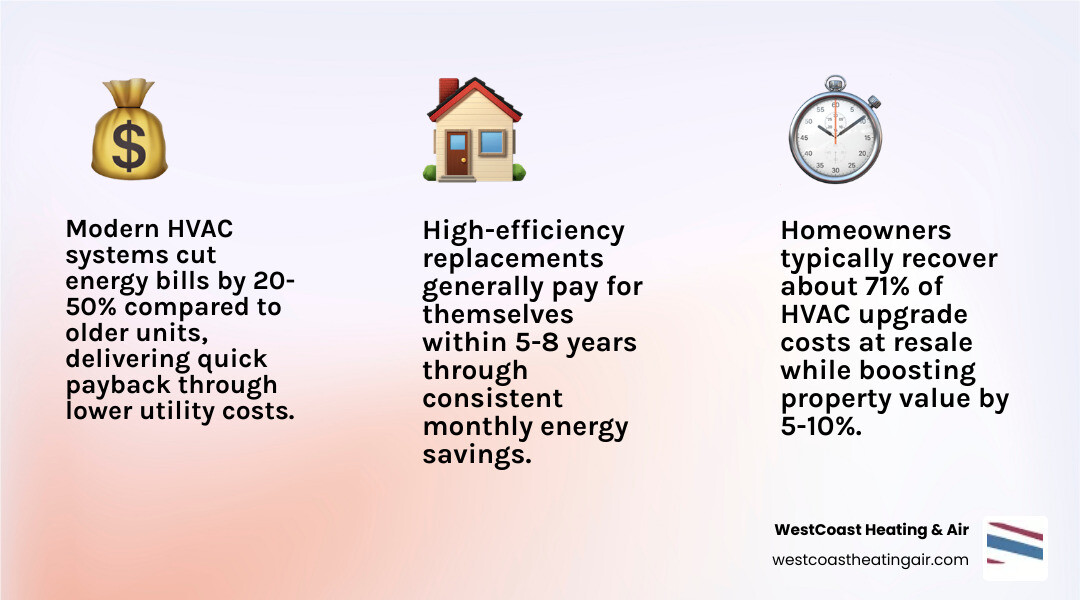
- Lower energy bills: Modern high-efficiency systems reduce heating and cooling costs by 20–50% compared to older units
- Faster home sales: Homes with new HVAC systems sell 10–15% faster than comparable homes with aging equipment
- Higher home value: A new system can add 5–10% to your home’s appraised value
- Strong cost recovery: Homeowners typically recoup approximately 71% of HVAC upgrade costs at resale
- Quick payback: High-efficiency systems generally pay for themselves within 5–8 years through utility savings alone
- Available incentives: Federal tax credits and utility rebates in 2026 can significantly offset upfront costs
- Safety improvements: Eliminating risks like carbon monoxide leaks from cracked heat exchangers and expensive phased-out refrigerants
For Puyallup homeowners dealing with the Pacific Northwest’s damp winters and warm summers, an outdated system isn’t just uncomfortable — it’s a financial drain that compounds over time. Whether you’re planning to stay in your home for years or getting ready to list it, understanding the full return on investment behind HVAC replacement helps you make a confident, data-driven decision.
I’m Michael Smith, owner of WestCoast Heating & Air in Puyallup, and after 30 years at Boeing followed by years serving local families with heating and cooling solutions, I’ve seen how why HVAC replacement is a smart investment stops being a theory and starts being a reality on your utility bill. In this guide, I’ll walk you through the financial frameworks, incentives, and home value impacts that make replacement one of the smartest moves a homeowner can make.
Basic why hvac replacement is a smart investment terms:
- does a new hvac help sell your home faster
- how a new hvac system increases home value
- how hvac condition affects home appraisals
I’m looking to upgrade my home’s heating and cooling. Who in Puyallup specializes in energy-efficient HVAC replacement?
When homeowners in Puyallup, Tacoma, or Sumner begin noticing uneven temperatures, strange noises, or spiking utility bills, their first question is often: Who can I trust to design a system specifically for my home’s layout and our local climate?
In Western Washington, we don’t experience the extreme, dry heat of the desert or the sub-zero winters of the Midwest. Instead, we deal with a unique marine climate characterized by high humidity, damp winters, and increasingly warm summers. This means your heating and cooling equipment has to work hard to manage both temperature and moisture levels. An off-the-shelf, oversized system will short-cycle, leaving your home feeling clammy and driving up your energy bills.
At WestCoast Heating & Air, we specialize in customized residential system design. Backed by over 20 years of local experience, our family-owned team doesn’t believe in one-size-fits-all installations. We take the time to educate you on your options—whether that’s a high-efficiency ducted heat pump, a hybrid dual-fuel system, or a sleek ductless mini-split setup. We focus on matching the exact thermal load of your home, ensuring your new investment operates at peak performance for its entire lifespan.
If you are noticing that your current system is struggling to keep up with seasonal shifts, it is helpful to look out for the early warning indicators. To learn what to watch for before a total system failure occurs, check out our guide on the Signs It’s Time to Upgrade Your HVAC System.
The Financial Framework: Why HVAC Replacement Is a Smart Investment
Deciding whether to patch up an old unit or invest in a brand-new system can feel overwhelming. Many homeowners fall into the “repair spiral”—paying for one minor fix this winter, another next summer, and suddenly realizing they have spent thousands of dollars on a terminal machine.
To make a truly smart investment, it helps to look at your HVAC system as a financial vehicle that pays monthly dividends in the form of utility savings. When you replace an old, inefficient system (typically rated at 8 to 10 SEER) with a modern high-efficiency unit (ranging from 16 to 22+ SEER2), you can immediately cut your heating and cooling energy consumption by 20% to 50%.
Because building operations consume roughly 40% of the energy and 74% of the electricity produced in the United States annually, upgrading your home’s system has a massive impact on your household’s energy footprint. Over a typical 15-year equipment lifespan, these monthly utility savings add up dramatically, allowing high-efficiency systems to pay for themselves within 5 to 8 years.
To help you visualize where your current system stands, we have created a direct comparison of repair and replacement indicators. If you’re weighing your options right now, you can find deeper insights in our comprehensive resources: Everything You Need to Know About When to Repair vs Replace Your HVAC System and our Step-by-Step Guide to Repair vs Replace Your Furnace or Heat Pump.
| Decision Factor | Lean Toward Repair | Lean Toward Replacement |
|---|---|---|
| System Age | Under 10 years old | Over 12–15 years old |
| Refrigerant Type | Modern R-410A or R-454B | Phased-out R-22 (Freon) |
| Repair Frequency | First major issue in several years | 2 or more repairs in the last 24 months |
| Utility Bill Trend | Stable, seasonal fluctuations only | Steady, unexplained increases of 20%–40% |
| Safety Status | Clean combustion, no electrical shorts | Cracked heat exchanger, carbon monoxide risks |
How the 50% Rule and Age Thresholds Prove Why HVAC Replacement Is a Smart Investment
To remove emotion from the decision-making process, professional HVAC contractors and financial planners rely on two objective mathematical frameworks: the 50% Rule and the $5,000 Rule.
The 50% Rule is simple: if a single repair quote exceeds 50% of the cost of a brand-new, fully installed system, you should invest that money into a replacement instead. Sinking half the value of a new system into an old machine that carries no warranty on its remaining parts is rarely a wise financial move.
The $5,000 Rule adds an extra layer of precision by factoring in the exact age of your equipment. To use this rule, multiply the age of your system by the repair quote:
System Age (Years) × Repair Quote = Decision Score
If your Decision Score is above $5,000, the math strongly favors replacement. If it is below $5,000, a repair is likely the more practical short-term choice.
Let’s look at two real-world examples:
- Scenario A: You have a 6-year-old air conditioner that needs a new capacitor. The repair quote is $300. Multiplying 6 by $300 gives you a score of $1,800. Since this is well below the $5,000 threshold, repairing the unit is the smart path.
- Scenario B: You have a 13-year-old heat pump with a failed compressor. The repair quote is $1,200. Multiplying 13 by $1,200 gives you a score of $15,600. Because this score is far above the $5,000 threshold, continuing to repair this aging unit is a sunk cost.
Understanding the expected lifespan of your equipment is critical when applying these rules. In our local climate, central air conditioners typically last 12–15 years, heat pumps last 10–15 years, and well-maintained gas furnaces can last 15–20 years. To learn more about how our regional weather affects your system’s longevity, read The Cold Hard Truth About HVAC Lifespans in the Northwest.
Leveraging 2026 Tax Credits and Rebates to Maximize Your Return

One of the reasons why HVAC replacement is a smart investment in 2026 is the unprecedented availability of federal, state, and local financial incentives. These programs are designed to lower the upfront barrier of upgrading to high-efficiency, eco-friendly systems.
Under the Inflation Reduction Act, Washington homeowners can access substantial savings. While some historic tax credits under Section 25C have shifted, new state-administered programs under the Home Energy Appliance Rebates (HEAR) are rolling out. These programs offer significant rebates—up to several thousand dollars for income-qualified households—when upgrading to energy-efficient heat pump technology. You can read a full breakdown of these local advantages in our guide to the Inflation Reduction Act Benefits for Washington Homeowners.
Additionally, local utilities in our service areas offer direct incentives to encourage energy conservation:
- Tacoma Public Utilities (TPU): Provides excellent rebates and low-interest financing options for customers upgrading to high-efficiency heat pumps. Learn how to take advantage of these perks in our article on Tacoma Public Utilities Efficiency Incentives That Put Money Back in Your Pocket.
- Puget Sound Energy (PSE): Offers generous rebates for qualifying ductless mini-splits and high-efficiency electric heat pumps.
Navigating these programs can feel complicated, but you don’t have to do it alone. A quality contractor will handle the heavy lifting, ensuring your new system meets the exact efficiency criteria required for every eligible rebate. Discover how we streamline this process for you in our guide on How Your HVAC Contractor Helps You Access Rebates.
Maximizing Property Value, Comfort, and Resale Appeal
An HVAC system is unique because it is one of the few home improvements that appeals equally to appraisers, real estate agents, and prospective buyers. Unlike a kitchen remodel or a bathroom upgrade—where personal design tastes can vary wildly—everyone values reliable, energy-efficient comfort.
If you are planning to sell your home in Puyallup, Tacoma, or University Place, the condition of your heating and cooling system will play a major role in buyer negotiations. Today’s buyers are incredibly savvy; in fact, 72% of home buyers prioritize energy-efficient features when searching for a new home.
When a buyer walks through an open house and sees a shiny, modern outdoor heat pump, it acts as an insurance policy for their bank account. They know they won’t have to face an emergency replacement cost shortly after moving in. Conversely, an ancient, rusted unit signals future expenses and immediate maintenance headaches.
This peace of mind translates directly into faster sales and higher offers. Homes with new HVAC systems sell 10% to 15% faster than comparable properties with aging equipment. Furthermore, real estate appraisers recognize a new heating and cooling system as a major capital improvement that extends the functional life of the property. On average, a new HVAC system can add 5% to 10% to a home’s appraised value, allowing homeowners to typically recoup approximately 71% of the upgrade costs at resale.
To explore how a modern system protects your equity during a transaction, read The Ultimate Guide to Does a New HVAC Help Sell Your Home Faster? and The Ultimate Guide to How HVAC Condition Affects Home Appraisals.
Why HVAC Replacement Is a Smart Investment Before Listing Your Home
If you know your heating or cooling system is on its last legs, waiting for a buyer’s home inspector to flag it is often the most expensive way to handle the situation.
When an inspector notes that an HVAC system is past its expected lifespan or in need of major repairs, it gives the buyer massive leverage. Buyers will often overestimate the cost of a replacement and demand a steep price concession—sometimes twice what the actual installation would cost. Alternatively, they may demand that you replace the system immediately using a contractor of their choosing, leaving you with zero control over the equipment selected or the quality of the installation.
By proactively replacing the system before listing your home, you retain complete control over the project. You can choose a reliable local contractor, select a system that fits your budget, take advantage of any available 2026 tax credits and rebates, and present a fully transferable warranty to the buyer. This completely eliminates a major inspection hurdle and keeps your transaction on track. To see how an outdated cooling system can hurt your listing, read our article: Is Your Old AC Killing Your Resale Price?.
Indoor Air Quality and Modern Comfort Upgrades
While the financial return on investment is easy to measure on paper, the “comfort ROI” is what you will feel every single day. Older HVAC systems are typically single-stage, meaning they operate like a light switch—they are either 100% on or completely off. This leads to annoying temperature swings, hot and cold spots, and constant on-and-off cycling noises.
Modern high-efficiency systems utilize variable-speed technology. Instead of blasting air at full capacity and then shutting down, a variable-speed motor operates like cruise control on a car. It adjusts its output in tiny increments to match the exact heating or cooling load of your home. This delivers incredibly consistent temperatures, eliminates drafts, and operates so quietly you’ll barely know it’s running.
Additionally, variable-speed systems provide superior humidity control. Because they run for longer, gentler cycles, they constantly pull moisture out of the air. In the damp Pacific Northwest, maintaining indoor humidity between 30% and 50% is crucial for preventing mold growth and dust mite infestations.
When paired with advanced filtration—such as MERV 13 media filters or whole-home air purifiers—a new system constantly scrubs your indoor air, removing pollen, agricultural dust, and pet dander. For families suffering from asthma or seasonal allergies, this improvement in indoor air quality is priceless.
Frequently Asked Questions about HVAC Replacement
How long does a typical residential HVAC system last?
In our Western Washington climate, system lifespans generally fall within the following ranges:
- Central Air Conditioners: 12 to 15 years
- Heat Pumps: 10 to 15 years
- Gas Furnaces: 15 to 20 years
While routine professional maintenance can extend these systems toward the upper end of their limits, their operating efficiency will naturally decline in their final years. If your system is within these age brackets and requires frequent repairs, planning a replacement is the most financially sound path.
Can a new high-efficiency HVAC system pay for itself?
Yes, absolutely. By upgrading from an older, inefficient unit to an ENERGY STAR certified system, you can expect to reduce your heating and cooling energy use by 20% to 50%. When you combine these monthly utility savings with the avoided costs of emergency repairs and leverage 2026 tax credits and rebates, most systems reach their break-even point within 5 to 8 years. Over a 15-year lifespan, this leaves you with nearly a decade of pure monthly savings. To see how much you can save on heating specifically, check out The Definitive Guide to High Efficiency Furnace Cost Savings.
What safety risks make immediate HVAC replacement necessary?
There are two critical safety hazards that make immediate replacement necessary:
- Cracked Heat Exchangers: In a gas furnace, a cracked heat exchanger is an extreme hazard that can leak deadly, odorless carbon monoxide gas into your home’s ductwork. If a technician discovers a crack during an inspection, they are legally required to shut down the system immediately for your safety.
- Phased-Out R-22 Refrigerant: Older air conditioners and heat pumps manufactured before 2010 rely on R-22 (Freon), which has been completely phased out by the EPA due to its ozone-depleting properties. If an R-22 system develops a refrigerant leak, sourcing reclaimed Freon is incredibly expensive and scarce, making a simple recharge financially impractical compared to upgrading to a modern, eco-friendly system.
Conclusion
Investing in a new heating and cooling system is more than just buying a piece of machinery—it is a strategic financial decision that protects your home’s structural integrity, slashes your monthly utility bills, and enhances your family’s daily comfort and health.
At WestCoast Heating & Air, we are proud to be the trusted residential heating and cooling company for homeowners throughout Puyallup, Tacoma, University Place, Sumner, Spanaway, and the surrounding areas. As a local, family-owned business, we are committed to top-quality products, customized system designs, and clear customer education. We don’t just install systems; we build long-term relationships backed by over 20 years of local experience.
If you are ready to stop throwing money at an unreliable, aging system and want to explore how a modern high-efficiency upgrade can pay you back, we are here to help. Contact our friendly, expert team today to design the perfect comfort solution for your home!