
Surviving the Afternoon Heat: Is Your AC Working Too Hard?
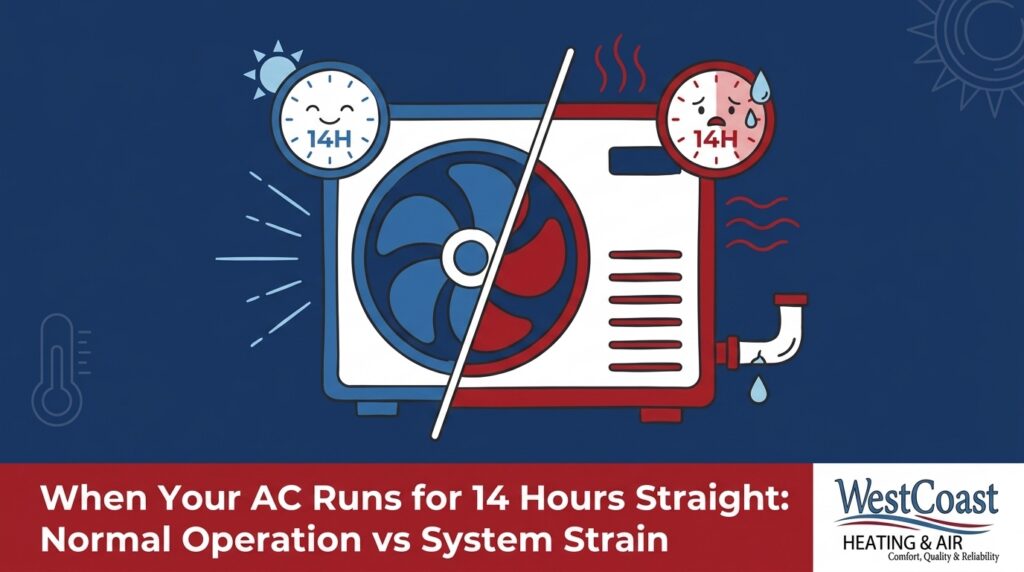
Late August in the Pacific Northwest usually brings a familiar shift in the weather, pushing afternoon temperatures far above normal and forcing your cooling system to work overtime. When your AC runs for 14 hours straight: normal operation vs system strain becomes the most important question on your mind. You hear the compressor humming outside without a break, and panic starts to set in. Is the unit about to break down, or is it just doing exactly what it was built to do?
If you are trying to decide whether to turn the system off to give it a rest or leave it running, you are not alone. For a deeper look at how regional weather impacts your comfort, check out our Pacific Northwest cooling guide. And if you ever feel that your system is truly struggling, you can always count on reliable AC repair without worrying about unnecessary upselling.
The concrete problem: It is 4 p.m., the sun is beating down on your roof, and your air conditioner has not cycled off since before lunch. Your instinct might tell you that a machine running this long is headed for a catastrophic failure. However, modern HVAC technology is specifically designed to handle long, continuous cycles during extreme late-August Pacific Northwest heatwaves. Understanding the difference between a system working hard and a system actively failing is the key to protecting your home’s comfort and your peace of mind.
The Science of Heat Load: Designing for Pacific Northwest Summers
To understand why your air conditioner is running non-stop, you first have to look at how homes in our region are built. Puyallup WA residential homes were historically constructed to retain heat for the long, damp winters, not to shed heat during intense summer spikes. When we look at the mechanics of cooling a home, it all comes down to a concept called “heat load.” This is the amount of heat energy that must be removed from your indoor space to maintain your desired temperature.
During a typical summer day, your AC removes heat faster than the sun can push it inside. But when extreme weather hits, the balance shifts. You can learn more about this specific phenomenon by reading about AC struggles during afternoon heat spikes. When ambient temperatures exceed the system’s maximum design threshold, the unit must run at 100% capacity just to keep the indoor temperature from rising.
Historical Design Temperatures vs. Modern Heatwaves
HVAC systems are sized using “design temperatures.” A design temperature is a historical weather average used to calculate the exact size of the equipment your home needs. For the Puget Sound area, historical residential cooling design temperatures typically sit around 82 to 85 degrees Fahrenheit. This means your air conditioner is perfectly sized to cool your home efficiently when it is 85 degrees outside.
The mathematical gap between an 85-degree design and a 95-degree modern reality is significant. When the outdoor temperature spikes to 95 degrees or higher, your system is officially operating beyond its historical design parameters. It is not undersized; it is simply fighting a battle it was never originally meant to fight. To overcome this massive heat load, the system has no choice but to run continuously. It is holding the line, ensuring your home stays at 72 degrees even when the outside air is sweltering.
How Thermal Mass Affects Your Home
Heat does not just sit in the air. It soaks into the physical structure of your house. This is known as thermal mass. Your walls, roof, attic insulation, hardwood floors, and even your living room sofa absorb and radiate heat throughout the day. When the sun beats down on your roof for ten hours, all that building material acts like a giant thermal battery, storing heat and slowly releasing it into your living space.
Your air conditioner has to remove the heat from the air, but it also has to constantly remove the radiant heat bleeding out of your walls and furniture. This continuous effort requires long run cycles. One local homeowner reached out to us during a warm spring spell when their eight-year-old HVAC system failed prematurely due to hidden installation errors from a previous contractor. By identifying structural and thermal mass issues that other companies had missed, we were able to perform high-quality work and quickly replace the system, preventing major issues before the severe summer weather arrived.
The ‘Give It a Rest’ Myth: Why Shutting Off Your AC Costs You More
The Problem: When an air conditioner runs for 12 or 14 hours straight, a common homeowner instinct is to turn the thermostat off. The logic seems sound: the motor has been running all day, so it must need a break to prevent overheating or burning out.
The Cause: This instinct comes from a misunderstanding of how modern scroll compressors and blower motors work. Unlike a car engine that might overheat if pushed to the redline constantly, HVAC compressors are continuous-duty motors. They are engineered to run for hours on end. The real stress on an air conditioning system actually occurs during the startup phase. Turning the system on and off repeatedly causes far more electrical and mechanical wear than simply letting it run.
The Solution: Leave the system running. Shutting the system down during the peak heat of the day is one of the worst things you can do for your home’s comfort and your energy bills. For a related perspective on managing your thermostat, you might wonder about turning off the household AC when leaving your home. While adjusting the temperature slightly when you leave is fine, completely powering down the unit during a late-August Pacific Northwest heatwave allows the home’s thermal mass to rapidly absorb heat.
The Trap of Rising Indoor Temperatures
If you turn off your AC at 2 p.m. to “give it a rest,” the indoor temperature will skyrocket. The heat stored in your attic and walls will immediately flood the living space. By the time you turn the system back on at 5 p.m., your house might be 85 degrees inside.
Every air conditioner has a “recovery capacity,” which is its ability to drop the indoor temperature. During extreme heat, a system’s recovery capacity is nearly zero. It can hold a steady temperature, but it cannot lower a high temperature until the sun goes down. By turning the system off, you trap yourself in a hot house, and your AC will consume exponentially more energy trying to cool down a boiling house than it would have used simply maintaining a comfortable temperature all afternoon.
Normal Operation Checklist: Signs Your System is Doing Its Job
When you are listening to your system run continuously, you need a way to verify that it is actually working and not just spinning its wheels. If your system meets the following criteria, you can rest easy knowing it is functioning correctly despite the long run time.
- The indoor temperature is holding steady: If your thermostat is set to 72 degrees, and the house stays at 72 degrees while it is 95 degrees outside, your system is a champion. Even if the temperature creeps up to 74 degrees during the absolute hottest part of the afternoon, holding that line is a massive success against the heat load.
- Air coming from the vents feels consistently cold: Place your hand near a supply register. The air blowing out should feel significantly colder than the room air. If it feels crisp and chilly, the compressor and refrigerant cycle are doing their jobs perfectly.
- The indoor humidity level feels comfortable: Continuous running is actually excellent for dehumidification. An AC removes moisture from the air as a byproduct of cooling. Short cycles leave your home feeling clammy, but long, steady runs pull gallons of water out of the indoor air, making the home feel cooler even at higher temperatures.
- The outdoor unit fan is spinning smoothly: Walk outside and look at the condenser unit. The large fan on top should be spinning rapidly and smoothly. You should hear the steady hum of the compressor, without any unusual grinding, screeching, or clanking noises.
To make it easier to see the difference at a glance, here is a quick breakdown of what to look for:
| Component / Factor | Normal Operation (Working Hard) | System Strain (Failing) |
|---|---|---|
| Indoor Temperature | Holding steady or rising very slowly | Rapidly rising despite AC running |
| Vent Airflow | Consistently cold and crisp | Lukewarm or room temperature |
| Operating Cycle | Running continuously for hours | Short-cycling (on/off rapidly) |
| Visual Inspection | Condensation dripping outside safely | Visible ice on copper lines or coils |
System Strain Checklist: Clear Indicators of Impending Failure
While continuous operation is normal during a heatwave, there are specific warning signs that indicate your system is genuinely struggling and requires professional intervention. If you notice any of these symptoms in your Puyallup WA residential home, it is time to take action.
- The indoor temperature is steadily rising: If your AC is running constantly but the indoor temperature climbs from 72 to 78, and then to 82 degrees, the system has lost its cooling capacity. It is running, but it is not transferring heat.
- Air coming from the vents feels lukewarm: If the airflow is strong but the air feels like room temperature or slightly warm, you likely have a refrigerant issue or a failing compressor.
- Visible ice formation: Check the indoor evaporator coils (if accessible) and the thick copper refrigerant line running to the outdoor unit. If you see white frost or solid ice building up, turn the system off immediately. Ice indicates restricted airflow or low refrigerant, and continuing to run the system can destroy the compressor.
- The system is short-cycling: If the unit turns on for three minutes, shuts off, and then turns right back on again before getting stuck in a long run cycle, the motors are experiencing extreme electrical strain.
Proactive AC maintenance is the best way to prevent these exact failure points before the late-August heat arrives. Earlier this spring, a local customer experienced a sudden system issue requiring urgent repair. Our technician arrived within two hours, quickly assessed the problem, and provided a reliable solution. At WestCoast Heating & Air, we believe in an honest evaluation approach: if you see these signs of strain, we will diagnose the actual problem and fix it without upselling you on a new system you might not need.

Frequently Asked Questions About Continuous AC Operation
Is it bad if my AC runs constantly in 90 degree weather?
No, it is not inherently bad. Systems are designed to run continuously during extreme heat to match the heat load of your home. When the outdoor temperature exceeds the historical design temperature of your region, the unit must operate at full capacity just to prevent the indoor air from getting warmer. As long as it is blowing cold air, continuous operation is completely normal.
Should I turn off my AC to give it a rest?
No. Turning it off allows heat to accumulate in the home’s thermal mass, making the system work much harder later. If you shut the unit down during peak afternoon heat, your drywall, floors, and furniture will absorb the heat. When you turn the AC back on, it will have to run even longer to remove that trapped heat, costing you more energy and comfort.
How many hours a day should an AC run in summer?
During mild days, it may cycle on and off regularly, running for a total of 6 to 8 hours. During severe heatwaves, 12 to 16 hours of operation is common and entirely safe. The runtime depends entirely on the outdoor temperature and how well your home is insulated against the elements.
What happens if an AC runs for prompt straight?
As long as it is blowing cold air and maintaining temperature, prompt operation simply means it is combating an extreme heat load. Modern continuous-duty motors are built to handle this type of marathon running. The only time a prompt run cycle is a problem is if the indoor temperature is rising while the unit runs.
Does continuous operation mean my AC is undersized?
Not necessarily. If it maintains the set temperature on the hottest days of the year, it is correctly sized for your home. An undersized unit will completely fail to maintain the temperature, allowing the house to get hotter and hotter as the day progresses. Continuous running is just a sign that the system is working at its maximum designed capacity.
How does continuous running affect indoor humidity?
Continuous operation actually improves dehumidification, as the system constantly pulls moisture out of the indoor air. Air conditioners remove humidity as air passes over the cold indoor coil. Short cycles do not give the system enough time to extract moisture, but long, steady runs keep your indoor air feeling dry, crisp, and comfortable.
Making the Right Call for Your Comfort and Safety
When extreme weather hits the Pacific Northwest, your cooling system becomes the most important appliance in your home. A long runtime is usually a sign of your system working hard to protect your comfort against an overwhelming heat load. If you are wondering about when your AC runs for 14 hours straight: normal operation vs system strain, remember to check the basics: if the air is cold and the temperature is steady, let the machine do its job.
However, if you notice the clear indicators of impending failure from our system strain checklist—like lukewarm air, rising indoor temperatures, or visible ice—professional diagnosis is the next step. Do not wait for a struggling system to completely fail. Schedule an inspection with local experts who prioritize honest assessments, ensuring your home stays cool and comfortable no matter how high the temperatures climb.