
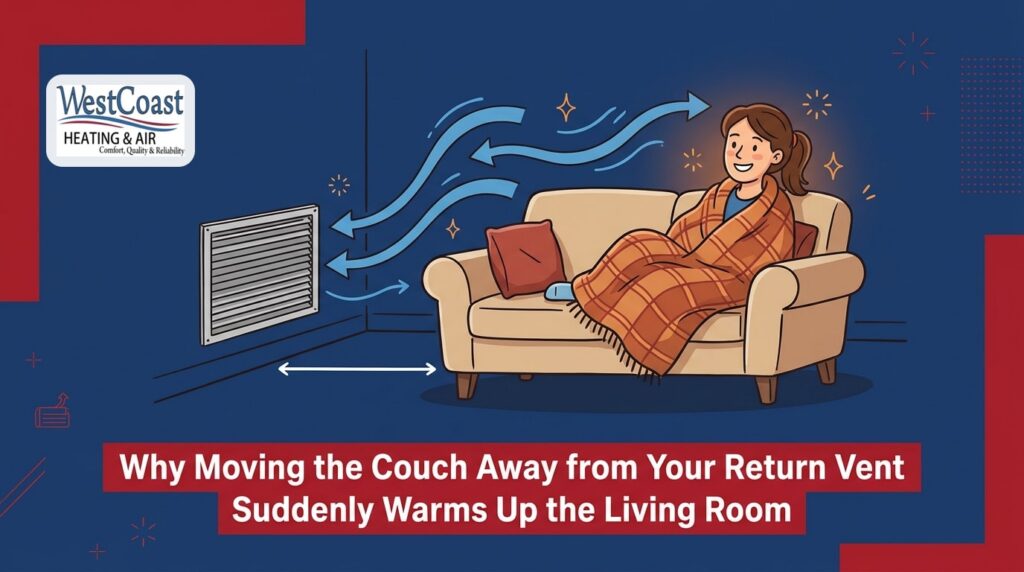
That Stubbornly Cold Living Room Might Just Be a Furniture Problem
Your furnace is running continuously, the blower motor is humming loudly, but your main living area still feels like an icebox. If you have furniture blocking return air vent grilles, that stubbornly cold room might not be a mechanical failure at all. During those crisp November pre-winter cold snaps, discovering a single freezing room in an otherwise warm house is incredibly frustrating. You might immediately suspect a broken heater, a failing thermostat, or a severe ductwork leak. However, before you assume the worst about your heating equipment, you need to evaluate your winter furniture layout.
A large piece of furniture, such as a heavy sectional couch pushed directly against a low-wall return air vent, is one of the most common culprits for isolated heating issues. When you cover these essential grilles, you starve your entire HVAC system of the air it desperately needs to circulate heat. The first cold snaps of the Pacific Northwest fall make these localized cold spots painfully obvious, as the sharp drop in outdoor temperature forces your furnace to work harder, immediately exposing any airflow restrictions inside the house.
Before you start worrying about expensive repairs, optimizing your room’s layout is the first step. If you have already cleared your vents and the room remains uncomfortably chilly, it is time to look into professional furnace maintenance. Let’s explore exactly how airflow mechanics dictate your indoor comfort, and why simply moving a couch a few inches can completely transform the temperature of your living space.
The Hidden Physics of Your Home’s Return Air Vents
To understand why a couch can ruin your winter comfort, you first have to understand how your heating system breathes. Most homeowners are familiar with supply vents—these are the smaller grilles, often located under windows or high on walls, that actively push warm air into the room. You can feel the heat blowing out of them. Return vents, on the other hand, do the exact opposite. These are typically larger, flat grilles located low on the wall, in the floor, or in central hallways. They do not blow air; they pull cold air out of the room and send it back to the furnace to be heated.
Your HVAC system operates on the principle of negative pressure. It requires a continuous, balanced loop of air exchange to function. The blower motor pulls a specific volume of air through the return ducts, pushes it across the heat exchanger to warm it up, and then forces it out through the supply ducts. If you disrupt this loop by covering the intake, the entire system suffers. If you are experiencing major issues despite clearing your vents, you may need gas furnace repair in Puyallup, but often, the physics of airflow are to blame.
When you block a return vent, you are essentially asking your furnace to breathe through a cocktail straw. The system becomes starved for air. In many typical Puyallup WA residential homes, return vents are strategically placed in large, open areas like living rooms to gather the maximum amount of ambient air. When a massive sofa covers that intake, the physical symptoms in the room become obvious: you will notice distinct draftiness near the floor, uneven temperature distribution, and a room that never quite reaches the temperature set on the thermostat.
How Airflow Dictates Heating Efficiency
Heating efficiency is not just about how well your furnace burns fuel; it is heavily dependent on how effectively air moves through your home. Here is a breakdown of why airflow is the foundation of heating performance:
- Calculated Air Volume: HVAC systems are meticulously designed for a specific volume of air exchange, measured in cubic feet per minute (CFM). Every component is sized based on this calculation.
- Disrupted Balance: Restricting the return vent disrupts this delicate balance. The system can only supply as much warm air as it can pull in. Less air in means less warm air out.
- Extended Run Times: A starved furnace operates significantly longer to achieve the same thermostat setting, wasting energy while failing to keep the room comfortable.
- Pressure Imbalances: Blocked returns can cause negative pressure in the living room, which actually pulls cold drafts in from around windows and exterior doors, making the room feel even colder.
Why Blocking the Return Air Vent Strains Your HVAC System
Covering a return vent elevates the situation from a simple comfort problem to a serious equipment health problem. When the intake is blocked, the blower motor has to work overtime to pull air through a severely restricted space. This creates massive static pressure within the ductwork. The motor runs hotter, draws more electrical current, and experiences accelerated wear and tear on its internal bearings.
The most immediate danger to your furnace is a phenomenon known as short-cycling. Inside your furnace is a heat exchanger, which gets extremely hot as burners ignite. The blower motor pushes air over this exchanger to safely carry the heat into your home. If there is not enough air flowing over the heat exchanger due to a blocked return vent, the internal temperature of the furnace skyrockets. A safety mechanism called the high-limit switch will detect this dangerous overheating and immediately shut the burners down to prevent a fire. The fan will continue to run to cool the system, and then the furnace will try to fire up again. This constant, rapid on-and-off cycling destroys efficiency and drastically shortens the lifespan of the equipment.
During November pre-winter cold snaps, this mechanical strain is the last thing you want. A furnace that is constantly short-cycling will eventually lock itself out, leaving you without heat when you need it most. Furthermore, this mechanical strain leads to increased energy consumption. Your utility bills will climb because the system is running longer and harder, yet delivering less heat. Proper airflow is essential for the longevity of all heating equipment, which is why checking your vents is a critical step before scheduling heat pump maintenance services or furnace tune-ups.
| System Factor | Healthy Airflow (Clear Vents) | Restricted Airflow (Blocked Vents) |
|---|---|---|
| Blower Motor Strain | Normal operation, low electrical draw | High strain, elevated electrical draw, overheating risk |
| Heating Cycle Length | Steady, complete cycles (10-15 minutes) | Rapid short-cycling (turning off every 3-5 minutes) |
| Temperature Distribution | Even, consistent warmth throughout the house | Severe cold spots, especially in the blocked room |
| Energy Consumption | Optimal efficiency, predictable utility bills | Wasted energy, significantly higher monthly costs |
Fighting Condensation: Airflow and Pacific Northwest Winters
The consequences of poor airflow extend beyond just temperature; they directly impact the moisture levels in your home. This is especially critical to understand when dealing with the unique climate challenges of the region. Puyallup’s damp winter climate requires optimal HVAC airflow to properly circulate warm air and prevent excessive moisture buildup indoors. When you block a return vent, you allow damp, stagnant air to settle heavily in the living room.
Proper airflow is critical for managing indoor moisture. Warm air holds more moisture than cold air. As your furnace heats the home, that warm air circulates, picking up ambient moisture from cooking, breathing, and bathing. The return vents pull this slightly humid air back into the system, keeping the air continuously moving and mixed. When a large piece of furniture blocks the return in a main living space, the air in that room stops circulating effectively. It becomes stagnant.
In many Puyallup WA residential homes, this stagnant air quickly leads to winter window condensation. The warm, damp air sits still against freezing cold window panes, causing water droplets to form, pool on the sills, and potentially encourage mold growth. You will also notice localized cold, damp spots on exterior walls or behind the very furniture that is blocking the vent. Maximizing your existing heating system’s airflow by keeping all return vents clear is your absolute best defense against the creeping winter dampness that plagues the Pacific Northwest.
The Golden Rule: How Far Should Furniture Be From a Return Vent?
Knowing that your furniture is causing the problem is only half the battle; knowing exactly how to fix it is the other. Homeowners often ask for precise measurements to ensure their HVAC system can breathe without having to completely abandon their interior design preferences. According to Department of Energy (DOE) airflow guidelines and Energy Star recommendations, there is a very clear standard for vent clearance.
The general rule is that return air vents require a minimum of 6 to 12 inches of unobstructed clearance to function properly. This gap allows the system to pull in the necessary volume of air without creating a restrictive vacuum effect. In typical Puyallup WA residential homes, achieving this clearance is a simple but vital step for winter preparation.
Here is how to properly evaluate and adjust your furniture clearance:
- Locate all return grilles: Walk through your home and identify every large return vent. They are usually found on lower walls, in hallways, or occasionally on the floor.
- Measure the current gap: Use a tape measure to check the distance from the face of the vent grille to the solid back of your couch or chair. If it is less than 6 inches, you have an airflow restriction.
- Account for furniture style: The type of furniture matters immensely. A modern couch with high, 6-inch legs allows some air to pass underneath the frame, meaning you might get away with the minimum 6-inch wall clearance.
- Adjust for flush furniture: If you have a heavy, floor-flush sectional with a skirt or no legs at all, it completely blocks airflow from the bottom. For these heavy pieces, you must pull the furniture at least 10 to 12 inches away from the wall to allow air to flow down from the top and sides into the vent.
- Check the surrounding area: Ensure that long curtains, large area rugs, or oversized decorative baskets are not inadvertently slipping over the vent and causing secondary blockages.

Practical Living Room Layout Workarounds
We know that telling you to pull your couch a foot away from the wall can disrupt the aesthetic flow of your living room. However, you do not have to sacrifice style for warmth. As local HVAC professionals, we believe in providing practical, honest layout troubleshooting to solve your problem for free, establishing trust before ever suggesting a paid service call. There are several creative ways to arrange your space that keep both your furnace and your interior designer happy.
If you implement these layout changes and are still wondering why your living room feels cold even when the thermostat is set to 70, there may be deeper ductwork issues at play. But for most Puyallup WA residential homes, these simple adjustments make a world of difference.
Try these practical layout workarounds:
- The Console Table Trick: Pull your heavy sectional forward by just 10 to 12 inches. To prevent the couch from looking like it is floating awkwardly in the room, place a slim, open-framed console table behind it. You can use this for lamps or decor, and the open legs of the table will allow air to flow freely down into the vent.
- Swap the Legs: If you have a low-profile couch, consider swapping the short, stubby legs for taller, 4-to-6-inch elevated legs. This simple DIY furniture hack lifts the bulk of the sofa off the ground, allowing a massive volume of air to pass directly under the frame and into the return vent.
- Float the Furniture: Modern interior design often favors “floating” furniture in the center of the room rather than pushing everything against the walls. Moving your seating arrangement toward a central focal point naturally clears all wall vents.
- Ditch the Decorative Covers: We strongly advise against using heavy, restrictive decorative vent covers or magnetic deflectors on return grilles. These accessories restrict intake volume even further, compounding the airflow problem.
Reassure yourself that optimizing your layout is a zero-cost way to dramatically improve your winter comfort. It takes ten minutes of rearranging to save your furnace from months of unnecessary strain.
Frequently Asked Questions About Return Air Vents and Furniture
Can you put a couch in front of a return air vent?
No, you should not place a couch directly against a return air vent. Doing so blocks the critical airflow your HVAC system needs to function, acting like a hand over a vacuum hose. If you must place a couch in that area of the room, ensure it sits far enough forward to allow air to circulate down and into the grille. In many Puyallup WA residential homes, simply moving the couch a few inches forward resolves chronic cold spots immediately.
How far should furniture be from a return vent?
Furniture should be kept a minimum of 6 to 12 inches away from any return vent. This specific measurement provides enough spatial clearance for the intake to pull in the required volume of air without creating a restrictive vacuum effect. If your sofa sits completely flush with the floor with no legs, you should aim for the full 12 inches of clearance to ensure air can reach the vent from the sides and top.
What happens if a return vent is blocked?
When a return vent is blocked, your heating system becomes starved for air and struggles to circulate heat throughout the home. This causes the blower motor to work significantly harder, leading to overheating, increased mechanical wear, and potential short-cycling. You will quickly notice cold spots in the blocked room, drafty hallways, and a furnace that seems to run constantly without ever warming the house up.
Is it safe to block a cold air return?
It is not safe for the long-term health of your HVAC equipment to block a cold air return. Restricting this vital airflow causes the internal components, specifically the heat exchanger, to overheat because the trapped heat is not being carried away fast enough. Over time, this mechanical strain can lead to premature system failure, cracked heat exchangers, and tripped safety switches that shut your system down.
Does blocking a return vent increase heating bills?
Yes, blocking a return vent will almost certainly increase your heating bills. Because the system is starved of air, it has to run much longer and work much harder to reach the temperature set on your thermostat. This extended running time and the increased electrical strain on the blower motor require more energy, which directly translates to noticeably higher utility costs each month.
Restore Your Airflow Before the Deep Freeze Hits
The short answer to your chilly living room is often the simplest: a clear return vent means a warmer room and a much healthier furnace. By simply giving your HVAC system the room it needs to breathe, you can eliminate cold spots, reduce the strain on your blower motor, and keep your indoor humidity levels in check. As we approach November pre-winter cold snaps, now is the time to prepare your home layout before the most severe winter weather arrives.
Take ten minutes today to do a quick walk-through of your home and check all vent clearances. Pull those heavy sectionals forward, check behind the guest bed, and make sure no rugs are creeping over your floor grilles. If you have optimized your layout and that stubborn room is still freezing, it might be time for a professional system evaluation to check your ductwork and equipment health.