

Why Efficiency Ratings Explained for Homeowners Matter More Than Ever
Efficiency ratings explained for homeowners comes down to one core idea: these numbers tell you exactly how well your heating, cooling, and other home systems convert energy into comfort — and how much that costs you every month.
Here is a quick breakdown of the most important ratings you will encounter:
| Rating | System Type | What It Measures | Higher or Lower is Better? |
|---|---|---|---|
| SEER2 | Air conditioners | Seasonal cooling efficiency | Higher |
| HSPF2 | Heat pumps | Seasonal heating efficiency | Higher |
| AFUE | Furnaces & boilers | Fuel-to-heat conversion | Higher |
| UEF | Water heaters | Water heating efficiency | Higher |
| HERS | Whole home | Overall energy performance | Lower |
| U-factor | Windows & doors | Heat loss rate | Lower |
| SHGC | Windows & doors | Solar heat gain | Depends on climate |
Understanding these numbers helps you:
- Lower your energy bills — upgrading from an old SEER 9 system to a modern SEER 14 unit can cut cooling costs by more than 35%
- Increase your home’s value — homes with energy efficiency ratings sell for 2.7% more on average, and high-rated homes can command 3–5% premiums
- Reduce your environmental footprint — upgrading a furnace from 56% to 90% AFUE can eliminate 1.5 to 2.5 tons of CO2 emissions per year
- Stay comfortable year-round — properly rated systems maintain steadier temperatures and better humidity control
Over 85% of American homes rely on residential HVAC systems for year-round comfort, yet most homeowners never look beyond the price tag when replacing equipment. That is a costly oversight — the rating on a system determines what you pay every single month for the life of that equipment.
I’m Michael Smith, owner of WestCoast Heating & Air in Puyallup, Washington, and after 30 years in precision engineering at Boeing followed by hands-on residential HVAC work in the Pacific Northwest, I’ve helped hundreds of local families make sense of efficiency ratings explained for homeowners so they can stop overpaying on energy bills. In the sections below, I’ll walk you through every major rating — what it means, what a good number looks like, and how it affects your home and wallet.
Efficiency Ratings Explained for Homeowners: HVAC and Beyond
Living in the South Sound, our energy needs are unique. Between the marine humidity and the summer heatwaves, your HVAC system works hard to maintain a steady indoor climate. When we talk about efficiency ratings explained for homeowners, we aren’t just talking about technical jargon; we are talking about your monthly energy consumption and your home’s carbon footprint.
In 2026, the push for electrification and smarter homes has made these ratings even more relevant. Whether you are looking to lower your Puget Sound Energy or Tacoma Public Utilities bill or you are interested in upgrading to the most efficient electric heat system, knowing these numbers is the first step toward a more comfortable home.
Why Efficiency Ratings Explained for Homeowners are Vital in 2026
Modern building codes have grown significantly stricter to reduce energy waste. In 2026, decarbonization trends are no longer just for new builds—they are part of the standard conversation for every home renovation. High-efficiency ratings mean your home is prepared for smart home integration, where your HVAC system can communicate with the grid to optimize energy use during off-peak hours. This long-term thinking saves you money and ensures your home remains compliant with evolving environmental standards.
How Efficiency Ratings Explained for Homeowners Influence Property Value
Efficiency is a major selling point in today’s real estate market. A study by Freddie Mac found that homes with energy efficiency ratings sell for 2.7% more on average. If you have a high-performing home, you could see a selling price 3% to 5% higher than a comparable home with standard equipment. Buyers today prioritize lower operating costs and better indoor comfort, making an efficient HVAC system a smart investment for your home’s equity.
Decoding Residential HVAC Metrics: SEER2, AFUE, and HSPF2
If you’ve looked at a yellow EnergyGuide label recently, you’ve seen a lot of acronyms. Let’s break down the big ones for cooling and heating.
| Metric | Full Name | Application | Good Rating (2026) |
|---|---|---|---|
| SEER2 | Seasonal Energy Efficiency Ratio 2 | Air Conditioners/Heat Pumps | 16 – 20+ |
| AFUE | Annual Fuel Utilization Efficiency | Furnaces | 90% – 98% |
| HSPF2 | Heating Seasonal Performance Factor 2 | Heat Pumps | 8.5 – 10+ |
SEER2 vs. SEER and EER2
You may be familiar with SEER, but as of 2023, the industry moved to SEER2. This updated testing procedure more accurately reflects real-world conditions, such as the static pressure caused by your home’s ductwork. While SEER measures efficiency over an entire season, EER2 (Energy Efficiency Ratio 2) measures how the system performs at a specific, high-temperature peak. When a Northwest heat wave hits and afternoons get scorching, a high EER2 ensures your system doesn’t struggle when you need it most.
If you are considering a 16 SEER heat pump, you are moving into a range that offers a fantastic balance of upfront cost and long-term savings. There are many advantages of upgrading to a high-efficiency heat pump, especially in our mild climate where they can handle both cooling and heating duties with ease.
Heating Efficiency: AFUE and HSPF2
When it comes to heating, we look at AFUE for gas furnaces and HSPF2 for heat pumps.
AFUE is expressed as a percentage. If a furnace has a 95% AFUE, it means 95 cents of every dollar you spend on gas is turned into heat, while only 5 cents escapes through the flue. High-efficiency furnaces range from 90% to 98.5% AFUE. If you are still running an old furnace with a pilot light, you might be at 60% or 70%—meaning you are literally venting money out of your roof.
For those looking for the best high-efficiency heating options for your home, heat pumps are often the answer. They use HSPF2 to measure heating efficiency. Because heat pumps move heat rather than creating it, they are incredibly efficient. This is exactly why your old gas furnace is feeling the heat from modern heat pumps; the efficiency levels of modern electric systems have simply surpassed what traditional combustion can offer in many scenarios.
Water Heating and UEF Ratings
Water heating is usually the second-largest energy expense in a home, accounting for about 20% of your energy use. The Uniform Energy Factor (UEF) is the standard for measuring water heater efficiency.
Standard electric tanks usually have a UEF around 0.93, but ENERGY STAR certified heat pump water heaters can reach UEF ratings of 3.3 to 4.1. This is possible because they move heat from the surrounding air into the water. A heat pump water heater can save a family of four hundreds of dollars a year. When shopping, check your “usage bin” (very small to high usage) to ensure you are comparing similar models that meet your family’s hot water demand.
Whole-Home Performance: HERS Index and ENERGY STAR
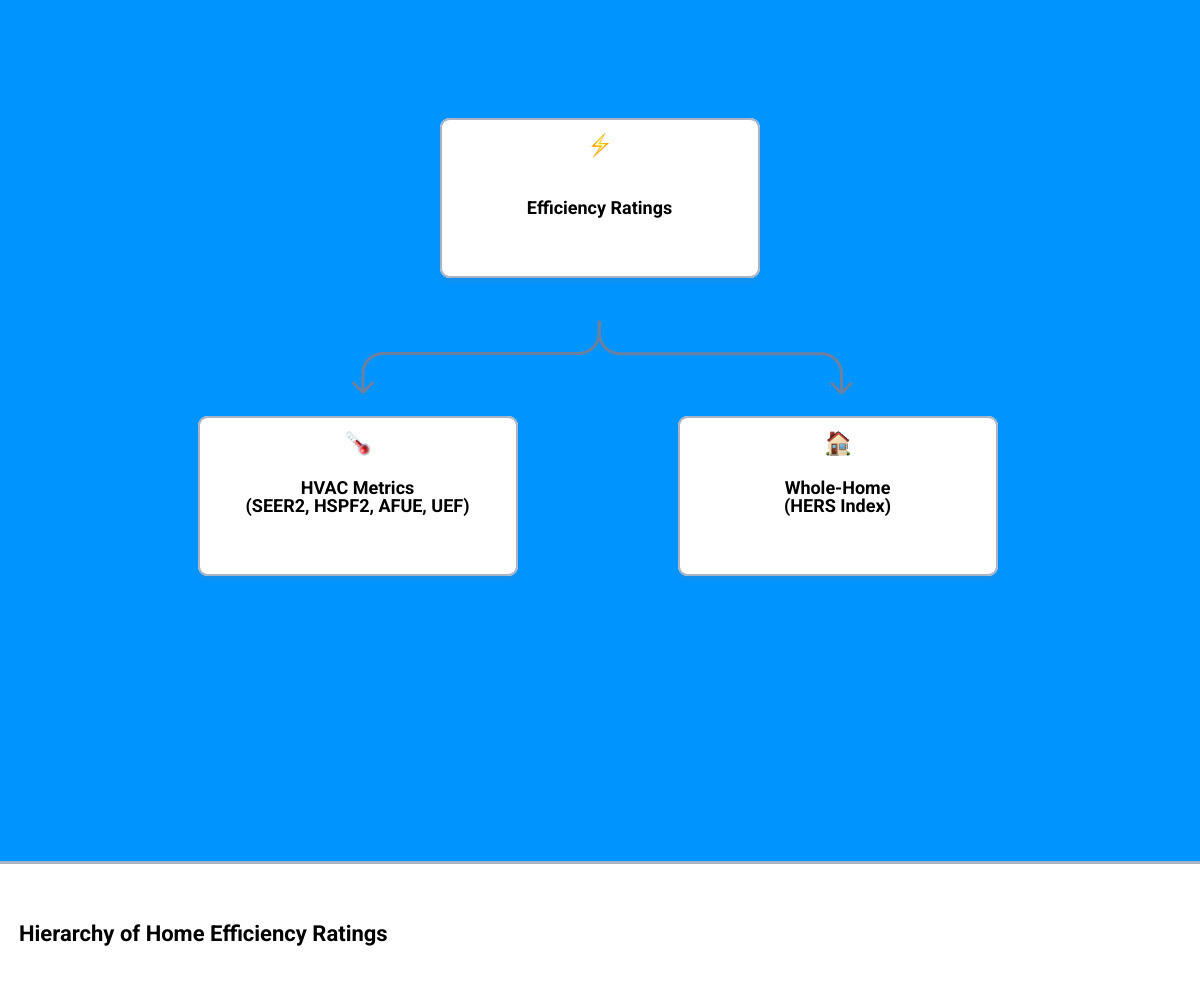
While HVAC ratings tell you about specific machines, the HERS Index tells you about the whole house. Developed by RESNET, the HERS (Home Energy Rating System) Index is like a “miles-per-gallon” rating for your home.
- A score of 100 represents a standard new home built to 2006 codes.
- A score of 0 represents a Net Zero Energy Home (a home that produces as much energy as it uses).
- Lower is better. Each 1-point decrease in the HERS Index corresponds to a 1% reduction in energy consumption compared to the HERS reference home.
ENERGY STAR and LEED Certifications
You’ve likely seen the blue ENERGY STAR logo on your dishwasher or fridge, but entire homes can be ENERGY STAR certified. These homes are at least 10% more efficient than those built to standard code, often averaging a 20% improvement.
LEED (Leadership in Energy and Environmental Design) is a global certification system that uses a points-based scale. It looks at everything from water efficiency to indoor air quality. If you are aiming for the highest tier, LEED Platinum, your home must score over 80 points. These certifications aren’t just for show; they ensure your home is healthier, quieter, and cheaper to run.
ENERGY STAR NextGen, launched recently, focuses heavily on electrification and decarbonization. It requires high-efficiency electric heat pumps for heating and cooling, heat pump water heaters, and induction cooktops, moving homes toward a cleaner, electric future.
DOE Zero Energy Ready Homes
The Department of Energy’s (DOE) Zero Energy Ready Home (ZERH) program represents the “gold standard” of home performance. These homes are so efficient that a small solar array can offset most or all of their annual energy use. They incorporate high-performance envelopes, the EPA’s Indoor airPLUS guidelines for superior air quality, and solar-ready infrastructure, making them ready for the energy demands of the future.
Windows, Doors, and Real-World Performance Factors
Your HVAC system shouldn’t have to fight your house. Windows and doors are the “skin” of your home, and their ratings are just as important.
- U-factor: Measures the rate of non-solar heat loss. For our damp Northwest winters, a lower U-factor keeps the warmth inside.
- Solar Heat Gain Coefficient (SHGC): Measures how much heat from the sun enters your home. In our sunny climate, a lower SHGC is often better to keep your home from overheating in the summer.
- Visible Transmittance (VT): Measures how much natural light comes through. A higher VT means more daylight and less need for artificial lighting.
- Air Leakage: Measures how much air moves through the assembly. A lower rating means a tighter seal and fewer drafts.
Factors Influencing Real-World Efficiency
A high rating on a box doesn’t guarantee savings if the installation is poor. Several factors influence how those ratings perform in the real world:
- Professional Installation: Even a SEER2 20 unit will perform like a SEER2 14 if it isn’t installed correctly. Proper refrigerant charging and airflow are critical.
- System Sizing: We use Manual J calculations to determine the exact size your home needs. An oversized system will “short cycle,” turning on and off too frequently, which wastes energy and wears out parts.
- Ductwork Integrity: You can lose up to 35% of your heating or cooling energy through leaky ducts in unconditioned spaces like attics or crawlspaces.
- Routine Maintenance: Clogged filters and dirty coils can drop your efficiency significantly. Changing your filter every 1–3 months is the simplest way to protect your investment.
Common Misconceptions About Ratings
- The “Bigger is Better” Myth: As mentioned, an oversized unit is less efficient and less comfortable. It won’t dehumidify your air properly, leaving you feeling “cold and clammy.”
- The “Guaranteed Savings” Myth: A rating represents potential. If you leave your windows open while the AC is running, the rating won’t save you.
- The “Maintenance-Free” Myth: High-efficiency systems are precision machines. They require regular check-ups to maintain their rated performance.
- The “Single Component” Myth: Replacing just the outdoor AC unit while keeping an old, mismatched indoor coil will prevent you from reaching the system’s rated efficiency.
Frequently Asked Questions about Efficiency Ratings Explained for Homeowners
What is a good HERS score for a home?
A “good” HERS score depends on the age of the home. For a new build, a score below 50 is excellent, meaning it is 50% more efficient than a standard new home. For an existing home, anything below 70 is considered very good.
How much can I save by upgrading from SEER 13 to SEER2 16?
Upgrading from a SEER 13 to a SEER2 16 system can reduce your cooling costs by approximately 20% to 25% annually. If you spend $500 on cooling over the summer, that is a savings of $100 to $125 every year.
Do efficiency ratings vary by geographic region?
While the rating scales (like SEER2) are national, the requirements vary. The Department of Energy sets different minimum efficiency standards for the North, South, and Southwest. In Washington, we fall under the North region, whose standards put the emphasis on heating efficiency for our climate.
Conclusion
Understanding efficiency ratings explained for homeowners is the best way to ensure you are getting the most value for your money. Whether you are looking at a new heat pump, upgrading your windows, or aiming for a better HERS score, these numbers are your roadmap to a more comfortable and affordable home.
At WestCoast Heating & Air, we are proud to be your local South Sound energy experts. With over 20 years of experience serving neighbors in Puyallup, Tacoma, and the surrounding areas, we specialize in customized residential system design tailored to our unique marine climate. We don’t just sell boxes; we educate our customers so they can make the best decisions for their families.
Ready to see how a high-efficiency system can transform your home comfort and slash your utility bills? Schedule your high-efficiency home upgrade today and let our family take care of yours.