
Stop Leaving Money on the Table: How to Take Advantage of Local Utility Programs in Puyallup, WA
Knowing how to take advantage of local utility programs can put hundreds — sometimes thousands — of dollars back in your pocket when you upgrade your home’s heating and cooling system. Here is a quick overview of the steps:
- Find your utility provider — check your monthly bill for your electric or gas company name.
- Search for available rebates — use the ENERGY STAR Rebate Finder or DSIRE database and enter your ZIP code.
- Check eligibility before you buy — confirm your equipment meets program requirements (usually ENERGY STAR certified).
- Get pre-approval if required — many programs require this step before installation begins.
- Install with a qualified contractor — some programs require certified or vetted installers.
- Submit your application with documentation — receipts, product specs, and contractor info are typically needed.
- Stack additional incentives — combine utility rebates with state programs and federal tax credits for maximum savings.
If you live in the Puyallup area, you have access to some of the most generous utility efficiency programs in the country — and most homeowners never use them. ENERGY STAR partners with roughly 700 utilities that collectively serve about 95% of U.S. households, with those utilities spending more than $7.6 billion every year on energy efficiency programming. That money is already budgeted and earmarked for customers like you. Yet a huge share of it goes unclaimed simply because people do not know where to look or how the process works.
The reality is that one in every seven U.S. households lives in energy poverty — spending a disproportionate share of their income just to keep the lights on and the house warm. Utility rebate programs exist, in part, to change that. Whether you are replacing an aging furnace, installing a heat pump, or upgrading to a smart thermostat, there is likely a program in your area ready to offset a significant portion of the cost.
This guide walks you through everything you need to know, from finding programs to submitting your claim and stacking every available incentive.
I’m Michael Smith, owner of WestCoast Heating & Air in Puyallup. After 30 years at Boeing working through complex systems and problem-solving challenges, I built this business around one goal: helping local homeowners make smart, informed decisions about their comfort — and knowing how to take advantage of local utility programs is one of the most valuable things I can share with the families I serve. Let’s dig into how you can put those savings to work.
Why Utilities Pay You to Save Energy in 2026
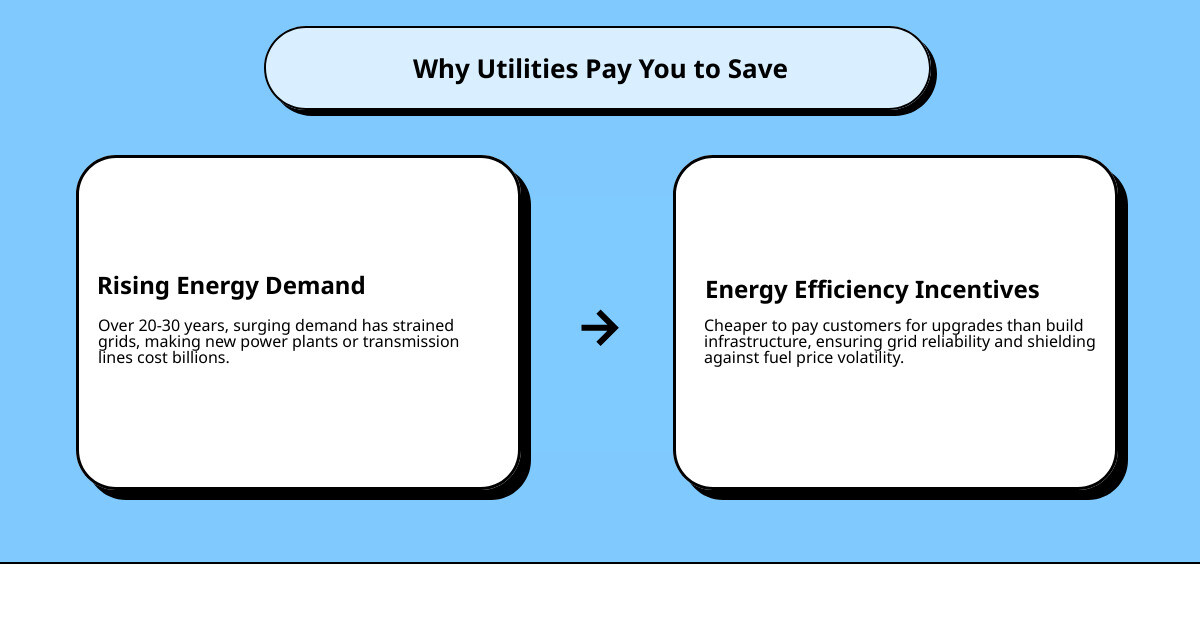
It might seem strange that a company selling you electricity or gas would pay you to use less of it. However, in May 2026, the motivations for utility companies are clearer than ever. Over the last 20 to 30 years, demand for energy has surged. For utilities, it is significantly cheaper to incentivize you to save energy than it is for them to build a new multi-billion dollar power plant or upgrade massive transmission lines to handle peak loads.
This strategy is known as “capacity management.” By reducing the overall demand on the grid, utilities can ensure grid reliability and avoid the risk of blackouts during extreme Washington winters or summer heatwaves. Furthermore, energy efficiency acts as a risk management tool. It protects utilities (and ultimately you) against fuel price volatility. When the market price of natural gas or electricity spikes, a more efficient home is shielded from the worst of those costs.
Beyond the technical side, there is the human element: customer retention and energy security. Utilities want to keep their customers happy and financially stable. By helping you lower your bills, they reduce the likelihood of past-due accounts and service disconnections. This is especially relevant when considering the Inflation Reduction Act Benefits for Washington Homeowners, which have created a historic partnership between federal policy and local utility goals to modernize our regional energy infrastructure.
How to take advantage of local utility programs for residential HVAC upgrades
When we talk about the “big wins” in home energy, we are almost always talking about residential HVAC. Heating and cooling account for over 40% of a typical home’s energy consumption. In our corner of the Pacific Northwest—from Tacoma to Orting—the most popular and effective way to lower that consumption is through heat pump technology.
Heat pumps are the “gold standard” for 2026 efficiency. Unlike a furnace that generates heat by burning fuel, a heat pump simply moves heat from one place to another. This makes them incredibly eco-friendly, often reducing a home’s carbon emissions by 40% compared to a gas furnace. Because they provide both heating and cooling, they are a year-round solution for our specific climate.
To encourage this transition, local utilities offer two main types of rebates:
| Rebate Type | How It Works | Best For |
|---|---|---|
| Prescriptive Rebates | Fixed dollar amounts for specific, pre-approved products. | Standard residential heat pump or furnace replacements. |
| Custom Rebates | Based on the actual calculated energy saved; requires verification. | Large whole-home retrofits or complex residential system designs. |
Beyond the equipment itself, utilities often provide incentives for “weatherization.” This includes air sealing and insulation. There is no point in installing a high-efficiency system if all that expensive air is leaking out through your attic or crawlspace. The average weatherization job can reduce energy bills by about $283 per year, making it a vital first step in knowing how to take advantage of local utility programs.
How to take advantage of local utility programs for smart thermostats
If you aren’t ready for a full system overhaul, smart thermostats are the “gateway drug” to utility savings. Most major utilities in the Puyallup and Sumner areas offer instant rebates—sometimes covering the entire cost of the device—for ENERGY STAR certified smart thermostats.
These devices do more than just let you change the temperature from your phone. They allow you to participate in “demand response” programs. During times of extreme grid stress, the utility can send a signal to your thermostat to slightly adjust the temperature (usually by just a degree or two). In exchange for this small cooperation, you receive bill credits or annual checks. It’s an automated way to earn money while helping keep the local grid stable.
How to take advantage of local utility programs if you are a renter
A common myth is that you have to own your home to benefit from these perks. While major installs like a central heat pump usually require homeowner authorization, renters in places like University Place or SeaTac have plenty of options.
Renters can often access rebates for portable or window AC units that meet high-efficiency standards. You can also request “direct-install” programs where the utility sends a technician to install LED bulbs, low-flow showerheads, and weatherstripping at no cost to you. For larger upgrades, we recommend talking to your landlord about the long-term value of the property; many landlords are happy to authorize a heat pump installation if the utility is picking up a large portion of the tab, as it increases their property value and makes the unit more attractive to future tenants.
Navigating the Application Process Without the Stress
We often hear from homeowners in Steilacoom and Spanaway that the “paperwork” is what keeps them from claiming their money. It’s true that the process can involve up to 12 steps, but it’s manageable if you know the order of operations.
First, always check for “pre-approval” requirements. Some utilities will deny a rebate if you buy the equipment before they sign off on the project. Use your ZIP code on the DSIRE database or the ENERGY STAR Rebate Finder to see exactly what is required in your specific neighborhood.
Documentation is king. You will need:
- The dated sales receipt or invoice.
- The AHRI (Air Conditioning, Heating, and Refrigeration Institute) certificate for your specific equipment.
- The contractor’s license and certification info.
- A copy of your most recent utility bill.
If the upfront cost is still a hurdle, look into financing options. Many programs in 2026 allow for “on-bill repayment,” where the cost of the upgrade is added to your monthly bill in small increments that are often offset by the energy savings you’re gaining.
The Power of Stacking: Combining Utility, State, and Federal Perks
This is where the real magic happens. “Stacking” is the practice of layering multiple incentives on top of each other. In 2026, a savvy homeowner in Puyallup can combine:
- A Local Utility Rebate: Direct cash back from your electric or gas provider.
- Federal 25C Tax Credit: A credit of up to $2,000 for qualifying heat pumps.
- State Navigators: Washington-specific funds aimed at reducing energy poverty.
- Manufacturer Promotions: Seasonal discounts from brands like Daikin or Mitsubishi.
In some cases, especially for low-to-moderate income (LMI) households, these stacked incentives can cover 50% to 100% of the project cost. For example, some programs specifically target households experiencing energy poverty, providing “point-of-sale” discounts so you don’t even have to wait for a check in the mail—the discount is taken right off the invoice.
Avoiding Common Mistakes That Cost Homeowners Money
Even with the best intentions, it is easy to miss out on funds. One of the biggest mistakes is waiting too long. Utility rebate budgets are often capped; once the money for the year is gone, it’s gone. If you wait until December to upgrade your furnace, you might find the program has run out of funding.
Another pitfall is “contractor vetting.” Some utilities only pay out rebates if the work is performed by an approved or “trade ally” contractor. At WestCoast Heating & Air, we stay up-to-date on these requirements to ensure our customers remain eligible.
Finally, watch out for retroactive claims. While some utilities allow you to apply up to 60 or 90 days after installation, many do not. If you don’t have that pre-approval or the right model number on your receipt, you could be leaving thousands on the table.
Frequently Asked Questions about Utility Incentives
What are the eligibility requirements for Washington utility programs?
Eligibility usually hinges on two things: the efficiency of the equipment and your status as a customer. Most residential HVAC equipment must be ENERGY STAR certified or meet specific SEER2 (Seasonal Energy Efficiency Ratio) and HSPF2 (Heating Seasonal Performance Factor) ratings. Some programs also have income thresholds, offering higher rebates for households that fall below a certain percentage of the area’s median income.
How do I find utility rebate programs available in my specific area?
The fastest way is to look at your most recent utility bill to identify your provider (such as Puget Sound Energy or Tacoma Power). Visit their website and search for “Residential Rebates.” Alternatively, you can use the DSIRE database, which is a comprehensive source of all state, local, and federal incentives.
What should I do if my local utility program runs out of funding?
Don’t panic. First, ask if there is a waitlist for the next funding cycle. Second, check if there are state-level programs or federal tax credits that can still apply. Finally, look for manufacturer rebates, which often run independently of utility budgets.
Conclusion
Understanding how to take advantage of local utility programs is about more than just saving a few bucks—it’s about making a long-term investment in your home’s comfort and our community’s energy future. Whether you are in Roy, Tumwater, or right here in Puyallup, these programs are designed to help you upgrade to better, cleaner technology without the financial strain.
At WestCoast Heating & Air, we believe in more than just “swapping boxes.” We focus on customized residential system design and customer education. With over 20 years of local experience, we know exactly which systems qualify for which rebates in our specific Washington climate. We take the guesswork out of the process, ensuring you get every penny you’re entitled to.
If you’re ready to stop overpaying the utility company and start letting them pay you, let’s talk about a new heat-pump for your home. We’ll help you design a residential system that maximizes your comfort and your savings. Give us a call today, and let’s get that money off the table and back into your wallet.