

The Cold Hard Truth About How Old Is Too Old for an HVAC System in the Pacific Northwest
Knowing how old is too old for an HVAC system could save you from a breakdown on the coldest night of a Puyallup winter — and here’s the short answer most homeowners need right away:
| Equipment Type | Average Lifespan | Generally “Too Old” At |
|---|---|---|
| Central Air Conditioner | 15-20 years | 15+ years |
| Gas Furnace | 15-20 years | 15+ years |
| Heat Pump | 10-15 years | 12+ years |
| Ductless Mini-Split | 10-15 years | 15+ years |
If your system is approaching or past these ages — especially if you’re noticing rising energy bills, uneven temperatures, or more frequent repair calls — it’s time to take a hard look at whether keeping it running still makes financial sense.
Most systems don’t fail overnight. They slow down gradually, cost more to operate, and become less reliable long before they stop working completely. According to industry data, nearly one in three homeowners faces a major HVAC breakdown before their system even reaches its expected lifespan. Older systems also commonly lose 20-40% of their original efficiency, which quietly adds up on your monthly utility bill whether the system seems to be “working fine” or not.
For homeowners in the Pacific Northwest, the stakes are especially real. Puyallup winters are no joke, and a system that’s limping along in October may not survive a cold snap in January.
I’m Michael Smith, owner of WestCoast Heating & Air in Puyallup, and after 30 years in engineering at Boeing followed by hands-on experience serving local families, I’ve helped hundreds of homeowners answer the question of how old is too old for an HVAC system before an emergency made the decision for them. In this guide, I’ll walk you through everything you need to know to make a confident, informed decision about your home’s heating and cooling system.
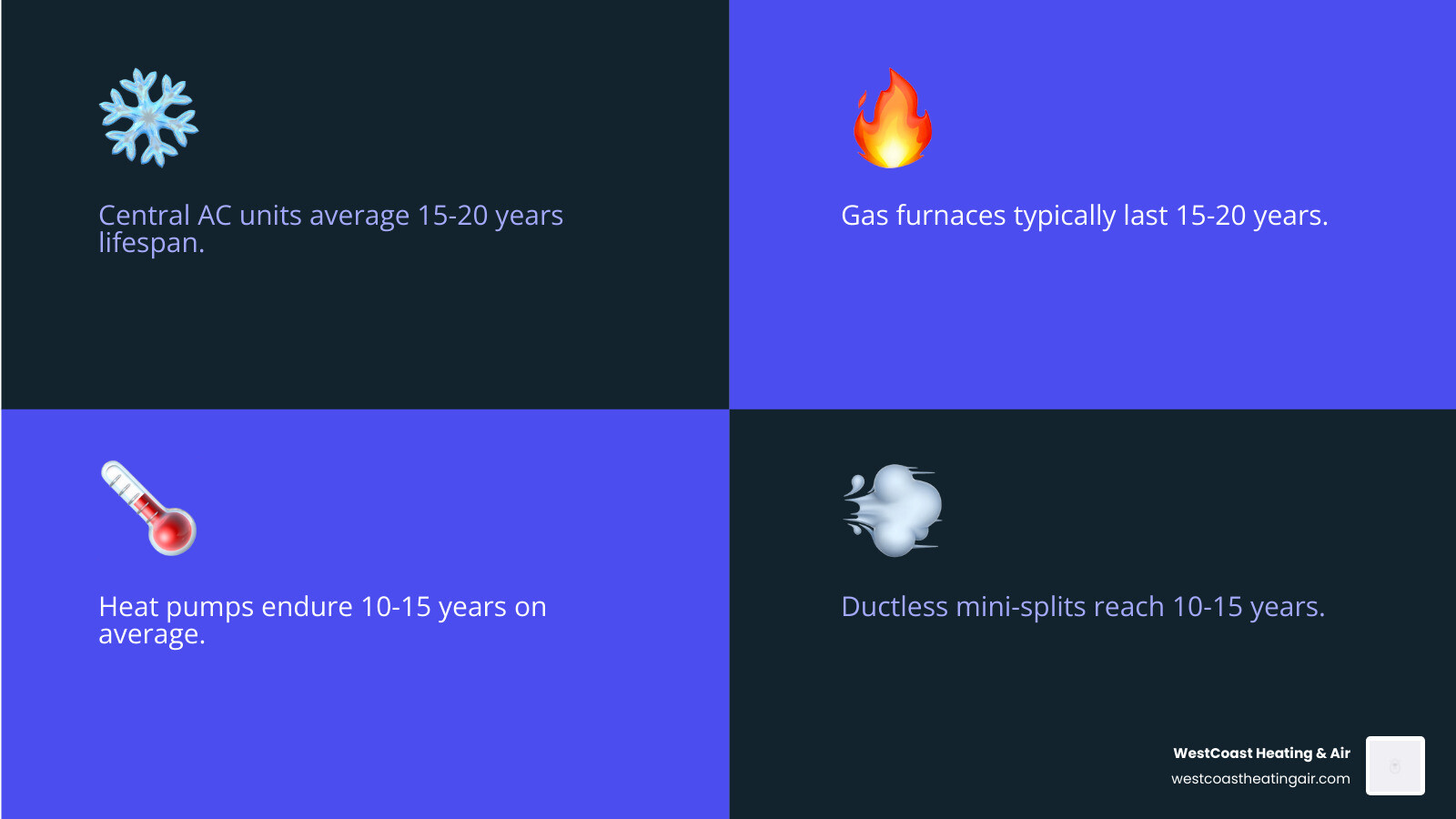
Understanding the Average Lifespan of Home Comfort Systems
When we talk about HVAC longevity, it is important to remember that “lifespan” isn’t a single number. It is a range influenced by how hard the system works and how well it is treated. In our service areas like Tacoma, Spanaway, and University Place, we see a wide variety of equipment, each with its own “expiration date.”
Central Air Conditioners
Standard central AC units typically last between 15 and 20 years. However, by the time they hit the 12-year mark, many have already lost 20-30% of their original efficiency. If your AC was installed during the Obama administration, it is likely using a different generation of technology and struggling to keep up with modern SEER2 standards.
Gas Furnaces
We often call furnaces the “marathon runners” of the HVAC world. Because they live indoors (away from the rain and wind of the South Sound) and have fewer moving parts than an AC, they can last 15 to 20 years. Some high-quality models might even push toward 25, but efficiency drops significantly after two decades.
Heat Pumps
Heat pumps are the workhorses of the Northwest. Because they provide both heating and cooling, they effectively pull “double duty.” This constant operation means they generally have a shorter lifespan, typically 10 to 15 years. If your heat pump is over 12 years old, it is entering its “golden years.”
Ductless Mini-Splits
These systems are popular in older homes in places like Steilacoom or Sumner where ductwork is a challenge. You can expect a mini-split to last 10 to 15 years. Their lifespan is highly dependent on keeping the filters clean and the outdoor unit clear of debris.
Knowing these averages is the first step in spotting Signs Its Time To Upgrade Your Hvac System.
How Old Is Too Old for an HVAC System in San Diego?
(Note: While we serve the beautiful communities of Puyallup and the surrounding Pierce County area, we understand that many homeowners look for general guidelines. For our local climate, the 15-year threshold is a critical turning point.)
In the Pacific Northwest, we don’t deal with the same constant salt air as coastal California, but we do have our own environmental challenges. Humidity, moss growth, and the occasional heavy snow or ice can take a toll on outdoor units.
The 15-Year Threshold
Once a system hits 15 years, it is living on borrowed time. At this age, the risk of a major component failure—like a seized compressor or a cracked heat exchanger—rises sharply. Furthermore, the technology gap is massive. A unit from 2011 likely has a SEER rating of 10 or 13, while modern units start at 14.3 SEER2 and go much higher.
Efficiency Degradation
By year 10, most central air systems operate at only 80-85% of their original efficiency. By year 15, you are essentially paying a “hidden tax” every month in the form of higher utility bills. Replacing an old unit can often reduce your cooling costs by 20% to 40% immediately.
The Refrigerant Factor
If your air conditioner is old enough to use R-22 refrigerant (Freon), it is officially “too old.” The EPA banned the production and import of R-22 in 2020. If you have a leak today, the cost of reclaimed coolant is astronomical. In many cases, a single refrigerant recharge on an R-22 system can cost over $1,000, making it a poor investment compared to a new unit. To learn more, check out our guide on R 22 Refrigerant Phase Out What Does This Mean For Your Ac Unit.

The Math of Replacement: When to Stop Repairing
Deciding whether to fix a broken part or buy a new system shouldn’t be an emotional choice. We recommend using two simple mathematical rules to remove the stress from the decision.
The 50% Rule
This one is straightforward: If a single repair cost exceeds 50% of the cost of a brand-new system, you should replace it. Why put a new engine in a car with 300,000 miles and a rusted frame? The same logic applies to your HVAC.
The $5,000 Rule
This is a favorite among technicians. Multiply the age of the system by the cost of the repair. If the total is $5,000 or more, replacement is the smarter financial move.
- Example A: A 12-year-old system needs a $600 repair. (12 x 600 = 7,200). Result: Replace.
- Example B: A 5-year-old system needs a $300 repair. (5 x 300 = 1,500). Result: Repair.
Repair Frequency
If you find yourself calling us every summer for a “quick fix” or a new capacitor, you are experiencing a “slow bleed.” Those small repairs add up over 2-3 years, and you still end up with an old, inefficient system with no warranty. You can see the risks of this cycle in our article on What Happens If You Skip Hvac Maintenance.
Why a 15-year-old furnace is often how old is too old for an hvac system
While an old AC might just leave you sweaty, an old furnace can actually be dangerous. The primary concern is the heat exchanger. This is the component that keeps combustion gases (like carbon monoxide) separate from the air blowing through your vents.
Over 15 to 20 years of heating up and cooling down, the metal in the heat exchanger can develop stress cracks. A cracked heat exchanger is a non-repairable safety hazard. If we find one during a service call, we are required by safety codes to shut the system down immediately to prevent carbon monoxide poisoning. This is why we emphasize How Often Should You Get Your Furnace Service—especially as the unit crosses that 15-year mark.
Critical Signs Your Aging System is Failing
Age isn’t the only factor. Sometimes a 12-year-old system acts like it’s 20 because of poor installation or a lack of maintenance. Here are the red flags that tell us a system is nearing its end:
- Uneven Temperatures: Does your master bedroom feel like an icebox while the living room is a sauna? This often means the system no longer has the “oomph” to distribute air properly.
- Rising Energy Bills: If your usage habits haven’t changed but your bills are 20% higher than last year, your system is struggling.
- Strange Noises: Banging, rattling, or a sound like “rocks in a washing machine” usually indicate a dying motor or a failing compressor.
- Poor Air Quality: Old systems can struggle to manage humidity and may begin circulating more dust and dander, which can affect your family’s health.
Many homeowners find that Why Your Old Gas Furnace Is Feeling The Heat From Modern Heat Pumps is a great starting point for understanding how modern technology solves these old-school problems.
Determining if your current unit is how old is too old for an hvac system
Not sure how old your unit actually is? You don’t have to guess. Every HVAC unit carries its “birth certificate” on a metal nameplate or sticker, usually located on the side of the outdoor condenser or the indoor furnace cabinet.
- Locate the Serial Number: Look for the “S/N” on the data plate.
- Decode the Date: In many brands, the first four digits represent the week and year of manufacture (e.g., “1214” would mean the 12th week of 2014).
- Check for SEER2: Modern units in 2026 are rated using SEER2 standards. If your unit has a SEER rating below 13, it is significantly outdated.
If you live in an older home in Orting or Roy, you might even be considering Teasing An Old House New Tricks Retrofitting Hvac to bring your comfort into the modern era.
Frequently Asked Questions about HVAC Longevity
Can a well-maintained furnace last 30 years?
It is possible, but it’s the exception, not the rule. A furnace that lasts 30 years usually lives in a very mild climate and has received meticulous annual maintenance. Even if it can run, it probably shouldn’t. A 30-year-old furnace is likely operating at 60-70% efficiency, meaning you are wasting a massive amount of fuel. Additionally, finding replacement parts for a 30-year-old unit is like trying to find parts for a vintage car—expensive and difficult.
Does salt air shorten AC life in coastal San Diego?
(Note: While our primary focus is the South Sound, we know many people move between regions.) In coastal environments like Carlsbad or Oceanside, salt air causes rapid corrosion of the aluminum fins and copper coils. This can reduce an AC’s life to just 8-14 years. In our Washington service areas like University Place or SeaTac, we deal more with moisture and debris, which can also cause corrosion if the unit isn’t kept clean.
Is it worth repairing a system that uses R-22 refrigerant?
In almost every case, the answer is no. Because R-22 is no longer produced, the supply is limited to “reclaimed” gas from old units. This has driven prices through the roof. If your R-22 system has a leak, you are essentially pouring expensive liquid into a sinking ship. Investing that money into a new system that uses modern, eco-friendly refrigerants like R-454B is a much better long-term financial move.
Conclusion
At WestCoast Heating & Air, we believe in educating our neighbors so they can make the best decisions for their families. Whether you are in Puyallup, Tacoma, or University Place, your home comfort system is one of your most important investments.
Replacing a system that is how old is too old for an hvac system isn’t just about avoiding a breakdown; it’s about improving your home’s value, lowering your monthly expenses, and ensuring your family stays safe and comfortable year-round. Modern systems offer incredible benefits like variable-speed motors for better dehumidification and smart home integration.
If you’re worried your system is on its last legs, don’t wait for the next Northwest cold snap to find out. We can help you understand What To Expect During An Hvac Replacement and design a customized solution just for your home.
Ready for peace of mind? Schedule a professional assessment with our residential heating and cooling company today, and let’s make sure your home stays comfortable for the next 20 years.