
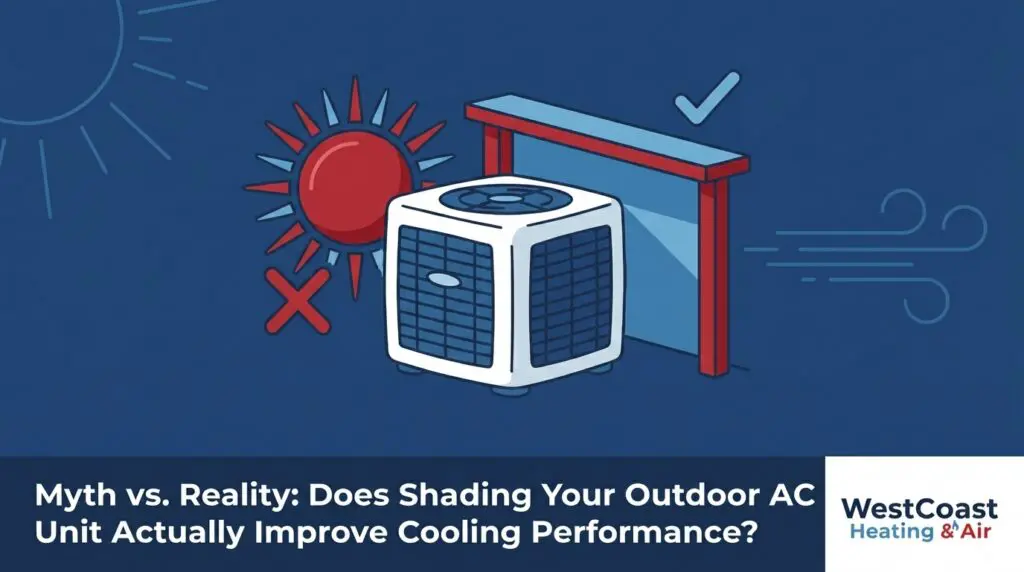
The Great DIY Cooling Debate: Block the Sun or Maximize Airflow?
A widespread myth circulating every summer is that building a protective roof over your condenser will drastically cut energy costs, but does shading your outdoor AC unit actually improve cooling performance? The short answer is no. When the afternoon sun is beating down and your air conditioner seems to be running non-stop just to keep up, our team at WestCoast Heating & Air understands that the instinct to build a shady canopy makes logical sense. However, in our experience, this well-meaning DIY project often forces the equipment to work much harder. As a homeowner, you are faced with a critical choice: try to block the direct sunlight to cool the metal, or prioritize the unrestricted airflow your system desperately requires to function.
For professional guidance on maximizing your system’s efficiency, explore our heating and cooling services or contact our cooling experts today.
During intense Pacific Northwest summer heatwaves, we know homeowners understandably look for any advantage to keep their living spaces comfortable. A sweltering July afternoon can make it feel like your air conditioner is losing the battle against the elements. It is completely natural to look at a metal box sitting in direct, ninety-degree sunlight and assume it needs some relief from the heat. On our service calls, we frequently see people grab plywood, lattice, or tarps to rig up a makeshift awning, hoping to give the machinery a break. The flaw in this instinct is a fundamental misunderstanding of how the equipment actually operates.
The core decision comes down to weighing the theoretical benefit of blocking solar radiation against the mechanical necessity of exhausting hot air. Your outdoor condenser is not designed to be kept cool by ambient shade; it is designed to act as a massive, high-powered heat exhaust mechanism. A clear, definitive rule governs modern HVAC design: unrestricted airflow is vastly more critical to cooling performance than ambient shade. If you block the fan from blowing hot air away from the house, you immediately cripple the system’s ability to cool your interior.
Understanding the Physics of Your Outdoor Condenser
To understand why shade structures often do more harm than good, you have to look at the mechanical reality of how an air conditioner dissipates heat. Your system does not actually “create” cold air out of nothing; it acts as a heat transfer engine. It removes thermal energy from the inside of your home and dumps it outside. This complex heat transfer relies entirely on thermodynamics, refrigerant pressures, and massive volumes of air.
In neighborhoods across Puyallup WA, our technicians see firsthand how sudden afternoon heat spikes put maximum thermal load on the compressor. During these extreme temperature shifts, efficient heat dissipation becomes absolutely vital to keep the system running. If you want to know more about the specific environmental factors at play, you can read about why your AC struggles during afternoon heat spikes. To survive these intense thermal loads, the outdoor unit follows a very specific mechanical process:
- Heat Absorption: Cold liquid refrigerant absorbs thermal energy from the warm indoor air passing over your indoor evaporator coil, turning the refrigerant into a warm gas.
- Pressurization: This warm gas travels outside to the compressor. The compressor violently squeezes the refrigerant gas, raising its temperature significantly higher than the outdoor ambient air.
- Air Intake: The large fan inside the condenser pulls cooler ambient outdoor air horizontally through the thin aluminum fins wrapped around the exterior of the unit.
- Heat Exhaust: As the outside air passes over the superheated internal coils, it absorbs the heat from the pressurized refrigerant. This hot air is then blasted straight up and out the top of the unit.
This mechanical process highlights the severe danger of exhaust heat recirculation. If the hot air blasted out of the top of the unit hits a low-hanging roof, a dense tarp, or a wooden box, it bounces right back down. The powerful intake fan then sucks that superheated air right back through the side coils. Instead of pulling in ninety-degree air to cool the coils, the system is suddenly trying to cool itself with stagnant air that is well over one hundred degrees.
While it is true that ambient shade offers a tiny theoretical benefit by slightly lowering the temperature of the metal casing, engineering studies show it only accounts for a one to two percent efficiency gain. That microscopic gain is instantly negated—and heavily penalized—if the upward airflow is compromised in any way.
The Myth of the DIY AC Shade Structure
Despite the clear physics of heat transfer, the internet is filled with viral tutorials for building wooden boxes, decorative awnings, and lattice covers to hide or shade outdoor equipment. During severe Pacific Northwest summer heatwaves, our installation crews frequently spot these DIY projects as homeowners try to optimize their cooling performance. Unfortunately, these structures are essentially suffocating the machinery they are meant to protect.
When you place a solid or semi-solid barrier above the exhaust fan, you disrupt the upward column of hot air. The exhaust air from a working condenser is already hot by design. When it gets trapped under an awning, it creates a localized micro-climate around the equipment where temperatures can easily exceed 110 degrees. The compressor is then forced to work overtime to push heat into an environment that is already superheated. Eventually, the compressor is forced into thermal overload, drastically reducing cooling performance, spiking your energy bills, and risking catastrophic mechanical failure.
Direct Sunlight vs. Trapped Heat
The debate between leaving a unit exposed or covering it usually stems from a misunderstanding of how sunlight affects industrial metal. Here is a clear breakdown of what actually happens in both scenarios:
| Operating Condition | Direct Sunlight + Open Air | Shaded + Restricted Air (DIY Cover) |
|---|---|---|
| Air Intake Temperature | Matches the ambient outdoor temperature, allowing for predictable and efficient heat transfer. | Artificially elevated by trapped exhaust air continuously recirculating into the intake fins. |
| Exhaust Path | Hot air is blown vertically into the open sky, moving thermal energy far away from the home. | Hot air hits the cover, bounces back down, and pools tightly around the base of the unit. |
| Compressor Strain | Normal operating load. The equipment is explicitly manufactured to withstand direct UV exposure. | High risk of thermal overload. The compressor works continuously without relief to reject heat. |
| Cooling Performance | Maintains factory-rated efficiency as long as the internal coils are clean and well-maintained. | Efficiency drops rapidly as the unit struggles to reject heat into a superheated, enclosed space. |
Direct sunlight slightly warms the outer metal casing, but it does not stop the fan from moving massive volumes of air. The internal components are heavily insulated and protected from this surface heat. Trapped heat, on the other hand, creates a suffocating blanket of superheated air that the air conditioner simply cannot use to cool the internal refrigerant. The machine is starved of the one resource it needs most: fresh, ambient air.

Natural Shade: The Hidden Dangers of Overgrown Foliage
If artificial structures are out of the question, many homeowners turn to landscaping as a natural alternative. It is widely acknowledged that natural tree shade is better than a low artificial roof, primarily because high tree canopies do not block the immediate vertical exhaust path. However, relying on natural shrubbery introduces a completely different set of mechanical risks that can be just as damaging to your system.
In our service area of Puyallup WA, our maintenance teams constantly pull fast-growing Pacific Northwest foliage and evergreen debris out of struggling units. Homeowners commonly plant dense bushes, tall ferns, or allow existing vegetation to encroach on the equipment to hide it from view or provide shade. As these plants grow, they shed falling leaves, pine needles, sticky pollen, and seeds directly into the condenser. The delicate aluminum fins on the outside of your unit act like a giant vacuum filter, catching all of this organic matter as the fan pulls air through.
When the coils become coated in wet pine needles, cottonwood fluff, and pollen, the system literally cannot breathe. Clogged coils restrict airflow just as severely as a wooden box would. The fan might be spinning at full speed, but no air is actually passing through the fins to absorb the heat from the refrigerant. To prevent this suffocating buildup, you must adopt proper landscaping practices around the HVAC equipment:
- Maintain a strict foliage border: Keep all bushes, ferns, and decorative grasses trimmed back well away from the metal casing.
- Rake the perimeter regularly: Remove dead leaves, grass clippings, and evergreen needles from the base of the unit so they do not get sucked into the side panels.
- Prune low-hanging branches: Ensure that the trees providing your natural shade are not dripping sap or dropping heavy seed pods directly into the fan grate.
- Mind the mulch: Keep bark and lightweight mulch away from the immediate base of the condenser, as high winds can blow it directly into the fins.
Natural shade is only beneficial if the plants providing it are kept completely out of the equipment’s breathing zone. A shaded unit with clogged coils will always perform worse than a perfectly clean unit sitting in direct sunlight.
Official Clearance Rules: What Your System Actually Needs
Instead of guessing how much breathing room your equipment requires, it is always best to rely on established engineering standards. The U.S. Department of Energy (DOE) and the American Society of Heating, Refrigerating and Air-Conditioning Engineers (ASHRAE) provide strict, scientifically backed guidelines for condenser installation and maintenance. The Department of Energy clearly advises against building solid structures over air conditioning units, noting that the severe risk of exhaust air recirculation far outweighs any minor cooling benefit from the shade.
During peak Pacific Northwest summer heatwaves, our technicians emphasize that adhering to these official clearance rules is the single best way to protect your cooling performance. Restricting this essential airflow can reduce system efficiency by up to 30%, which means your equipment is running longer, working much harder, and driving up your monthly utility costs unnecessarily. To keep your system running within factory specifications, we strongly recommend following this definitive clearance checklist:
- Side clearance (minimum): Maintain at least 2 feet of totally unobstructed space on all four sides of the unit.
- Side clearance (optimal): Aim for 3 feet of clearance if the unit is located near high-traffic areas, fast-growing vegetation, or dusty pathways.
- Vertical clearance: Ensure there is a minimum of 5 feet of completely open sky directly above the fan grate so the hot exhaust plume can dissipate safely.
- Wall distance: Keep the unit positioned at least 12 to 24 inches away from the exterior wall of your house to allow sufficient air to flow behind it.
- Ground leveling: Ensure the concrete pad or composite base sits perfectly flat so the compressor oil remains balanced and the fan spins evenly without vibration.
These metrics are not merely suggestions; they are the required operating parameters for the machinery. Giving your condenser the open space it needs to breathe is vastly more effective than trying to build a shelter for it.
Signs Your System is Struggling with Trapped Heat
If you currently have a shade structure built over your condenser, or if your landscaping has completely engulfed the unit, the machinery might already be suffering. Heat damage is cumulative. An air conditioner forced to operate in a superheated micro-climate will eventually start showing clear, undeniable symptoms of mechanical distress.
One of the most obvious signs of a struggling compressor our technicians diagnose is short cycling. This happens when the unit turns on, runs for a few minutes, and abruptly shuts off before the house is actually cool. This is often the compressor clicking off on thermal overload to protect itself from melting down. You might also notice unusually high energy bills, as the system draws massive amounts of electricity trying to force heat into a restricted space. Inside the house, this struggle often presents as lukewarm air gently blowing from the vents instead of a strong, crisp breeze.
Listen closely to the outdoor unit. The sound of a strained fan motor often resembles a harsh buzzing or a deep, vibrating hum that sounds much louder than normal. If we find a unit has been suffocated by a DIY shade structure for an extended period, the internal components have usually suffered excessive wear. The compressor valves can weaken under the high pressure, and the electrical capacitors can bulge and fail from the intense ambient heat.
Leveraging WestCoast Heating & Air’s local expertise, our field technicians frequently diagnose severe thermal overload caused directly by well-intentioned DIY shading attempts. We highly recommend scheduling a professional inspection to assess your coil health and compressor vitality. If you suspect your system has been damaged by restricted airflow in Puyallup WA or the surrounding areas, securing reliable AC repair is the critical next step to restore your home’s comfort and prevent a total breakdown.
Common Questions About AC Shading and Airflow
Should I build a cover for my AC unit?
No, you should never build a solid cover over your operating air conditioning unit. A cover traps the hot exhaust air blowing out of the top, forcing the system to suck that same hot air back into the side intake fins. This recirculation causes the compressor to overheat rapidly, reducing efficiency and risking mechanical failure. Any type of cover must be completely avoided during the cooling season to ensure your system can properly exhaust heat.
Does putting an umbrella over an AC unit help?
Putting a patio umbrella over an AC unit provides a negligible efficiency boost and carries significant risks. While an umbrella might block direct sunlight, it can easily blow over in a storm and smash into the delicate fan blades or refrigerant lines. Furthermore, if the umbrella is positioned too low, it will deflect the exhaust heat right back down into the machinery. The tiny one percent gain in ambient shade is simply not worth the risk of physical damage or restricted airflow.
How much clearance does an outdoor AC unit need?
An outdoor AC unit requires a minimum of two to three feet of unobstructed clearance on all four sides. Vertically, the unit needs at least five feet of completely open sky above the exhaust fan to properly vent hot air away from the house. Restricting this space with fences, walls, or low roofs prevents the system from breathing. Maintaining these official clearance zones is the most effective way to ensure peak cooling performance.
Can I plant bushes around my AC unit?
You can plant bushes near your AC unit, but they must be kept at least three feet away from the metal casing at all times. Fast-growing shrubbery can quickly encroach on the equipment, blocking the intake fins and starving the system of air. Additionally, bushes drop leaves, twigs, and pollen that can get sucked into the condenser coils, creating a thick, restrictive mat of debris. Regular pruning is mandatory if you choose to landscape around your HVAC equipment.
Is it bad if my AC unit is in direct sunlight?
No, it is perfectly normal and safe for your AC unit to sit in direct sunlight. The exterior casing and internal components are engineered by the manufacturer to withstand intense UV exposure and extreme outdoor temperatures. The heat from the sun only slightly warms the metal, which has almost zero impact on the massive volume of air the fan moves. As long as the unit has open air to breathe, it will function efficiently regardless of the sun’s position.
Does shading an AC condenser actually save money?
Shading an AC condenser does not save a meaningful amount of money and often ends up costing you more in the long run. Studies indicate that perfectly executed ambient shade only improves efficiency by one to two percent. However, if the shade structure restricts airflow even slightly, the resulting drop in efficiency can spike your energy bills by up to 30 percent. During intense Pacific Northwest summer heatwaves, prioritizing open airflow over artificial shade is the smartest financial decision you can make.
Keep Your System Breathing Easy This Summer
Ultimately, keeping the area around the condenser completely clear is the absolute best way to ensure peak efficiency. While the instinct to block the sun is understandable, you can rest assured that direct sunlight is a perfectly normal operating condition for your equipment. The machinery is built to handle the heat, provided it has the open space required to exhale that heat safely away from your home.
If you are concerned about your unit’s current performance, or if you suspect that overgrown landscaping in Puyallup WA has clogged your internal coils, do not wait for the system to overheat. A professional assessment can quickly identify airflow restrictions and restore your equipment to factory specifications. To schedule a comprehensive inspection and keep your home comfortable all season long, contact our cooling experts today.