
Why Wet, Cold Winters Are Harder on Your Heating System Than You Might Think
How wet cold winters stress your furnace and heat pump is something every homeowner in the Puyallup area should understand before the next round of freezing rain rolls through. Most people assume cold is cold — but damp, icy winters like those in Western Washington create a different kind of punishment for heating equipment than dry cold ever does.
Here is a quick summary of how wet, cold winters stress your heating system:
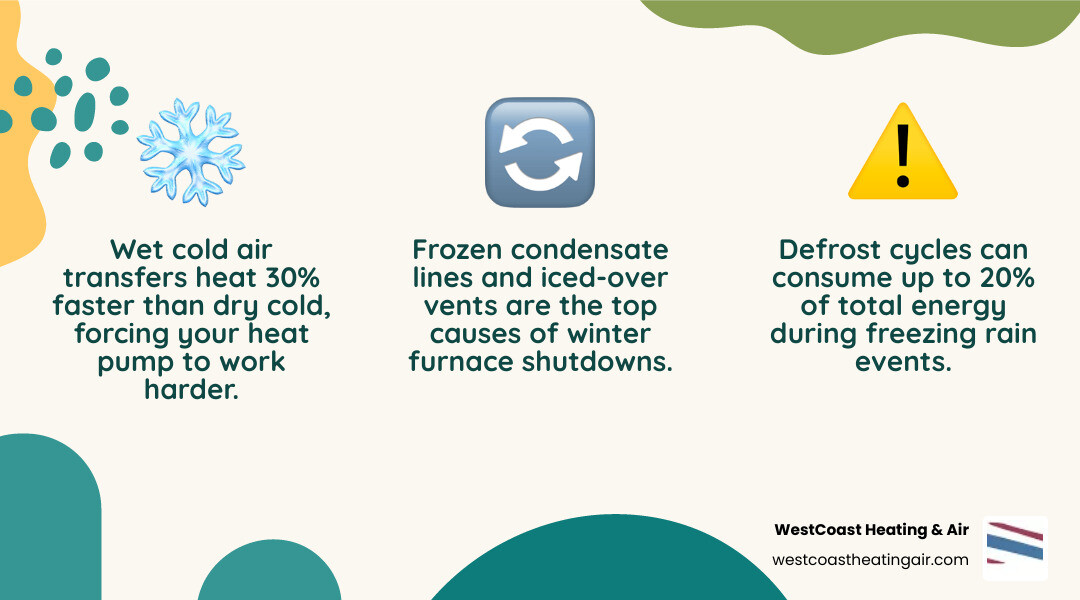
- Heat pumps: Moisture freezes onto outdoor coils, blocking airflow and triggering more frequent defrost cycles, which reduce efficiency and drive up energy costs
- Furnaces: Frozen condensate lines and ice-blocked PVC vent pipes can cause pressure switch errors and system shutdowns
- Both systems: Continuous operation during prolonged cold snaps accelerates wear on motors, heat exchangers, and electrical components
- Ice storms specifically: Combine coil icing, defrost overload, potential power outages, and expensive auxiliary heat activation all at once
- Wet climates add a triple penalty: Low temperatures, extra energy spent on defrosting, and supplemental heat all hit at the same time in cold-humid regions like the South Puget Sound
Western Washington averages over 150 rainy days per year, and when temperatures dip below freezing, that constant moisture does not just make things uncomfortable — it actively works against your heating equipment. The combination of freezing rain, temperature swings, and high humidity creates stress that dry-cold climates simply do not produce.
I’m Michael Smith, owner of WestCoast Heating & Air in Puyallup, and after decades of hands-on problem-solving work, I have seen how how wet cold winters stress your furnace and heat pump in ways that catch homeowners off guard. In the sections below, I will walk you through exactly what is happening inside and outside your system when Pacific Northwest winter weather hits its worst.
Terms related to how wet cold winters stress your furnace and heat pump:
- how western washington climate affects your hvac system
- how rain and humidity affect your system performance
- best hvac setup for western washington weather
The Physics of Damp Chill: How Wet Cold Winters Stress Your Furnace and Heat Pump
To understand why a damp winter in Tacoma, Sumner, or Orting is so much harder on your HVAC system than a dry, sub-zero winter in the mountains, we have to look at the physics of moisture. Water is an incredible conductor of thermal energy. In fact, damp air transfers heat (and cold) far more efficiently than dry air.
When the outdoor air is saturated with moisture, that dampness clings to your outdoor equipment. For a heat pump, this means the cold outdoor air doesn’t just pass through the unit; it physically coats the metal fins with moisture that is ready to freeze at the slightest drop in temperature. This constant exposure to high-humidity cold forces your system to work significantly harder just to extract the same amount of heat.
Furthermore, damp air accelerates the physical wear on your system’s components. Moisture can find its way into electrical connections, accelerate rust on older metal casings, and create a highly corrosive environment for internal parts. When you combine this high humidity with freezing temperatures, you get a recipe for accelerated wear and tear that we regularly see during our local winter service calls.
The Triple Penalty of Cold-Humid Climates
In the HVAC industry, we often talk about the “triple penalty” that cold-humid climates like ours impose on air-source heat pumps. When the weather gets wet and cold simultaneously, your system faces three distinct challenges at once:
- Reduced Heating Capacity: As the outdoor temperature drops, there is naturally less heat available in the air for the heat pump to extract.
- Defrost Energy Consumption: High humidity means frost accumulates rapidly on the outdoor coil. To melt this ice, the heat pump must regularly reverse its operation into cooling mode, consuming extra electricity to warm up its own outdoor components.
- Supplemental Heat Reliance: While the system is busy defrosting or struggling against the damp cold, it must rely on auxiliary heat sources (like electric resistance strips) to keep your family warm, which drastically increases your energy usage.
This triple penalty is why a heat pump that runs beautifully in a dry, cold climate can struggle and run up high utility bills during a wet, humid Western Washington winter.
Thermal Shock and Material Fatigue in Western Washington
Another major factor in our region is the frequent transition above and below the freezing mark. Unlike regions that freeze in November and stay frozen until March, cities like Puyallup, University Place, and Steilacoom experience constant freeze-thaw cycles.
These rapid temperature swings cause the metal components in your heating system to expand and contract repeatedly. This physical movement creates thermal shock, which leads to material fatigue. Over time, this fatigue can cause:
- Hairline cracks in furnace heat exchangers
- Weakened solder joints in heat pump refrigerant lines
- Loose electrical connections as metal terminals expand and contract
- Brittle sealant and gaps in ductwork connections
This constant flexing of metal and sealants is one of the primary reasons why mid-to-late winter is the most common time for heating systems to break down.
Heat Pump Vulnerabilities: Ice, Frost, and the Defrost Cycle
A heat pump is an engineering marvel. In the winter, it works by using a refrigeration cycle to extract heat from the outdoor air and move it indoors. If you want to dive deeper into this process, check out our guide on how heat pumps work.
However, because the outdoor coil acts as an evaporator during the heating season, its temperature is actually much colder than the surrounding outdoor air. When our humid Western Washington air hits that super-cooled coil, the moisture instantly condenses and freezes into frost.
Airflow Restrictions and Coil Icing
Under normal conditions, a thin layer of frost is perfectly manageable. But during freezing rain, heavy wet snow, or high-humidity cold snaps, that frost quickly escalates into thick, solid ice.
When ice blankets the outdoor condenser coil, it acts as a physical barrier. Airflow is the lifeblood of a heat pump; if air cannot pass through the coil fins, the system cannot extract heat. This restriction forces the compressor to run longer and work much harder, putting immense strain on the motor bearings and electrical contacts. If freezing rain coats the fan blades, the added weight can unbalance the fan, leading to severe vibrations, loud clanging noises, and potential motor failure.
How Wet Cold Winters Stress Your Furnace and Heat Pump through Defrost Cycles
To combat this ice, heat pumps are equipped with a defrost mode. When the system detects ice buildup, it temporarily reverses its cycle, essentially running in air conditioning mode. It sends hot refrigerant to the outdoor coil to melt the ice while shutting off the outdoor fan so the cold air isn’t blown back into the unit.
While defrosting is a normal and necessary process, wet cold winters force the system into this cycle far too often. According to research from the National Renewable Energy Laboratory (NREL), frequent frosting and defrosting cycles lead to a measurable seasonal Coefficient of Performance (COP) degradation. Every time your system enters defrost mode, it stops actively heating your home and instead consumes energy to clear its own coils. This constant cycling not only reduces your seasonal efficiency but also accelerates wear on the reversing valve and compressor.
The Ice Pedestal and Drainage Failures
When a heat pump goes through a defrost cycle, the melting ice has to go somewhere. Under normal circumstances, the water drips down through drain holes in the bottom pan of the unit and flows away.
However, during prolonged freezing weather in wet climates, that meltwater can refreeze immediately after dripping out of the unit. Over several days, this refreezing water can build up directly underneath the outdoor unit, creating what we call an “ice pedestal.”
If this ice mound grows high enough, it can block the unit’s drain holes entirely. Once the drain holes are frozen shut, subsequent defrost cycles cannot shed water. The water pools in the bottom pan and freezes solid, encasing the bottom of the coil in ice, damaging the fan blades, and compromising the physical stability of the entire outdoor unit.
Furnace Vulnerabilities: Condensate, Vents, and Constant Run Times
While furnaces do not have an outdoor compressor unit to worry about, they are far from immune to the stresses of a wet, cold Pacific Northwest winter. Modern high-efficiency furnaces (those rated at 90% AFUE or higher) extract so much heat from the combustion gases that the moisture in those gases condenses into liquid water inside the furnace.
Frozen Condensate Lines and Pressure Switch Errors
Because high-efficiency furnaces produce a significant amount of water during normal operation, they require a dedicated condensate drain line to safely carry this water away. Typically, these drain lines run through crawlspaces, basements, or directly to an outdoor drain.
During extreme cold snaps in areas like Sumner, Spanaway, or Tumwater, these condensate lines are highly vulnerable to freezing. If a drain line runs through an uninsulated crawlspace or exits outdoors without proper insulation, the water inside can quickly freeze solid.
Once the line is blocked by ice, the condensate water backs up into the furnace’s internal drain pan. High-efficiency furnaces are equipped with safety sensors, specifically pressure switches, that detect when water is backing up or when the draft inducer motor cannot vent properly. When the pressure switch detects a backup, it immediately shuts the system down to prevent water damage or carbon monoxide leaks. This results in a sudden “no-heat” emergency for the homeowner.
How Wet Cold Winters Stress Your Furnace and Heat Pump with Blocked PVC Vents
High-efficiency furnaces also utilize plastic PVC pipes for both pulling in fresh outdoor combustion air and venting out exhaust gases. In wet, freezing conditions, these vents face unique hazards.
As the warm, moisture-heavy exhaust gas exits the PVC pipe, it hits the freezing outdoor air. The moisture in the exhaust can instantly condense and freeze right around the rim of the vent pipe, gradually building up a thick “ice crust” or “ice dam.” Additionally, blowing snow or freezing rain can physically block the intake pipe.
When these pipes become restricted, the furnace cannot pull in enough oxygen or safely expel exhaust. The system’s safety controls will trip, shutting down the furnace to protect your home. More importantly, a severely restricted exhaust vent can increase the risk of carbon monoxide backing up into your living spaces if safety switches fail to operate correctly.
The Auxiliary Heat Trap and Grid Stress during Ice Storms
Ice storms are the ultimate test for any home heating system. They combine heavy moisture, freezing temperatures, restricted airflow, and a high risk of power grid failures all at once.
Resistance Heat Strips and Skyrocketing Energy Bills
When a heat pump’s outdoor coil is heavily iced over, or when the outdoor temperature drops below the system’s thermal balance point, the heat pump can no longer keep up with the home’s heating demand on its own. To maintain comfort, the thermostat triggers the auxiliary or supplemental heat.
In most local homes, auxiliary heat comes in the form of electric resistance heat strips built into the indoor air handler. These heat strips operate exactly like a giant hair dryer. While they are highly effective at generating quick heat, they are incredibly inefficient compared to the heat pump’s compressor cycle.
On the coldest, iciest nights, thousands of heat pumps across the South Puget Sound can flip into this high-wattage resistance heating. Not only does this put massive stress on the local electrical grid, but it also causes a sudden, shocking spike in your monthly utility bill.
Power Outages and System Resilience
Ice storms regularly bring down tree branches and power lines, leading to prolonged electrical outages. According to national utility data, average electricity customers lose power for several hours a year, but major winter storms can extend those outages to days.
When the power goes out, the difference in resilience between a furnace and a heat pump becomes very clear:
| Feature | Heat Pump | Gas Furnace (High-Efficiency) |
|---|---|---|
| Primary Fuel Source | Electricity | Natural Gas or Propane |
| Electrical Power Draw | High (Requires 3,000 to 5,000+ Watts) | Low (Requires less than 600 Watts) |
| Generator Compatibility | Requires a large, expensive whole-home generator | Can run on a small, portable generator |
| Vulnerability to Ice Storms | High (Outdoor unit is exposed to freezing rain) | Low (All major heating components are indoors) |
Because a gas furnace only needs a small amount of electricity to power the blower motor, draft inducer, and control board, it is much easier to keep running during an outage using a modest portable generator. A heat pump, on the other hand, requires massive amounts of electrical current to start and run the compressor, making backup power options much more complex and expensive.
Winterizing Your HVAC: Installation and Maintenance Best Practices
Preventing winter heating failures starts long before the first freeze. Proper installation design and proactive maintenance are your best defenses against the unique challenges of Western Washington weather.
Elevation, Drainage, and Placement Strategies
When we install a heat pump in wet, cold-prone areas like Roy, Orting, or SeaTac, we follow strict placement guidelines to ensure long-term reliability:
- Elevation: We always mount outdoor heat pumps on elevated stands (often called snow stands) to keep them 6 to 12 inches off the ground. This allows plenty of room for defrost meltwater to drain and prevents the unit from being buried in snow or sitting in a pool of water.
- Roof Drip Line Avoidance: We never install an outdoor unit directly under a roof drip line. Water dripping from the gutterless edge of a roof will glaze the unit in a thick coat of solid ice during a freeze, completely bypassing the defrost cycle’s ability to clear it.
- Clearance: We maintain at least two to three feet of open space around all sides of the outdoor unit to ensure unrestricted airflow.
Homeowner Action Plan for Ice Storms
When an ice storm or heavy snow is forecast for our area, there are several steps you can take to protect your system:
- Keep the Outdoor Unit Clear: Gently clear away snow drifts or loose ice from the top and sides of your heat pump using a broom or your hands.
- Never Use Sharp Tools: If your heat pump is encased in solid ice, do not attempt to chip it away with a shovel, screwdriver, or hammer. The aluminum fins and copper refrigerant coils inside are incredibly fragile and easily punctured.
- Use the Thermostat Strategically: Avoid making large, sudden temperature adjustments on your thermostat during an extreme cold snap. Turning the heat up by more than two degrees at once can trigger your expensive auxiliary heat strips unnecessarily.
- Replace Your Air Filter: A dirty air filter restricts airflow. When combined with the restricted airflow of an icy outdoor coil or a cold-stressed furnace, a clogged filter is often the final straw that triggers a system shutdown.
Frequently Asked Questions about Winter HVAC Stress
Why does my heat pump blow cool air during a defrost cycle?
When your heat pump enters defrost mode, it temporarily reverses its cycle to send heat to the outdoor unit to melt ice. During this brief period (usually 5 to 15 minutes), the indoor coil gets cold. While your system’s auxiliary heat strips should kick on to temper this air, you may still feel a brief draft of cooler air from your vents. This is a completely normal part of the defrost process.
Can I cover my outdoor heat pump with a tarp during an ice storm?
No, you should never wrap your outdoor heat pump in a tight plastic tarp or cover while it is in operation. A solid cover completely blocks the essential airflow your system needs to function, which will cause the compressor to overheat and suffer severe, permanent damage. If you want to protect the top of the unit from falling ice, only use a manufacturer-approved, highly breathable cover designed specifically for your model.
Why is my furnace running constantly during a cold snap?
When outdoor temperatures drop significantly, your home loses heat much faster than it does on a mild winter day. Your furnace runs longer — or even continuously — because it is working hard to offset this rapid heat loss and maintain your thermostat’s set temperature. However, if the system is running constantly but your home is still cold, it could indicate a clogged filter, leaky ductwork, or a failing component that needs professional attention.
Conclusion
Wet, cold winters in the Pacific Northwest are undeniably tough on home heating systems. From the physical strain of frequent defrost cycles on heat pumps to the risk of frozen condensate lines on high-efficiency furnaces, our local climate demands a lot from your HVAC equipment.
At WestCoast Heating & Air, we are proud to be a local, family-owned company with over 20 years of experience serving our neighbors throughout Puyallup, Sumner, Tacoma, and the surrounding areas. We specialize in customized system design, thorough customer education, and top-quality residential service to keep your family warm and safe no matter what winter throws our way.
If you want to make sure your residential heating system is fully prepared to handle the damp winter chill, or if your system is already showing signs of struggle, we are here to help. Contact us today to schedule your winter maintenance check-up with our experienced, local technicians.
Get in touch with the local experts at WestCoast Heating & Air today!