
Is Upgrading to a High-Efficiency Home HVAC System Actually Worth It?
Upgrading to high efficiency hvac pros and cons is one of the most common questions homeowners face when their system starts aging, breaking down, or driving up monthly energy bills. Here is a quick breakdown before we dive deeper:
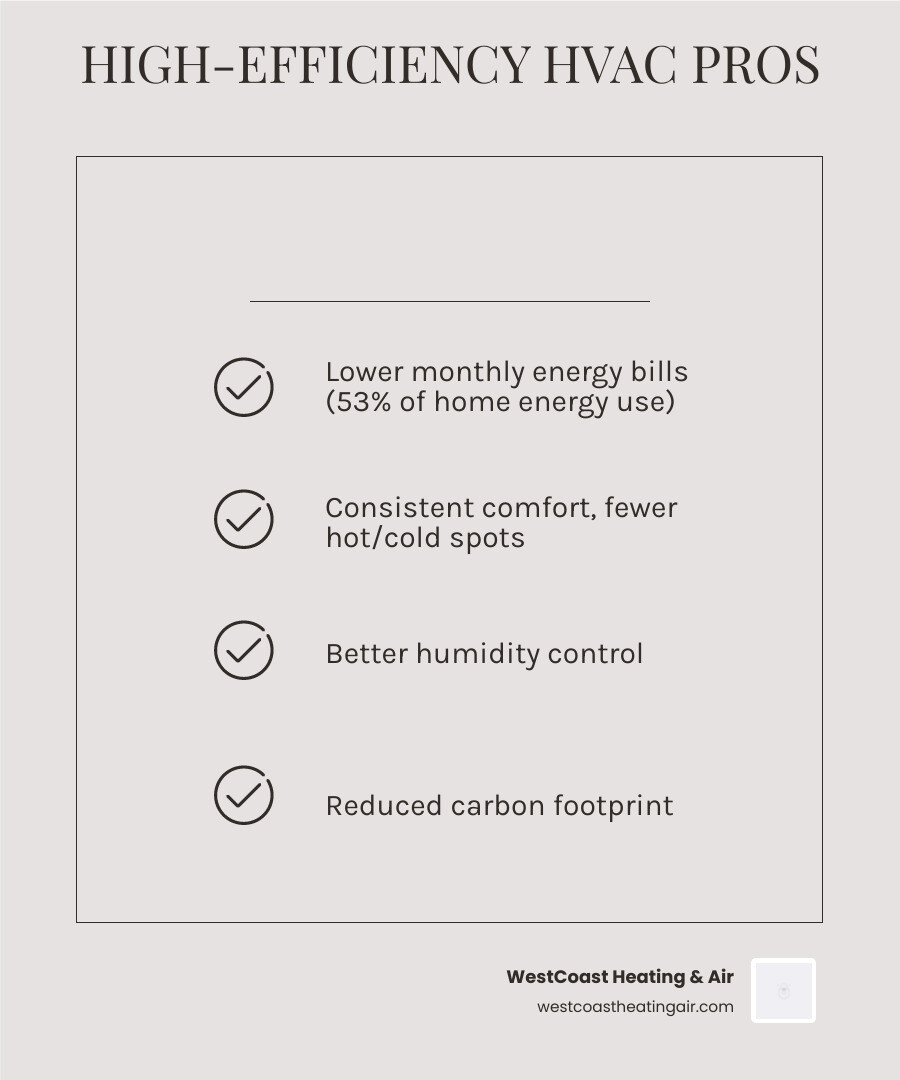
Pros of Upgrading to a High-Efficiency Home HVAC System:
- Lower monthly energy bills (heating and cooling account for 53% of a typical home’s energy use)
- More consistent comfort with fewer hot or cold spots
- Better humidity control
- Reduced carbon footprint with eco-friendly refrigerants
- Potential to raise home value by 5–7%
- Eligibility for rebates and tax credits
Cons of Upgrading to a High-Efficiency Home HVAC System:
- Higher upfront cost compared to standard models
- May require ductwork upgrades or modifications
- Longer payback period in mild climates or short-term ownership situations
- More complex systems that need professional maintenance
- Financing costs can sometimes offset energy savings
The honest answer is: it depends on your home, your climate, and how long you plan to stay. For many homeowners in the Pacific Northwest, where heating loads are significant and energy costs matter, the math often works in your favor. But not always — and that is exactly what this guide is here to help you figure out.
I am Michael Smith, owner of WestCoast Heating & Air in Puyallup, Washington, with deep hands-on experience helping local families evaluate upgrading to high efficiency hvac pros and cons and choose systems that fit their actual needs and budgets. After working through hundreds of these decisions with homeowners across the region, I have seen what works, what does not, and what questions you should be asking before you spend a single dollar.
Understanding High-Efficiency Home HVAC Metrics in 2026
If you’ve looked at a new air conditioner or furnace recently, you’ve probably seen a alphabet soup of acronyms. In May 2026, the standards are stricter than they used to be, and understanding these numbers is the first step in seeing through the marketing fluff.
SEER2: The New Standard for Cooling
SEER stands for Seasonal Energy Efficiency Ratio. However, as of 2023 and continuing into 2026, the residential HVAC industry has moved to SEER2. This updated metric uses a new testing procedure that better reflects the external static pressure found in real-world ductwork. While a standard unit might sit around 13.4 or 14.3 SEER2, high-efficiency models can soar into the 20s. An 18 SEER2 unit, for example, uses roughly 28% less electricity than a 14 SEER2 model.
AFUE: Squeezing Every Penny Out of Your Fuel
For those of us in Washington using gas furnaces, AFUE (Annual Fuel Utilization Efficiency) is the number to watch. Think of it like this: an 80% AFUE furnace converts 80 cents of every dollar into heat, while 20 cents literally goes up the chimney. A high-efficiency 96% AFUE unit only “wastes” 4 cents. Over a long Puyallup winter, those pennies add up to hundreds of dollars in savings. You can explore more about The Best High Efficiency Heating Options For Your Home to see how these ratings translate to different fuel types.
HSPF2: Heat Pump Performance
Since we live in a region where heat pumps are incredibly popular, HSPF2 (Heating Seasonal Performance Factor 2) is vital. It measures the efficiency of the heating side of your heat pump. The higher the number, the less electricity the unit needs to keep you warm when the temperature drops.
The Magic of Variable-Speed and Inverters
The real “secret sauce” of high-efficiency gear isn’t just a bigger coil; it’s the technology inside. Standard systems are like a light switch—they are either 100% on or 100% off. High-efficiency systems use variable-speed motors and inverter-driven compressors. They can “throttle” up or down like a car’s accelerator, running at 30% or 60% capacity to maintain a perfectly steady temperature. This prevents the “blast of cold air” followed by silence that characterizes older, less efficient systems.
Upgrading to high efficiency hvac pros and cons: Is It Worth It?

Deciding whether to go with a “standard” unit or a “high-efficiency” model is essentially a math problem mixed with a comfort preference. In our service areas—from Tacoma and Sumner to University Place and Steilacoom—the climate plays a huge role in the ROI (Return on Investment).
Climate Considerations
In the Pacific Northwest, we have relatively mild summers but long, damp heating seasons. This means that while a ultra-high SEER2 air conditioner might take a long time to pay for itself, a high-efficiency furnace or a cold-climate heat pump often pays for itself much faster. If you are in a home where the furnace runs from October through May, that 16–20% savings on heating bills becomes very significant.
| Feature | Standard Efficiency | High-Efficiency (Premium) |
|---|---|---|
| Typical SEER2 | 13.4 – 14.3 | 16 – 25+ |
| Typical AFUE | 80% | 95% – 98% |
| Blower Motor | Single-stage (On/Off) | Variable-speed (Modulating) |
| Sound Levels | Noticeable “clunk” and hum | Whisper quiet |
| Humidity Control | Basic | Advanced (Longer run cycles) |
The Major Benefits of Upgrading to High Efficiency HVAC Pros and Cons
When we talk about the “pros,” most people think of money first. But after 20 years in the business, I can tell you that comfort is often the bigger win.
- Lower Utility Bills: This is the obvious one. Moving from an old 80% furnace to a 96% model can save between $200 and $260 a year on gas alone.
- Enhanced Comfort: Because variable-speed systems run longer at lower speeds, they circulate air more effectively. This eliminates those annoying hot and cold spots in different rooms.
- Humidity Control: By running longer, lower-intensity cycles, high-efficiency ACs and heat pumps pull more moisture out of the air. This is a game-changer for the damp “June Gloom” we often experience in Puyallup and Spanaway.
- Quiet Operation: High-efficiency units are designed with sound-dampening blankets and variable fans that don’t make that loud “thump” when they kick on.
- Environmental Impact: Using less energy means a smaller carbon footprint. Plus, modern units use refrigerants with lower Global Warming Potential (GWP).
If you are considering a transition, there are specific Advantages Of Upgrading To A High Efficiency Heat Pump that go beyond just cooling, providing a dual-fuel or all-electric solution for our unique climate. Even a 16 Seer Heat Pump can represent a massive jump in technology for a home currently using baseboard heat or an old furnace.
The Potential Drawbacks of Upgrading to High Efficiency HVAC Pros and Cons
We believe in being 100% honest with our neighbors. High-efficiency isn’t always the right choice for every single person.
- Upfront Investment: High-efficiency systems can cost anywhere from $500 to $3,000 more than standard models. If you plan on moving in two years, you likely won’t recoup that through energy savings.
- Installation Complexity: These units aren’t “plug and play.” For example, a 90%+ AFUE furnace produces acidic condensation that requires a dedicated drain line. If your old furnace was in the middle of a finished basement without a drain nearby, the installation gets more complicated.
- Ductwork Compatibility: High-efficiency systems move air differently. If your home has old, leaky, or undersized ducts, a high-end system might actually perform worse than a standard one because it’s being “choked” by the infrastructure. This is why Teaching An Old House New Tricks Retrofitting Hvac is such a critical part of the process.
- Payback Timelines: In very mild climates or for homeowners who keep their thermostats at extreme settings, the “break-even” point might be 10 to 12 years. Since most systems last 15 to 20 years, you have to decide if that window works for you.
When to Pull the Trigger on a System Replacement
How do you know when you’ve crossed the line from “it just needs a tune-up” to “it’s time for an upgrade”?
The 10-15 Year Rule
Most air conditioners and heat pumps have a lifespan of 10 to 15 years. Furnaces can sometimes stretch to 20, but efficiency usually starts to drop significantly after the 12-year mark. If your system is in its teenage years, you’re likely paying for it every month in wasted energy.
The “50% Rule”
If a repair bill comes in at 50% of the cost of a new system, it is almost always a better financial move to upgrade. Why put a new transmission in a car with 300,000 miles? We often see this with the R-22 refrigerant phase-out. If your old AC uses R-22 (Freon), a simple leak repair can be astronomically expensive because that refrigerant is no longer produced.
Frequent Repairs and Rising Bills
If you know your HVAC technician’s first name because they are at your house three times a year, that’s a sign. Similarly, if your utility bills are creeping up even though rates haven’t changed much, your system is working harder and harder to do the same job. Recognizing the Signs Its Time To Upgrade Your Hvac System can save you from a “no-heat” emergency in the middle of a January freeze.
Sometimes, it makes sense to look at the whole picture. Thinking About Replacing Your Ac And Furnace At The Same Time can save you significantly on labor costs and ensure that both halves of your system are perfectly matched for maximum efficiency.
Maximizing Your Investment with Incentives and Proper Sizing
Once you decide to go high-efficiency, you want to make sure you get every discount available and that the system is actually sized for your home.
The Importance of Manual J
A common mistake in the residential HVAC industry is “sizing by square footage.” At WestCoast Heating & Air, we use Manual J load calculations. This takes into account your insulation, window types, home orientation, and even how many people live there. An oversized high-efficiency unit is a waste of money—it will “short cycle,” turning on and off too quickly, which ruins the efficiency and the comfort benefits.
2026 Incentives and Tax Credits
The federal government and local utilities want you to upgrade.
- Energy Efficient Home Improvement Credit (25C): For 2025 and 2026 installations, you can often claim up to $2,000 for heat pumps and $600 for high-efficiency furnaces or central AC.
- Utility Rebates: Local providers in the Puyallup and Tacoma areas often offer rebates ranging from $100 to $1,500. These can cut your payback period by 30% to 50% instantly.
Knowing What To Expect During An Hvac Replacement helps take the stress out of the process. From the initial load calculation to the final permit inspection, a professional assessment ensures you aren’t just buying a box, but a custom-designed comfort system. If you are focused specifically on the heating side, Furnace System Upgrades can often be the most impactful change you make to your home’s energy profile.
Frequently Asked Questions about High-Efficiency Home HVAC
What is the difference between SEER and SEER2?
SEER2 is the new, more accurate way of measuring efficiency that became mandatory in 2023. It accounts for the actual air pressure in your home’s ducts, which standard SEER ratings often ignored. Generally, a SEER2 rating will be slightly lower numerically than the old SEER rating for the same equipment, but it represents a more “honest” look at how the unit will perform in your home.
How long do high-efficiency systems typically last?
You can expect a high-quality, professionally installed system to last 15 to 20 years. However, because high-efficiency systems have more complex electronic components (like inverter boards), regular maintenance is non-negotiable to reach that 20-year mark.
Do high-efficiency units require more maintenance?
They don’t necessarily need more frequent visits, but the maintenance needs to be more precise. A standard system might “tolerate” a slightly dirty filter or a small refrigerant imbalance better than a high-efficiency unit. These systems are finely tuned machines; keeping the sensors and coils clean is essential to maintaining the high SEER2 or AFUE ratings you paid for.
Conclusion
Upgrading your home’s HVAC system is a major decision, but it’s also an opportunity to transform how your home feels and functions. Whether you’re in Orting, SeaTac, or Roy, the goal is the same: staying comfortable without overpaying the utility company.
By weighing the upgrading to high efficiency hvac pros and cons, you can move away from “emergency” repairs and toward a proactive, energy-smart future. At WestCoast Heating & Air, we’ve spent over 20 years helping our neighbors navigate these choices with zero pressure and 100% transparency. We live where you live, and we want your home to be the sanctuary it’s meant to be.
Ready to see the math for your specific home? Schedule your high-efficiency consultation today and let’s find the perfect fit for your comfort and your cash.