
Heat Pump Advantages Over Gas Furnaces: What Puyallup Homeowners Need to Know
Heat pump advantages over gas furnaces are reshaping how homeowners in Puyallup, WA heat and cool their homes — and for good reason. Here is a quick summary of the key advantages:
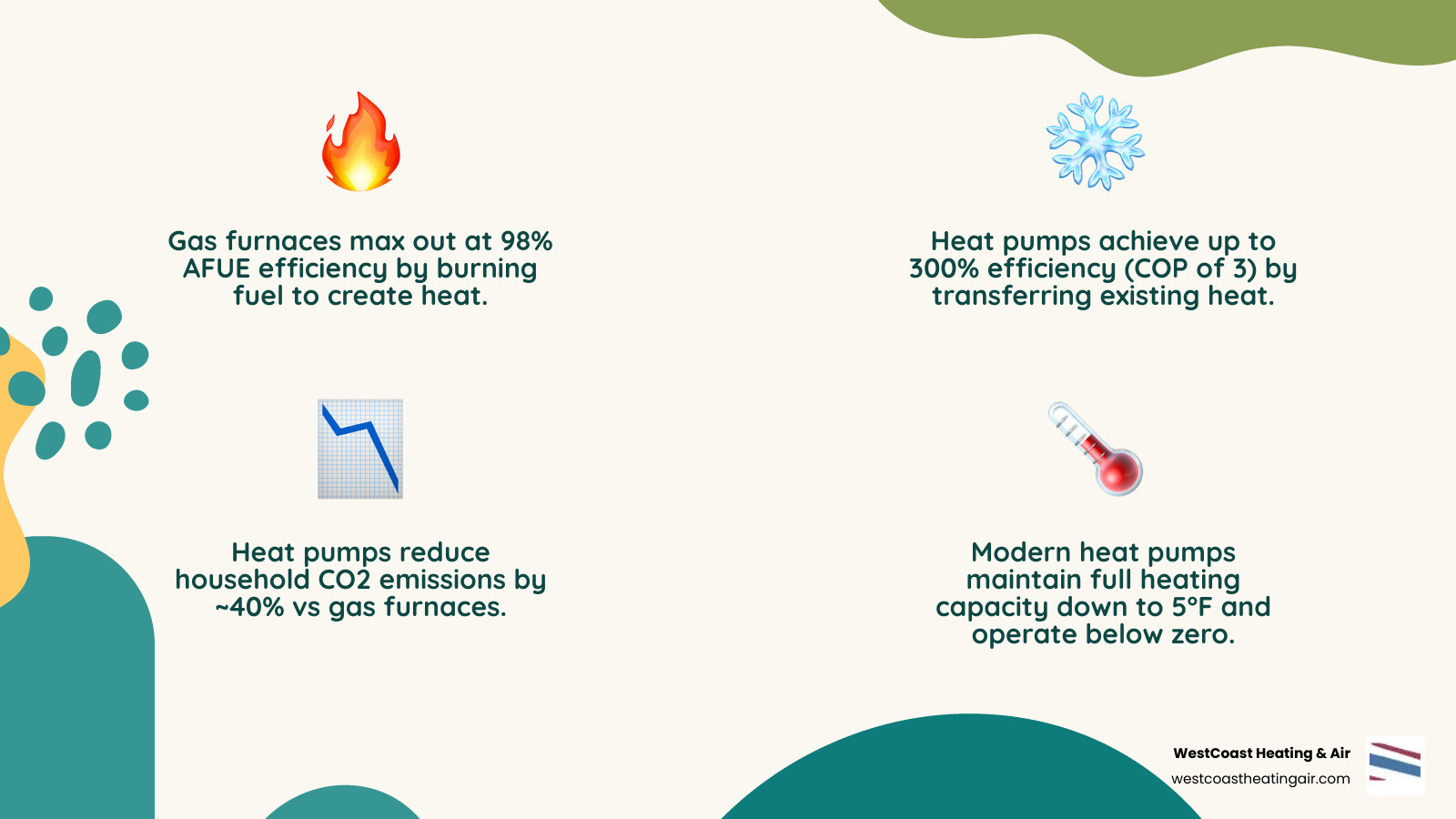
- Higher efficiency — Heat pumps can deliver up to 300% efficiency (a COP of ~3), meaning they move three units of heat for every one unit of electricity consumed. Gas furnaces top out at around 98% AFUE.
- Dual heating and cooling — A single heat pump replaces both your furnace and your air conditioner, eliminating the need for two separate systems.
- Lower carbon footprint — Heat pumps can reduce household CO2 emissions by roughly 40% compared to a gas furnace, according to research from UC Davis.
- No combustion risks — No burning fuel means no carbon monoxide risk, no gas leaks, and no combustion byproducts in your home.
- Cold-weather capable — Modern cold-climate heat pumps deliver full heating capacity down to 5°F and remain operational well below zero.
- Eligible for significant rebates — Federal tax credits and state incentives can meaningfully offset upfront installation costs.
- Better humidity control — Heat pumps deliver gentler, more consistent airflow that preserves indoor humidity better than the dry blast of a gas furnace.
If you have lived with a gas furnace your whole life, the case for switching can feel abstract — until you look at the numbers and the technology side by side. Gas furnaces have been the default home heating choice in the U.S. for decades. But the gap between what a modern heat pump can do and what a conventional gas furnace offers has grown significantly. Today’s heat pumps are quieter, smarter, and far more capable in cold weather than most homeowners realize — and Puyallup’s mild maritime climate happens to be nearly ideal for them.
I’m Michael Smith, owner of WestCoast Heating & Air in Puyallup, and after years of helping local families evaluate their heating options firsthand, I’ve seen how understanding the heat pump advantages over gas furnaces can lead to smarter, more comfortable, and more cost-effective decisions for Pacific Northwest homes. Read on for a complete breakdown of everything you need to know before making a switch.
Understanding the Technology: Heat Transfer vs. Combustion
To truly appreciate the heat pump advantages over gas furnaces, we first have to look at how these two systems create comfort. They use fundamentally different scientific principles to keep your family warm during a damp Washington winter.
A Gas Furnace is a combustion appliance. It works by burning a fuel source—usually natural gas or propane—inside a combustion chamber. This creates intense heat, which is transferred through a metal heat exchanger to the air blowing through your vents. While modern high-efficiency furnaces are impressive, they are limited by the laws of physics: they can never be more than 100% efficient because they have to create every BTU of heat they provide.
In contrast, a heat pump doesn’t “create” heat at all. Instead, it uses a refrigeration cycle to move heat from one place to another. Even when it feels chilly outside in Tacoma or Spanaway, there is still thermal energy present in the outdoor air. The heat pump absorbs that energy using refrigerant and “pumps” it into your home. This thermodynamic advantage is why heat pumps are so much more efficient.
Efficiency Ratings: COP vs. AFUE
When comparing these systems, we use two different “languages” for efficiency. Furnaces use AFUE (Annual Fuel Utilization Efficiency), while heat pumps use COP (Coefficient of Performance) and HSPF2 (Heating Seasonal Performance Factor).
| Feature | Gas Furnace (High-Efficiency) | Modern Heat Pump |
|---|---|---|
| Efficiency Metric | 90% – 98% AFUE | 2.0 – 4.0 COP |
| Energy Source | Natural Gas / Propane | Electricity |
| Mechanism | Combustion (Creating Heat) | Heat Transfer (Moving Heat) |
| Typical Efficiency | 96% (0.96 units of heat per 1 unit of fuel) | 300% (3 units of heat per 1 unit of electricity) |
By moving heat rather than burning fuel, a heat pump can achieve “efficiencies” that seem impossible on paper—often reaching 300% to 400% during moderate Puyallup spring and fall days.
Safety and Air Quality
Beyond the numbers, there is the question of home safety. Because heat pumps run entirely on electricity, they eliminate the risks associated with indoor combustion. There is no risk of a cracked heat exchanger leaking carbon monoxide into your bedrooms, and no danger of gas leaks or explosions. Additionally, because they don’t burn fuel, they don’t produce the ultra-dry, scorched-air feel often associated with furnaces, leading to better indoor air quality and more stable humidity levels.
The Top Heat Pump Advantages Over Gas Furnaces
As we move through 2026, the shift toward electrification is accelerating. One of the biggest advantages of upgrading to a high-efficiency heat pump is the sheer versatility of the equipment.
1. Two Systems in One
The most obvious advantage is that a heat pump provides both heating and cooling. When you install a furnace, you still need a separate central air conditioner if you want to stay cool during those 80-degree July days in Steilacoom. A heat pump handles both jobs. In the summer, it simply reverses its cycle, absorbing heat from inside your home and dumping it outside. This dual functionality often leads to a lower total cost of ownership over the life of the system.
2. Superior Comfort and Humidity Control
Gas furnaces tend to operate in “blasts.” They turn on, blow very hot air (often 120°F+) until the thermostat is satisfied, and then turn off. This creates “temperature swings” where the house feels hot, then chilly. Modern inverter-driven heat pumps are variable-speed. They can ramp up or down to provide a steady, gentle flow of air (usually 95°F – 105°F) that maintains a constant temperature without the dry, parched feeling of a furnace.
3. Environmental Heat Pump Advantages Over Gas Furnaces
For many of our neighbors in University Place and SeaTac, the environmental impact is a deciding factor. Residential heat pumps can reduce a home’s carbon footprint by 38% to 53% when replacing a gas furnace. Because Washington’s electrical grid is increasingly powered by renewable sources like hydro and wind, switching to an electric heat pump effectively “decarbonizes” your home’s heating. You are no longer tethered to fossil fuel combustion to stay warm.
4. Heat Pump Advantages Over Gas Furnaces in Cold Weather
One of the most persistent myths we hear at WestCoast Heating & Air is that “heat pumps don’t work in the cold.” While that may have been true in the 1980s, modern cold-climate heat pumps have changed the game.
Today’s high-performance units can deliver 100% of their heating capacity down to 5°F and continue to provide efficient heat even when temperatures drop to -13°F. They use advanced “defrost cycles” to keep the outdoor coils clear of ice and sophisticated inverter technology to extract heat from even the frostiest air. For those rare Arctic blasts we get in the Puget Sound, most systems include Heat Pump Emergency Heat—electric backup strips that ensure you’re never left in the cold.
Performance and Suitability for the Puyallup Climate
When we look at the map, the Pacific Northwest is the “Goldilocks zone” for heat pumps. Our maritime climate features cool, damp winters and relatively mild summers—exactly the conditions where heat pumps shine brightest.
If you are considering a heat pump installation in tacoma wa, you should look at the HSPF2 (Heating Seasonal Performance Factor) and SEER2 (Seasonal Energy Efficiency Ratio). These ratings measure how efficiently the unit performs over an entire season in a climate like ours. Because our winter lows typically hover in the mid-30s, a heat pump will spend the vast majority of the year operating in its most efficient “sweet spot,” rarely needing to rely on backup heat.
Financial Incentives and Long-Term Affordability
While a heat pump is a sophisticated piece of technology, the financial barrier to entry has never been lower thanks to current incentives. Under the Inflation Reduction Act, homeowners can qualify for a federal tax credit of up to $2,000 for a qualifying heat pump installation. This is a significant boost compared to the much smaller credits available for gas furnaces.
Furthermore, many local utilities in the Orting and Roy areas offer rebates that can shave thousands more off the initial price. When you factor in the “AC value”—the fact that you’re getting a high-end air conditioner included—the math starts to look very favorable.
Over a 10-year period, the total cost of ownership for a high-efficiency heat pump in a moderate climate is estimated at roughly $22,500, compared to $31,000 for a 96% AFUE gas furnace paired with a separate central AC unit. For many, a 16 Seer Heat Pump represents the perfect balance of upfront value and long-term monthly savings.
Maintenance, Reliability, and Hybrid Solutions
Whether you choose gas or electric, the key to longevity is professional care. As a leading Gas Furnace Maintenance Company In Puyallup Wa, we always remind our customers that both systems need an annual “physical.”
- Heat Pump Maintenance: Requires checking refrigerant levels, cleaning outdoor coils, and ensuring the condensate drain is clear. Since the system runs year-round (heating and cooling), a bi-annual checkup is often best.
- Furnace Maintenance: Focuses on burner cleaning, heat exchanger inspection, and ensuring the exhaust flue is venting dangerous gases safely.
The Best of Both Worlds: Dual-Fuel Systems
If you aren’t quite ready to go “all-electric” or if you live in a particularly drafty older home in Sumner or Orting, a hybrid system might be the answer. By Finding Your Perfect Dual Fuel Heat Pump Combo, you get a heat pump for 90% of the year and a gas furnace that only kicks in during the absolute coldest nights. This “hybrid” approach maximizes efficiency without sacrificing the “blow-torch” heat some homeowners prefer during a freeze.
And of course, if you decide to stick with your current gas setup for now, we are always available for Gas Furnace Repair In Puyallup Wa to keep your older system running as efficiently as possible.
Frequently Asked Questions about Heat Pumps
Are heat pumps really more efficient than gas furnaces in 2026?
Yes, absolutely. From a scientific standpoint, heat pumps have a significant “Coefficient of Performance” advantage. While the best gas furnace is 98% efficient (meaning it loses 2% of its energy up the chimney), a heat pump regularly operates at 300% efficiency or higher. This is because it is moving existing heat rather than creating it through combustion.
Is it safer to have a heat pump than a gas furnace in my house?
Generally, yes. Heat pumps eliminate the two biggest risks associated with HVAC systems: carbon monoxide poisoning and gas explosions. While gas furnaces have many built-in safety features, a heat pump is an all-electric appliance that removes the “fire” from your home’s heating process entirely.
How can I calculate my potential savings when switching from gas to electric?
The best way is to look at your local utility rates. In Washington, we often enjoy lower-than-average electricity prices, which makes the energy price ratio very favorable for heat pumps. You can convert your gas usage (therms) and electricity usage (kWh) into a common unit like kBTUs to see exactly what you’re paying for every unit of heat delivered. Our team can help you perform a “load calculation” to see exactly how much a new system would save you based on your home’s insulation and size.
Conclusion
The heat pump advantages over gas furnaces are more than just marketing hype—they are a reflection of a massive technological shift toward cleaner, more efficient, and more versatile home comfort. Whether you are looking for the the best high-efficiency heating options for your home or you’re simply tired of high gas bills and uneven temperatures, a modern heat pump is a future-proof investment.
At WestCoast Heating & Air, we’ve spent over 20 years serving families from Tacoma to Puyallup and beyond. We don’t believe in “one-size-fits-all” solutions. We pride ourselves on customized system design and customer education, ensuring you understand exactly why a specific system is right for your unique home and budget.
Ready to see if a heat pump is the right fit for your Puyallup home? Contact us for a heat pump consultation today, and let’s get you on the path to year-round comfort.