
Should I Repair or Replace My Furnace or Heat Pump? Here’s Your Quick Answer
Deciding should I repair or replace my furnace or heat pump is one of the most stressful calls a homeowner can face — and it almost always happens at the worst possible time, like on a freezing January morning in Puyallup when the heat just stops working.
Here’s a fast answer based on the most widely used industry guidelines:
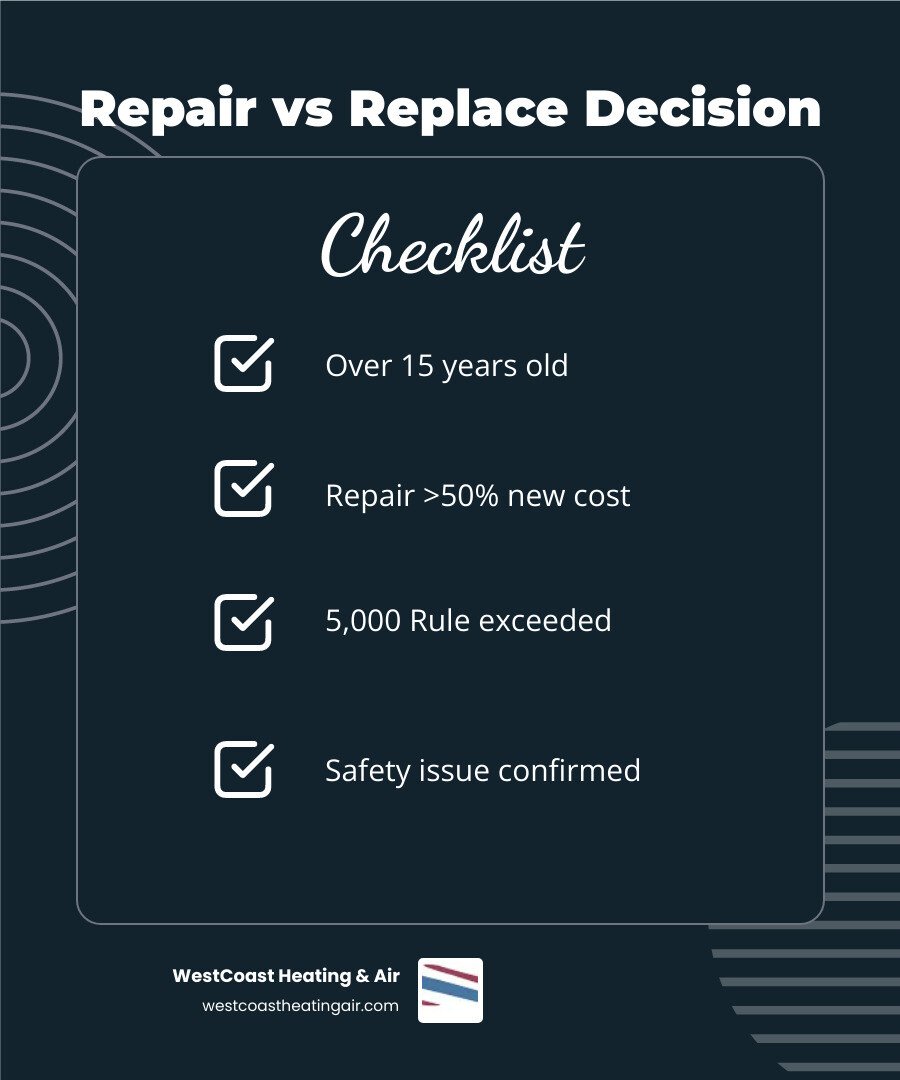
Replace your furnace or heat pump if any of these are true:
- The system is over 15 years old (heat pumps) or over 15–20 years old (furnaces)
- Repair cost exceeds 50% of the cost of a new system
- System age × repair cost exceeds $5,000 (the 5,000 Rule)
- You have had 2 or more major repairs in the past 2 years
- A cracked heat exchanger or carbon monoxide leak has been confirmed
- The system uses R-22 refrigerant and needs a significant repair
Repair your furnace or heat pump if most of these are true:
- The system is under 10 years old and well-maintained
- The repair is a minor wear item like a capacitor, flame sensor, or contactor
- Repair cost is well under 50% of replacement cost
- The 5,000 Rule calculation stays below $5,000
- No safety issues have been identified
If you’re not sure which camp you’re in, keep reading — this guide walks you through every factor, step by step.
The reality is that most homeowners don’t think about their heating system until something goes wrong. A system that’s been quietly losing efficiency for years suddenly becomes the most urgent problem in the house. Whether you’re weighing a repair quote or sensing that your system is on its last legs, the decision deserves a clear framework — not a rushed call made under pressure.
I’m Michael Smith, owner of WestCoast Heating & Air in Puyallup, Washington, and after decades of hands-on problem-solving — including a 30-year career with Boeing before transitioning into the residential HVAC industry — I’ve helped hundreds of local homeowners work through the exact question of should I repair or replace my furnace or heat pump. In this guide, I’ll share the same straightforward process I use with every customer so you can make a confident, informed decision.
The Core Decision: Should I Repair or Replace My Furnace or Heat Pump?

When your home’s heating system starts acting up, it is easy to fall into a cycle of worry. You might wonder if a quick fix will buy you another five years, or if you are simply throwing good money after bad. To make the best choice for your household, you need to step back and look at the big picture rather than reacting to a single cold morning.
Every home heating system represents a balance between upfront investment, ongoing operational costs, and daily comfort. When we sit down with families in Puyallup, Tacoma, or University Place, we guide them through a structured decision framework. We look at the physical condition of the equipment, how well it has been maintained, and whether the system can still keep up with our damp, chilly Pacific Northwest winters.
If you are constantly adjusting your thermostat, noticing unusual sounds, or dreading your monthly utility bills, your system is trying to tell you something. Before authorizing a major fix, it is essential to evaluate the overall health of your unit. Understanding the key Signs It’s Time to Upgrade Your HVAC System can save you from the frustration of a system that fails again just weeks after a costly service call.
How Age and Lifespan Help Answer: Should I Repair or Replace My Furnace or Heat Pump?
The physical age of your equipment is one of the most reliable indicators of whether you should invest in a repair or plan for a complete system upgrade. Just like a reliable pair of work boots, even the highest-quality heating systems eventually wear out after years of hard service.
In a perfect environment, a standard residential gas furnace typically has a useful lifespan of 15 to 20 years. Electric furnaces can sometimes stretch a bit longer if they have been lightly used and meticulously maintained. On the other hand, heat pumps generally have a shorter average lifespan of 12 to 18 years. Because heat pumps work double-duty — providing cooling in our increasingly warm summers and heating throughout our long winters — they accumulate mechanical wear much faster than a furnace that sits idle for half the year.
Our local climate plays a massive role in how these lifespans play out in the real world. The persistent moisture and coastal air patterns of the Puget Sound region can accelerate rust and corrosion on internal metal components. If your system is located in a damp crawlspace or a poorly ventilated garage in Spanaway or Steilacoom, it may reach the end of its reliable operating life sooner than a system in a drier climate. To understand how our local weather patterns impact your equipment over the long haul, take a look at our detailed breakdown of The Cold Hard Truth About HVAC Lifespans in the Northwest.
Applying the 5,000 Rule: Should I Repair or Replace My Furnace or Heat Pump?
To remove the emotion from this decision, the HVAC industry relies on a couple of simple mathematical sanity checks. The first is the 5,000 Rule.
To use this rule, you multiply the exact age of your system in years by the service quote you received for the repair. If the resulting number is over 5,000, the math strongly suggests that replacing the system is the wiser financial move. If the number is well under 5,000, repairing the unit is usually a safe bet.
For example, if you have a 6-year-old furnace that needs a moderate repair, multiplying the age by the repair quote will likely yield a number far below the 5,000 threshold. In this scenario, repairing the system makes total sense because the equipment still has plenty of useful life ahead. However, if you have a 14-year-old heat pump facing a major component failure, the calculation will easily sail past 5,000. Investing heavily in a system that is already nearing retirement is rarely a sound strategy.
Another excellent guideline is the 50% Rule. If the cost of a single repair approaches or exceeds 50% of the value of a brand-new, modern system, that money is almost always better spent as a down payment on an upgrade. Keeping an older, inefficient system on life support through expensive, recurring repairs often leads to what we call the “repair spiral.” You fix a blower motor this winter, only to have the circuit board fail next summer.
The best way to avoid these urgent financial decisions is to catch small mechanical issues before they turn into system-ending failures. Regular, professional maintenance keeps your system running at peak efficiency and extends its overall lifespan. Investing in routine check-ups is the single most effective way to protect your budget, as outlined in our guide on The Financial Case for Preventive Maintenance.
Key Warning Signs Your Heating System is Failing
Your heating system rarely fails completely without giving you a few warning signs first. The key is knowing how to spot these subtle distress signals before you are left in a freezing house. Common indicators of a system in decline include uneven temperatures from room to room, a system that constantly turns on and off (known as short-cycling), and strange mechanical noises like rattling, squealing, or banging.
Ignoring these early warning signs can have serious consequences. A system that is struggling to operate will consume significantly more energy, causing your utility bills to climb. More importantly, a neglected heating system can eventually develop safety hazards that put your family at risk. Understanding What Happens If You Skip HVAC Maintenance is the first step in recognizing why these early warning signs require prompt, professional attention.
Critical Safety Risks and Carbon Monoxide Warnings
While comfort and efficiency are important, safety must always be your top priority. This is especially true for gas furnaces. A cracked heat exchanger is one of the most serious mechanical failures a furnace can experience. The heat exchanger is the metal chamber that keeps toxic combustion gases, including carbon monoxide, safely separated from the clean air circulating through your home’s ductwork.
If a heat exchanger develops even a microscopic crack due to years of metal expansion and contraction, carbon monoxide can leak directly into your living spaces. Because carbon monoxide is completely colorless, odorless, and tasteless, it is a silent hazard.
To protect your household, you should look for these physical warning signs of a combustion issue:
- A burner flame that is yellow or flickering instead of a crisp, steady blue.
- Excessive moisture condensing on the inside of cold windows.
- Streaks of dark soot around the furnace cabinet or venting pipes.
- Frequent, unexplained physical symptoms among family members, such as headaches, dizziness, or nausea.
Ensure you have working carbon monoxide detectors installed on every level of your home, especially near sleeping areas. If a technician diagnoses a cracked heat exchanger in your furnace, the unit must be shut down immediately for safety reasons. In almost every case, a cracked heat exchanger on an older furnace means it is time for a system replacement.
Performance Issues and Rising Energy Bills
If your heating system is safe but simply cannot keep your home comfortable, it may be reaching the end of its operational life. You might notice that your living room is cozy, but the bedrooms are freezing. Or, your system might run continuously without ever reaching the temperature set on your thermostat.
This lack of performance is often accompanied by a steady increase in your monthly energy bills. As internal components wear out, motors must work harder and run longer to deliver the same amount of heat. If you compare your current winter utility bills to those from previous years and notice a clear upward trend despite similar weather patterns, your system is losing its efficiency.
Strange noises are another clear indicator of internal wear. While no heating system is completely silent, loud banging, squeaking, or grinding sounds suggest that mechanical components are failing. A rattling sound often indicates loose panels or a failing blower wheel, while a sharp squeal can mean a motor bearing is on its way out.
Technical and Efficiency Factors to Consider
When evaluating whether to repair or replace your system, it helps to look beyond the immediate mechanical issue and consider the long-term technological and financial benefits of upgrading. Modern heating systems are vastly more efficient than those built a decade ago.
To understand these efficiency gains, you need to look at three key ratings:
- AFUE (Annual Fuel Utilization Efficiency): This measures how efficiently a gas furnace converts fuel into heat. Older furnaces often have AFUE ratings around 78% or 80%, meaning that 20% or more of the fuel you pay for is wasted up the chimney. Modern high-efficiency furnaces can achieve AFUE ratings of 96% or higher, virtually eliminating wasted fuel.
- SEER2 (Seasonal Energy Efficiency Ratio 2): This measures the cooling efficiency of a heat pump during the summer months. Higher SEER2 ratings mean lower electric bills when you are keeping your home cool.
- HSPF2 (Heating Seasonal Performance Factor 2): This measures the heating efficiency of a heat pump over the course of a typical winter.
Upgrading to a system with higher ratings can result in immediate, noticeable savings on your monthly energy bills. If you want to explore how a modern, electric heat pump compares to a traditional gas furnace in terms of technology and efficiency, read our comparison on Why Your Old Gas Furnace Is Feeling the Heat From Modern Heat Pumps.
Refrigerant Phase-Downs and System Compatibility
If you have an older heat pump or air conditioner, the type of refrigerant it uses can heavily influence your repair vs. replace decision. Older systems manufactured before 2010 rely on R-22 refrigerant (often called Freon). Because of environmental regulations, the production and import of R-22 was completely phased out.
If your R-22 system develops a refrigerant leak, sourcing reclaimed refrigerant to recharge the system is incredibly difficult and expensive. Investing in a major leak repair on an R-22 system is rarely a sound decision; those resources are far better directed toward a modern system that uses current, environmentally friendly refrigerants. Even R-410A, the refrigerant that replaced R-22, is currently undergoing its own regulatory phase-down, which will make servicing older R-410A systems increasingly expensive in the coming years.
Another technical factor is system compatibility. If you decide to replace an aging outdoor heat pump, you must also consider the indoor air handler or furnace. An HVAC system is designed to work as a matched pair. If you attempt to connect a brand-new, high-efficiency outdoor heat pump to an old, mismatched indoor blower unit, you will likely experience reduced performance, higher energy consumption, and a shortened system lifespan. In many cases, a mismatched system will even void the manufacturer’s warranty. To understand why replacing both units at the same time is usually the smartest approach, read our guide on Westcoast Heating Air Com Thinking About Replacing Your AC and Furnace at the Same Time.
Efficiency Upgrades and Rebates
While a new heating system is a significant home investment, there are numerous financial programs designed to help ease the transition. Upgrading to an ENERGY STAR certified furnace or heat pump can make you eligible for a variety of federal tax credits, state incentives, and local utility rebates.
Here in Western Washington, local utility providers like Tacoma Power and Puget Sound Energy frequently offer substantial rebates for homeowners who upgrade from older, inefficient heating systems to high-efficiency electric heat pumps. These incentives can significantly lower the net cost of your installation.
Additionally, choosing a high-efficiency system ensures you will continue to save money month after month through reduced utility bills. If you are interested in exploring the long-term financial benefits of upgrading your heating equipment, check out our resource on Furnace System Upgrades.
Frequently Asked Questions about Heating System Replacement
Is it better to replace the furnace and heat pump at the same time?
Yes, in almost every residential scenario, it is highly recommended to replace both components together. Your outdoor heat pump and your indoor furnace or air handler are designed to operate as a single, cohesive system.
When you install a matched system, you ensure that the indoor and outdoor units communicate perfectly, allowing the system to achieve its maximum rated efficiency (SEER2 and HSPF2). Replacing both units at the same time also ensures you receive full manufacturer warranty coverage and saves you from paying for a second, separate installation down the road. If you are curious about what the actual installation day looks like, you can read more in our overview of What to Expect During an HVAC Replacement.
How does the 50% rule apply to residential heating repairs?
The 50% rule is a simple financial threshold: if the cost of a pending repair is more than half the cost of a brand-new system, you should replace the unit instead of repairing it.
This rule is especially true for older systems that are past their manufacturer warranty period. Spending a significant amount of money to fix a system that is already near the end of its expected lifespan is risky, as other aging components within the unit are likely to fail in the near future.
What maintenance steps can prevent premature system failure?
The single most important step you can take as a homeowner is to change your system’s air filter regularly — typically every 30 to 90 days depending on your household’s pet situation and usage. A clogged air filter restricts airflow, forcing every mechanical component in your system to work harder and run hotter, which leads to premature wear and unexpected breakdowns.
Additionally, you should keep the area around your outdoor heat pump clear of leaves, weeds, and debris to ensure proper airflow. Finally, scheduling a professional maintenance tune-up once a year is the best way to catch minor issues before they turn into expensive, system-ending failures.
Conclusion
Deciding whether to repair or replace your home’s heating system is a significant decision, but you do not have to make it alone. By looking at your system’s age, evaluating its recent repair history, and keeping a close eye on your monthly energy bills, you can make a choice that protects both your family’s comfort and your household budget.
At WestCoast Heating & Air, we are proud to be a local, family-owned residential HVAC company serving our neighbors in Puyallup, Tacoma, Sumner, Orting, and the surrounding communities. With over 20 years of local experience, our focus is always on customer education, honest assessments, and customized system designs tailored to the unique needs of your home. We never believe in high-pressure sales tactics; our goal is simply to give you the clear, reliable information you need to make the right choice for your family.
If you are currently facing a difficult decision regarding an aging furnace or heat pump, we are here to help. Schedule your residential heating consultation today and let our friendly, experienced team guide you to the perfect comfort solution for your home.