
What to Do When Your HVAC System Fails: Quick Answer Guide
Knowing emergency HVAC repair what to do when your system fails can mean the difference between a quick fix and a costly disaster — especially on the coldest night of a Puyallup winter or the hottest afternoon of a Pacific Northwest heat wave.
If your home HVAC system just failed, here’s what to do right now:
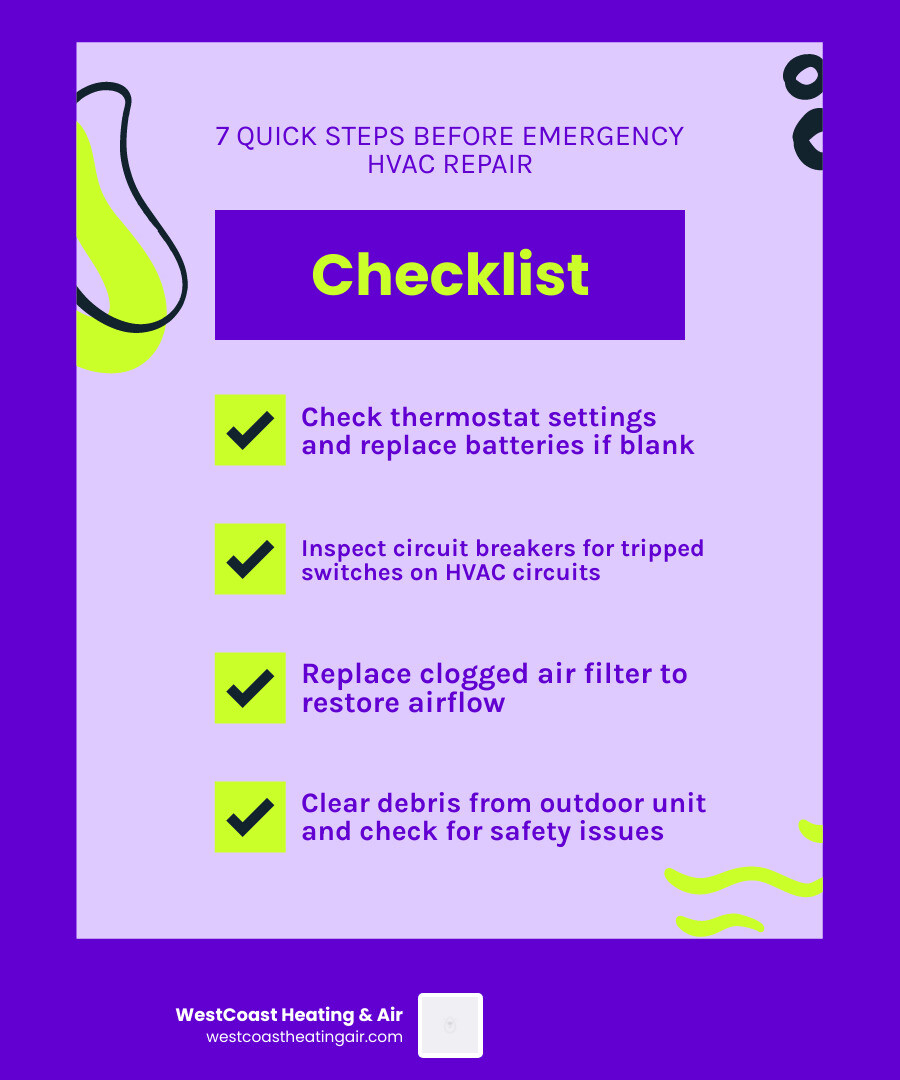
- Check the thermostat – Verify settings, mode, and replace batteries if the screen is blank or dim
- Check your circuit breaker – Look for tripped breakers on both the indoor and outdoor unit circuits and reset once if needed
- Replace or inspect the air filter – A clogged filter is one of the most common causes of sudden system failure
- Check the outdoor unit – Clear any debris, ice, or obstructions around the condenser
- Identify warning signs – If you smell gas, see sparks, or hear your CO alarm, evacuate immediately and call 911
- Turn the system off – If you notice burning smells, strange noises, or visible smoke, shut the system down at the thermostat and breaker
- Call a professional – If basic checks don’t restore operation, contact a licensed HVAC technician for emergency service
It’s a scenario no homeowner wants to face: your heating or cooling system stops working right when you need it most. And it almost never happens at a convenient time. Research shows that 70% of homeowners experience an HVAC breakdown during peak seasons — the hottest days of summer and the coldest stretches of winter — when the system is working hardest and contractor phones are ringing nonstop.
For Puyallup and Pierce County homeowners, a failed HVAC system isn’t just uncomfortable. Depending on the season and the nature of the failure, it can create genuine health and safety risks for your family. Knowing how to respond quickly and correctly — and understanding when a breakdown crosses the line into a true emergency — gives you the confidence to protect your home and your loved ones while you wait for professional help.
I’m Michael Smith, owner of WestCoast Heating & Air in Puyallup, and after 30 years at Boeing followed by years in the HVAC industry serving Pacific Northwest families, I’ve seen how the right response to emergency HVAC repair — and knowing what to do when your system fails — can prevent a stressful situation from turning into an expensive one. In this guide, I’ll walk you through everything you need to know, from identifying a true emergency to troubleshooting basics, staying comfortable while you wait, and protecting your home from future breakdowns.
Emergency hvac repair what to do when your system fails vocab explained:
- how to prevent hvac emergencies with maintenance
- signs you need emergency hvac service
- what to expect during an emergency service call
What Qualifies as a True Emergency HVAC Repair What to Do When Your System Fails
When your home heating or cooling drops out, your immediate reaction is probably a bit of panic. However, it helps to distinguish between a situation that requires immediate dispatch and one that can safely wait for a scheduled appointment during normal business hours.
Understanding this distinction can save you unnecessary stress and help you prioritize your family’s immediate safety. A true emergency is generally defined as any system failure that directly threatens your family’s health, safety, or the physical integrity of your property.

If your system is showing minor symptoms like slightly uneven temperatures or a tiny rattle, it is certainly a problem, but it may not be a crisis. However, if you are dealing with extreme outdoor temperatures, active water leaks, or signs of combustion issues, you need to act fast. To help you evaluate your situation, we highly recommend reading up on how to spot these issues in our guide: Don’t Ignore These Signs of a True HVAC Emergency.
Weather-Critical Failures and Health Risks
In places like Tacoma, Spanaway, and Puyallup, winter temperatures can drop below freezing, while summer can bring intense heat waves. When your system fails during these extreme weather events, the indoor climate can quickly reach dangerous levels.
For vulnerable residents — including infants, the elderly, or family members with chronic health conditions — a lack of climate control is a major health hazard. In freezing conditions, a home can lose its heat reservoir within hours, running the risk of hypothermia.
During summer heat waves, indoor temperatures can rapidly climb past 90°F, creating a real danger of heat exhaustion or heatstroke. If your heat pump or furnace fails on a freezing night, you may need to reach out for immediate assistance. If you find your system struggling when the temperature drops, check out our guide on Same Day Heat Pump Repair in Tacoma to Save Your Toes for quick, reliable support.
Life-Safety Hazards and System Red Flags
Beyond extreme temperatures, some system failures present immediate physical dangers to your household. These are “life-safety” emergencies that require you to shut off your system and, in some cases, leave your home immediately:
- Carbon Monoxide (CO) Alarms: If your CO detector sounds, treat it as a 911 emergency. Carbon monoxide is an odorless, colorless, and silent killer. Residential furnaces cause hundreds of accidental poisoning deaths in the U.S. every year. Evacuate immediately and call emergency services from outside.
- Gas Smells: Natural gas is naturally odorless, but utilities add a chemical called mercaptan to give it a distinct “rotten egg” smell. If you smell gas near your furnace, do not flip any light switches, light matches, or use your phone inside. Evacuate the house and contact your gas utility immediately.
- Burning Smells or Sparks: If you smell burning plastic, sulfur, or see visible sparks coming from your indoor air handler or outdoor unit, you are looking at an active electrical hazard. Turn off the power at your main electrical panel immediately.
- Active Water Leaks: A major condensate backup or ruptured line can quickly flood your drywall, ceilings, and flooring, leading to structural damage and rapid mold growth.
If you suspect your gas furnace is acting up or showing any of these red flags, do not hesitate. Read our detailed Emergency Gas Furnace Repair Puyallup Guide to know exactly how to protect your household.
Immediate Safety and Troubleshooting Steps for Homeowners
Before you pick up the phone to call for help, it is vital to secure your home and perform a few simple safety checks. Statistics show that roughly 25% of all emergency service calls are actually resolved by basic troubleshooting steps that homeowners can perform themselves.
To help you navigate this process safely, we have put together a step-by-step approach. For a complete walkthrough of what our team does when we arrive, you can review The Emergency Repair Process Explained for Homeowners.
| Troubleshooting Step | What to Check | When to Call a Professional |
|---|---|---|
| Thermostat | Mode (Heat/Cool), fan setting, and battery power | Display is completely blank even with fresh batteries |
| Circuit Breaker | Look for tripped switches in the main electrical panel | Breaker trips again immediately after being reset once |
| Air Filter | Remove and inspect for heavy dust, pet hair, or blockages | System does not resume airflow after filter is replaced |
| Outdoor Condenser | Clear leaves, snow, grass clippings, and debris | Fan blade is bent, or unit is making loud grinding noises |
| Evaporator Coil | Check for visible ice buildup on copper lines | Ice is present (requires system shutoff and professional diagnosis) |
Quick Troubleshooting Before Calling for Emergency HVAC Repair What to Do When Your System Fails
If your system has completely shut down, walk through these quick diagnostic checks to see if you can safely restore power:
- Inspect the Thermostat: Make sure the thermostat is set to the correct mode (e.g., “Heat” in the winter or “Cool” in the summer). If the screen is blank or flashing, replace the batteries. About 40% of all HVAC emergencies actually start with a simple thermostat malfunction or dead batteries.
- Check the Electrical Panel: Locate your home’s main breaker box and look for any switches labeled “Furnace,” “AC,” or “Heat Pump” that have tripped to the middle position. Flip the breaker completely to the “Off” position, then back to “On.” Rule of thumb: Only reset a breaker once. If it trips again immediately, you have an electrical short or a failing component. Repeatedly resetting a tripped breaker is a major fire hazard.
- Examine the Air Filter: A heavily clogged air filter acts as a bottleneck for airflow. In the winter, this can cause your furnace to overheat and trigger a safety limit switch (short-cycling). In the summer, restricted airflow causes the temperature of your AC coils to plummet, leading to a frozen evaporator coil. If the filter is dirty, swap it out.
- Clear the Outdoor Unit: Ensure your outdoor heat pump or AC condenser has at least two feet of clear space around it. Remove accumulated autumn leaves, high grass, snow, or wind-blown debris that could block heat transfer.
For homeowners living in Tacoma and surrounding areas, keeping your heating system in check is crucial. If your furnace is refusing to kick on, take a look at our Tacoma Emergency Furnace Maintenance Guide for specific troubleshooting tips designed for our local climate.
Temporary Comfort Measures While You Wait
If your system is truly broken and you are waiting for our technician to arrive, you can take several safe steps to manage your home environment and keep your family comfortable:
- In the Winter:
- Gather your family in a single, central room and close the doors to unused areas of the house to conserve heat.
- Use portable space heaters safely. Keep them at least three feet away from furniture, curtains, and bedding. Always plug them directly into a wall outlet rather than an extension cord, and turn them off when you go to sleep.
- To prevent your pipes from freezing on extremely cold nights, open the cabinet doors under your kitchen and bathroom sinks to let warm air circulate around the plumbing. Set your faucets to a slow, steady drip to keep water moving.
- Block drafts by rolling up towels and placing them at the base of exterior doors.
- In the Summer:
- Close all blinds, shades, and curtains during the hottest parts of the day to block solar heat gain.
- Use ceiling fans and portable fans to keep air moving. Moving air creates a wind-chill effect that can make a room feel 4 to 6 degrees cooler than it actually is.
- Stay hydrated by drinking plenty of water, and limit physical activity.
- If indoor temperatures become unbearable, consider spending the warmest hours of the day at a local air-conditioned public space, like a library or community center.
If your furnace breaks down on a freezing night in Spanaway, don’t freeze in your own living room. We offer rapid response times to get your heating back up and running. Learn more about our fast-acting services in our guide on Same Day Gas Furnace Repair in Spanaway for Chilly Nights.
What to Expect During a Professional Emergency Service Visit
When you call WestCoast Heating & Air for a residential emergency repair, we understand that you are dealing with a highly stressful situation. Our goal is to restore your comfort and peace of mind as quickly and safely as possible. From the moment you contact us, we prioritize rapid communication and clear, honest service.
Our dispatch team is trained to assess the urgency of your situation, prepare our technicians with the right details, and get help on the way. If you are using a ductless mini-split system in Tacoma and find yourself without heat, you can read our specialized guide on what to expect during a repair call: Emergency Ductless Heating Repair Tacoma Guide.
Information to Provide When Requesting Emergency HVAC Repair What to Do When Your System Fails
When you call our dispatch team, having a few key details ready will help us serve you much faster:
- The Symptoms: What exactly is the system doing? Is the blower fan running but blowing cold air? Is the system completely silent? Are you hearing loud banging, squealing, or clicking noises?
- System Type: Do you have a gas furnace, an electric heat pump, or a ductless mini-split system?
- Model and Serial Numbers: If it is safe to do so, take a quick photo of the manufacturer’s nameplate on your indoor or outdoor unit. This helps our technicians identify the exact system design and check our truck inventory for compatible parts before we arrive.
- Safety Concerns: Let us know immediately if you smell gas, hear a carbon monoxide alarm, or have vulnerable family members (such as newborns or elderly relatives) in the home.
If you are a Puyallup resident dealing with a ductless heating issue, you can find tailored advice on how to communicate your system’s symptoms to our team in our Emergency Ductless Heating Repair in Puyallup WA guide.
The Diagnostic and Repair Process
Once our technician arrives at your home, they will follow a structured process to identify and resolve the issue:
- Safety Assessment: First and foremost, we conduct a safety sweep to check for gas leaks, carbon monoxide, or hazardous electrical wiring.
- System Diagnostics: We perform a complete physical and electrical inspection, testing key components like the thermostat, circuit boards, capacitors, blower motors, and safety switches.
- Clear Explanation: Before we perform any work, we will explain exactly what failed, why it failed, and walk you through your repair options. We believe in customer education, so we will show you the problem component and answer any questions you have.
- Same-Day Repair: Our service trucks are stocked with common replacement parts like capacitors, contactors, ignitors, and flame sensors. We aim to resolve the vast majority of common failures on our very first visit.
When your heat pump quits unexpectedly, you want a team that can diagnose and repair the issue without delay. Learn more about our diagnostic process and how we handle sudden failures in our guide: When Your Heat Pump Quits Same Day Repair Solutions.
Preventing Future Breakdowns with Regular Maintenance
While knowing how to handle an emergency is incredibly important, the best emergency is the one that never happens. Research shows that up to 68% of all emergency HVAC service calls are completely preventable with regular, professional maintenance.
By investing in routine care, you can reduce your likelihood of a sudden breakdown by 50%, while keeping your system running at peak energy efficiency.
Just like changing the oil in your car, your heating and cooling systems need regular tune-ups to clear away dust, tighten electrical connections, and catch minor wear and tear before it turns into a major system failure. For residents in Tacoma, keeping your heat pump maintained is a year-round job. Discover how we keep local systems running smoothly in our guide to Tacoma Emergency Heat Pump Maintenance That Never Sleeps.
The Benefits of a Residential Maintenance Plan
Enrolling in a regular maintenance program is one of the smartest investments you can make for your home. Here is why proactive maintenance pays off:
- Catching Issues Early: During a routine tune-up, our technicians can spot small problems — like a slightly frayed wire, a weak capacitor, or a dirty flame sensor — and fix them before they cause a complete system shutdown on a freezing January night.
- Maximizing Lifespan: A well-maintained heating and cooling system can easily last 15 to 20 years. On the other hand, neglected systems often suffer from premature compressor or heat exchanger failures, forcing a replacement in as little as 8 to 10 years.
- Lower Energy Bills: Dust and dirt buildup forces your system to work harder to circulate air, consuming more power. Clean, well-adjusted systems operate 15% to 20% more efficiently, saving you money on your monthly utility bills.
- Priority Scheduling: Should you ever experience a breakdown, maintenance members typically receive priority service scheduling, getting a technician to your door even faster during peak seasons.
If you want to protect your home and keep your system running safely, consider setting up a regular maintenance schedule. Learn more about how we keep systems in top shape with our guide on Fast and Reliable 24 Hour Heat Pump Maintenance in Puyallup.
Frequently Asked Questions About HVAC Failures
We know that when your HVAC system fails, you have a lot of questions. Here are some of the most common questions we hear from homeowners in Puyallup, Tacoma, and across Pierce County:
Is no air conditioning considered a true emergency in Washington?
In the Pacific Northwest, whether a lack of air conditioning is a true emergency depends heavily on the outdoor temperature and your household’s health. During extreme summer heat waves, indoor temperatures can rapidly climb to dangerous levels, posing a serious risk of heat exhaustion or heatstroke, especially for infants, the elderly, or those with medical conditions.
If outdoor temperatures are soaring and you have vulnerable family members at home, a complete loss of cooling is absolutely a true emergency. If you are looking to upgrade or install a highly reliable system to prevent summer outages, take a look at our Emergency Ductless Heating Install Tacoma Guide for year-round comfort solutions.
What should I do if I smell gas or a burning odor?
If you smell a “rotten egg” gas odor near your furnace, or if your carbon monoxide detector sounds, you must treat it as a life-safety emergency. Do not attempt to troubleshoot the system yourself. Evacuate everyone from the home immediately. Do not use phones, light matches, or flip any electrical switches inside, as a small spark could ignite a gas leak. Once you are safely outside, call 911 and your natural gas utility.
If you notice a strong, electrical burning odor or see smoke, shut off your system at the thermostat and turn off the main breaker in your electrical panel, then call us for an immediate inspection. For more safety tips on furnace care, read our guide on Puyallup Emergency Furnace Care When You Need It Most.
Can a thermostat malfunction cause a total system failure?
Yes, absolutely. Your thermostat is the brain of your entire heating and cooling system. If it loses power, has a loose wire, or experiences an internal component failure, it cannot communicate with your furnace or heat pump. This can make your entire system appear completely dead.
Before assuming your heating system is broken, always check your thermostat’s screen. If it is blank, try replacing the batteries. If the display still won’t turn on, you may need a professional to inspect the low-voltage wiring or replace the thermostat. If your system is completely unresponsive on a cold night, our team is ready to help. Check out our guide on 24 Hour Gas Furnace Repair in Tacoma WA for fast diagnostic support.
Conclusion
Facing a sudden heating or cooling failure can be incredibly stressful, but knowing emergency HVAC repair what to do when your system fails gives you the tools to stay safe, troubleshoot smart, and protect your home investment. By performing basic checks on your thermostat, circuit breakers, and air filters, you can often resolve simple issues yourself. When a true emergency strikes, prioritizing safety and calling in a trusted professional is the best way to restore your home’s comfort.
At WestCoast Heating & Air, we have spent over 20 years helping families in Puyallup, Tacoma, Spanaway, Sumner, Orting, and surrounding communities stay comfortable in every season. As a local, family-owned business, we are committed to customized system design, honest customer education, and top-quality residential service.
Whether you need a rapid emergency repair, a seasonal tune-up, or a complete system replacement, we are here to help. Contact us today to experience the peace of mind that comes with partnering with a dedicated, local residential heating and cooling company.