
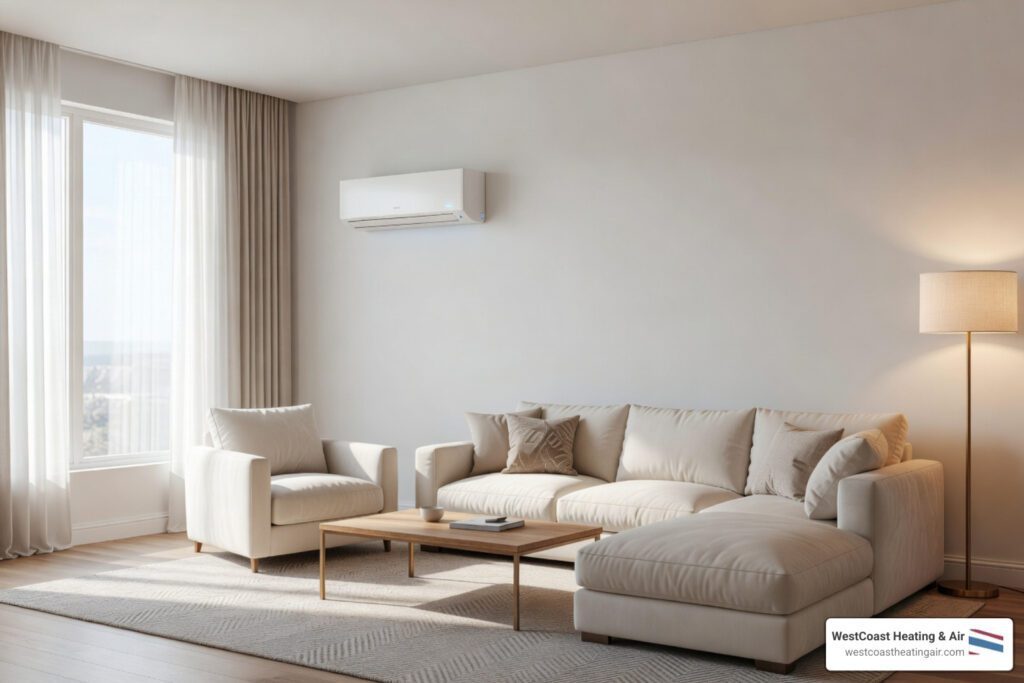
Are You Getting Comfort Where It Counts? The Best Rooms for a Ductless System in Puyallup, WA
The best rooms for a ductless system are:
| Room | Why It Works |
|---|---|
| Living Room | High traffic, heat buildup, open layouts benefit from targeted airflow |
| Master Bedroom | Whisper-quiet operation and personal temperature control for better sleep |
| Home Office | Steady temps protect electronics and boost focus |
| Finished Basement | Combats moisture and uneven heating from central HVAC |
| Garage or Workshop | Makes unconditioned spaces usable year-round |
| Room Additions and Sunrooms | No ductwork needed, handles high solar heat gain |
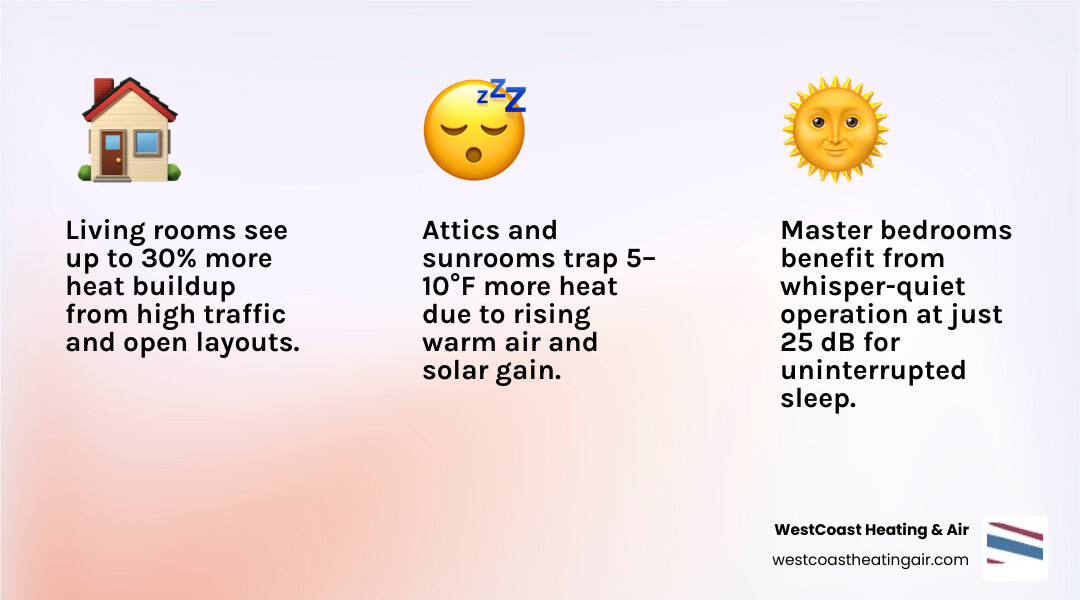
| Converted Attic | Addresses heat that rises and collects, often 5–10°F warmer than ground floor |
If you’ve ever noticed one room in your home that’s always too hot in summer or too cold in winter, you’re not alone. Many homes in Puyallup, WA have what HVAC professionals call “comfort gaps” — spaces that central ductwork simply can’t reach well, or rooms that were added or converted after the original system was designed. A ductless mini-split system solves that problem by delivering heating and cooling exactly where you need it, without tearing into walls or extending existing ductwork across your whole home.
I’m Michael Smith, owner of WestCoast Heating & Air in Puyallup — and after 30 years at Boeing followed by hands-on HVAC work serving Pacific Northwest homeowners, I’ve helped dozens of families pinpoint the best rooms for a ductless system in homes just like yours. In the sections below, I’ll walk you through each room type so you can make a confident, informed decision.
Identifying the Best Rooms for a Ductless System in Your Home
When we talk about the best rooms for a ductless system, we are usually looking for areas where your central furnace or air conditioner struggles to keep up. In the Pacific Northwest, our weather can be unpredictable. One day it’s a damp 45 degrees in Spanaway, and the next, the sun is beating down on your south-facing windows in Tacoma.
Ductless systems are unique because they don’t rely on a maze of metal pipes in your attic or crawlspace. Instead, they use a small indoor unit connected to an outdoor compressor by a narrow line set. This allows for Ductless Heating Benefits for the Modern Home like personalized comfort and incredible energy efficiency. Because each unit has its own thermostat, you aren’t paying to heat the guest room when you’re only using the den.
High-Traffic Living Areas
Living rooms and family rooms are often the heart of the home, but they are also prone to heat buildup. Whether it’s a crowd of people gathered for a game or large windows letting in the afternoon sun, these open-concept spaces can become stuffy. A ductless unit here acts as a powerful supplement to your existing system, ensuring that the “main hub” stays cool without forcing the rest of the house to feel like a refrigerator. If you’re looking for a Puyallup WA Ductless Installation Guide, starting with the living area is often the most impactful choice for overall family happiness.
Master Bedrooms and Guest Suites
We spend nearly one-third of our lives sleeping, so it makes sense that bedrooms are among the best rooms for a ductless system. Many of our neighbors in older Tacoma homes ask us, “Aircon Mini Split AC for Older Homes Near Tacoma Is This Doable?” The answer is a resounding yes.
Ductless units are whisper-quiet, often operating at noise levels below 25 dB—that’s quieter than a soft rustle of leaves. This makes them a dream for light sleepers. Plus, if you prefer a crisp 66 degrees for sleeping while your partner wants it warmer, a ductless system allows for that independent control. No more “thermostat wars” in the middle of the night!
Why Mini-Splits are the Ultimate Solution for Additions and Converted Garages
If you’ve recently added a new room or converted a garage into a living space, you’ve likely realized that extending your existing ductwork is a massive (and expensive) headache. New additions often require a complete recalculation of your home’s “cooling load.” If your current central AC wasn’t sized for that extra square footage, it will struggle and likely fail prematurely.
This is where Ductless Heating and Cooling truly shines. Check out how they stack up against the old-school alternatives:
| Feature | Ductless Mini-Split | Window Unit | Central HVAC Extension |
|---|---|---|---|
| Efficiency | Extremely High (Inverter Tech) | Low | Varies (often loses 30% in ducts) |
| Security | Safe (Small 3″ hole in wall) | Risky (Easy to remove from window) | Safe |
| Noise | Whisper Quiet | Very Loud/Rattly | Moderate |
| Aesthetics | Sleek/Wall-mounted | Blocks the view | Hidden |
Maximizing Comfort: The Best Rooms for a Ductless System in Two-Story Homes
In places like South Hill or Puyallup, two-story homes often suffer from the “hot upstairs” syndrome. Since heat rises, the second floor can be 5 to 10 degrees warmer than the ground floor. Converted attics are the biggest culprits. A ductless system installed in a master suite or a stuffy upstairs bonus room provides targeted relief that a centrally located thermostat downstairs simply can’t manage.
Sunrooms and Bonus Rooms
Sunrooms are beautiful, but those large glass panes act like a greenhouse. Even in April 2026, a sunny day in Orting can make a sunroom unbearable without proper climate control. Ductless systems handle this solar heat gain with ease. Furthermore, for bonus rooms over the garage, a mini-split offers a major security advantage over window ACs. You don’t have to worry about an intruder popping out a window unit to gain access to your home. It’s a permanent, secure, and stylish solution. For more details, see our Best Puyallup Ductless Installation Guide.
Strategic Placement: How to Maximize Efficiency and Performance
Choosing the best rooms for a ductless system is only half the battle; where you put the unit inside that room matters just as much. Proper placement ensures that the air circulates effectively and the system doesn’t have to work harder than necessary.
Standard practice is to mount the indoor unit high on a wall, usually 6 to 8 feet above the floor. This allows the cool air to descend naturally through the room’s air volume. We almost always recommend using a perimeter (exterior) wall. Why? It makes condensate drainage much simpler. Gravity can do the work of pulling moisture outside through the line set, often removing the need for a noisy condensate pump. For more professional tips, check out our Ductless Heating Installation Tacoma Tips.
Technical Considerations for the Best Rooms for a Ductless System
- Avoid Airflow Blocks: Don’t tuck your unit behind a curtain or above a tall bookshelf. It needs at least 6 feet of clear space in front to “read” the room temperature correctly.
- Stay Away from Heat: Keep the unit away from lamps, TVs, or kitchen stoves. If the unit thinks the room is hotter than it actually is, it will “short-cycle,” turning on and off too frequently.
- Maintenance Access: You’ll need to clean the filters every month or two. Make sure the unit is in a spot where you can safely reach it with a small step ladder. Our Best Ductless Heating Maintenance Tacoma Tips emphasize that a clean filter is the secret to a long system life.
Outdoor Unit Location
The outdoor compressor needs to breathe, too. We look for a shaded area on the side of the house to prevent the sun from overworking the unit. It should be placed on a solid, level surface (like a concrete pad or specialized wall brackets) with at least 1 to 3 feet of clearance on all sides. We also consider wind protection and ensure it’s away from roof runoff where “waterfalls” from gutters might pour directly onto the electronics.
Choosing Between Single-Zone and Multi-Zone Systems for Your Layout
When we design a system for a home in Sumner or Steilacoom, we have to decide between single-zone and multi-zone setups.
- Single-Zone: One indoor head connected to one outdoor unit. This is perfect for a standalone garage workshop, a new sunroom addition, or a basement guest suite.
- Multi-Zone: One outdoor compressor powering up to five indoor heads. This is the gold standard for whole-home comfort. You can have a unit in the living room, one in the master bedroom, and one in the home office—all running off a single outdoor unit.
Each indoor unit can be set to a different temperature. This is the beauty of Ductless Heating and Cooling. However, sizing is critical. We don’t just guess based on square footage. We perform a “Manual J” load calculation that factors in your insulation quality, the number of windows, and even which way your house faces. An oversized unit will leave the room feeling clammy, while an undersized unit will run constantly and drive up your utility bills.
Frequently Asked Questions about Ductless Installation
Can a mini-split effectively cool an open-concept living area?
Yes, absolutely. Because ductless units use inverter technology, they can ramp their speed up or down to match the needs of a large space. For very large open-concept areas, we sometimes suggest two smaller heads placed at opposite ends of the room to ensure there are no “dead zones” where the air doesn’t circulate.
How far apart can the indoor and outdoor units be installed?
Most modern systems allow for a distance of up to 100 feet between the indoor and outdoor components. However, efficiency is highest when the distance is shorter. If we have to run a very long line set, we may need to add extra refrigerant to ensure the system maintains its performance ratings.
Are there specific rooms where a ductless system should not be installed?
We generally advise against installing standard wall-mounted units directly in kitchens where grease buildup can clog the filters and coils very quickly. If you must have one in a kitchen, it should be at least 3 to 5 feet away from the cooking surface. We also avoid bathrooms due to extreme humidity, unless the unit is specifically rated for high-moisture environments.
Conclusion
Finding the best rooms for a ductless system is all about identifying where you spend your time and where your current comfort is lacking. Whether it’s making a garage workshop usable in the dead of winter or finally getting a good night’s sleep in a cool master bedroom, ductless technology is a game-changer for homeowners in the South Sound.
At WestCoast Heating & Air, we are a local, family-owned company with over 20 years of experience serving Puyallup, Tacoma, Spanaway, and the surrounding areas. We don’t believe in “one-size-fits-all” solutions. Our USP is customized system design and customer education—we want you to understand exactly how your new system works so you can get the most out of it. From SeaTac to Roy, we are committed to providing top-quality products and service that keep our neighbors comfortable all year long.
Ready to close those comfort gaps in your home? Explore our Ductless Heating and Cooling services today and let us help you design a system that actually works for your unique space.