
Why Summer Heat Waves in the Pacific Northwest Are a Growing Cooling Crisis
How summer heat waves challenge Pacific Northwest cooling is no longer a rare or theoretical concern — it’s a reality that Puyallup and greater Western Washington homeowners are facing with increasing urgency. Most homes in this region were built for mild, temperate weather. Air conditioning was optional for decades. Then June 2021 happened.
In just five days, the Pacific Northwest was transformed into something unrecognizable. Portland hit 116°F. Lytton, British Columbia, recorded a staggering 121°F before a wildfire forced the town to evacuate. At least 486 heat-linked deaths were reported in British Columbia alone — a 195% spike above normal mortality for that period. In Washington State, more than 1,300 people flooded emergency rooms with heat exhaustion, dehydration, and loss of consciousness. In Oregon, the state medical examiner attributed 63 deaths directly to the heat.
The core problem is this: the Pacific Northwest was simply not built for this.
Summer heat waves challenge Pacific Northwest cooling in several key ways:
- Most older homes lack central air conditioning entirely
- Residents have little physiological acclimatization to sustained extreme heat
- Urban neighborhoods with less tree cover experience temperatures up to 7°F hotter than surrounding areas
- Electrical grids were not designed to handle sustained cooling demand at this scale
- Manufactured homes and poorly insulated rentals trap heat with no relief
- Heat dome weather patterns are becoming more frequent and more intense due to climate change
And this isn’t a one-time event. Since the 1960s, the average number of heat waves in major U.S. cities has grown from two per year to six. The average heat wave season is now 47 days longer than it was six decades ago. The Pacific Northwest is expected to warm by an average of 5.8°F by mid-century, bringing 20 to 30 more days above 90°F per year.
For homeowners in Puyallup, Auburn, Federal Way, and across Pierce and South King County, understanding what drives these events — and how to prepare your home — is no longer optional.
I’m Michael Smith, owner of WestCoast Heating & Air in Puyallup, and after 30 years at Boeing followed by hands-on work in residential HVAC across Western Washington, I’ve watched how summer heat waves challenge pacific northwest cooling systems that were never designed with extreme heat in mind. In the sections ahead, we’ll break down exactly what’s driving these events and what you can do to keep your home safe.
How summer heat waves challenge pacific northwest cooling word guide:
- best hvac setup for western washington weather
- how western washington climate affects your hvac system
The 2021 Heat Dome: How Summer Heat Waves Challenge Pacific Northwest Cooling

To truly understand how summer heat waves challenge Pacific Northwest cooling, we have to look back at the historic June 2021 heat dome. It serves as a stark benchmark for the future of residential comfort in our region. This was not just a typical warm spell; it was an atmospheric anomaly that rewrote the record books and tested local home cooling systems to their absolute limits.
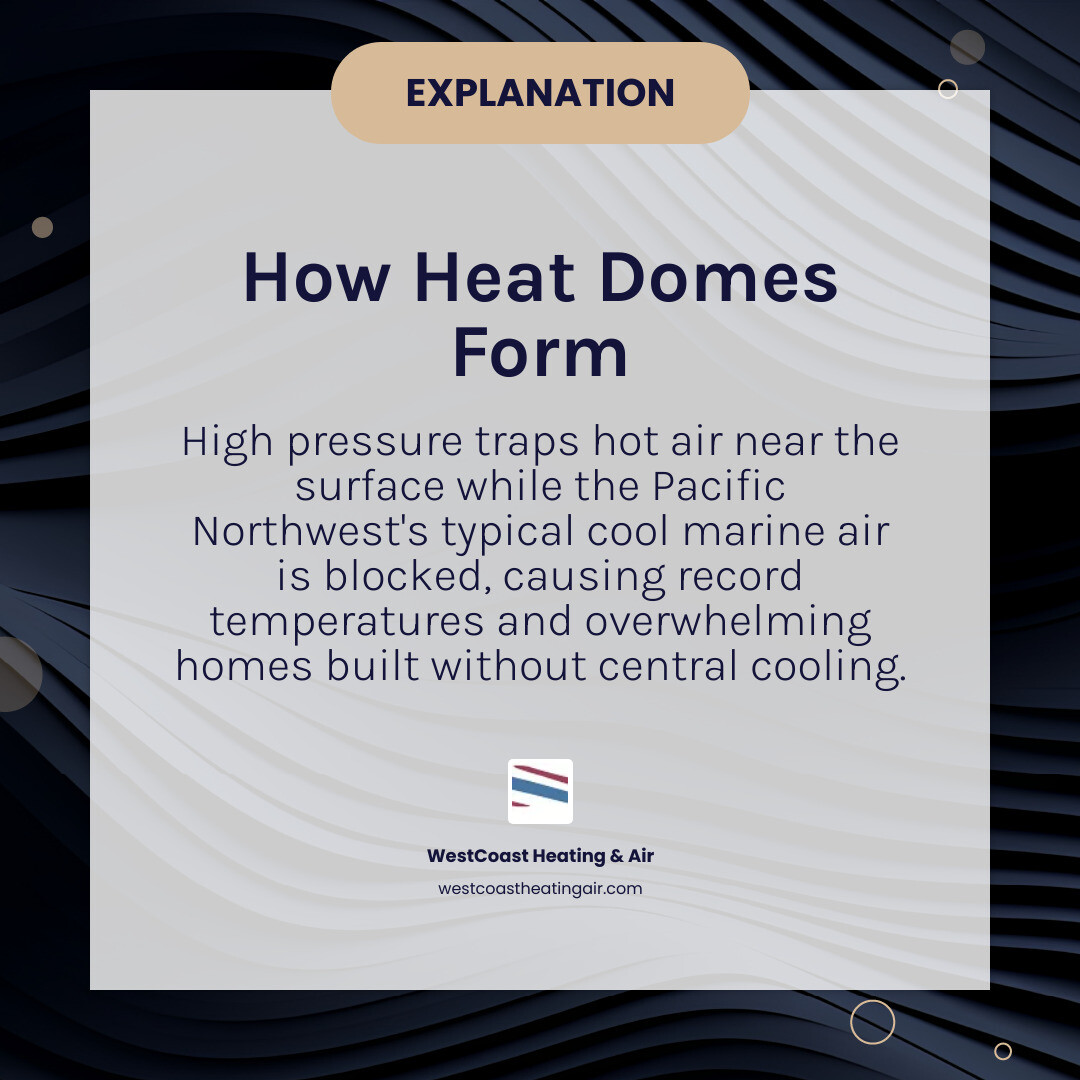
During this event, temperatures in cities like Tacoma, Puyallup, and Spanaway shattered all-time highs. The heat dome acted like a heavy, insulated lid on a boiling pot, trapping hot air over the Puget Sound and preventing the cool marine air we rely on from sweeping inland.
For decades, local home cooling relied on the natural rhythm of our climate: warm days followed by cool, breezy nights that naturally ventilated our living spaces. But when a heat dome descends, that natural cycle breaks down. Temperatures remain dangerously high overnight, meaning homes never get a chance to shed the thermal energy they absorbed during the day. This puts an immense, continuous load on residential air conditioners and heat pumps, forcing them to run non-stop without a break.
Understanding the unique relationship between our regional climate and your home’s mechanical systems is the first step in keeping your family comfortable. For a deeper look at this dynamic, check out our guide on Western Washington Weather vs Your HVAC System.
Dynamic and Thermodynamic Drivers Behind the Unprecedented Heat
The sheer intensity of the 2021 heatwave was fueled by a combination of dynamic atmospheric forces and thermodynamic feedbacks. On the dynamic side, a massive, slow-moving atmospheric block — specifically an “Omega Block” high-pressure system — parked itself over western North America. This system created strong, descending currents of air (subsidence). As the air sank, it compressed, and in physics, compression means heating. This mechanical warming converted potential energy in the upper atmosphere directly into sensible heat at the surface.
Thermodynamically, this intense heating was amplified by long-term background warming from global climate change. Additionally, the region was experiencing unusually dry soil conditions leading up to June. Because there was very little moisture in the ground to evaporate, the sun’s energy went entirely into heating the air rather than evaporating water. This created a self-reinforcing feedback loop: the hotter it got, the drier the soil became, which in turn drove temperatures even higher.
To protect your home from these complex, compounding weather patterns, it is vital to understand how to keep your system resilient. Read more about protecting your equipment in Don’t Let the Evergreen State Weather Wilt Your HVAC.
Upwind Latent Heating and Tropospheric Temperature Spikes
Another fascinating — and alarming — contributor to the extreme heat was a process occurring thousands of miles upwind over the North Pacific Ocean. Before the heatwave reached our doorsteps in Washington, strong storm systems over the Pacific were releasing massive amounts of latent heat.
When warm, moist ocean air rises and condenses into clouds, it releases heat into the upper atmosphere (the troposphere). This pre-heated air mass was then carried eastward by atmospheric currents and pulled directly into the descending circulation of the high-pressure ridge parked over the Pacific Northwest. By the time this air sank down to sea level in our Puget Sound communities, it had been double-heated: first by ocean condensation, and second by atmospheric compression. This created a massive reservoir of hot air aloft, waiting to be mixed down to the surface.
Localized Meteorological Factors and Soil Moisture Feedbacks
While large-scale atmospheric patterns set the stage, localized conditions dictate exactly how hot your specific neighborhood gets. Microclimates, local topography, and soil conditions play a massive role in how summer heat waves challenge Pacific Northwest cooling at the street level.
| Condition Metric | Historical Normal Summer | Extreme Heatwave Dynamics (e.g., 2021 Dome) |
|---|---|---|
| Peak Daytime Temp | 75°F – 82°F | 105°F – 116°F |
| Overnight Recovery | 50°F – 55°F (Cool marine air resets home) | 75°F – 80°F (No thermal relief for HVAC) |
| Soil Moisture | Moderate (Evaporative cooling active) | Critically Low (Sensible heating dominates) |
| Boundary Layer Height | Shallow (1 to 1.5 km) | Extremely Deep (3 to 4+ km) |
| HVAC Run Time | Intermittent (Cyclical afternoon use) | Continuous (24/7 maximum capacity) |
Navigating these stark differences requires a localized approach to home comfort. Partnering with a professional who understands our unique local geography is essential. Learn how we help you adapt in Navigating PNW Weather with a Local Western Washington HVAC Provider.
Deep Boundary Layers and Terrain Effects on Surface Temperatures
During a severe heatwave, the atmospheric boundary layer — the lowest part of the atmosphere that directly interacts with the earth’s surface — expands dramatically. Normally, this layer is relatively shallow in Western Washington, kept in check by cool marine air. However, under a heat dome, the boundary layer can swell to three or four kilometers deep. This deep boundary layer effectively connects the air at the surface with the massive reservoir of superheated air high above, allowing intense vertical mixing to bring those extreme upper-level temperatures straight down to our rooftops.
Furthermore, our complex terrain amplifies this effect. As air moves over the Cascade Range and descends into the lowlands of Puyallup, Orting, and Sumner, it undergoes downslope compression. This downslope wind acts like a giant hair dryer, further warming and drying the air as it spills into the valleys.
Quantifying the Impact of Soil Moisture Anomalies on Regional Heat
The dryness of our local soil isn’t just bad for lawns; it directly impacts how hard your air conditioner has to work. Scientific analyses of recent heatwaves have quantified the exact impact of dry soil on surface temperatures.
In a normal Western Washington summer, a portion of the sun’s energy is consumed by evaporating moisture from the soil and plants (latent heat flux). When the soil is anomalously dry, this natural cooling mechanism is deactivated. Instead, nearly 100% of the solar radiation is converted into sensible heat — the heat you can actually feel. Research indicates that dry soil anomalies alone raised regional temperatures by an average of 3°C (5.4°F) during peak heatwave conditions, with some localized inland valley areas experiencing anomalies exceeding 5°C (9°F) solely due to dry ground feedback.
Human Health Impacts and Historical Climate Comparisons
The physical and meteorological drivers of extreme heat culminate in a very real, very dangerous human cost. Because our region historically enjoyed mild summers, our residential infrastructure and public health systems were not designed to cope with sustained triple-digit heat.
When a heatwave hits, the lack of residential air conditioning quickly escalates from an inconvenience to a public health emergency. Homes act as thermal batteries, absorbing heat during the day and trapping it indoors. Without mechanical cooling, indoor temperatures can easily exceed outdoor temperatures, offering no safe refuge for vulnerable family members. To understand how to prepare your home and create a safe environment, take a look at The Spanaway Guide to Not Melting This Summer.
Public Health Toll Across British Columbia, Washington, and Oregon
The human toll of these changing climate dynamics is profound. During the 2021 event, emergency services across the Pacific Northwest were completely overwhelmed. More than 1,300 people in Washington State sought emergency medical care for heat-related illnesses such as heat stroke, severe dehydration, and cardiovascular distress.
The risk is highly unequal. Seniors, young children, individuals with pre-existing health conditions, and those living in older, poorly insulated homes face the highest danger. Unlike populations in the American Southeast, Pacific Northwest residents are not physiologically acclimated to high temperatures, making us far more susceptible to heat-related illnesses at lower thermal thresholds.
How Summer Heat Waves Challenge Pacific Northwest Cooling Compared to History
Historically, a 100-degree day in the Puget Sound was an exceedingly rare event. In Seattle, for instance, temperatures had only reached 100°F three times since official record-keeping began. Now, we are seeing those thresholds crossed with alarming frequency.
Climate attribution studies have shown that extreme events like the 2021 heat dome would have been virtually impossible without the background influence of human-induced climate change. What used to be a “one-in-a-thousand-year” event is rapidly shifting toward a regular summer occurrence. This shifting baseline means that relying on historical weather patterns to plan our home comfort is a recipe for system failure.
Adapting Residential Infrastructure for Future Extreme Heat
As we look toward the future in July 2026, adapting our homes to handle severe thermal stress is no longer a luxury — it is a fundamental aspect of home safety and resilience. The days of relying solely on open windows and box fans to get through August are behind us.
Fortunately, modern residential HVAC technology has advanced to meet these challenges head-on. Today’s systems are designed to deliver high-efficiency cooling even when outdoor temperatures climb into the triple digits, all while keeping energy consumption manageable. To explore the absolute best options for our local climate, read our comprehensive article on the Best HVAC Setup for Western Washington Weather Explained.
Upgrading Home Systems to Handle Severe Thermal Stress
When upgrading your home’s cooling capacity, there are several highly effective strategies to consider:
- Ductless Mini-Split Heat Pumps: These systems are incredibly efficient and allow for zoned cooling, meaning you can focus maximum cooling power on the rooms you use most (like bedrooms or living areas) without wasting energy on empty spaces.
- High-SEER Heat Pumps: Traditional central air conditioning is excellent, but modern variable-speed heat pumps provide both whisper-quiet cooling in the summer and highly efficient heating in the winter.
- Proactive System Maintenance: An air conditioner is only as reliable as its last service. Extreme heat forces your system to run at maximum capacity for days on end, which will quickly expose and amplify any minor mechanical issues or dirty components.
To prevent sudden system breakdowns when you need cooling the most, scheduling a professional tune-up is critical. If you find yourself facing a sudden system failure, you can learn about our rapid response options in Beat the Heat with Emergency AC Maintenance in Tacoma WA.
How Summer Heat Waves Challenge Pacific Northwest Cooling in Vulnerable Communities
The challenge of adapting to extreme heat is particularly acute in vulnerable housing sectors. Manufactured homes, older rentals, and houses in densely populated urban centers often lack proper insulation and ductwork, making the installation of traditional central air conditioning difficult and cost-prohibitive.
During a heatwave, these structures can quickly become thermal hazards. To address this, local programs and utility rebates have made high-efficiency heat pumps and ductless systems far more accessible. Additionally, implementing simple home upgrades — like installing exterior solar screens, utilizing cellular shades, and sealing leaky windows — can drastically reduce the cooling load on your mechanical systems. For practical tips on keeping your utility bills under control during peak summer months, check out our guide on How to Reduce Cooling Costs This Summer.
Frequently Asked Questions About PNW Summer Cooling
Why are summer heatwaves in the Pacific Northwest becoming so much more intense?
The increasing intensity of our summer heatwaves is driven by a combination of global warming and shifting atmospheric patterns. As the global average temperature rises, the baseline temperature of our atmosphere is higher. When high-pressure “heat domes” or atmospheric blocks form, they trap this already-warmer air over our region. Additionally, drier soils and reduced snowpack in the spring create a feedback loop that amplifies summer temperatures, turning what would have been a normal warm spell into an extreme weather event.
How can homeowners protect their AC systems from failing during extreme heat?
The best way to protect your cooling system is through proactive care:
- Change your air filters regularly: A dirty filter restricts airflow, forcing your system to work twice as hard and potentially causing the evaporator coils to freeze.
- Keep the outdoor unit clear: Ensure grass, leaves, pollen, and debris are cleared away from your outdoor condenser unit so it can shed heat efficiently.
- Provide shade: If possible, shade your outdoor unit from direct afternoon sun, but ensure there is plenty of clearance for airflow.
- Avoid drastic thermostat adjustments: Don’t turn your system completely off when you leave; instead, set it a few degrees warmer (e.g., 75°F to 78°F) to prevent the house from heat-soaking, which makes it incredibly difficult for the system to cool down later.
If your system is struggling or making strange noises, don’t wait for it to stop working completely. You can read about professional diagnostic solutions in Don’t Sweat It with Reliable AC Repair in Tacoma.
What is the most efficient cooling setup for a Western Washington home?
For most homes in Puyallup, Tacoma, and the surrounding areas, a variable-speed ductless mini-split heat pump or a high-efficiency central heat pump is the gold standard. Because these systems use advanced inverter technology, they can modulate their output to match the exact cooling needs of your home, rather than constantly turning fully on and off. This saves massive amounts of energy while maintaining a perfectly consistent indoor temperature.
To keep these high-efficiency systems running at peak performance, regular professional care is essential. Learn more about maintaining ductless equipment in Don’t Sweat the Small Stuff with Tacoma’s Best Ductless Maintenance. And if you’re planning ahead for the seasons, check out our tips on Switching Gears from Heating to Cooling This Spring.
Conclusion
As we navigate the warm summer months of July 2026, the message is clear: the climate of the Pacific Northwest has shifted, and our homes must adapt. How summer heat waves challenge Pacific Northwest cooling is a complex puzzle involving atmospheric physics, local terrain, and residential infrastructure. But it is a puzzle we can solve together.
At WestCoast Heating & Air, we are proud to be a local, family-owned HVAC company rooted right here in Puyallup, WA. With over 20 years of hands-on local experience, we specialize in customized residential system design, thorough customer education, and a commitment to top-quality products that keep your family safe and comfortable no matter what the weather brings. Whether you are in Tacoma, Spanaway, Sumner, Orting, or right here in Puyallup, we are here to help you design a residential cooling system that is built to withstand the modern Pacific Northwest summer.
Don’t wait for the next heat dome to test your home’s limits. Contact us today at WestCoast Heating & Air to schedule your professional cooling consultation and ensure your home remains a safe, comfortable sanctuary all summer long.