
Central System vs Ductless for Older Homes: What Puyallup Homeowners Need to Know
Central system vs ductless for older homes is one of the most important decisions you’ll face as a vintage home owner — and the right answer depends almost entirely on whether your home already has ductwork.
Quick Answer:
| Factor | Central System | Ductless Mini-Split |
|---|---|---|
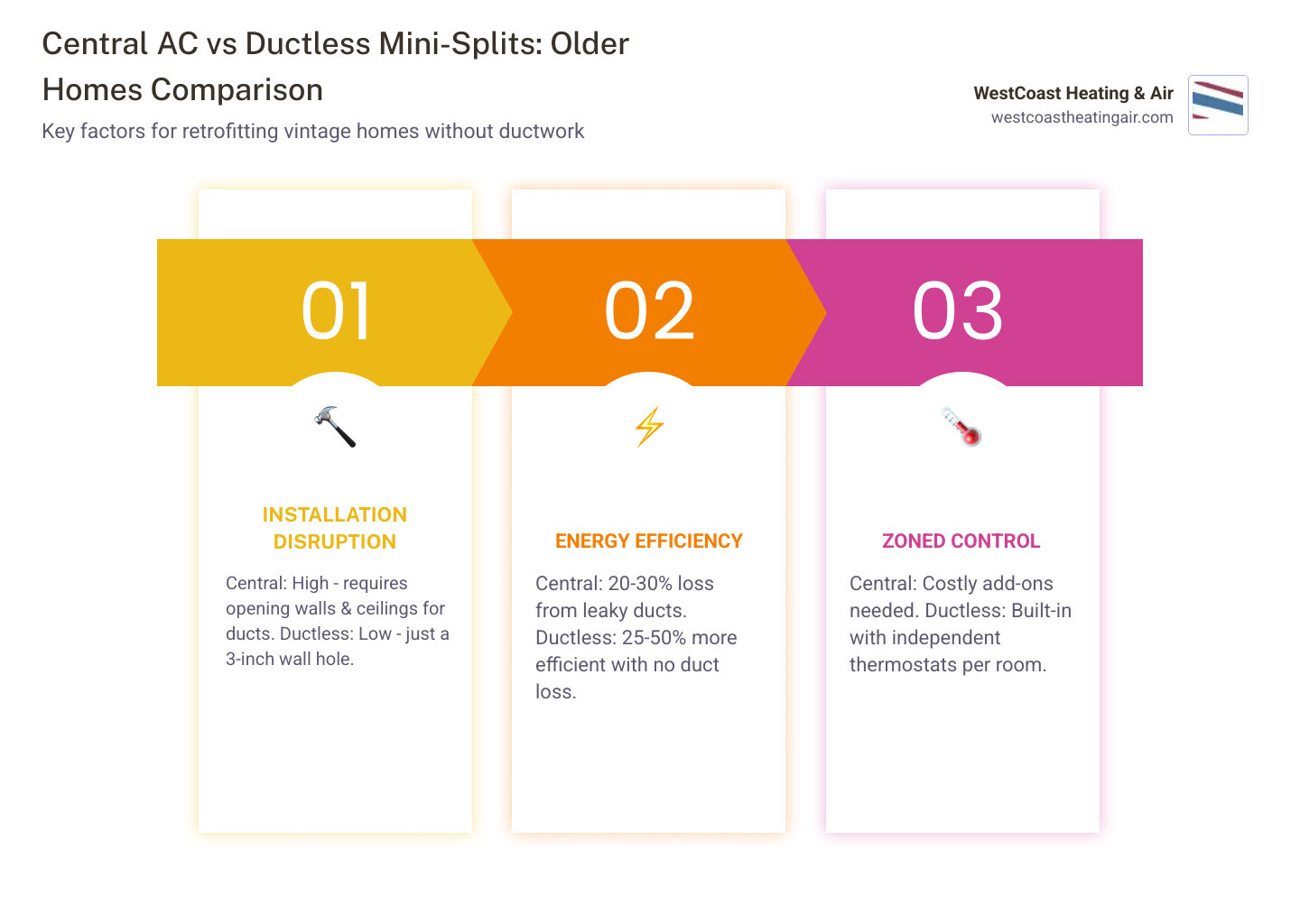
| No existing ductwork | Expensive, disruptive retrofit | Ideal — only a 3-inch wall hole needed |
| Existing good ductwork | Cost-effective, familiar setup | Still an option for problem zones |
| Energy efficiency | 20–30% duct loss is common | No duct loss; 25–50% more efficient |
| Installation disruption | High — walls, ceilings may be opened | Low — minimal structural impact |
| Zoned temperature control | Possible but costly to add | Built in by design |
| Historic preservation | Risk of damage to plaster, trim | Minimal impact on original features |
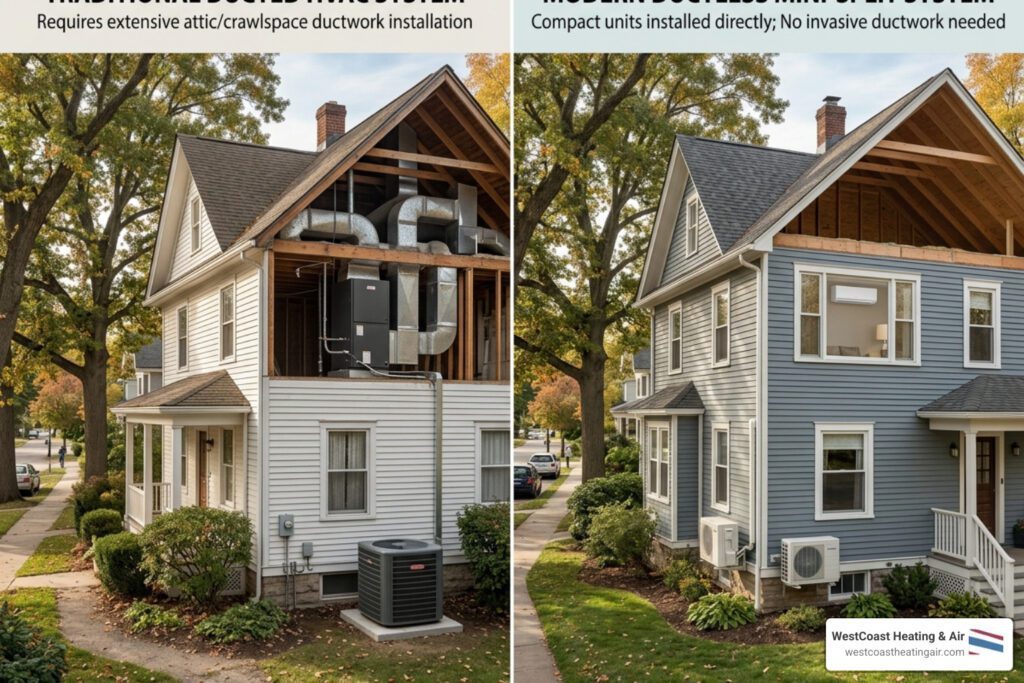
Most homes built before the 1970s were never designed for forced-air systems. That means adding central air often requires tearing into plaster walls, running new ductwork through tight crawl spaces, and potentially damaging the original character of your home. Ductless mini-splits sidestep most of those problems entirely — connecting an outdoor compressor to indoor units through a small opening in the wall, with no ducts required.
That said, central air isn’t always the wrong call. If your home already has functioning ductwork in decent shape, it can still be a practical and efficient choice. The key is knowing what you’re actually working with before you decide.
I’m Michael Smith, owner of WestCoast Heating & Air in Puyallup, and after a 30-year career at Boeing followed by years helping Pacific Northwest families solve exactly this kind of problem, I’ve seen how the central system vs ductless for older homes decision plays out in real homes with real constraints. Let’s walk through what actually matters so you can make the right call for your home.
Why is it so hard to cool a vintage home in Tacoma?
If you own a classic home in Tacoma or Steilacoom, you know that “character” often comes with a side of “sweltering summers.” The very things we love about older architecture—thick walls, intricate trim, and solid construction—are the same things that make modern HVAC retrofits a headache. Most homes built before the 1970s relied on radiators, baseboard heat, or wood stoves. They simply weren’t designed with the “lungs” (ductwork) required for a traditional central air system.
When we walk into a home with original plaster-and-lath walls, we have to tread lightly. Unlike modern drywall, plaster is brittle. Cutting into it to run large metal ducts can lead to extensive cracking and a messy, expensive repair bill. Furthermore, many of these homes have limited attic space or narrow crawl spaces that make it physically impossible to route standard 10-inch or 12-inch ducts without lowering ceilings or building unsightly “bulkheads” that ruin the room’s aesthetic. Maintaining the structural integrity of your home is our top priority at our Residential Heating And Cooling Company.
I’m looking for a way to fix hot upstairs rooms in Puyallup
One of the most common complaints we hear from homeowners in Puyallup and Sumner is the “hot upstairs” syndrome. You set the thermostat to 70 degrees, the living room feels like a meat locker, but the master bedroom upstairs is still pushing 80. Why does this happen?
It’s a combination of factors:
- Heat Rises: Basic physics dictates that warm air travels upward.
- Solar Gain: Your roof absorbs incredible amounts of heat from the Washington sun, which then radiates into the rooms directly below.
- Poor Insulation: Older homes often have settled or insufficient attic insulation, failing to provide a thermal barrier.
- Single-Zone Limitations: A traditional central system usually has one thermostat on the main floor. Once that area hits the target temperature, the system shuts off, leaving the upstairs neglected.
If you’ve been wondering, Aircon Mini Split Ac For Older Homes Near Tacoma Is This Doable, the answer is a resounding yes. In fact, it’s often the most effective way to target those specific “hot zones” without overworking your main system.
Central system vs ductless for older homes: Which fits your lifestyle?
Choosing between a central system vs ductless for older homes isn’t just about the equipment; it’s about how you live in your space. A central system is like whole-home audio—one volume for every room. A ductless system is more like having high-end Bluetooth speakers in every room; you only play music where you’re actually sitting, and at the exact volume you prefer.
| Feature | Central Air Conditioning | Ductless Mini-Split |
|---|---|---|
| Indoor Visibility | Low (only small floor/ceiling vents) | Moderate (wall, floor, or ceiling units) |
| Noise Level | Moderate (whoosh of air through vents) | Ultra-Quiet (19–26 dB, like a whisper) |
| Zoning | Difficult/Expensive add-on | Standard (room-by-room control) |
| Filtration | Excellent (whole-home central filter) | Good (individual filters in each unit) |
| Installation Time | 1–5+ days depending on ductwork | Often 1 day for single-zone |
At WestCoast Heating & Air, we specialize in Ductless Heating And Cooling because it offers a level of flexibility that traditional systems just can’t match in a retrofit scenario.
Is a central system vs ductless for older homes better for preserving historic charm?
For the purists in University Place or Orting who have spent years restoring original crown molding and mahogany trim, the thought of a contractor “opening up the walls” is terrifying. This is where the central system vs ductless for older homes debate leans heavily toward ductless.
A central AC retrofit requires significant wall penetration. You’re looking at cutting large rectangular holes for supply registers and even larger ones for return air grilles. In contrast, a ductless installation only requires a small 3-inch hole through an exterior wall. This hole accommodates the refrigerant lines, condensate drain, and power cable that connect the indoor head to the outdoor condenser.
If you’re worried about a white plastic box on your wall clashing with your vintage wallpaper, there are options. Modern ductless units come in:
- Floor-Mounted Units: These sit low to the ground, much like a traditional radiator, and blend seamlessly into the room’s perimeter.
- Ceiling Cassettes: These sit flush with the ceiling, showing only a discrete grille.
- Paintable Covers: Some units allow for custom covers that can be matched to your wall color.
Deciding between a central system vs ductless for older homes with multiple stories
If your home has a complex layout—perhaps a daylight basement in Spanaway or a converted attic in SeaTac—a single central system will likely struggle. Traditional systems often lose 20% to 30% of their conditioned air through leaks and poor connections in the ductwork. In an older home where ducts might be routed through unconditioned spaces like a drafty attic, those losses can be even higher.
Ductless systems provide “zoned comfort.” Each indoor unit has its own thermostat. This means you can keep the nursery at a steady 72 degrees while keeping your home office at a crisp 68, all while the guest room stays turned off to save energy. If your home already has a Gas Furnace but lacks cooling, we can often design a hybrid system that uses your existing heat for winter and ductless units for summer comfort.
Maximizing energy efficiency and tax credits in 2026
As of April 2026, energy efficiency isn’t just a “nice-to-have”—it’s a financial imperative. Modern systems are lightyears ahead of the units installed even ten years ago. When comparing a central system vs ductless for older homes, the efficiency gap is significant.
Most ductless systems today achieve SEER2 (Seasonal Energy Efficiency Ratio) ratings between 18 and 30+. Standard central air systems typically hover around 14 to 16. Because ductless systems use inverter technology (think of it like a dimmer switch rather than an on/off light switch), they ramp up and down smoothly to maintain temperature rather than blasting on at full power. This technology, combined with a modern Heat Pump, can reduce your monthly energy bills by 20% to 40% compared to traditional cooling.
Understanding the Inflation Reduction Act incentives
The good news for homeowners in the South Sound is that the federal government is essentially helping you pay for these upgrades. Under the Inflation Reduction Act, 2026 tax credits are more accessible than ever:
- Ductless Heat Pumps: You may be eligible for a federal tax credit of up to $2,000 per year for qualifying high-efficiency heat pump installations.
- Central Air Conditioners: Qualifying energy-efficient central units can earn a credit of up to $600 per year.
- Total Credit Cap: Homeowners can often claim up to 30% of the total project cost, including labor, up to the annual limits.
2026 Efficiency Standards Checklist:
- Look for the ENERGY STAR “Cold Climate” certification for heat pumps in Washington.
- Ensure your central AC has a SEER2 rating of at least 16 to qualify for most federal incentives.
- Check with local utility providers in Tacoma and Puyallup for additional “instant rebates” that can be stacked with federal credits.
Maintaining your retrofit for long-term performance
Whether you choose a central or ductless system, your investment only lasts as long as your maintenance routine. Both systems have an estimated lifespan of 10 to 20 years, but in our salty, damp Pacific Northwest air, neglected units tend to fail closer to the 10-year mark.
For ductless systems, maintenance is surprisingly simple but must be consistent. You should rinse the washable filters in each indoor head every 2 to 4 weeks. Dust buildup on these filters restricts airflow and forces the motor to work harder, which spikes your energy bill.
Central systems require a bit more professional “under-the-hood” work. You’ll need to change the central furnace filter every 1 to 3 months and have the ductwork inspected for leaks every few years. Leaky ducts are the silent thieves of comfort in older homes; if 30% of your cold air is leaking into the crawl space, you’re paying to cool the spiders, not your family.
Pro-Tip for All Systems: Keep at least two feet of clearance around your outdoor condenser unit. Trim back those Douglas fir branches and keep the blackberry vines at bay. Your system needs to “breathe” to disperse heat effectively.
Frequently Asked Questions about Retrofitting Older Homes
Can I install AC without tearing down my plaster walls?
Yes! This is the primary reason we recommend ductless mini-splits for historic homes in places like Steilacoom and North Tacoma. We only need to drill one small hole to connect the system. There is no need to open up walls or ceilings to run bulky ductwork.
How does zoning help with a hot second floor?
Zoning allows the upstairs unit to operate independently of the downstairs. Because heat rises, the upstairs unit will naturally run more often than the downstairs one. With a central system, the downstairs usually gets too cold before the upstairs gets cool enough. With ductless zoning, each floor gets exactly what it needs.
Are there rebates for historic home HVAC upgrades in Washington?
Absolutely. Beyond the federal tax credits, many local utilities in Pierce and Thurston counties offer rebates specifically for transitioning from “zonal” heat (like baseboards) to high-efficiency heat pumps. We always help our customers navigate these programs during the design phase.
Conclusion
Retrofitting an older home doesn’t have to mean compromising its soul. At WestCoast Heating & Air, we believe in “Teaching an Old House New Tricks” by blending 21st-century technology with the timeless architecture of the Pacific Northwest. Whether you live in a 1920s craftsman in Puyallup or a mid-century rambler in University Place, the choice between a central system vs ductless for older homes comes down to your home’s unique structure and your personal comfort goals.
We take pride in our customized system design and our commitment to customer education. We want you to understand exactly why a specific system fits your home before a single tool is lifted. There are many Ductless Heating Benefits For The Modern Home, from lower bills to whisper-quiet operation.
Contact us today to discuss your options and see how we can help you bring modern comfort to your classic home. Whether you need a full system overhaul or just want to finally fix that sweltering upstairs bedroom, our team is ready to help you find the perfect fit.