
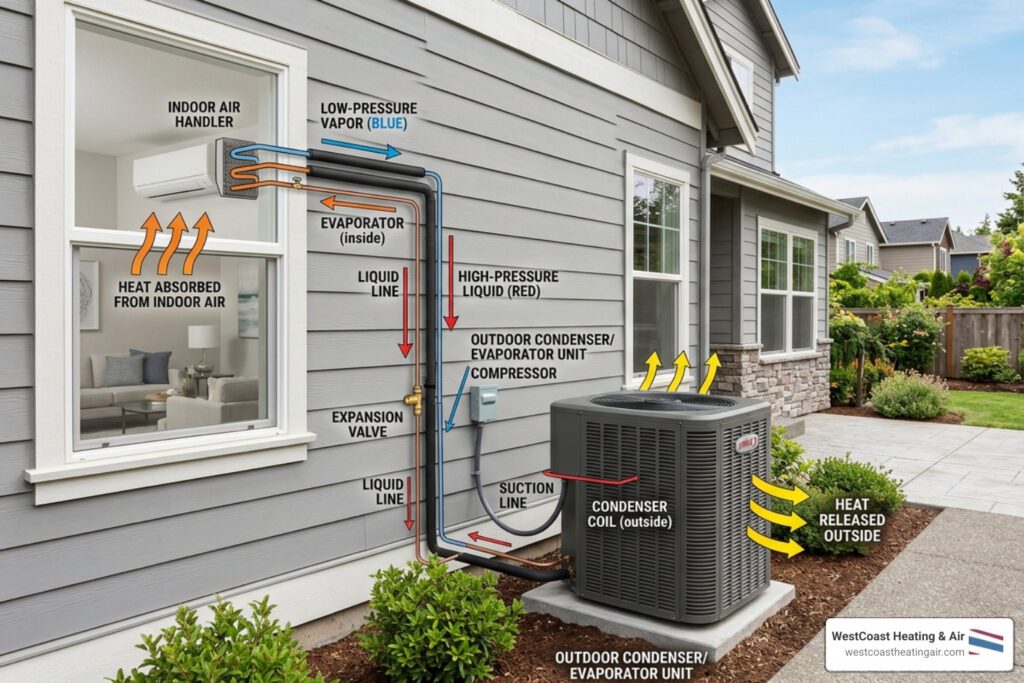
What Is a Heat Pump and How Does It Work? A Homeowner’s Quick Answer
How does a heat pump work is one of the most common questions we hear from homeowners looking to upgrade their home comfort — and for good reason. It’s a surprisingly simple idea wrapped in some clever engineering.
Here’s the short answer:
- A heat pump moves heat from one place to another rather than generating heat by burning fuel
- In winter, it pulls heat energy from outdoor air (even cold air) and transfers it inside your home
- In summer, it reverses the process, pulling heat out of your home and releasing it outside
- It runs on electricity and uses a refrigerant to carry heat through a continuous cycle
- Because it moves heat instead of creating it, a single unit of electricity can deliver 2 to 5 units of heating or cooling energy
That ratio — moving more energy than you consume — is what makes heat pumps 3 to 5 times more energy-efficient than traditional gas boilers, and why so many Pacific Northwest homeowners are making the switch.
Think of it like a refrigerator for your whole house. Your fridge doesn’t create cold — it pulls heat out of the inside and releases it behind the unit. A heat pump does the same thing, just on a much larger scale, and with the ability to run in both directions.
There’s a lot more to understand once you get into the details — the components, the refrigerant cycle, the different system types, and how cold weather affects performance. That’s exactly what this guide covers.
I’m Michael Smith, owner of WestCoast Heating & Air in Puyallup, and after 30 years in engineering at Boeing followed by hands-on work in residential HVAC, I’ve made it my mission to help homeowners truly understand how does a heat pump work so they can make confident decisions about their home comfort. Let’s dig in.
The Fundamental Mechanics: How Does a Heat Pump Work?
To understand a Heat Pump, we first have to look at a basic law of physics: heat always wants to move from a warm place to a cold place. If you open your front door on a chilly Puyallup morning, the heat doesn’t stay inside; it rushes out to meet the cold. A heat pump is essentially a machine that forces this process to happen in reverse.
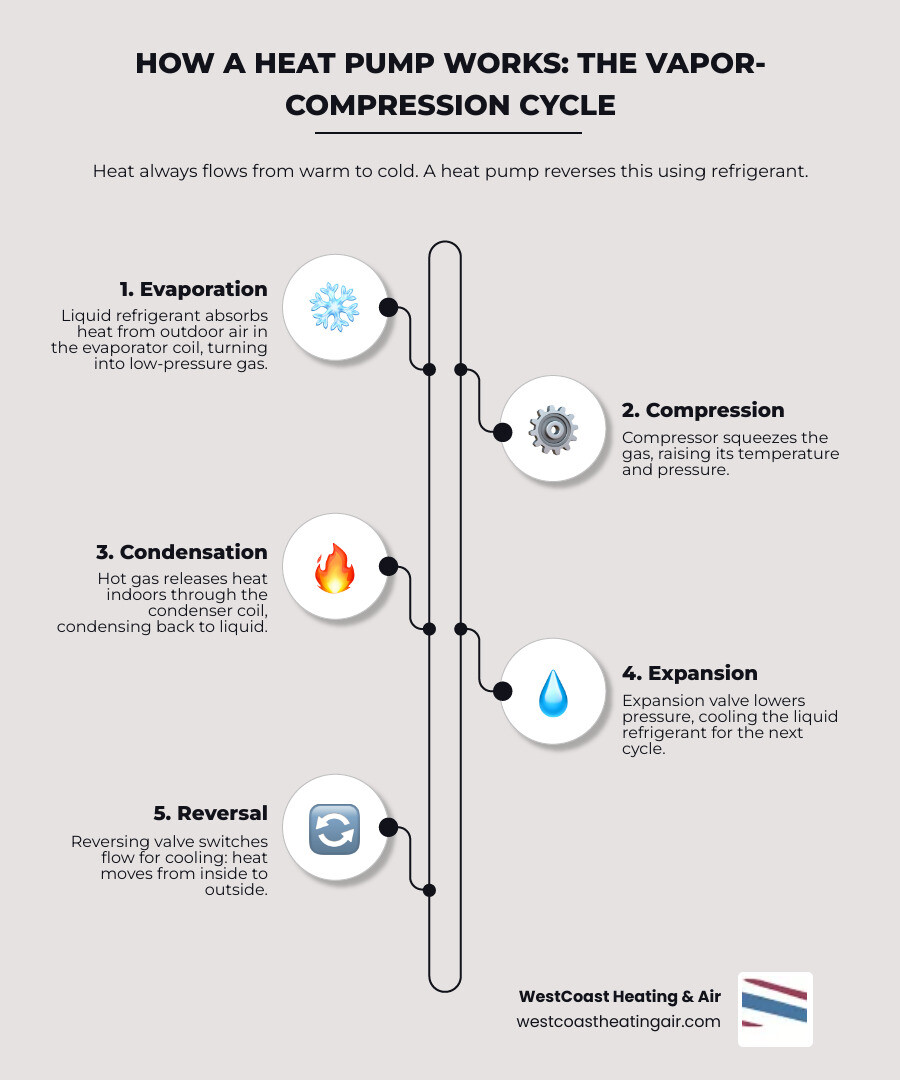
Using a process called the vapor-compression cycle, the system uses mechanical energy to “pump” heat against its natural flow. It’s like an invisible conveyor belt moving thermal energy into your home when you’re cold and out of your home when you’re hot.
The Role of the Refrigerant
The “blood” of the system is the refrigerant. This special fluid has an incredibly low boiling point, meaning it can turn into a gas even at temperatures that feel freezing to us.
The magic happens during a phase change. When the refrigerant evaporates (turns from liquid to gas), it absorbs a massive amount of “latent heat” from its surroundings. When it condenses (turns from gas back to liquid), it releases that heat. By controlling where and when these phase changes happen, we can precisely manage the temperature inside your home.
Core Components and Their Functions
A standard residential system relies on four primary parts working in a closed loop:
- The Compressor: Located in the outdoor unit, this is the “heart.” It squashes the gaseous refrigerant, raising its pressure and temperature significantly.
- The Condenser: In heating mode, the indoor coil acts as the condenser. As the hot gas travels through it, a fan blows air across the coils. The gas gives up its heat to your home’s air and turns back into a liquid.
- The Expansion Valve: This acts like a nozzle on a spray bottle. It quickly drops the pressure of the liquid refrigerant, which causes its temperature to plummet instantly.
- The Evaporator: In heating mode, the outdoor coil is the evaporator. Because the refrigerant is now much colder than the outdoor air, it “sucks up” heat from the environment, causing the liquid to boil back into a gas.
- The Reversing Valve: This is the “brain” that differentiates a heat pump from a standard air conditioner. It flips the direction of the refrigerant flow, allowing the system to switch between heating and cooling.
Year-Round Comfort in the Pacific Northwest
In places like Tacoma, Spanaway, and Puyallup, our weather is famously indecisive. We might need the heater at 7:00 AM and the AC by 2:00 PM. This is where the dual functionality of a heat pump shines. Because it can reverse its cycle, it replaces the need for both a separate furnace and a standalone air conditioner.
However, because these systems work so hard year-round, Heat Pump Maintenance Services in Puyallup WA are vital. Unlike a furnace that sits dormant all summer, a heat pump is a four-season workhorse.
Winter Operation: How does a heat pump work in the winter?
A common myth is that there is no “heat” in cold air. In reality, heat exists in the air all the way down to absolute zero (-459°F). Modern heat pumps are incredibly efficient at finding this energy. Even when it is 18°F outside, a high-quality air-source heat pump can still achieve a Coefficient of Performance (COP) of 1 to 4, meaning it’s delivering much more heat than the electricity it consumes.
For those rare, brutal Washington freezes, many systems include Heat Pump Emergency Heat. This is typically an electric resistance strip (like a giant toaster element) that kicks in if the outdoor temperatures drop below the unit’s effective range, ensuring you never wake up to a freezing house.
Summer Operation: How does a heat pump work in the summer?
In the summer, the reversing valve flips, and the system acts exactly like a high-efficiency air conditioner. It absorbs heat from inside your house and rejects it to the outdoors.
An added benefit for our humid North West summers is dehumidification. As the indoor coil gets cold, moisture from your home’s air condenses on the coils and is drained away. This leaves your indoor air feeling crisp and cool rather than sticky and heavy.
Choosing the Right System for Your Washington Home
When we design a system for a home in University Place or Steilacoom, we look at the specific layout and insulation of the house. Not all heat pumps are built the same.
| Feature | Air-Source Heat Pump | Ground-Source (Geothermal) | Ductless Mini-Split |
|---|---|---|---|
| Heat Source | Outdoor Air | The Earth (Underground) | Outdoor Air |
| Efficiency (COP) | 2.0 – 5.0 | 3.0 – 6.0 | 2.0 – 5.0+ |
| Installation | Easier / Lower Cost | Complex / High Cost | Flexible / No Ducts |
| Best For | Most WA Homes | Large Lots / Long-term | Additions / Older Homes |
For many of our neighbors, a 16 SEER Heat Pump represents the “sweet spot” of performance and value, providing excellent cooling efficiency during our increasingly warm summers.
Hybrid and Dual Fuel Options
In some cases, the best solution isn’t just a heat pump. A “Dual Fuel” or hybrid system pairs an electric heat pump with a high-efficiency gas furnace. The heat pump handles the heating on most days (above 35-40°F), but when a true arctic blast hits the South Sound, the gas furnace takes over. This ensures maximum efficiency and the “toasty” feel that some homeowners prefer during the darkest weeks of January. You can learn more about these pairings in our guide to the Bosch and Beyond Finding Your Perfect Dual Fuel Heat Pump Combo.
Maximizing Efficiency and Performance
If you’re looking at the numbers, you’ll see acronyms like SEER2 and HSPF2. These are simply “miles per gallon” ratings for residential HVAC.
- SEER2 (Seasonal Energy Efficiency Ratio): Measures cooling efficiency. The higher the number, the less electricity it uses in summer. The highest efficiency models can reach up to 24 SEER.
- HSPF2 (Heating Seasonal Performance Factor): Measures heating efficiency over a typical season.
- COP (Coefficient of Performance): The real-time efficiency. A COP of 4 means you get 4 units of heat for every 1 unit of electricity you pay for.
There are massive Advantages of Upgrading to a High Efficiency Heat Pump, including lower monthly bills and a significantly reduced carbon footprint. In fact, 70% of houses in the U.S. could reduce their emissions just by switching to a heat pump.
Maintenance and Troubleshooting
Even the best system needs a little love. To keep your system running like a pro:
- Filter Changes: Check them monthly. A dirty filter is the #1 cause of “my heat pump isn’t working” calls.
- Outdoor Clearance: Keep leaves, snow, and “Puyallup mud” away from the outdoor unit. It needs to breathe to move heat effectively.
- Professional Inspections: We recommend a tune-up twice a year—once before the heating season and once before the cooling season.
Learning How to Identify Heat Pump Problems in Puyallup can save you from a cold night. If you hear grinding noises or notice ice buildup on the coils during summer, it’s time to call in the experts.
Frequently Asked Questions about Heat Pump Operation
Do heat pumps use a lot of electricity?
While heat pumps run on electricity, they are not “electric heat” in the traditional sense. Traditional electric baseboard heaters convert 1 unit of electricity into 1 unit of heat. A heat pump moves existing heat, meaning it can be 300% to 500% more efficient.
The average annual consumption typically falls between 6,176 and 10,244 kWh. Your actual usage depends on:
- How well your home is insulated.
- The SEER2 and HSPF2 ratings of your unit.
- Your preferred thermostat settings.
- The local climate (luckily, the South Sound is very heat-pump friendly!).
At what temperature do heat pumps stop working?
Older models used to struggle when the mercury hit freezing. However, technology has come a long way. Some specialized cold-climate models can operate effectively down to -22°F.
In our region, you might notice your outdoor unit occasionally frosting over. Don’t panic! This is normal. The unit will automatically enter a “defrost cycle” to melt the ice so it can get back to work. If the temperatures stay extremely low for days, the system may rely on its supplemental backup heat to keep you comfortable.
Can a heat pump replace my furnace and AC?
Yes! That is exactly what it is designed to do. By combining both functions into one system, you save space and reduce the number of appliances you need to maintain. It’s an all-in-one solution that provides consistent, even comfort throughout every room in your house.
Conclusion
Understanding how does a heat pump work is the first step toward a more comfortable, efficient home. These systems are the future of home heating in Washington, offering a way to stay cool in the summer and warm in the winter without the heavy carbon footprint of older technologies.
At WestCoast Heating & Air, we don’t believe in “one-size-fits-all” residential HVAC. We take the time to understand your home’s unique needs, from the ductwork in your Sumner attic to the insulation in your Orting basement. Whether you’re in Tacoma, Puyallup, or Spanaway, our family-owned team is here to provide customized system designs and the education you need to feel confident in your investment.
Ready to see how a heat pump can transform your home comfort? More info about residential heat pump services is just a click away, or give us a call to chat with a local expert who knows our climate—and our community—inside and out.