

Federal Tax Credits for Heat Pump Upgrades: What Puyallup Homeowners Need to Know in 2026
Federal tax credits for heat pump upgrades offered homeowners a meaningful way to reduce the cost of switching to high-efficiency heating and cooling — and if you installed a qualifying system by December 31, 2025, you can still claim that credit when you file your 2025 taxes this year.
Here’s a quick summary of what the credit covered:
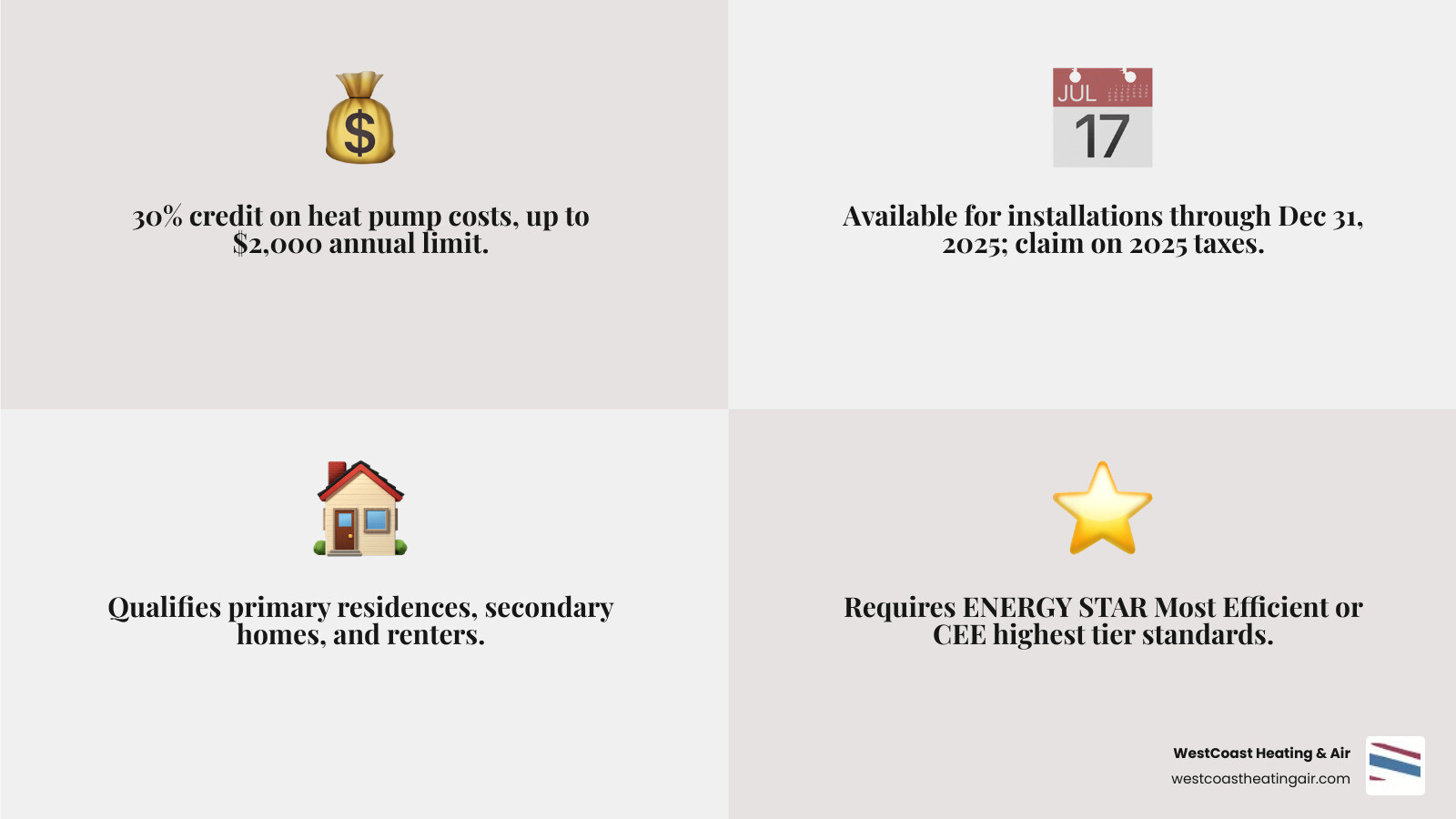
- Credit amount: 30% of total installation costs, up to $2,000 per year
- Program: Section 25C Energy Efficient Home Improvement Credit (Inflation Reduction Act)
- Expiration: December 31, 2025 — installations after this date do not qualify
- Who qualifies: Homeowners and renters in existing U.S. residences (primary or secondary); no income limit required
- What qualifies: Air-source heat pumps meeting ENERGY STAR Most Efficient or CEE highest efficiency tier standards
- How to claim: File IRS Form 5695 with your 2025 federal tax return
- Refundable? No — the credit reduces your tax bill but cannot exceed what you owe
- Can it stack with rebates? Yes — state and utility rebates can be combined, but must be subtracted from costs before calculating the credit
The 25C credit is now expired for new installations, but the 2026 tax season is your window to claim it for work completed in 2025. Understanding the rules around eligibility, efficiency standards, and documentation can make a real difference in how much you recover.
I’m Michael Smith, owner of WestCoast Heating & Air in Puyallup, Washington, and while my background is in aerospace engineering from a 30-year career at Boeing, the same attention to detail I applied there shapes how I guide homeowners through decisions around federal tax credits for heat pump upgrades. Let’s walk through exactly how to make the most of this credit before the filing deadline passes.
Understanding the 25C Federal Tax Credits for Heat Pump Upgrades
When the Inflation Reduction Act was passed, it significantly boosted the 25C Energy Efficient Home Improvement Credit. For those of us living in the South Sound, this was a game-changer. Unlike previous years where tax credits were small and often a one-time lifetime deal, the new rules allowed for a 30% credit on qualified expenses.
The most important figure to remember is the $2,000 annual limit specifically for heat pumps and heat pump water heaters. While other energy-efficient upgrades like windows or doors have a combined annual cap of $1,200, heat pumps are in a league of their own with that higher $2,000 ceiling. This was designed to encourage the transition to Heat Pump Services because they are three to five times more efficient than traditional fossil fuel systems.
It is vital to understand that this is a non-refundable tax credit. In plain English, this means the credit can reduce the amount of tax you owe to zero, but the IRS won’t send you a check for the difference if the credit is larger than your tax bill. Also, for the 25C credit, you cannot carry any leftover credit over to the next tax year. If you didn’t have enough tax liability in 2025 to use the full $2,000, the remaining portion unfortunately vanishes.
As we stand here in April 2026, we are looking back at the 2025 tax year. If you noticed Signs It’s Time to Upgrade Your HVAC System and made the switch before the December 31, 2025 deadline, you are in a prime position to claim these savings.
Eligibility and Efficiency Standards for Residential Systems
One of the most common questions we hear at WestCoast Heating & Air is, “Does my home qualify?” The good news is that the eligibility for the 25C credit was quite broad. It applied to existing homes used as a residence by the taxpayer. This included your primary home and even secondary homes (like a vacation cabin in the Cascades), provided you used it as a residence and didn’t just rent it out full-time.
Speaking of renters, they were also eligible! If you are a renter in Tacoma or Puyallup and paid for a qualifying heat pump installation in your rental home, you can claim the credit. However, landlords who do not live on the property cannot claim the 25C credit for their rental units.
But eligibility isn’t just about who you are; it’s about what you bought. The IRS didn’t give out credits for just any unit. To qualify, the system had to meet strict efficiency standards. There are many Advantages of Upgrading to a High-Efficiency Heat Pump, but for the tax man, the unit had to meet or exceed the highest efficiency tier (not including the advanced tier) set by the Consortium for Energy Efficiency (CEE).
For installations in 2025, the standard shifted to require “ENERGY STAR Most Efficient” recognition. In our region, we typically look at specific ratings:
- SEER2 Ratings: For a 16 SEER Heat Pump (or rather, the updated SEER2 equivalent), split systems generally needed to meet 15.2 SEER2 or higher, while non-ducted systems often required 16 SEER2 or higher.
- HSPF2 Standards: This measures heating efficiency, which is critical for our damp Washington winters. Minimums usually hovered around 8.1 to 9.0 depending on the system type.
By ensuring your system met these high bars, you didn’t just get a tax break; you secured a system that significantly reduces electricity consumption—sometimes by as much as 50 percent compared to an old electric furnace.
Filing and Documentation Requirements
Now that we’re in the heart of the 2026 tax filing season, the paperwork becomes the priority. To claim the credit for your 2025 installation, you must use IRS Form 5695, specifically Part II.
The IRS requires more than just a receipt. You need to have a “Manufacturer’s Certification Statement” for the specific model you installed. This is a signed document from the manufacturer certifying that the product meets the required efficiency Tiers. At WestCoast Heating & Air, we always recommend our customers keep a digital or physical folder containing:
- The final invoice showing the total cost.
- The installation date (which must be on or before Dec 31, 2025).
- The Manufacturer’s Certification Statement.
- Documentation of any rebates received from Puget Sound Energy (PSE) or Tacoma Public Utilities (TPU).
A new requirement for the 2025 tax year was the Qualified Manufacturer Identification Number (QMID). Starting in 2025, the IRS mandated that taxpayers include this QMID on Form 5695 to verify the equipment’s eligibility. If you’re looking at What to Expect During an HVAC Replacement documentation from last year, check your manufacturer’s website or contact us if you can’t find this specific code.
If you utilized any of our Financing Options, the tax credit is calculated based on the total cost of the project (equipment plus labor), regardless of whether you paid cash or financed the system.
How to Claim Federal Tax Credits for Heat Pump Upgrades
Claiming the credit is a step-by-step process that integrates with your standard Form 1040. Here is how you generally navigate the forms:
- Open Form 5695: Head to Part II, which covers the “Energy Efficient Home Improvement Credit.”
- Enter Costs in Section A: You will enter the total cost of your heat pump on the line designated for “electric or natural gas heat pumps” (usually Line 29).
- Calculate the 30%: The form will guide you to multiply your total cost by 0.30.
- Apply the Cap: If 30% of your cost is $2,500, you must limit the entry to $2,000, as that is the maximum annual credit for heat pumps.
- Subtract Rebates First: This is a crucial “aerospace-level” detail. If your system cost $10,000 and you received a $1,000 rebate from your utility provider, you must subtract that rebate first. You would calculate 30% of $9,000, not $10,000.
- Transfer to Form 1040: The final amount from Form 5695 transfers to your main tax return to reduce your total tax liability.
We often help neighbors find How to Get Affordable Heat Pump Installation in Puyallup by explaining that labor costs are fully includable for heat pumps. This is different from “building envelope” upgrades like insulation, where only the material costs count. For a heat pump, every penny spent on the professional installation counts toward that 30%.
Strategic Planning for Homeowners
While the 25C credit for new installations has expired as of the end of 2025, many homeowners in 2025 were smart about how they used the “annual aggregate limits.” The total cap for all 25C credits in a single year was $3,200. This was broken down into two “buckets”:
- Bucket 1: Up to $2,000 for heat pumps, heat pump water heaters, and biomass stoves.
- Bucket 2: Up to $1,200 for other upgrades like insulation, windows, and electrical panels.
If you planned it right, you could have upgraded your heat pump and also received a credit for an electrical panel upgrade. If your home’s existing panel couldn’t handle the load of a new high-efficiency system, a panel upgrade of at least 200 amps could qualify for a separate $600 credit (30% of the cost, capped at $600). This was a popular move for those looking to Upgrade to the Most Efficient Electric Heat System.
Some homeowners also explored Finding Your Perfect Dual Fuel Heat Pump Combo, which pairs an electric heat pump with a gas furnace for extreme cold snaps. As long as the heat pump component met the efficiency standards, the project could still qualify for the federal tax credit.
Maximizing Federal Tax Credits for Heat Pump Upgrades
To truly maximize savings, the secret was often in the timing. Because the limits were annual and not lifetime, savvy homeowners spread their upgrades across multiple years.
| Upgrade Type | Annual Tax Credit Limit | Percentage of Cost |
|---|---|---|
| Air-Source Heat Pump | $2,000 | 30% |
| Heat Pump Water Heater | $2,000 | 30% |
| Electrical Panel Upgrade | $600 | 30% |
| Insulation & Air Sealing | $1,200 | 30% |
| Exterior Windows | $600 | 30% |
| Exterior Doors | $250 per door ($500 max) | 30% |
| Home Energy Audit | $150 | 30% |
For example, a homeowner in Sumner might have installed a heat pump in 2024 (claiming $2,000) and then waited until 2025 to install a heat pump water heater (claiming another $2,000). By spreading these out, they could receive $4,000 in total credits rather than being capped at $2,000 if they did both in the same year.
Conclusion
At WestCoast Heating & Air, we’ve spent over 20 years serving our neighbors in Puyallup, Tacoma, and throughout Pierce County. We know that navigating federal tax codes is about as fun as a broken furnace in January, but the savings are real. If you made the investment in a high-efficiency heat pump in 2025, don’t leave that $2,000 on the table.
While the 25C credit has reached its sunset for new installations, we remain committed to helping you find every available way to save. From local utility rebates to our own flexible Financing Options, our goal is to make comfort affordable and efficient.
Whether you are in University Place, Steilacoom, or Orting, we are here to provide the top-quality service and expert education you deserve. If you have questions about the documentation for your 2025 installation, or if you’re looking for other ways to improve your home’s efficiency in 2026, give us a call.
Can I still claim the credit if I installed my heat pump in 2025?
Yes! Even though it is now April 2026, you are currently filing taxes for the 2025 tax year. As long as your qualifying heat pump was installed and “placed in service” by December 31, 2025, you are eligible to claim the credit on your current tax return.
Is the tax credit refundable if I owe zero taxes?
No, the 25C federal tax credit is non-refundable. It can only be used to reduce the amount of federal income tax you owe. If you owe $1,500 in taxes and have a $2,000 credit, your tax bill will go to zero, but you will not receive the remaining $500 as a refund, nor can you carry it forward to 2026.
Can I combine federal tax credits with Washington state utility rebates?
Absolutely. You can stack federal credits with rebates from providers like PSE or TPU. However, you must subtract the utility rebate from the total project cost before calculating your 30% federal tax credit. For example, if a $10,000 system received a $1,500 utility rebate, you would calculate the 30% tax credit based on the remaining $8,500.