
How Puget Sound Energy Rebates for Homeowners Work — Quick Answer
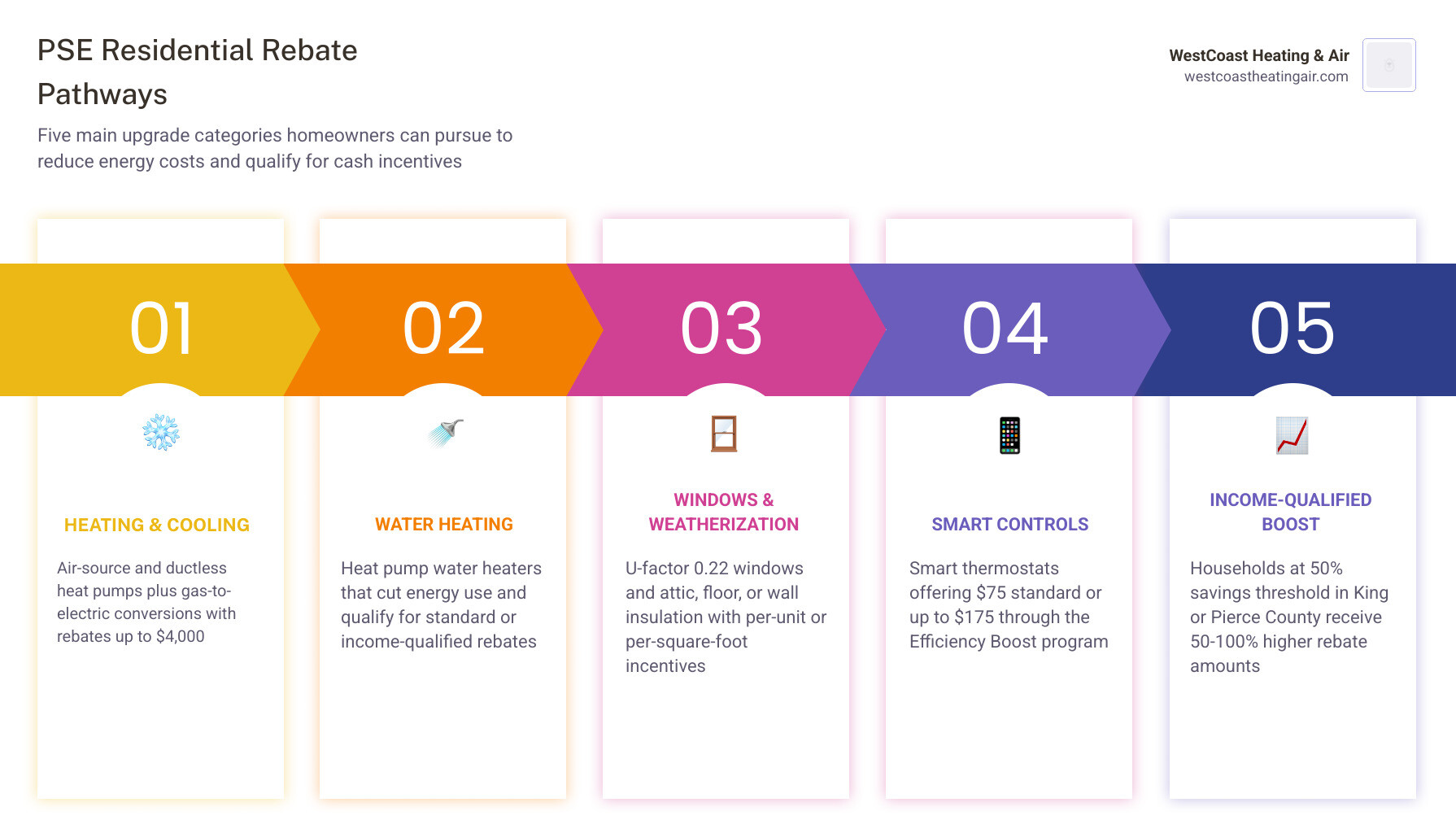
Puget Sound Energy rebates for homeowners are cash incentives that reduce the upfront cost of energy-efficient upgrades like heat pumps, windows, insulation, water heaters, and smart thermostats. Here is a quick look at what is available in 2026:
| Upgrade | Standard Rebate | Efficiency Boost (Income-Qualified) |
|---|---|---|
| Air-source heat pump | Up to $1,500 | Up to $2,400–$4,000 |
| Windows | Up to $100/window ($1,500 max) | Up to $200/window ($2,000 max) |
| Heat pump water heater | Available | Higher amounts available |
| Smart thermostat | $75 | Up to $175 |
| Attic/floor insulation | Per sq. ft. rate | Per sq. ft. rate |
| Gas-to-electric conversion | Up to $3,000+ | Up to $4,000 |
Key eligibility facts:
- Must be an existing single-family home (not new construction)
- Must be a PSE electric or gas residential customer
- Applications must be submitted within 30 days of installation for most residential rebates
- Approximately 50% of PSE customers qualify for higher rebates through the Efficiency Boost program
- Starting April 2026, heat pump installations must be completed by a PSE Trade Ally or Recommended Energy Professional (REP)
If you are a homeowner in Puyallup or the surrounding Pierce County area, navigating energy costs can feel overwhelming — especially when heating bills climb through the wet Pacific Northwest winters. The good news is that PSE offers a wide range of rebate programs designed to put real money back in your pocket when you upgrade to more efficient equipment. Whether you are replacing old electric resistance heat, swapping out single-pane windows, or adding insulation to your attic, there is likely a rebate available that applies to your home.
What makes these programs especially valuable right now is that they can also be stacked with federal tax credits under the Inflation Reduction Act — meaning the savings go even further than the PSE rebate alone.
I’m Michael Smith, owner of WestCoast Heating & Air in Puyallup, and after spending 30 years at Boeing and then transitioning into the residential HVAC industry, I have helped countless local homeowners identify and claim the Puget Sound Energy rebates for homeowners that match their specific upgrade needs. In this guide, I will walk you through everything — from which programs exist, to how to qualify, to how to get your application submitted correctly and on time.
Terms related to puget sound energy rebates for homeowners:
- federal tax credits for heat pump upgrades
- tacoma public utilities incentives for efficiency
- washington energy rebates for hvac upgrades
Core Residential Puget Sound Energy Rebates for Homeowners
As homeowners in areas like Puyallup, Sumner, and Orting look for ways to cut down their monthly utility bills, upgrading key home systems is one of the most reliable strategies. Puget Sound Energy (PSE) provides an extensive menu of incentives that target the primary drivers of residential energy consumption: heating, cooling, water heating, and the home envelope (windows and insulation).
When you upgrade to high-efficiency systems, you are not just reducing your carbon footprint; you are directly lowering the amount of energy your home requires to stay comfortable year-round. Investing in these upgrades is one of the smartest financial decisions you can make for your property, especially when you consider the Advantages of Upgrading to a High Efficiency Heat Pump. By taking advantage of these programs, you can Stop Leaving Money on the Table with Local Utility Perks that are specifically funded to help you transition to clean, affordable energy.
Heating and Cooling Rebates for Puyallup Residents
Space heating is typically the largest energy expense for households in Western Washington. If your home in Puyallup, Tacoma, or Spanaway relies on outdated electric baseboards, wall heaters, or an older electric forced-air furnace, your winter utility bills are likely much higher than they need to be.
PSE offers generous rebates to help you transition to highly efficient heat pump technology:
- Ductless Heat Pump Conversions: If you are converting your primary heating source from zonal electric resistance heat (like cadet wall heaters or baseboards) to an energy-efficient ductless mini-split system, you can receive a standard rebate of $1,500. This incentive increases up to $2,400 for manufactured homes and income-qualified Efficiency Boost customers.
- Air-Source Heat Pumps: Upgrading an existing electric forced-air furnace to a ducted air-source heat pump can qualify you for standard rebates up to $1,500, or up to $2,400 under the Efficiency Boost program.
- Gas-to-Electric Heat Pump Conversions: To encourage the transition away from fossil fuels, PSE offers substantial incentives for homeowners converting from a natural gas heating system to a ducted or ductless electric heat pump. These conversion rebates range from $3,000 to $4,000 depending on your home type and income qualification.
- High-Efficiency Gas Furnaces: If you live in an area where natural gas is the primary fuel source and you choose to replace an old furnace with a high-efficiency model (95% AFUE or higher), PSE offers a standard rebate of $250, which jumps to $750 for Efficiency Boost and manufactured housing.
Windows, Insulation, and Smart Thermostats
Even the most efficient heating system will struggle to keep your bills low if warm air is constantly escaping through drafty windows, uninsulated attics, or unsealed ductwork. PSE’s weatherization rebates are designed to seal your home’s envelope so that your HVAC system doesn’t have to work overtime.
- Energy-Efficient Windows: You can replace drafty single-pane windows with high-efficiency double-pane or triple-pane models and receive up to $100 per window (up to a lifetime maximum of 15 windows or $1,500 total). For manufactured homes and Efficiency Boost customers, this rebate doubles to $200 per window (up to $2,000 total).
- Smart Thermostats: Installing an ENERGY STAR certified smart thermostat allows you to manage your home heating remotely and set energy-saving schedules. PSE offers a $75 rebate for standard customers and up to $175 for Efficiency Boost customers.
- Weatherization and Insulation Measures: PSE incentivizes homeowners to upgrade their home’s insulation and seal leaks. These rebates are calculated on a per-square-foot basis:
- Attic Insulation: Upgrading from R-11 or less to R-49 qualifies for $1.75 per sq. ft. (or $0.50 per sq. ft. if upgrading from R-12 to R-19).
- Floor Insulation: Upgrading from R-11 or less to R-30 qualifies for $2.50 per sq. ft.
- Wall Insulation: Upgrading uninsulated walls to R-13 or higher yields significant per-square-foot savings.
- Duct Sealing and Insulation: Sealing leaky ducts can prevent conditioned air from escaping into crawlspaces. Advanced duct sealing performed by an Aeroseal-certified contractor can qualify for rebates up to $1,250.
- Air Sealing: Sealing drafts around doors, pipes, and outlets helps stabilize indoor temperatures.
Additionally, PSE offers a Customer Bundle Bonus of up to $500 when you complete three or four qualifying weatherization measures at the same time, maximizing your overall project savings.
Technical Requirements and Efficiency Ratings
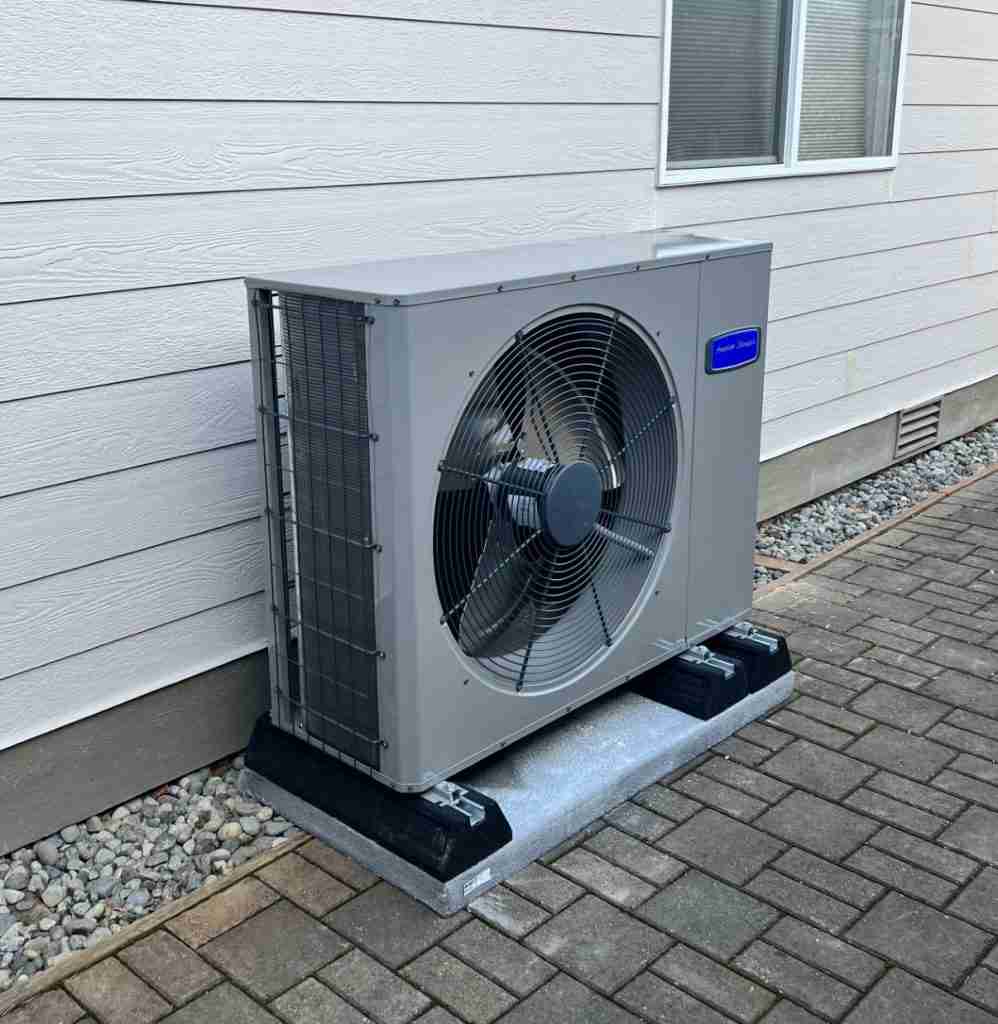
To qualify for puget sound energy rebates for homeowners, the equipment you install must meet strict technical performance criteria. PSE establishes these baselines to ensure that the incentivized systems deliver verified, long-term energy savings.
Before purchasing any equipment, it is essential to understand the specific efficiency metrics used by manufacturers and utilities. If you are unfamiliar with these terms, you can read our comprehensive guide on Energy Efficiency: What Ratings Should You Look For? to help you make an informed decision.
Understanding SEER2 and HSPF2 for Heat Pumps
In recent years, the residential HVAC industry transitioned to new testing standards known as SEER2 (Seasonal Energy Efficiency Ratio 2) and HSPF2 (Heating Seasonal Performance Factor 2). These newer metrics represent more realistic, real-world operating conditions compared to the older SEER and HSPF ratings.
PSE uses a tiered rebate structure for air-source heat pumps based on these updated standards:
| Rebate Tier | Minimum SEER2 Rating | Minimum HSPF2 Rating | Standard Rebate |
|---|---|---|---|
| Tier 1 (Retrofit Only) | 15.2 | 8.1 | $300 ($210 to customer, $90 to contractor) |
| Tier 2 | 15.2 | 8.5 | $400 ($270 to customer, $130 to contractor) |
| Tier 3 | 16.0 | 9.5 | $600 ($390 to customer, $210 to contractor) |
For ducted heat pump systems, PSE requires that any backup electric resistance heating elements are programmed to lock out at 5°F above the home’s natural balance point. This prevents the system from prematurely relying on expensive auxiliary electric heat when the heat pump is fully capable of warming the home on its own. All heat pumps must be AHRI (Air-Conditioning, Heating, and Refrigeration Institute) certified, and the specific indoor and outdoor coil combination must match the AHRI certificate.
Window and Insulation Specifications
To qualify for window rebates, PSE does not look at SEER or HSPF; instead, they measure performance using the U-factor. The U-factor measures how well a window prevents heat transfer. A lower U-factor indicates better insulating properties.
- Standard Window Rebate: To qualify for the standard $100-per-window rebate, you must replace single-pane windows or metal-framed double-pane windows with new wood, vinyl, or fiberglass windows that have a certified U-factor of 0.30 or lower.
- Maximum Window Rebate: To qualify for the higher $200-per-window rebate (available to manufactured homes and Efficiency Boost customers), the replacement windows must achieve a U-factor of 0.22 or lower.
- Documentation: You must preserve the NFRC (National Fenestration Rating Council) stickers on your new windows or keep the manufacturer’s packing slips, as PSE requires proof of the U-factor rating during the application process.
For insulation upgrades, the primary metric is the R-value, which measures thermal resistance. To receive attic or floor insulation rebates, your existing insulation levels must fall below PSE’s baseline (typically R-11 or less) and be upgraded to at least R-49 for attics and R-30 for floors.
Maximizing Savings with the PSE Efficiency Boost Program
One of the most impactful aspects of Puget Sound Energy’s incentive framework is the Efficiency Boost program. This initiative is specifically designed to make home energy upgrades highly affordable for moderate-income households.
By offering significantly higher rebate amounts — often double or triple the standard incentives — Efficiency Boost helps families who might otherwise struggle with the upfront cost of home efficiency projects. In fact, approximately 50% of PSE customers qualify for these increased rebate amounts based on their household size and local county income limits. To understand how these local programs fit into the broader national landscape of energy incentives, you can read our overview on Utility Rebates for High Efficiency Heating: A Federal Overview.
How to Qualify for Puget Sound Energy Rebates for Homeowners via Efficiency Boost
Eligibility for the Efficiency Boost program is determined by your household size, your geographic location (county), and your gross monthly income. Because living costs vary across the Puget Sound region, the income thresholds are adjusted by county.
For example, here are the monthly gross income limits for qualifying in Pierce County (covering Puyallup, Tacoma, Sumner, Orting, Spanaway, Roy, Steilacoom, and University Place) compared to King County (covering SeaTac) in 2026:
| Household Size | Pierce County Gross Monthly Income Limit | King County Gross Monthly Income Limit |
|---|---|---|
| 1 Person | $6,084 | $7,284 |
| 2 People | $6,952 | $8,324 |
| 3 People | $7,819 | $9,364 |
| 4 People | $8,686 | $10,404 |
| 5 People | $9,384 | $11,237 |
| 6 People | $10,078 | $12,069 |
If your household’s total gross monthly income falls at or below these limits, you qualify for the Efficiency Boost program. This means instead of receiving a standard $1,500 rebate for a ductless heat pump conversion, you could receive up to $2,400. If you are converting from natural gas to an electric heat pump, your rebate could reach up to $4,000, potentially covering up to 50% of the total installation cost.
Manufactured Homes vs. Site-Built Properties
PSE recognizes that manufactured homes face unique heating and cooling challenges. Many manufactured homes in rural Pierce County locations like Roy or Spanaway rely on expensive electric furnace heating or old zonal Cadet heaters.
Because of this, PSE offers manufactured home owners the same elevated rebate rates as Efficiency Boost customers, regardless of income:
- Ductless Heat Pump Conversions: Manufactured homes converting from zonal electric resistance heat or an electric forced-air furnace to a ductless mini-split qualify for a flat $2,400 rebate.
- Windows: Replacing older windows in a manufactured home qualifies for the $200-per-window rebate (up to $2,000 total) without requiring income verification.
- Duct Sealing: Properly sealing ductwork in a manufactured home is highly incentivized, as these systems often experience high thermal loss through the belly board of the home.
Contractor Requirements and the Application Process
Getting a high-efficiency system installed is only half the battle; ensuring that you meet PSE’s strict procedural and contractor guidelines is essential to actually receiving your check.
Many homeowners miss out on incentives simply because they worked with an unauthorized contractor or missed the strict filing deadlines. If you live in the Tacoma area, you may also want to compare these rules with other local programs, such as the Tacoma Public Utilities Efficiency Incentives That Put Money Back in Your Pocket.
The Mandatory PSE Trade Ally Rule for 2026
A major change took effect on April 2, 2026. Starting on this date, Puget Sound Energy officially mandated that all residential heat pump installations must be completed by a credentialed PSE Trade Ally or Recommended Energy Professional (REP) to be eligible for rebates.
This rule was implemented to protect homeowners and guarantee quality assurance. High-efficiency heat pumps are sophisticated pieces of equipment that require precise sizing, refrigerant charging, and electrical configuration. If a system is installed incorrectly by an uncertified contractor, it will not deliver the promised energy savings and may suffer premature mechanical failure.
By requiring the use of a PSE Trade Ally, the utility ensures that:
- The contractor is fully licensed, bonded, and insured in Washington State.
- The installation complies with all local mechanical and electrical codes.
- The equipment has been properly sized using accurate load calculations for our marine climate.
- The rebate paperwork is filled out accurately, often allowing the contractor to apply the rebate as an instant discount directly on your invoice.
At WestCoast Heating & Air, we are proud to be an active member of this network, helping families in Puyallup, Sumner, and Tacoma navigate these updated 2026 guidelines seamlessly.
Step-by-Step Guide to Submitting Your Rebate
If your contractor does not offer an instant rebate on your invoice, you will need to submit the application yourself. Here is how to navigate the process:
- Verify Eligibility Before You Buy: Ensure your home is located in PSE’s electric or gas service territory. In some areas, like parts of Tacoma or Seattle, utility boundaries overlap (for example, you might have PSE for natural gas but Tacoma Public Utilities or Seattle City Light for electricity). Your electric rebates must go through your electric provider, and gas rebates through your gas provider.
- Work with a Certified REP: Confirm your chosen residential HVAC installer is an approved PSE Trade Ally before signing any contracts.
- Gather Required Documentation: Once the installation is complete, collect the following paperwork:
- Your PSE residential account number.
- The paid contractor invoice showing the installation date, equipment model numbers, and proof of payment.
- The AHRI certificate of product performance (your contractor will provide this).
- For windows, the NFRC stickers or packing slips showing the U-factor.
- Submit Within the Deadline: Residential rebate applications must be submitted within 30 days of the installation date. Do not delay; submitting your paperwork the same week the job is finished is the best way to avoid missing this strict window.
- Processing and Payment: Once submitted through the online PSE portal, typical processing times range from four to six weeks before your rebate check is mailed.
Stacking PSE Rebates with Federal Tax Credits
One of the most lucrative opportunities for homeowners in 2026 is the ability to combine local utility rebates with federal tax incentives. Under the Inflation Reduction Act (IRA), the 25C Energy Efficient Home Improvement Credit allows you to claim substantial tax credits on your federal tax return.
The 25C tax credit covers 30% of the total installation cost of qualifying heat pumps, up to an annual limit of $2,000. Because this is a tax credit, it reduces your federal tax liability dollar-for-dollar.
Here is how stacking these incentives works in practice:
- No Reduction in Tax Credit Value: PSE rebates do not reduce your eligibility for the federal 25C tax credit. You can claim the full 30% credit based on the pre-rebate cost of the installation, up to the $2,000 cap.
- Dual Incentives: If you install a qualifying Tier 3 heat pump, you can claim up to a $1,500 standard PSE rebate (or up to $2,400 via Efficiency Boost) and still claim up to $2,000 back on your federal taxes.
- Combining Weatherization: The 25C credit also offers up to $1,200 annually for draft-proofing measures, including up to $600 for energy-efficient windows and $1,200 for insulation. You can combine these federal tax credits with PSE’s per-square-foot insulation rebates and window incentives to significantly offset your total project costs.
To learn more about maximizing these dual savings pathways, read our detailed guide on the Inflation Reduction Act Benefits for Washington Homeowners.
Frequently Asked Questions about Puget Sound Energy Rebates for Homeowners
Can I combine Puget Sound Energy rebates for homeowners with federal tax credits?
Yes! You can absolutely stack puget sound energy rebates for homeowners with the federal 25C tax credit. The utility rebate is paid directly to you as a check (or applied as an instant invoice discount), while the 25C credit is claimed when you file your federal income taxes. Combining these two incentives is the single most effective way to lower the net cost of upgrading your home’s comfort systems.
What is the deadline to submit a residential PSE rebate application?
For residential customers, most rebate applications must be submitted within 30 days of the installation date. This is a strict deadline, and PSE rarely grants exceptions. To ensure you do not miss out, we recommend compiling your invoice, AHRI certificate, and model numbers, and submitting them online the same week your project is completed.
Do new construction homes qualify for these residential rebates?
No, standard residential rebates are reserved strictly for existing single-family homes. However, if you are building a new energy-efficient home, PSE offers a separate program called Next Level Homes. This program provides incentives directly to builders and developers for constructing high-performance homes that exceed the Washington State Energy Code.
Conclusion
Upgrading your home’s heating, cooling, windows, and insulation is one of the most effective ways to lower your monthly utility bills and improve your family’s comfort. With the combination of Puget Sound Energy rebates, the income-qualified Efficiency Boost program, and federal tax credits, there has never been a better time to invest in your home’s efficiency.
As a local, family-owned company with over 20 years of experience serving Puyallup, Tacoma, Sumner, Orting, and the surrounding areas, WestCoast Heating & Air is committed to helping our neighbors make the most of these opportunities. We specialize in customized residential system design, customer education, and top-quality residential installations. As a credentialed PSE Trade Ally, we ensure your new system meets all technical requirements so you can claim every dollar you are owed.
If you are ready to upgrade your home’s comfort and start saving, contact us today. We can guide you through the qualifying equipment options and help you explore our flexible financing options to make your project as affordable as possible.