
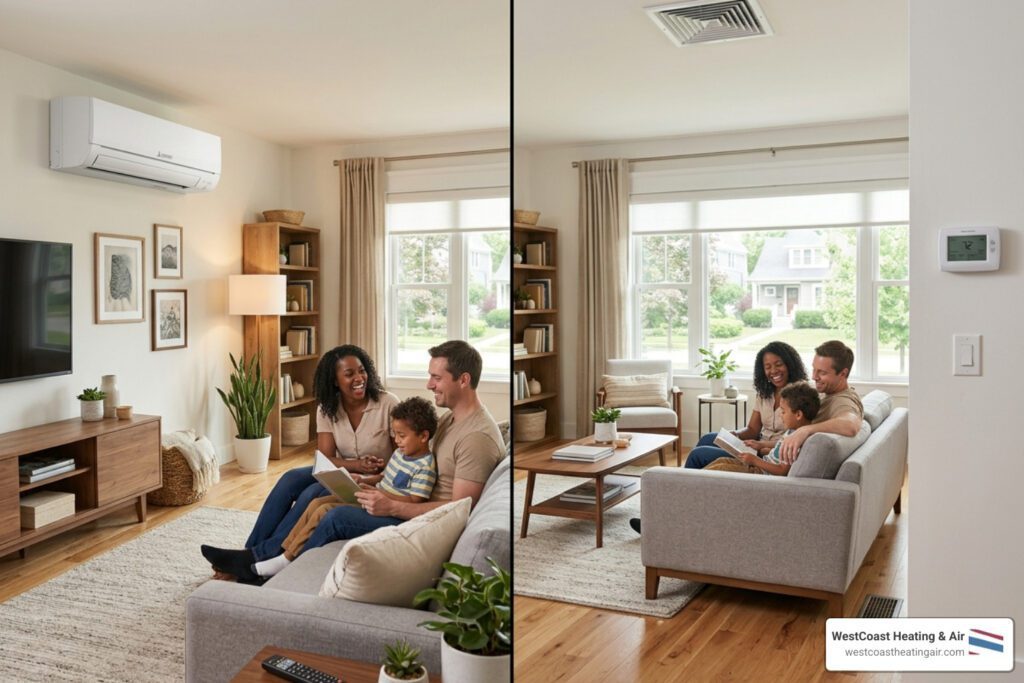
I’m comparing ductless vs central hvac pros and cons. What should I know?
Ductless vs central HVAC pros and cons is one of the most common questions homeowners face when it’s time to upgrade or replace a heating and cooling system — and for good reason. The right choice can affect your comfort, your energy bills, and how much disruption you deal with during installation. The wrong choice can mean years of regret.
Here’s a quick breakdown to help you decide:
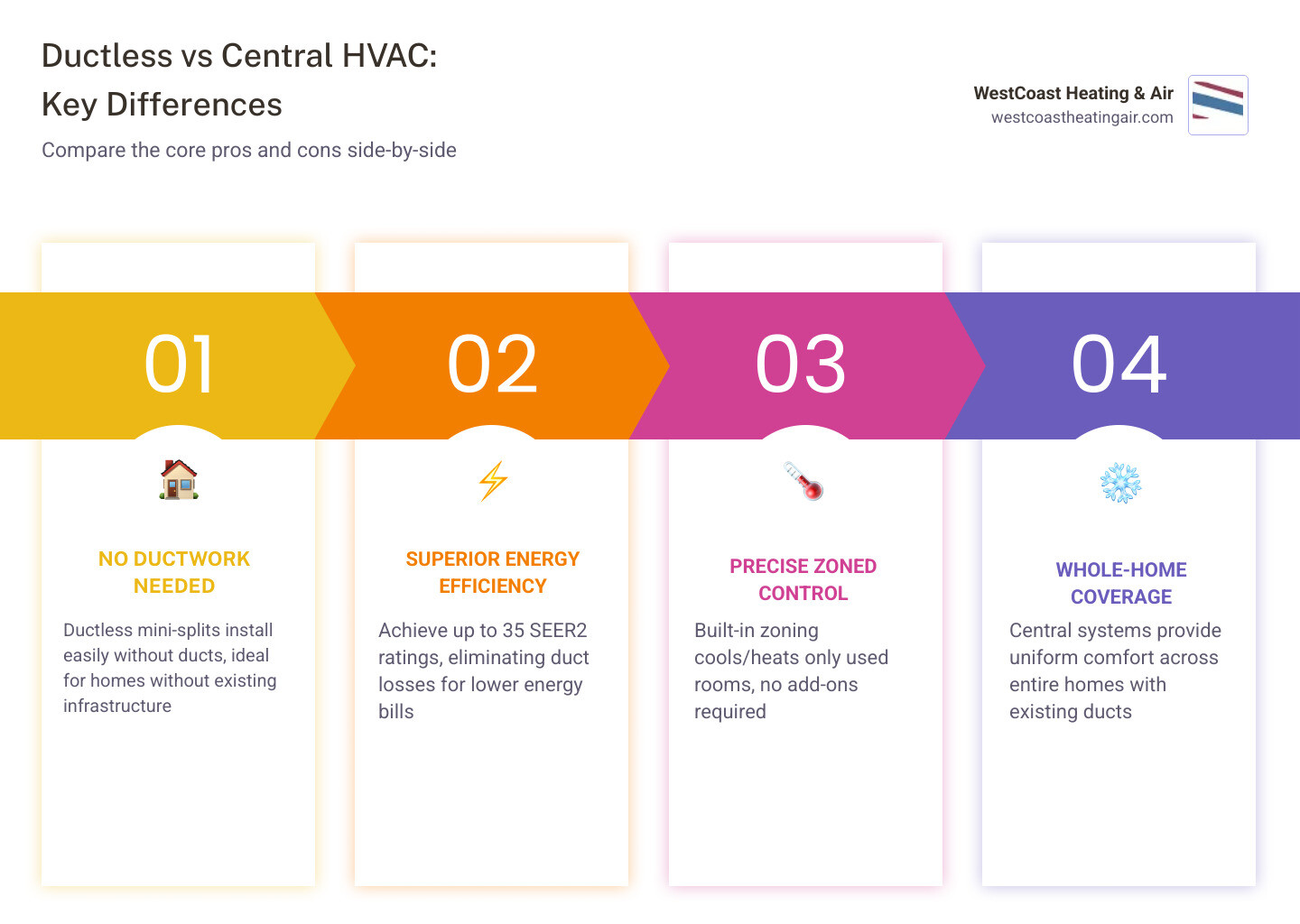
| Factor | Ductless Mini-Split | Central HVAC |
|---|---|---|
| Requires ductwork | No | Yes |
| Energy efficiency | Higher (up to 35 SEER2) | Good (up to 26 SEER) |
| Zoned temperature control | Built-in | Requires add-ons |
| Best for homes without ducts | Yes | No |
| Upfront cost (no existing ducts) | Lower overall | Higher (ductwork adds cost) |
| Upfront cost (existing ducts) | Higher | Lower |
| Whole-home cooling | Multi-unit systems required | Yes, single system |
| Indoor air filtration | Basic | Superior (high-MERV filters) |
| Aesthetics | Visible wall units | Hidden vents and ducts |
| Heating capability | Yes (heat pump) | Paired with furnace |
| Lifespan | 15–20 years | 12–15 years |
The honest answer? There is no universal winner. The best system depends on your home’s layout, whether you already have ductwork, how you use your space, and what matters most to you — whether that’s energy savings, comfort control, or keeping costs manageable upfront.
In this guide, we walk through everything you need to know to make a confident, informed decision for your home in Puyallup.
I’m Michael Smith, owner of WestCoast Heating & Air in Puyallup, Washington — after a 30-year career at Boeing solving complex engineering problems, I brought that same analytical mindset to the residential HVAC industry, and helping homeowners navigate decisions like ductless vs central HVAC pros and cons is exactly the kind of challenge I’m passionate about. Let’s break it all down so you can choose the system that truly fits your home and your life.
When we talk about Air Conditioning and heating, we are essentially talking about moving heat from one place to another. Whether you choose a central system or go with Ductless Heating and Cooling, the core physics remain the same: refrigerant circulates through a closed loop, absorbing heat from inside your home and dumping it outside during the summer, or vice versa in the winter.
A central HVAC system is what most of us grew up with. It uses a large outdoor condenser and an indoor evaporator coil (often sitting on top of a Gas Furnace). A heavy-duty blower fan pushes conditioned air through a spiderweb of metal or flexible ducts hidden in your attic, crawlspace, or walls.
A ductless mini-split, however, skips the “middleman” of ductwork. It consists of an outdoor unit connected to one or more indoor air handlers by small refrigerant lines and electrical wiring. These lines only require a small three-inch hole in the exterior wall. Because there are no ducts to leak or collect dust, the Heat Pump technology in a mini-split can deliver air directly into the room it’s serving.
The “pros and cons” usually boil down to infrastructure. If your home has “good bones” but no vents, ductless is a lifesaver. If you have a modern home with existing, well-insulated ducts, central air is often the path of least resistance.
What are the main benefits of a ductless mini-split for my house?
The rise of ductless technology in the Pacific Northwest isn’t just a trend; it’s a response to our unique housing stock and rising energy costs. In April 2026, efficiency is the name of the game.
One of the most significant Ductless heating benefits for the modern home is the sheer level of control it offers. With a multi-zone system, you can keep your home office at a crisp 68 degrees while leaving the guest room uncooled, saving you from paying to condition empty space.
Ductless systems are widely considered The best high-efficiency heating options for your home because they utilize inverter technology. Unlike traditional systems that are either “100% on” or “completely off,” a variable-speed compressor in a mini-split acts like a dimmer switch. It ramps up or down to maintain a steady temperature, using only the exact amount of electricity needed. This prevents the energy-intensive “startup” cycles common in older central units.
Analyzing ductless vs central hvac pros and cons for energy savings
When we look at the numbers, the efficiency gap is striking. Central air systems in 2026 top out around 26 SEER, while ductless systems can soar up to 35 SEER2. But the real “secret” to ductless savings isn’t just the equipment—it’s the lack of ducts.
The U.S. Department of Energy estimates that typical ductwork loses up to 30% of its energy to leaks, gaps, and poor insulation. When you eliminate the ducts, you eliminate that 30% waste instantly. There are massive Advantages of upgrading to a high efficiency heat pump that go beyond the monthly bill; these systems run so quietly (as low as 19 decibels) that you might forget they are even on. For a homeowner in Puyallup or Tacoma, that means a more peaceful home environment and a significantly smaller carbon footprint.
Why do many homeowners still prefer central air conditioning?
Even with the high-tech appeal of ductless, central air remains the “gold standard” for many residential homes. As a Residential Heating and Cooling Company with over 20 years of experience, we often see homeowners choose central systems for their “invisible” nature.
The biggest “pro” for central air is aesthetics. All the bulky equipment is hidden in the attic, basement, or garage. All you see are small, low-profile vents that blend into your floor or ceiling. For homeowners who have spent a lot of time on interior design, the sight of a white plastic box on the wall (a mini-split head) can be a dealbreaker.
Furthermore, central systems are unparalleled when it comes to Indoor Air Quality. Because a central blower moves a massive volume of air through a single point, we can install thick, high-efficiency MERV 13 or MERV 16 filters, UV light purifiers, and whole-home humidifiers. While mini-splits have filters, they are generally smaller and designed more to protect the machine than to scrub the air for the entire house.
Evaluating ductless vs central hvac pros and cons for indoor air quality
If someone in your family suffers from severe allergies or asthma, the central system’s ability to integrate advanced filtration is a major advantage. However, this comes with a maintenance responsibility. You have to ask yourself How often do you need air duct cleaning to ensure you aren’t just circulating old dust.
Central systems also allow for Air balancing: the art of avoiding hot and cold spots through the use of dampers and professional calibration. While mini-splits provide “zoning” by default, a central system can achieve similar results through Furnace zone control systems that use motorized dampers to direct air only where it’s needed. This allows you to have the “hidden” look of central air with some of the efficiency benefits of a zoned system.
I’m looking to upgrade my home’s heating in Puyallup. Which system fits my layout?
The “best” system is usually dictated by the architecture of your home. In our service areas like Steilacoom or Orting, we see a wide variety of home styles, from historic craftsman houses to modern open-concept builds.
| Scenario | Recommended System | Why? |
|---|---|---|
| New Home Addition | Ductless Mini-Split | Avoids the massive cost of extending existing ductwork. |
| Historic Home (No Ducts) | Ductless Mini-Split | Preserves plaster walls and original architectural details. |
| Garage or Attic Conversion | Ductless Mini-Split | Provides independent climate control for a specific “bonus” room. |
| Large, Modern Open Floor Plan | Central HVAC | Provides uniform cooling across large spaces with existing vents. |
| Multi-Level Home with “Hot Upstairs” | Hybrid Approach | Use central for the main floor and a mini-split for the master suite. |
Ductless systems are often the perfect fit for:
- Homes with baseboard or radiant heat (no existing ducts).
- Empty nesters who only use two or three rooms of a large house.
- Home offices where sensitive electronics require extra cooling.
- Sunrooms with a lot of glass that get too hot for the central system to handle.
If you are looking to upgrade your home’s heating in Puyallup, the layout is the first thing we analyze. For example, in a split-level home in University Place, a central system might struggle to push air to the furthest bedroom. In that case, adding a single-zone mini-split to that “problem room” can be much more effective than trying to “force” the central system to work harder.
Frequently Asked Questions about Residential HVAC
Can a ductless system provide both heating and cooling?
Yes, absolutely! Most modern ductless systems are “heat pumps.” This means they can reverse their operation. In the summer, they pump heat out of your house. In the winter, they extract heat from the outdoor air (even when it’s cold outside!) and pump it into your home. They are incredibly efficient heaters for our Puyallup climate.
Is it possible to combine both systems in one home?
We do this all the time! This is called a “hybrid” or “supplemental” setup. Many homeowners keep their central system for the main living areas but install a ductless unit in a newly finished basement or a primary bedroom that doesn’t get enough airflow. It gives you the best of both worlds: whole-home coverage and precision control where you need it most.
How often do these systems require professional maintenance?
For both systems, we recommend a professional tune-up at least once a year. However, the “DIY” maintenance differs. Central systems usually require a filter change every 1–3 months. Ductless units have small permanent filters that you should rinse under a tap every 2–4 weeks, especially if you have pets. Keeping those filters clean is the single best thing you can do for the lifespan of your equipment.
Conclusion
Choosing between ductless vs central HVAC pros and cons doesn’t have to be a headache. At WestCoast Heating & Air, we believe in a “measure twice, cut once” philosophy. We don’t just sell boxes; we provide customized system design tailored to the specific “micro-climates” inside your home.
Whether you’re in Sumner, Spanaway, or SeaTac, our goal is to ensure you understand exactly what you’re buying. We’ve spent over 20 years serving our neighbors with a commitment to education and top-quality service. If you’re tired of “thermostat wars” or high utility bills, we’re here to help you find the perfect fit.
Ready to see which system is right for your Puyallup home? Explore our Ductless Heating and Cooling options or give us a call to schedule a personalized home evaluation. Let’s get your home comfort back on track!