
Why Your Spring Air Filter Replacement Guide Starts Here
A spring air filter replacement guide is the single most useful tool a homeowner can have when April arrives, pollen counts climb, and your HVAC system fires up for the first time since fall. Here is a quick overview of what this guide covers:
Spring Air Filter Replacement — Quick Steps:
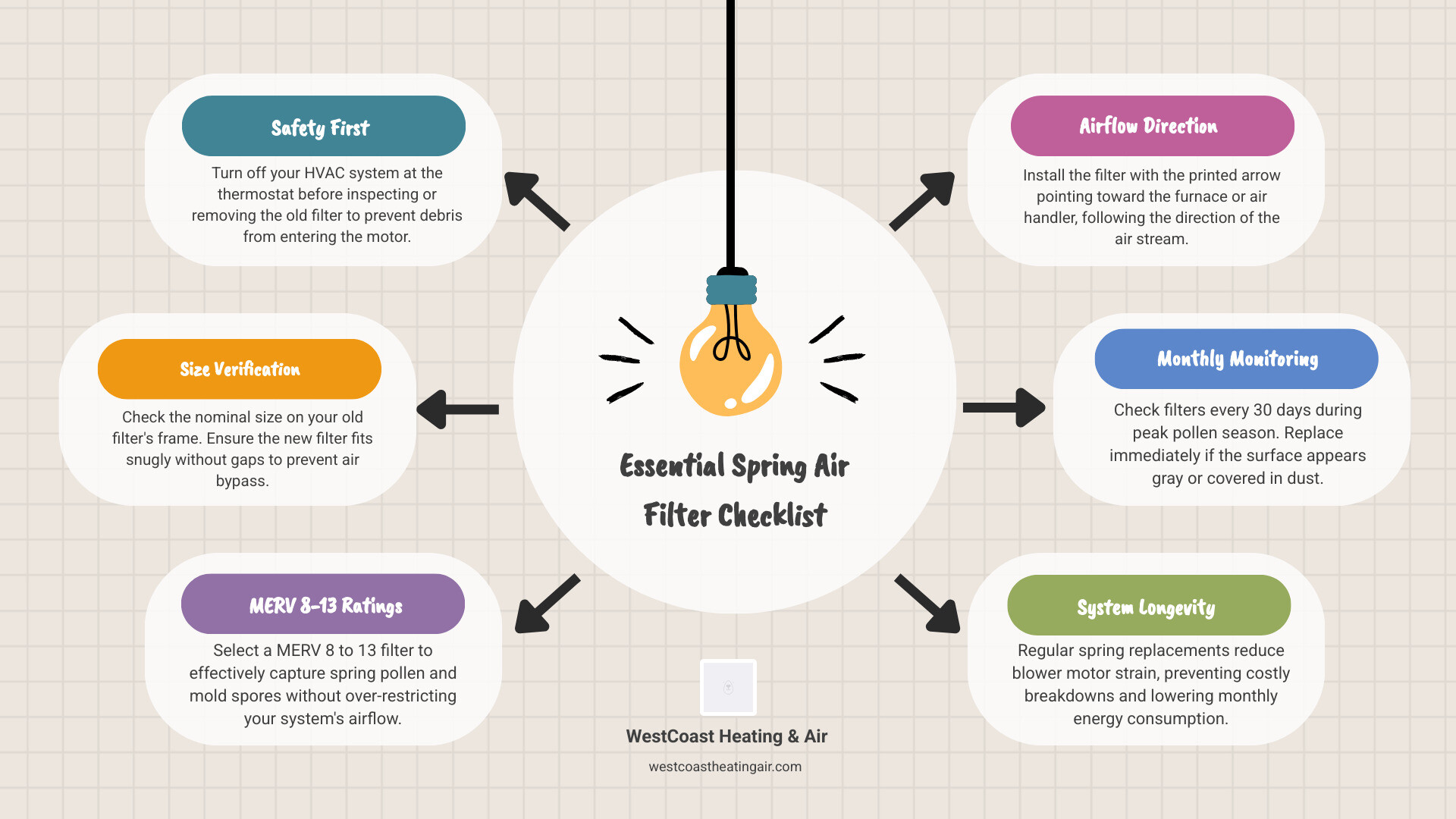
- Turn off your HVAC system at the thermostat before touching anything.
- Locate your filter — return air vent, furnace cabinet, or air handler unit.
- Check the size printed on the old filter frame.
- Choose a replacement with a MERV rating between 8 and 13 for spring pollen.
- Slide in the new filter with the airflow arrow pointing toward the furnace.
- Write the installation date on the filter frame with a marker.
- Check again every 30 days during peak pollen season.
Spring is genuinely the worst time of year for indoor air quality. Trees and grasses release massive amounts of pollen, winter dust that settled into your ductwork gets stirred up the moment your system kicks on, and your HVAC is suddenly working harder than it has in months. If your filter is still the same one you put in last fall, it is likely already at capacity — and a clogged filter does not just hurt your air quality, it strains your entire system and drives up your energy bills.
The same principle applies to your car. That cabin air filter has been collecting road salt, moisture, and winter grime for months. Spring is the perfect reset point for both your home and your vehicle.
I’m Michael Smith, owner of WestCoast Heating & Air in Puyallup, Washington, and after 30 years at Boeing followed by years running a residential HVAC business in the Pacific Northwest, I have seen what a neglected filter does to a system — and how simple a proper spring air filter replacement guide makes the fix. Let’s walk through everything you need to know to get it done right.
Essential spring air filter replacement guide terms:
- Spring AC and Heat Pump Maintenance Checklist
- Spring AC and Heat Pump Maintenance for Washington
Why Spring is the Most Critical Time for a Filter Refresh
In the Puyallup and Tacoma areas, spring 2026 is bringing more than just blooming tulips. It’s bringing a massive “pollen surge” that can quickly overwhelm a standard air filter. During the winter, your HVAC system likely ran steadily to keep you warm, collecting a thick layer of household dust, pet dander, and skin cells. If you don’t swap that filter now, you’re forcing your system to breathe through what essentially looks like a “dusty book from your grandmother’s attic.”
When you ignore this seasonal task, you risk more than just a sneeze. What Happens If You Dont Get An Air Filter Change can range from poor indoor air quality to a total system breakdown. A clogged filter restricts airflow, causing the system to work overtime, which shortens its overall lifespan and can lead to expensive repairs just as the first summer heatwave hits.
The Impact on Monthly Energy Bills
One of the most immediate benefits of following a spring air filter replacement guide is the impact on your wallet. When airflow is restricted by a dirty filter, the blower motor has to work significantly harder to push air through your home. This increased strain translates directly into higher utility bills.
By replacing a clogged filter, you can improve your system’s efficiency and save on energy consumption. We often tell our neighbors in Sumner and Orting that The Importance Of Seasonal Filter Changes Airflow Optimization is the easiest way to keep monthly costs down. Think of it as removing a kink in a garden hose; the air flows smoother, and the machine doesn’t have to “grunt” to get the job done.
Recovering from Winter Accumulation
Winter in Western Washington is damp and dark. During those months, we keep our windows shut tight, which leads to stagnant air and the accumulation of dust mites and pet dander. Furthermore, coastal humidity can sometimes get trapped in the dust layers of an old filter, potentially creating a breeding ground for mold. Spring is the time to clear out that winter “cocktail of seasonal invaders” and ensure your moisture management is on point before the humidity of late spring sets in.
Your Step-by-Step Spring Air Filter Replacement Guide
Replacing a filter is a “totally painless” DIY task, but it does require attention to detail. Before you start, always prioritize safety. Turn off the power to your HVAC system at the thermostat or the dedicated power switch. This prevents the system from kicking on while you have the filter out, which could suck unfiltered debris directly into the sensitive internal components.
When buying a new filter, understand the difference between nominal vs. actual size. The nominal size is the rounded number printed in large text on the box (like 20x20x1). The actual size is the precise measurement, often 1/4 to 1/2 inch smaller. If you buy a filter that is even a quarter-inch too small, you’ll experience “blow-by,” where air bypasses the filter entirely. For more tips on what you can do yourself, check out these 3 Easy Diy Hvac Upkeep Tasks Homeowners Can Do Between Professional Visits.
Using This Spring Air Filter Replacement Guide for Central HVAC
- Locate the Intake: Your filter is usually found in a return air register (the large grille on a wall or ceiling), an air handler cabinet in a closet, or a slot on the side of your furnace.
- Remove the Old Filter: Slide it out slowly. If it looks “fuzzy” or dark gray, it’s definitely time for a change.
- Clean the Area: Use a damp microfiber cloth or a vacuum attachment to wipe away stray dust from the grille or the filter rack.
- Insert the New Filter: Ensure the arrow on the frame points toward the unit (the direction the air is being sucked).
- Secure the Latch: Make sure the cover or grille is locked back in place to maintain a tight seal.
Maintenance Steps for Window AC Units
If you use window AC units in University Place or Steilacoom, their maintenance is slightly different. Most of these use reusable filters.
- Unplug the unit: Safety first!
- Remove the front panel: Most units have a filter that slides out from the side or top.
- Wash the filter: Use mild soap and warm water to rinse away dust. Rinse in the opposite direction of the airflow.
- Air Dry Completely: This is crucial. Reinstalling a damp filter can lead to mold growth inside your unit.
- Clean the Grille: Wipe down the plastic cover before putting everything back together.
Car Cabin Maintenance: A Spring Air Filter Replacement Guide for Drivers
Don’t forget the “lungs” of your vehicle! Your car’s cabin air filter purifies the air entering through the vents. Most manufacturers recommend a change every 12,000 to 15,000 miles, but after a Washington winter, you might need it sooner.
- Access the housing: Usually located behind the glove box. You may need to remove a few plastic stops to let the glove box drop down.
- Swap the filter: Note the orientation of the old one before removing it.
- The Benefits: A clean cabin filter can boost acceleration by up to 11% and improve gas mileage by 10% because it reduces the load on the car’s HVAC system and alternator. Plus, it stops you from breathing in that “locker room” smell that develops when old filters get damp.
Understanding MERV Ratings for Spring Pollen and Allergens
MERV stands for Minimum Efficiency Reporting Value. The scale runs from 1 to 20, and choosing the right one is a balancing act between clean air and proper airflow.
| MERV Rating | What it Captures | Best For |
|---|---|---|
| MERV 1-4 | Large lint, carpet fibers, sanding dust | Basic protection; not recommended for spring pollen. |
| MERV 8 | Pollen, dust mites, mold spores | The standard choice for most Puyallup homes. |
| MERV 11 | Pet dander, auto emissions, fine dust | Great for homes with pets or mild allergies. |
| MERV 13 | Bacteria, smoke, microscopic allergens | The “sweet spot” for high-level filtration without killing airflow. |
Choosing the Best Rating for Puyallup Homes
For our local climate, we usually recommend a MERV 8 to MERV 11 for standard residential systems. If you have severe allergies, you might be tempted by a MERV 16 or a HEPA filter, but be careful—these are very dense and can act like a “wall” rather than a filter if your blower motor isn’t designed to handle them. For odors or heavy pet dander, look for filters with activated carbon to help neutralize smells.
The Importance of Airflow Direction
Every quality filter has an arrow printed on the side. This is not a suggestion! The arrow must point in the direction of the airflow (toward the furnace or air handler). If you install it backward, the structural integrity of the filter is compromised. The wire mesh meant to support the pleats will be on the wrong side, which can cause the filter to collapse into the blower motor, leading to a catastrophic system failure.
Signs Your Home and Car Filters Need Immediate Attention
Sometimes you don’t need a calendar to tell you it’s time for a change. Your home will give you hints. If you notice a fine layer of yellow pollen dust on your coffee table just a day after cleaning, your filter has likely failed. Other signs include:
- Musty Odors: That “old gym bag” smell when the AC kicks on.
- Short Cycling: Your system turns on and off frequently because it’s overheating due to restricted air.
- Increased Bills: A sudden spike in your Puget Sound Energy bill without a change in weather.
For more local insights, read our Washington Spring Hvac Maintenance Tips For Local Homeowners.
Monitoring Filters During Peak Pollen Months
During peak spring months (April and May), we recommend checking your filter every 30 days. While high-quality pleated filters can last 60 to 90 days in the winter, the heavy pollen load in areas like Spanaway and Roy can clog them much faster. If you have shedding pets, a monthly swap is a non-negotiable.
Automotive Warning Signs
In your car, watch for a foggy windshield that won’t clear even with the defroster on. This often means the cabin filter is so clogged with moisture and dirt that it can’t dehumidify the air. You might also notice reduced airflow from the vents or a sluggish engine response when merging onto the highway—a sign that your engine’s air filter (different from the cabin filter) is gasping for breath.
Beyond the Filter: Essential Spring HVAC Maintenance Tasks
A filter change is the best first step, but it shouldn’t be the only one. To ensure your home stays comfortable during those 70-degree spring days that catch us by surprise, perform these quick checks:
- Clear the Outdoor Unit: Ensure there is at least two feet of clearance around your outdoor condenser. Trim back any bushes or grass and clear away leftover winter leaves or pine needles.
- Check the Drain Line: Make sure the condensate drain line isn’t clogged with algae or debris.
- Test Your Thermostat: Switch to “Cool” mode now to make sure the system actually engages before you really need it.
Our guide on Spring Maintenance To Prevent Summer Problems And Sweaty Foreheads goes into deeper detail on these tasks.
Preparing for the Summer Heat
As we transition from the “autumn cold” to the summer heat, small issues can become big problems. If you noticed any strange whistling noises during the winter, now is the time to have a professional look at your ductwork for leaks. Don’t wait until July to find out your system can’t keep up. For a refresher on what you should have done last season, see our guide on Fall Hvac Maintenance Prepare Your Home For The Autumn Cold.
Frequently Asked Questions about Spring Air Filters
Can I wash and reuse my home air filter?
Unless your filter is specifically labeled as “washable” (usually with a plastic or metal frame), the answer is no. Most residential filters are made of paper or polyester fibers. Getting them wet ruins their structural integrity and can lead to mold growth within your ducts. It is always safer and more effective to replace them with new ones.
How does a clean filter improve my car’s gas mileage?
A clean cabin filter allows the HVAC system to reach the desired temperature faster, meaning the AC compressor runs less. This reduces the load on the engine and alternator. The U.S. Department of Energy suggests that maintaining clean filters can improve fuel efficiency by up to 10%.
What happens if I install my filter backward?
If the filter is backward, the air pushes against the “unsupported” side of the pleats. This can cause the filter to bend, buckle, or even get sucked into the fan. Additionally, filters are often designed with a “graduated density,” meaning they catch large particles on one side and smaller ones on the other. Reversing it makes the filter far less efficient.
Conclusion
Taking the time to follow this spring air filter replacement guide is one of the best investments you can make in your home’s comfort and your family’s health. At WestCoast Heating & Air, we pride ourselves on being more than just technicians; we are your neighbors in Puyallup, Tacoma, and the surrounding areas. With over 20 years of local experience, we understand the specific challenges our Pacific Northwest climate poses to your HVAC system.
If you find that a simple filter swap isn’t enough to clear the air, or if your system is making strange noises as it gears up for summer, we are here to help. Schedule your professional spring tune-up today and let us ensure your home stays “fresh and so clean” all season long.