
Why Understanding How Your HVAC Contractor Helps You Access Rebates Could Save You Thousands
How your HVAC contractor helps you access rebates is simpler than most homeowners expect — and knowing the basics upfront can put serious money back in your pocket.
Here is a quick overview of the ways your contractor makes rebates happen:
- Recommends qualifying equipment — They select systems that meet SEER2, ENERGY STAR, and program-specific efficiency requirements
- Checks your eligibility — They verify income qualifications for programs like HEEHRA and utility incentives like Puget Sound Energy’s Efficiency Boost
- Secures pre-approval before installation — Most programs require a reservation before work begins; your contractor handles this timing
- Submits the paperwork — Contractors in approved networks, like TVA’s Quality Contractor Network, file rebate applications on your behalf
- Stacks multiple incentives — They identify where utility rebates, state programs, and federal credits can be combined for maximum savings
- Connects you to financing — They can link you to on-bill repayment plans and interest-free utility loan options
Most homeowners find out about available rebates after they have already signed the installation contract. At that point, some savings opportunities are gone for good.
The rebate landscape in 2026 covers everything from heat pump installations to duct sealing, and the amounts are significant. Programs like HEEHRA offer up to $8,000 for income-qualified households, while utilities like Tacoma Power and Puget Sound Energy layer on additional incentives. But accessing that money almost always runs through one key person: your HVAC contractor.
I’m Michael Smith, owner of WestCoast Heating & Air in Puyallup, and after working with hundreds of Pacific Northwest homeowners on energy-efficient upgrades, I have seen how how your HVAC contractor helps you access rebates can make or break the financial case for a new system. In this guide, I will walk you through exactly what a qualified contractor does at every step so you do not leave money on the table.
Understanding the Complex Landscape of Residential Energy Incentives

Navigating home energy rebates can feel a bit like trying to program a thermostat from 1985—confusing, frustrating, and highly likely to give you a headache. In 2026, the landscape of residential energy incentives is more dynamic than ever, with overlapping programs offered at the federal, state, and local utility levels.
For homeowners in Western Washington—stretching from Puyallup and Tacoma to Orting and Tumwater—the transition toward clean energy is heavily incentivized. However, these programs are not structured as simple, automatic discounts. They are tied to highly specific technical standards, including:
- SEER2 Ratings (Seasonal Energy Efficiency Ratio 2): This updated testing standard measures the cooling efficiency of air conditioners and heat pumps under more realistic duct pressure conditions.
- ENERGY STAR Certification: Only systems that meet strict energy-efficiency guidelines set by the EPA qualify for premium rebates.
- Decarbonization Goals: Many local utility programs specifically incentivize “electrification”—the process of replacing old fossil-fuel heating systems (like gas or oil furnaces) or inefficient electric resistance baseboards with clean, highly efficient heat pumps.
Because modern heat pumps are incredibly efficient—delivering up to three times more heat energy than the electrical energy they consume—utilities are highly motivated to help you make the switch. If you want to understand the broader national context of these programs, you can explore our guide on Utility Rebates for High Efficiency Heating: A Federal Overview.
However, actually securing these funds requires absolute precision. A single missing document, an unapproved system model, or an installation completed without the proper municipal permits can instantly disqualify you from thousands of dollars in savings. This is where we come in to act as your expert guides, ensuring every technical requirement is met perfectly.
How Your HVAC Contractor Helps You Access Rebates
When you partner with an experienced, local residential heating and cooling company, you are not just hiring someone to install a piece of metal outside your home. You are gaining an advocate who understands the local utility portals, federal requirements, and manufacturer promotions.
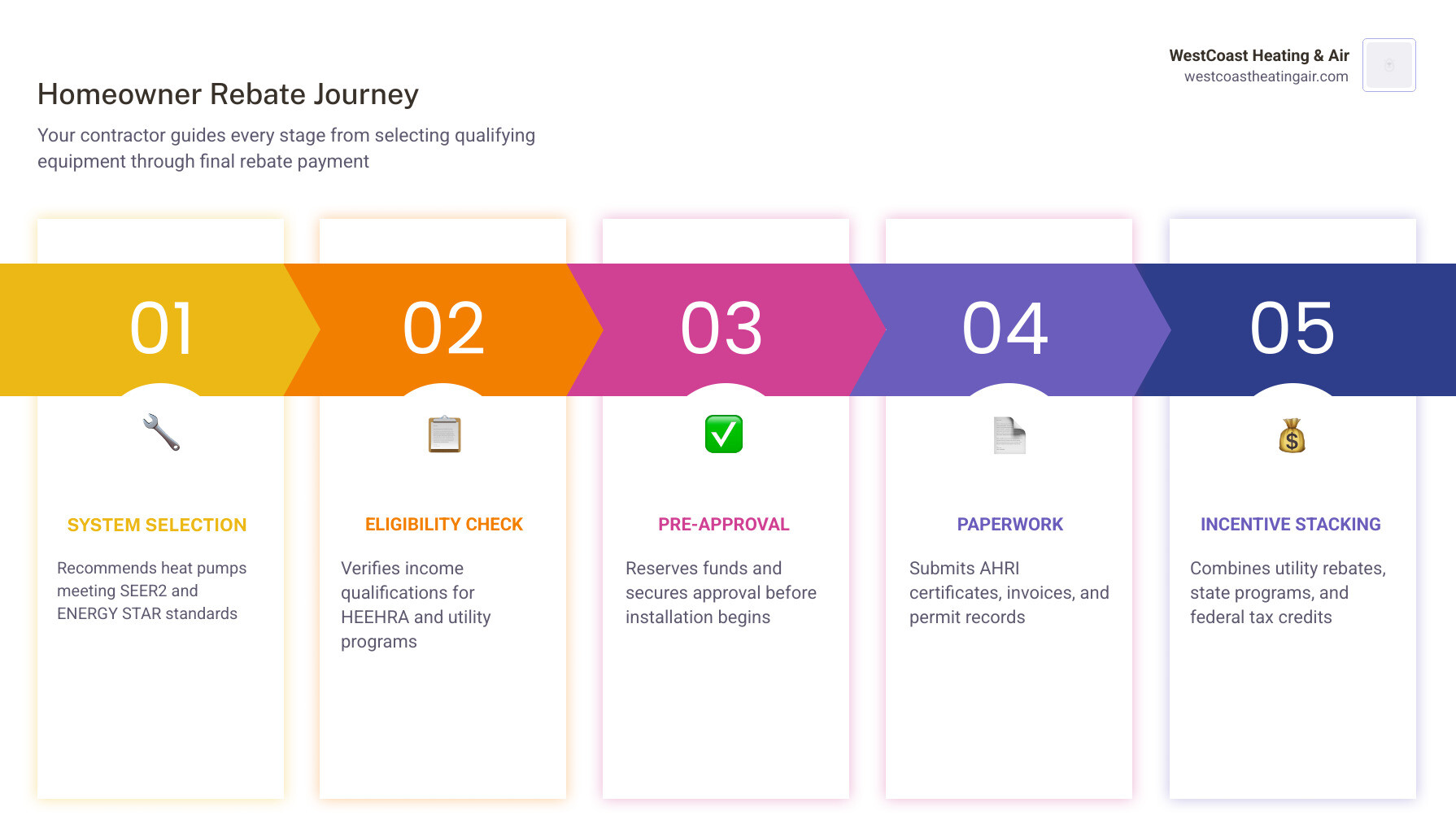
Here is a detailed breakdown of the step-by-step process we use to guide you through the rebate journey.
Step 1: Navigating How Your HVAC Contractor Helps You Access Rebates Through System Selection
Rebate eligibility is determined long before the first wrench is turned. It starts during the initial home assessment. We analyze your home’s unique layout, existing ductwork, and heating needs to design a customized system.
During this phase, we look specifically for systems that utilize variable-speed technology. Unlike older single-stage systems that turn completely on or off (like a noisy light switch), modern variable-speed heat pumps ramp up or down gradually (like a dimmer switch). This technology not only keeps your indoor temperature incredibly stable but also ensures the system achieves the high SEER2 and HSPF2 ratings required by local utility programs.
For example, if you are a Tacoma Power customer, we look for systems that align with their specific heating upgrades. To learn more about how these local programs put money back in your pocket, check out our resource on Tacoma Public Utilities Efficiency Incentives That Put Money Back in Your Pocket. We make sure the exact model numbers proposed are pre-verified on the utility’s qualifying product list.
Step 2: Verifying Income Eligibility and Program Requirements
Many of the most lucrative rebate programs in 2026 are tiered based on household income to ensure energy-efficiency upgrades are accessible to everyone.
- HEEHRA (High-Efficiency Electric Home Rebate Act): This federally funded program offers up to $8,000 in rebates for heat pump HVAC installations. Low-income households (earning under 80% of the Area Median Income, or AMI) can qualify for the maximum amount, while moderate-income households (80% to 150% of AMI) can access substantial partial rebates.
- Puget Sound Energy (PSE) Efficiency Boost: For homeowners in areas like Puyallup, Sumner, and Spanaway, PSE offers an “Efficiency Boost” program. This program provides increased rebate amounts—up to $2,400 for heat pump conversions—for income-qualified households.
We help you navigate these portals safely. We will guide you to the secure utility and state-administered verification tools where you can safely input your information, ensuring you receive the highest tier of funding you qualify for without compromising your privacy.
Step 3: Securing Pre-Approval and Reserving Funds
One of the most common—and costly—mistakes homeowners make is assuming they can apply for rebates retroactively. In 2026, almost every major utility and state program requires a rebate reservation or pre-approval before any installation work begins.
Because rebate funding is limited and subject to budget cycles, programs can fill up quickly. When we design your system, we submit a formal pre-approval request to the utility or state program portal. This secures your spot in line and guarantees that the rebate funds are reserved specifically for your home. By working with a program-approved contractor, this reservation process is streamlined, preventing delays that could push your installation back.
Step 4: How Your HVAC Contractor Helps You Access Rebates by Submitting the Paperwork
The actual application process for energy rebates can feel incredibly tedious. It requires a mountain of technical documentation that most homeowners do not have readily available.
When we handle your rebate application, we compile and submit:
- The AHRI Certificate: Issued by the Air-Conditioning, Heating, and Refrigeration Institute, this certificate proves that the specific combination of indoor coil, outdoor condenser, and furnace/air handler installed in your home achieves the certified efficiency ratings required by the rebate program.
- Itemized Invoices: Rebate administrators require clear invoices showing the exact model numbers, serial numbers, and a breakdown of equipment and labor.
- Permit Records: In cities like SeaTac, Steilacoom, or Tumwater, local building permits are required for HVAC installations. Many utility programs will not release funds until proof of a closed, inspected permit is submitted. We handle the permitting and municipal inspections from start to finish.
Stacking Utility Incentives, Federal Tax Credits, and State Programs
One of the greatest benefits of working with a knowledgeable contractor is the ability to “stack” multiple incentives. Stacking means layering different rebate and tax programs on top of one another to drive down the net cost of your home comfort upgrade.
In 2026, a typical strategic stacking plan for a homeowner in our service area might look like this:
- Utility Rebate: Replacing an old electric resistance furnace with an air-source heat pump can qualify for up to $1,500 through Puget Sound Energy, or up to $2,000 for a variable-speed central heat pump through Tacoma Power.
- Income-Qualified Boosts: If you qualify for PSE’s Efficiency Boost, that utility rebate can jump up to $2,400.
- Duct Sealing Incentives: If your project includes sealing leaky ductwork, you can access up to an advanced duct sealing rebate of $1,250 through PSE.
- Federal Tax Credits: While the old 25C tax credit rules have evolved, federal incentives and state-administered IRA programs (like HEEHRA) continue to provide significant avenues for savings.
To see how these programs work together to maximize your budget, take a look at our detailed breakdown of the Inflation Reduction Act Benefits for Washington Homeowners. We specialize in designing system packages that check the boxes for multiple programs simultaneously, ensuring you claim every single dollar available to you.
Ensuring Installation Compliance to Avoid Rebate Disqualification
Even if you select the perfect residential system and secure your pre-approval, your rebate can still be denied if the installation itself does not meet strict programmatic standards. Utility companies do not just want to know what was installed; they want to know how it was installed.
To protect your investment, we adhere to rigorous installation protocols:
- Manual J Load Calculations: We never guess on system sizing. We perform a full Manual J calculation to determine the exact heating and cooling load of your home based on insulation, window types, and square footage. Under-sized or over-sized systems run inefficiently and are frequently disqualified by rebate auditors.
- Airflow and Charge Verification: Many programs require post-installation testing to verify that the refrigerant charge and system airflow match the manufacturer’s precise specifications. Our technicians use digital manifolds and airflow hoods to document these metrics.
- Duct Integrity: An incredibly efficient heat pump attached to leaky, uninsulated ductwork will not deliver the promised energy savings. That is why we offer comprehensive duct sealing services, which often qualify for their own standalone rebates (such as PSE’s $1,250 advanced duct sealing incentive).
If you are looking for ways to manage the upfront investment of these high-performance systems while waiting for your rebate checks to arrive, we can connect you with flexible options. You can explore our Financing page to learn about low-interest utility programs, on-bill repayment plans, and deferred loan options tailored for local homeowners.
Frequently Asked Questions About HVAC Rebates
Can I stack utility rebates with federal tax credits?
Yes! In almost all cases, local utility rebates (from providers like Tacoma Power or Puget Sound Energy) can be combined with federal tax incentives and state-administered programs. The key is ensuring that the equipment selected meets the independent efficiency criteria for each program. We specialize in cross-referencing these standards to build a compliant system package.
Do I need to use a certified contractor to qualify for rebates?
Absolutely. Nearly every major residential rebate program requires the system to be installed by an approved, licensed, and bonded participating contractor. Utilities establish these networks to protect their energy grids and ensure that high-efficiency systems are installed safely and correctly. Installing a system yourself or using an uncertified contractor will almost certainly result in the immediate denial of your rebate.
What happens if I install the equipment before getting rebate pre-approval?
If you proceed with an installation before securing the necessary pre-approvals or funding reservations, you run a very high risk of losing your rebate eligibility. Most modern utility and state programs do not allow retroactive claims. Always ensure your contractor has secured a formal reservation confirmation before the physical installation begins.
Conclusion
Upgrading your home’s heating and cooling system is a significant investment in your family’s comfort, health, and long-term energy savings. While the rebate process can seem overwhelming, you do not have to navigate it alone.
At WestCoast Heating & Air, we combine over 20 years of local expertise with a deep commitment to customer education and customized residential system design. Whether you live in Puyallup, Tacoma, Orting, Sumner, or Tumwater, we are here to handle the technical details, secure your pre-approvals, and ensure your new system is installed to the highest standards of efficiency.
Are you ready to maximize your savings and experience the unmatched comfort of a modern heat pump? Schedule your energy-efficient heat pump upgrade today and let our team handle the hard work for you!