
How to Know When Your HVAC System Has Reached the End of the Road
Knowing the signs your HVAC needs replacing not just fixing can save you hundreds — sometimes thousands — of dollars before your system fails on the hottest day of a Puyallup summer or the coldest night of a Pierce County winter. Most homeowners don’t think about their heating and cooling system until it stops working entirely. By then, the decision is already being made under pressure, and that almost always costs more.
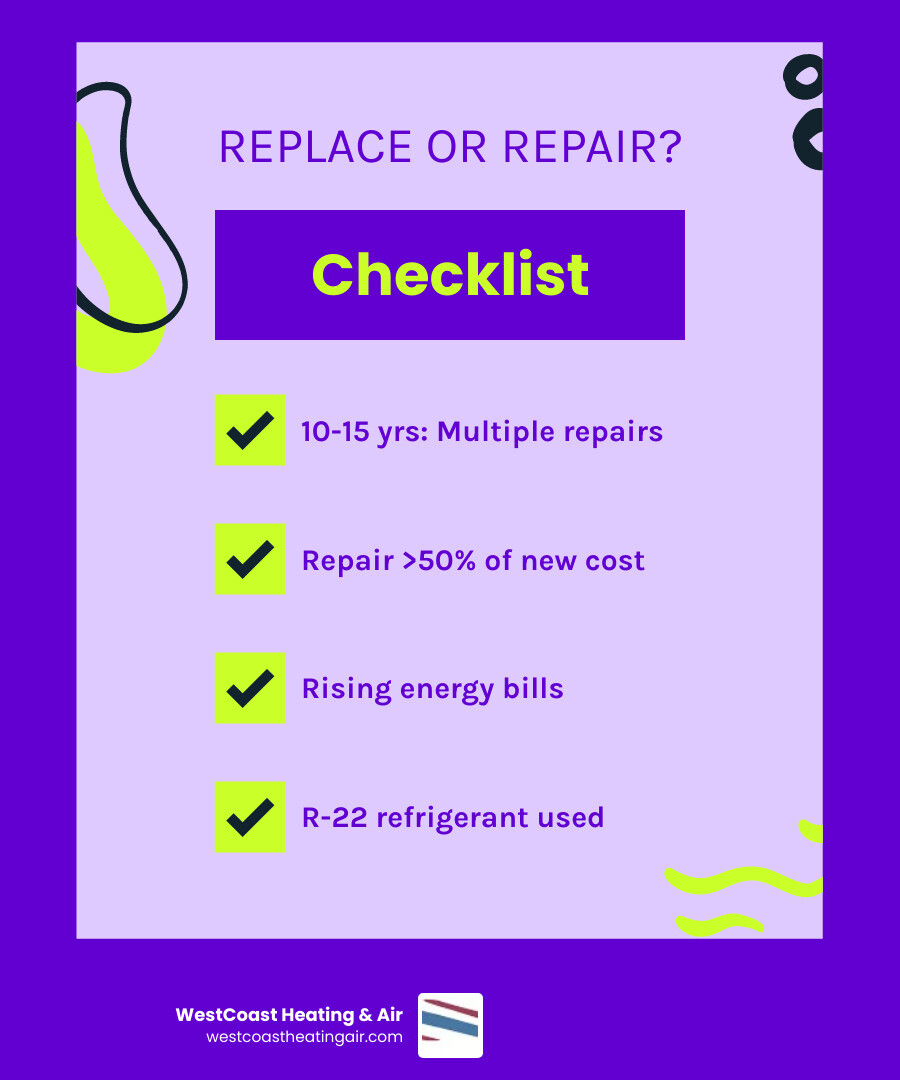
Here is a quick-reference summary of the most common signs that point to replacement rather than another repair:
- Your system is 10 to 15 years old and has needed multiple repairs in the past two years
- Repair costs exceed 50% of the price of a new system (the 50% rule)
- Your energy bills have been climbing year over year without a clear explanation
- Your home has uneven temperatures, with some rooms too hot and others too cold
- The system short cycles — turning on and off more frequently than it should
- Your system uses R-22 refrigerant, which has been phased out and is now expensive to source
- You see a yellow or orange furnace flame instead of a steady blue one
- You’ve had a technician out three or more times in the past year for different problems
- Your indoor humidity feels wrong — too sticky in summer or too dry in winter
- You hear banging, grinding, or hissing sounds that weren’t there before
If three or more of these apply to your system, replacement is likely the smarter financial move — and the sections below will help you understand exactly why.
I’m Michael Smith, owner of WestCoast Heating & Air in Puyallup, and after 30 years at Boeing followed by hands-on work in residential HVAC across Pierce and South King County, I’ve helped hundreds of local homeowners work through the exact signs your HVAC needs replacing not just fixing so they can make confident, informed decisions. In the guide below, I’ll walk you through each of those signs in plain language — no pressure, no upselling, just straight answers.
Signs your hvac needs replacing not just fixing vocab explained:
- how old is too old for an hvac system
- when to repair vs replace your hvac system
The Lifespan Factor: How Age Affects Your Heating and Cooling System

The age of your equipment is the ultimate baseline when determining whether to invest in another repair or transition to a replacement. While a well-maintained system can run reliably for years, wear and tear eventually catches up with even the highest-quality components.
Our unique Northwest climate plays a significant role in how systems age. Here in the Puget Sound region, our damp, cool winters mean our heating systems run almost continuously for months on end. Conversely, our increasingly hot summers place a heavy burden on air conditioners and heat pumps that weren’t historically expected to work quite so hard. This seasonal stress accelerates mechanical fatigue, making system age a critical factor in your decision-making process.
Understanding how old is too old for an hvac system is about recognizing the point of diminishing returns. When your equipment crosses its expected operational threshold, even small repairs can become a gamble. You might fix a failed capacitor today only to have the blower motor fail next month. To make a proactive, stress-free decision, it is always best to plan ahead; Don’t Wait for a Breakdown during a extreme weather event when local service schedules are at their tightest.
Typical Lifespans for Furnaces and Heat Pumps
Not all heating and cooling units are engineered to last the same amount of time. Here is what you can realistically expect from the main residential system types in our region:
- Gas Furnaces (15 to 20 Years): Because they rely on combustion and have fewer complex electronic moving parts than heat pumps, gas furnaces generally have the longest lifespans. However, after 15 years, the risk of a cracked heat exchanger increases dramatically.
- Air-Source Heat Pumps (10 to 15 Years): Because heat pumps provide both heating in the winter and cooling in the summer, they operate year-round. This double-duty usage means their mechanical components experience twice the annual wear of a heating-only or cooling-only system, typically putting their reliable lifespan right around the 12-year mark.
- Central Air Conditioners (10 to 15 Years): Standard AC units only run during our warmer months, but the damp winter environment can lead to rust and electrical corrosion while the system sits idle, limitings its useful life.
If your current setup is approaching or has exceeded these age ranges, continuing to repair individual parts is often like putting new tires on a car with a failing transmission. Investing in modern equipment ensures you aren’t throwing good money after bad. For instance, there are significant Advantages of Upgrading to a High Efficiency Heat Pump, which can handle both your heating and cooling needs seamlessly while slashing your monthly energy usage.
Key Signs Your HVAC Needs Replacing Not Just Fixing
When a system begins to fail, it rarely goes quiet. Instead, it sends clear signals through your home’s comfort levels, your monthly utility bills, and its overall operational behavior. Recognizing these Signs It’s Time to Upgrade Your HVAC System early allows you to schedule a replacement on your own terms rather than during a home comfort urgent.
Comfort Issues and Signs Your HVAC Needs Replacing Not Just Fixing
If your system is struggling to maintain a comfortable indoor environment, it’s a strong indicator that the internal machinery is losing its capacity to perform. Here are the primary comfort issues to watch out for:
- Uneven Temperatures: Do you find that your living room in Puyallup feels like a sauna while your upstairs bedrooms feel like an icebox? When compressors or blower motors weaken, they can no longer distribute conditioned air evenly through your ductwork.
- Short Cycling: If your system turns on, runs for a couple of minutes, shuts off, and then repeats the cycle shortly after, it is short cycling. This places massive electrical and mechanical strain on the system and is often a sign of failing controls, an oversized unit, or a compressor on its last legs.
- Poor Humidity Control: A properly functioning air conditioner or heat pump doesn’t just cool the air; it removes moisture. If your home feels sticky and humid in August, or excessively dry and dusty in January, your system is no longer managing your indoor air quality effectively.
- Weak Airflow: If you hold your hand up to your registers and only feel a faint whisper of air, your blower motor is likely failing or your internal coils are severely restricted.
When these issues become chronic, simple maintenance is no longer enough. To get a complete picture of why these symptoms occur and how to address them, read our guide on when to repair vs replace your hvac system.
Rising Energy Bills as Signs Your HVAC Needs Replacing Not Just Fixing
Have you noticed your monthly utility bills creeping upward, even though your heating and cooling habits haven’t changed? This is a classic sign of declining efficiency. As mechanical parts wear down, motors must work harder and run longer to deliver the same amount of heating or cooling.
An aging system that was rated at 14 SEER when it was installed 12 years ago may only be performing at an 8 or 10 SEER level today due to internal wear, dirty coils, and motor degradation. This efficiency drop can quietly add hundreds of dollars to your annual utility costs.
Modern systems are engineered to meet strict SEER2 (Seasonal Energy Efficiency Ratio 2) standards, which measure cooling efficiency under real-world conditions. Upgrading from an old, degraded unit to a high-efficiency system can reduce your heating and cooling energy consumption by 20% to 40%. For a detailed breakdown of how much you can save on your heating bills by upgrading, explore The Definitive Guide to High Efficiency Furnace Cost Savings.
The Financial Math: Applying the 50% and $5,000 Rules
Deciding whether to repair or replace your system doesn’t have to be a guessing game. By applying simple, time-tested financial rules, you can remove the emotion from the decision and focus on the numbers. Knowing how to evaluate these decisions helps you manage your home budget logically, ensuring you are Upgrading Your HVAC Without Losing Your Cool or Your Cash.
While we always champion The Financial Case for Preventive Maintenance to extend your system’s life, there comes a point where continuing to pay for repairs is no longer financially sound.
Understanding the 50% Rule
The 50% Rule is a straightforward comparison tool used by HVAC professionals. It states: If the cost of a single repair exceeds 50% of the value of a brand-new replacement system, you should replace the system.
For example, if your 12-year-old air conditioner experiences a major component failure—such as a failed compressor or a severely leaking evaporator coil—the cost to fix that single issue is often halfway to the cost of installing a brand-new, fully warrantied unit. Investing a large sum into an older unit only guarantees that one part is new; the remaining old components (like the blower motor, fan, and electrical controls) are still prone to failing next.
Applying the $5,000 Rule
Another excellent tool is the $5,000 Rule, which factors in the age of your equipment. To use this rule, you multiply the age of your system by the cost of the proposed repair:
$$text{Age of System (Years)} times text{Repair Cost} = text{Score}$$
- If the result is under $5,000, repairing the system is generally a safe bet.
- If the result is over $5,000, you should strongly consider replacement.
Let’s look at two real-world examples:
- Scenario A: Your 6-year-old heat pump needs a moderate electrical repair. Multiplying its age (6) by the repair cost yields a score well below the $5,000 threshold. In this case, repairing the unit makes perfect sense because the system still has plenty of reliable years left.
- Scenario B: Your 13-year-old air conditioner has a major refrigerant leak. Multiplying its age (13) by the substantial cost of finding, sealing, and recharging the system yields a score that far exceeds $5,000. Here, the math clearly points to replacement as the wiser long-term investment.
Impact on Home Value and Appraisals
Your HVAC system is one of the most valuable mechanical assets in your home. If you plan to sell your property in Tacoma, Sumner, or Puyallup in the next few years, an old, failing HVAC system can be a major liability during negotiations.
Prospective buyers and home inspectors look closely at the age and condition of the heating and cooling equipment. A system that is near the end of its lifespan can scare off buyers or lead to steep requests for price reductions during the inspection phase. If you’re wondering how your current cooling setup affects your home’s marketability, read Is Your Old AC Killing Your Resale Price?.
Furthermore, a modern, highly efficient HVAC system positively influences property valuations. To understand how appraisers view your home’s mechanical systems, check out The Ultimate Guide to How HVAC Condition Affects Home Appraisals.
Safety Risks and Environmental Triggers That Make Replacement Non-Negotiable
While comfort and financial math are important, safety and environmental regulations can sometimes make the repair-vs-replace decision for you. In these scenarios, continuing to run or repair an old system is simply not a safe or viable option.
Cracked Heat Exchangers and Carbon Monoxide Concerns
In a gas furnace, the heat exchanger is the metal chamber where fuel is burned to create heat. It keeps the dangerous combustion byproducts—including carbon monoxide (CO)—completely separate from the clean air that circulates through your home.
Over years of heating up and cooling down, the metal of the heat exchanger expands and contracts. Eventually, this constant stress can cause the metal to crack. A cracked heat exchanger is an immediate safety hazard because it can allow carbon monoxide to leak directly into your living spaces.
Signs of a cracked heat exchanger or combustion issue include:
- A furnace burner flame that is yellow or orange instead of a steady, crisp blue.
- Soot buildup inside the furnace cabinet.
- A strong, unpleasant chemical odor when the furnace runs.
- Frequent activation of your home’s carbon monoxide detectors.
If a technician diagnoses a cracked heat exchanger in an older furnace, replacement is non-negotiable. Because the heat exchanger is the core of the furnace, replacing just this component is incredibly labor-intensive and rarely makes financial sense on a system that is already past its prime.
The R-22 Refrigerant Dilemma in 2026
If your air conditioner or heat pump was installed before 2010, there is a very high probability that it utilizes R-22 refrigerant (commonly known as Freon). Due to environmental regulations aimed at protecting the ozone layer, the EPA completely phased out the production and import of R-22.
In 2026, R-22 is incredibly scarce, and servicing these older systems has become prohibitively expensive. If your R-22 system develops a refrigerant leak, recharging it can cost a fortune just for the refrigerant itself—without even addressing the cost of finding and repairing the leak. Because these older systems are also nearing the end of their mechanical lifespans, investing in a temporary R-22 recharge is a poor financial decision. Upgrading to a modern system that uses eco-friendly, readily available refrigerants is the safest and most cost-effective path forward.
Frequently Asked Questions about HVAC Replacement
Should I replace my furnace and AC at the same time?
In most cases, yes. Your furnace and air conditioner (or heat pump) are designed to work together as a matched system. They share the same blower motor and ductwork. Replacing both units at the same time ensures that they are perfectly compatible, allowing you to achieve the maximum rated efficiency (SEER2) of your new equipment. Additionally, combining the installation saves you significant money on labor costs compared to replacing them years apart, and it resets the warranty clock for your entire home comfort system.
How do modern SEER2 ratings affect my energy savings?
SEER2 is the updated national standard for measuring the energy efficiency of air conditioners and heat pumps. The higher the SEER2 rating, the less electricity the system uses to cool your home. Upgrading from an older, degraded 10-SEER system to a modern 16-SEER2 or 18-SEER2 unit can reduce your cooling energy consumption by 30% to 40%. Over the lifespan of the system, these monthly utility savings can offset a significant portion of your initial investment.
What is the best time of year to replace my HVAC system in Pierce County?
The ideal times to replace your system are during the “shoulder seasons”—typically spring (March to May) and fall (September to November). During these months, the weather is mild, meaning you won’t have to go without heating or cooling during extreme temperatures. Furthermore, because HVAC companies are less busy with urgent repair calls during these periods, you’ll enjoy more flexible scheduling options and can take your time making an informed decision.
Conclusion
Recognizing the signs your HVAC needs replacing not just fixing is the first step toward securing long-term comfort, safety, and energy savings for your family. Whether you are dealing with frequent breakdowns, skyrocketing energy bills, or an outdated R-22 system, being proactive prevents the stress of an urgent problem replacement when the Northwest weather takes a turn.
At WestCoast Heating & Air, we are a local, family-owned company based right here in Puyallup, WA, with over 20 years of experience serving our neighbors in Tacoma, Sumner, Orting, Spanaway, and the surrounding communities. We pride ourselves on customized system design, thorough customer education, and delivering top-quality residential heating and cooling solutions without the high-pressure sales tactics.
If you suspect your system is nearing the end of its useful life, let us help you find the perfect match for your home’s unique needs. Schedule a professional home comfort assessment with WestCoast Heating & Air today, and let’s make sure your home stays comfortable all year round.