
Is a High Efficiency Furnace Worth the Extra Cost? Here’s What Puyallup Homeowners Need to Know
Is a high efficiency furnace worth the extra cost? For most homeowners in colder climates like the Pacific Northwest, the answer is yes — but the details matter. Here’s a quick breakdown before we dive deeper:
| Your Situation | Worth It? |
|---|---|
| Cold climate, staying 7+ years | Yes — payback typically in 4–7 years |
| Mild climate or moving within 2–3 years | Probably not — payback can stretch to 10–15 years |
| High gas bills, older inefficient furnace | Yes — savings add up faster |
| Tight budget, moderate winters | Consider standard efficiency or a heat pump instead |
| Eligible for utility rebates or incentives | Yes — rebates can cut payback time by 30–50% |
Heating accounts for roughly 45% of a typical home’s energy bill. When your furnace is running from October through March — as it often does in Western Washington — even a modest efficiency gain adds up to real savings over time. A high-efficiency furnace converts 95–98% of every dollar of natural gas into usable heat, compared to just 80% for a standard model. That 15–18 cent difference on every dollar spent on gas is exactly what makes this decision worth thinking through carefully.
The challenge is that the upfront cost is real, the installation requirements are more involved, and the payback timeline depends heavily on your climate, your home, and how long you plan to stay. Getting the math right before you commit is the difference between a smart investment and a costly mistake.
I’m Michael Smith, owner of WestCoast Heating & Air in Puyallup, and after years of helping Pacific Northwest families navigate furnace decisions, I’ve seen when a high-efficiency upgrade delivers strong returns — and when it doesn’t. In this guide, I’ll walk you through the honest numbers so you can decide whether a high efficiency furnace is worth the extra cost for your specific situation.
Understanding Furnace Efficiency: Standard vs. High-Efficiency Systems
To understand if a high-efficiency system is right for your home, we first need to look at what happens inside the metal cabinet of your heating system. Standard and high-efficiency gas furnaces may look similar from the outside, but their internal engineering is completely different.
Traditional standard-efficiency systems are built around a single heat exchanger. When natural gas combusts, the hot gases pass through this heat exchanger, transfer heat to your home’s air, and then quickly vent out through a metal chimney. Because these exhaust gases must remain hot enough to rise naturally up the flue, a substantial amount of thermal energy is wasted.
High-efficiency furnaces, often referred to as condensing furnaces, use advanced engineering to squeeze every last drop of heat out of the fuel. They feature a secondary heat exchanger and a sealed combustion chamber. By routing the exhaust through a second stage, the system cools the combustion gases to the point where water vapor condenses, releasing latent heat back into your home. This process is highly sophisticated and represents one of The Best High Efficiency Heating Options for Your Home.
What is AFUE and how does it determine if a high efficiency furnace is worth the extra cost?
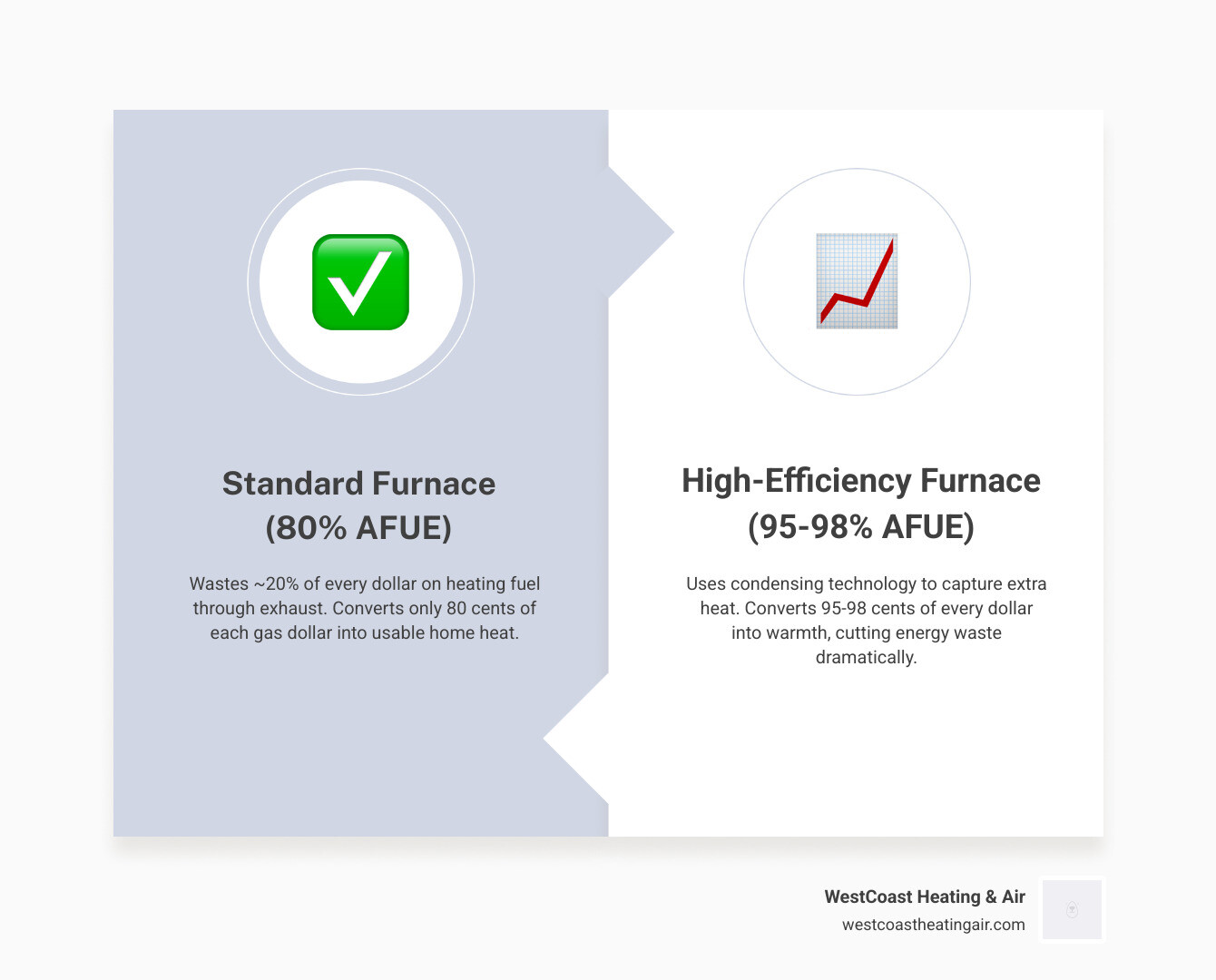
Efficiency in the heating world is measured by AFUE, which stands for Annual Fuel Utilization Efficiency. Think of AFUE as the “miles per gallon” rating for your heating system. It tells us exactly what percentage of the fuel burned is converted into usable heat for your living spaces, and how much is lost as waste up the exhaust flue.
- Standard-Efficiency (80% AFUE): For every dollar you spend on natural gas, only 80 cents actually warms your home. The remaining 20 cents escapes through the chimney as hot exhaust gas.
- High-Efficiency (95% to 98% AFUE): These systems convert up to 98 cents of every dollar into heat, wasting a mere 2 to 5 cents.
When you look at your winter heating bills, that 15% to 18% efficiency gap is the primary driver of your return on investment. If you are experiencing Signs It’s Time to Upgrade Your HVAC System, moving from an aging, deteriorating system to a modern condensing unit is one of the most impactful Furnace System Upgrades you can make to lower your monthly operating costs.
Single-Stage vs. Two-Stage and Modulating Technology
Another major difference between standard and high-efficiency systems is how they distribute heat. Standard 80% furnaces are almost exclusively single-stage. They operate like a light switch: they are either 100% on or completely off. This leads to noticeable temperature swings, where your home gets warm, cools down significantly, and then blasts hot air again.
High-efficiency units typically feature two-stage or modulating gas valves paired with variable-speed blower motors.
- Two-Stage Heating: The furnace runs on a low, highly efficient setting for about 80% of the time, only stepping up to high capacity on the coldest days of the year.
- Modulating Heating: The gas valve adjusts in tiny increments, continuously matching your home’s precise heating needs.
When you are Comparing the Cost and Comfort of Modern HVAC Systems, these variable-speed blowers and multi-stage burners do more than just save fuel. They run for longer, gentler cycles, which virtually eliminates cold spots, keeps air moving continuously through your filtration system, and operates at a whisper-quiet noise level.
Is a high efficiency furnace worth the extra cost for San Diego homeowners?

When evaluating if a high efficiency furnace is worth the extra cost, climate is the single most important factor. In very mild climates, such as San Diego or other coastal Southern California regions, the heating season is incredibly short. Homeowners there rarely run their furnaces for more than a few weeks out of the year, meaning the potential for annual gas savings is very low. In those warm areas, a standard-efficiency furnace or a heat pump is often the most sensible choice because the payback period on a premium gas furnace could easily exceed the lifespan of the equipment.
However, for our homeowners here in Western Washington—including Puyallup, Tacoma, SeaTac, and surrounding areas—the math is entirely different. Our winters are long, damp, and chilly. We rely on our heating systems heavily from mid-autumn all the way into late spring. Because our furnaces run for hundreds of hours every year, the cumulative gas savings from a high-efficiency unit accumulate rapidly. If you are debating gas options, it is also worth exploring Why Your Old Gas Furnace is Feeling the Heat from Modern Heat Pumps, as modern electric systems are becoming an increasingly popular alternative in our region.
Calculating the ROI: When is a high efficiency furnace worth the extra cost?
To determine if the higher upfront price tag of a high-efficiency unit makes financial sense for your home, you can run a straightforward return on investment (ROI) calculation:
$$\text{Payback Period (Years)} = \frac{\text{Extra Upfront Cost of High-Efficiency System}}{\text{Annual Energy Savings}}$$
Because we do not use specific pricing figures, let’s look at how the variables interact:
- Your Heating Demand: Larger homes and homes with average or poor insulation have higher heating demands. The more fuel you use, the more money you save by upgrading to a 95%+ AFUE unit, which shortens your payback period.
- Your Ownership Timeline: If you plan to live in your home for at least 5 to 10 years, a high-efficiency furnace is almost always worth the investment in the Pacific Northwest. You will easily clear the payback hurdle and enjoy pure utility savings for the remainder of the system’s lifespan.
- Insulation Quality: If your home is drafty, upgrading your furnace will save you money, but pairing that upgrade with proper weatherization will maximize your ROI.
Hidden Installation Requirements and Infrastructure Upgrades
When upgrading from a standard 80% furnace to a high-efficiency condensing model, there are several physical installation differences that your contractor must address:
- PVC Venting: Because condensing furnaces extract so much heat from the combustion gases, the exhaust is cool enough to condense into acidic water. This means the exhaust can no longer vent through a standard metal chimney, which would quickly corrode. Instead, the installer must run dedicated plastic PVC pipes through an exterior wall or the roof to safely vent the exhaust and bring in fresh outdoor air.
- Condensate Drainage: High-efficiency units produce gallons of water daily as a byproduct of the condensation process. Your home must have a proper drainage route, such as a nearby floor drain, a dedicated utility sink, or a condensate pump to safely direct this water out of your home.
- Chimney Liners: If your old furnace shared a metal chimney flue with your gas water heater, removing the furnace from that vent system means the remaining water heater flue may now be oversized. This can prevent proper drafting, requiring the installation of a new chimney liner to keep your home safe from backdrafting carbon monoxide.
Maximizing Your Investment with Rebates, Incentives, and Alternative Options
One of the easiest ways to shorten your payback period is to take advantage of utility rebates and government incentives. While federal tax credits under the Inflation Reduction Act have shifted over time, local utility companies across Western Washington continue to offer excellent rebates for homeowners upgrading to qualifying high-efficiency equipment.
To help you compare your options, here is a look at how high-efficiency gas furnaces stack up against modern electric heat pumps:
| Feature | High-Efficiency Gas Furnace (95%+ AFUE) | Modern Electric Heat Pump |
|---|---|---|
| Primary Fuel Source | Natural Gas | Electricity |
| Efficiency Rating | 95% to 98% AFUE | Up to 300%+ (COP of 3.0+) |
| Venting Required? | Yes (PVC drainage & exhaust pipes) | No venting required |
| Cooling Capability | Heating only (requires separate AC) | Year-round heating and cooling |
| Climate Fit | Excellent for extreme and prolonged cold | Ideal for moderate maritime climates |
| Local Incentives | Utility rebates and manufacturer promotions | Substantial utility rebates and clean-energy programs |
By stacking manufacturer promotions with local incentives, you can significantly reduce the initial cost premium of a high-efficiency installation. For a detailed guide on how to navigate these financial perks, take a look at our overview of Utility Rebates for High Efficiency Heating: A Federal Overview and explore the specific Inflation Reduction Act Benefits for Washington Homeowners.
The Heat Pump Alternative for Southern California Climates
While gas furnaces remain a staple of home heating, many homeowners are choosing to bypass gas entirely. In moderate climates, heat pumps are incredibly efficient because they do not burn fuel to create heat; instead, they simply move heat from the outdoor air into your home.
Even in our cooler Western Washington climate, modern cold-climate heat pumps are an outstanding option. They provide highly efficient heating during our damp winters and offer the added benefit of high-performance air conditioning during our increasingly warm summer months. If you are considering transitioning away from fossil fuels, check out the Advantages of Upgrading to a High Efficiency Heat Pump to see if a hybrid dual-fuel system or a standalone heat pump is the right fit for your property.
Frequently Asked Questions About Furnace Efficiency
How long do high-efficiency furnaces typically last?
A professionally installed, high-efficiency gas furnace typically lasts between 15 and 20 years. Because condensing furnaces have a secondary heat exchanger made of high-grade stainless steel to resist acidic condensate, the core heating components are highly durable. However, because these systems are more mechanically complex than standard models, keeping up with annual preventative maintenance is crucial to achieving maximum longevity.
Do high-efficiency furnaces require more maintenance?
While the core maintenance steps—such as regularly replacing your air filters—remain the same, high-efficiency systems do require a few extra checks. During an annual tune-up, a technician will clean the condensate trap, inspect the PVC venting pipes for blockages, and ensure the condensate pump is operating correctly. Keeping these drainage lines clear prevents water from backing up and triggering safety switches that could shut down your heating system on a cold night.
Will a high-efficiency furnace increase my home’s resale value?
Yes. Modern home buyers are highly sensitive to energy costs and green home features. Having a certified high-efficiency heating system installed in your home is a major selling point that can increase your property’s marketability and overall value, especially in regions with distinct winter seasons where heating bills are a top-of-mind concern.
Conclusion
Deciding whether a high efficiency furnace is worth the extra cost ultimately comes down to your home’s unique layout, your local climate, and your long-term comfort goals. For families living in our Western Washington communities—from Puyallup and Sumner to Tacoma and beyond—the combination of long winters and excellent local utility rebates makes high-efficiency systems an incredibly smart, high-return investment.
At WestCoast Heating & Air, we believe in customer education and customized system design. We don’t believe in high-pressure sales pitches or one-size-fits-all solutions. Our team has over 20 years of local experience helping homeowners choose the perfect residential heating and cooling systems for their budgets and lifestyles.
If you are ready to explore your options and want an honest, personalized assessment of what a high-efficiency upgrade can do for your home’s comfort and energy bills, we are here to help. Contact West Coast Heating, Air Conditioning & Solar today to schedule your consultation.