
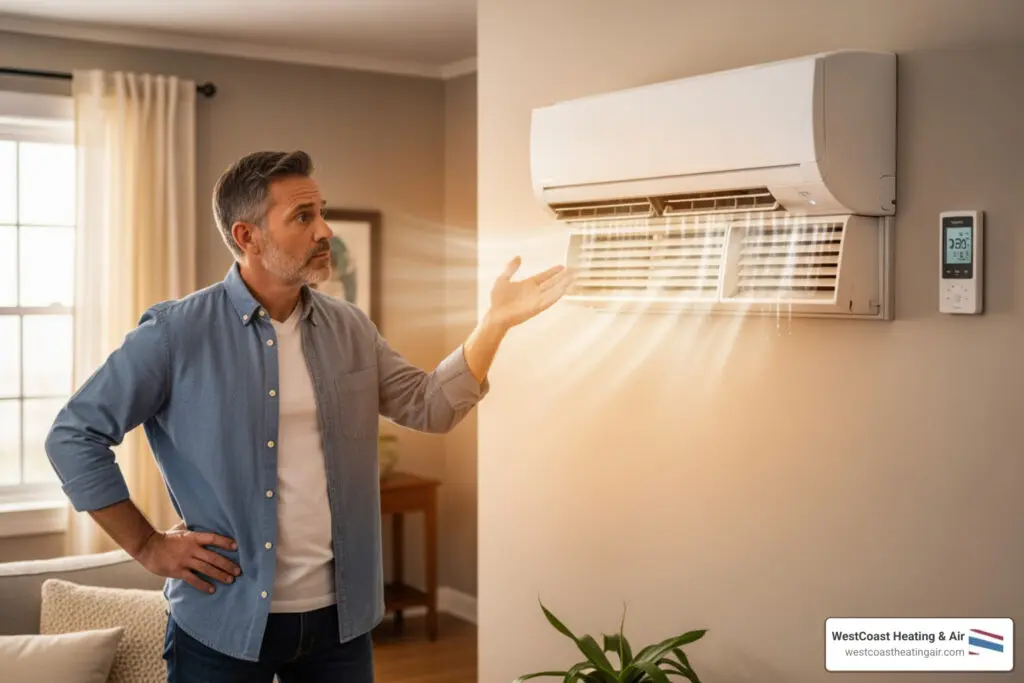
Why Is My AC Blowing Warm Air? Here’s What’s Going On
If you’re wondering why is my AC blowing warm air, you’re not alone — and the good news is that most causes are diagnosable without a lot of guesswork. Here are the most common reasons:
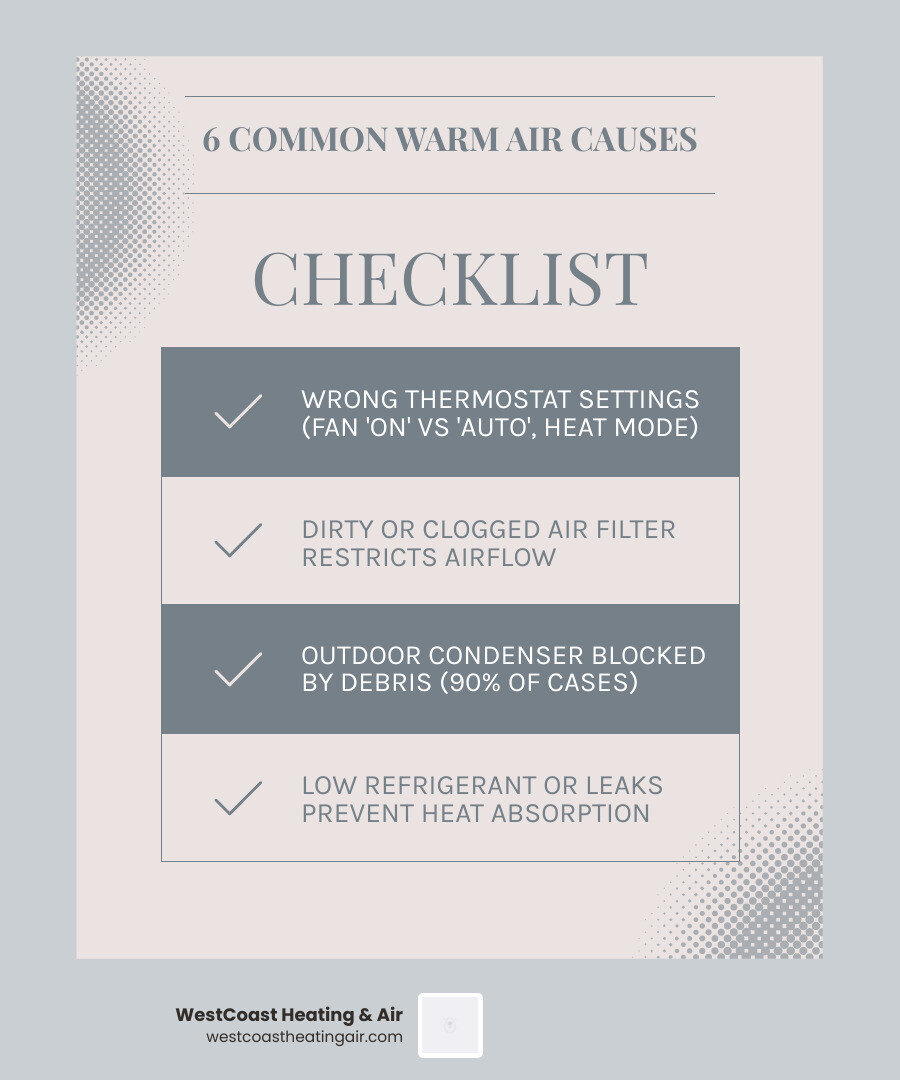
- Wrong thermostat settings — fan set to “On” instead of “Auto,” or mode accidentally switched to “Heat”
- Dirty or clogged air filter — restricts airflow and is one of the most frequent culprits
- Outdoor condenser unit problems — debris buildup, fan failure, or loss of power (responsible for roughly 90% of hot air issues)
- Low refrigerant or a leak — prevents your system from absorbing heat properly
- Frozen evaporator coils — often caused by restricted airflow or low refrigerant
- Tripped circuit breaker — cuts power to the outdoor unit while the indoor fan keeps running
- Failing compressor or capacitor — mechanical issues that require professional diagnosis
Understanding the cause is the first step to getting your home cool again — and many of these issues have simple fixes you can try right now.
It’s May 2026, and if the Pacific Northwest heat has already arrived at your door, a warm-air AC isn’t just annoying — it’s urgent. You walk past a vent expecting relief and instead get a blast of air that feels closer to a hair dryer than a cooling system. Whether your system is running constantly without cooling your home, or it’s only blowing warm air on the hottest days, something in the cooling cycle has broken down — and this guide will walk you through exactly what to look for.
I’m Michael Smith, owner of WestCoast Heating & Air in Puyallup, Washington, and after a 30-year career at Boeing followed by years of hands-on HVAC work across the South Sound, I’ve seen nearly every reason why is my AC blowing warm air — from a simple thermostat mix-up to a failing compressor. In the sections ahead, I’ll take you through each cause step by step so you can troubleshoot confidently and know exactly when it’s time to call for backup.
Immediate DIY Checks: Why Is My AC Blowing Warm Air?
Before assuming the worst, start with the quick checks. A surprising number of “broken AC” calls turn out to be settings, power, or airflow issues.
First, check your thermostat:
- Make sure it is set to
Cool, notHeat - Set the fan to
Auto, notOn - Lower the temperature setting at least a few degrees below room temperature
- Replace thermostat batteries if the display is dim, blank, or acting strangely
That Fan On setting causes a lot of confusion. When the fan is set to On, it can keep blowing air even when the cooling cycle is not running. That means you may feel room-temperature or warm air from the vents and assume the AC is failing, when really the blower is just doing exactly what you asked it to do. Helpful? Sometimes. Misleading? Very.
Next, check power to the system:
- Look for a tripped breaker in your electrical panel
- Reset it once if needed
- Check the disconnect box near the outdoor unit if accessible
- Make sure the emergency switch near the indoor unit has not been turned off accidentally
If the indoor unit is running but the outdoor condenser is not, the air handler may still push air through your vents, but it will not be cooled. That is one of the classic reasons homeowners ask, “why is my AC blowing warm air when it sounds like it’s on?”
If you reset a breaker, give the system a few minutes before expecting full operation. Many systems have a built-in delay to protect the compressor. For broader prevention tips, we also recommend professional AC maintenance for Tacoma homeowners.
Airflow Obstructions and Dirty Filters
A dirty air filter is one of the most common causes of an AC blowing warm air. It is also one of the easiest things to fix.
Your air conditioner needs steady airflow across the evaporator coil to remove heat from your home. When the filter gets clogged with dust, pet hair, and everyday debris, airflow drops. That causes several problems:
- Less cool air reaches your rooms
- The system has to work harder
- The evaporator coil can get too cold and freeze
- The AC may overheat or lose efficiency
- You may end up with warm air even though the system is still running
In many homes, filters should be checked monthly and replaced every 1 to 3 months. If you have pets, allergies, ongoing remodeling dust, or heavy seasonal pollen, you may need to replace them more often.
Here is how to check and replace the filter:
- Turn off the system at the thermostat.
- Locate the filter at the return grille or indoor air handler.
- Slide the filter out and hold it up to the light.
- If light barely passes through, it is time to replace it.
- Match the airflow arrow on the new filter to the direction of airflow.
- Install the new filter and restart the system.
If your system uses a ductless setup, airflow problems can also come from dirty indoor heads, filters, or coils. This is one reason ductless systems may also start blowing warm air. You can learn more in ductless cooling repair in Puyallup.
We also cover the long-term effects of neglected filters in what happens if you don’t get an air filter change.
While you are at it, make sure vents and returns are open and not blocked by rugs, furniture, or curtains. Restricted airflow anywhere in the system can reduce cooling and strain components.
Outdoor Condenser Unit Issues
If the thermostat and filter look fine, head outside. In our experience, and in industry guidance, the outdoor condenser unit is behind the problem a large share of the time. Some sources put it at around 90% of hot-air complaints.
Why? Because your outdoor unit is where your system releases the heat it pulled from inside your home. If that heat cannot escape, the cooling cycle falls apart.
Common outdoor unit problems include:
- Leaves, cottonwood fluff, or grass clippings packed into the coil
- Shrubs or fencing too close to the unit
- Condenser fan not spinning
- Tripped breaker or power loss to the unit
- Dirty condenser coils
- Failed capacitor or contactor
- Compressor trouble
A quick outdoor check:
- Listen for the unit running
- Look to see if the fan is spinning
- Clear away debris from around the cabinet
- Keep at least a couple of feet of open space around the unit
- If the coil is visibly dirty, gently rinse it with a hose after shutting off power
Do not use a pressure washer. Your condenser coil does not need a power wash facial.
If the fan is not spinning, the unit hums, or the breaker keeps tripping, stop there and call a pro. Electrical components and starting parts can fail in ways that are not safe for DIY repair.
For seasonal upkeep, see Spanaway AC maintenance tips. If your system still is not cooling after basic checks, AC repair in Tacoma may be the next step.
Mechanical Failures and Refrigerant Leaks
Once you have ruled out thermostat settings, airflow issues, and obvious outdoor-unit problems, the next suspects are mechanical failures and refrigerant problems.
To understand why these cause warm air, it helps to know how an air conditioner works.
Your AC does not create cold air. It moves heat:
- Warm indoor air passes over the evaporator coil.
- Refrigerant inside that coil absorbs heat.
- The compressor pumps refrigerant to the outdoor unit.
- The condenser releases that heat outside.
- The cooled indoor air is sent back through your ducts.
If any major part of that cycle fails, your system may still blow air, but it will not be properly cooled.
Here is a simple comparison of two common issues:
| Symptom | Frozen Evaporator Coil | Low Refrigerant |
|---|---|---|
| Weak airflow | Common | Possible |
| Ice on indoor coil or lines | Very common | Common |
| Hissing or bubbling | Uncommon | Common |
| AC runs long without cooling | Common | Common |
| Dirty filter often involved | Very common | Sometimes |
| Needs professional repair | Often | Yes |
Identifying signs of low refrigerant and why is my ac blowing warm air
Low refrigerant is a serious issue because a properly sealed AC system should not “use up” refrigerant like a car burns fuel. If levels are low, there is usually a leak.
Signs of low refrigerant include:
- Warm air from vents
- Longer cooling cycles
- Ice on refrigerant lines or evaporator coil
- Hissing or bubbling noises
- Higher indoor humidity
- Cooling that gets worse on hotter days
If you suspect a refrigerant leak, turn the AC off and call for service. Continuing to run the system can strain the compressor, which is one of the most important parts in the unit.
Refrigerant is not a DIY fix. Homeowners should not try to top it off, patch lines, or handle refrigerant directly. The leak needs to be found and repaired first, then the system can be charged correctly.
If your system is older, refrigerant type matters too. Some older units still use R-22, which has been phased out and is more difficult to deal with today. We explain that in R-22 refrigerant phase out: what it means for your AC unit. We also cover common refrigerant questions in how long does AC Freon near Graham last.
Frozen evaporator coils and why is my ac blowing warm air
Yes, a frozen coil can lead to warm air. It sounds backward, but here is what happens: when the evaporator coil freezes over, airflow and heat transfer drop dramatically. The system can no longer cool air effectively, so you may get weak airflow, uneven temperatures, or air that feels warmer than it should.
Frozen coils are commonly caused by:
- Dirty air filters
- Blocked return air
- Closed supply vents
- Low refrigerant
- Blower problems
If you think the coil is frozen:
- Turn the thermostat from
CooltoOff. - Set the fan to
Onto help thaw the ice. - Replace the filter if it is dirty.
- Check that vents and returns are open.
- Let the system thaw fully, which may take several hours.
Once thawed, do not rapid-fire the thermostat on and off. Follow the basic 3-minute rule and wait a few minutes before restarting to reduce stress on the compressor.
If the coil freezes again, that is your sign the underlying problem has not been solved. You may need emergency AC maintenance in Tacoma or help with local ductless cooling repair in Spanaway if you have a mini-split system.
Frequently Asked Questions About AC Cooling Issues
Should I turn off my AC if it’s blowing warm air?
Yes, in most cases you should.
If your AC is blowing warm air, letting it keep running can:
- Waste energy
- Increase wear on the compressor
- Make a frozen coil worse
- Turn a smaller issue into a larger repair
Turn the system off at the thermostat while you inspect the filter, thermostat settings, and outdoor unit. If you find ice, hear hissing, or notice breaker trips, leave it off and schedule service. For more efficiency-related warning signs, see is my AC running efficiently near Orting.
Why does my AC blow cold air sometimes but warm air other times?
Intermittent cooling usually means the problem is developing, not imaginary.
Common causes include:
- A frozen evaporator coil that thaws and refreezes
- Low refrigerant
- A failing capacitor
- Thermostat issues
- Intermittent outdoor unit power loss
- Dirty condenser coils
- Ductless head or sensor issues on mini-split systems
A common pattern is this: the AC cools in the morning, struggles in the afternoon, then seems to recover later. That can point to an outdoor component failing when heat load rises, or a coil icing up during longer run times.
If your system is cycling between cold and warm air, do not ignore it. That “sort of working” phase often comes right before “not working at all.” If you need help sorting out ductless-specific symptoms, here is how to find professional ductless cooling repair in Tacoma.
Is an oversized air conditioner the reason for my cooling problems?
Sometimes, yes.
An oversized air conditioner can cool the home too quickly and shut off before it has properly removed humidity or evenly conditioned the space. This is called short cycling.
Short cycling can lead to:
- Hot and cold spots
- Clammy indoor air
- More wear and tear
- Poor efficiency
- Inconsistent comfort that feels like “sometimes cold, sometimes warm”
Oversizing does not always mean the system will blow straight hot air, but it can absolutely contribute to comfort complaints and uneven cooling. If your system seems to start and stop constantly, sizing may be part of the problem. We dig into that here: why an oversized air conditioner is problematic.
Conclusion
When homeowners ask us, “why is my AC blowing warm air,” the answer usually comes down to a handful of root causes: thermostat settings, dirty filters, outdoor unit trouble, frozen coils, refrigerant leaks, or mechanical failure. The good news is that many of the first checks are simple and safe to do yourself.
The better news? You do not have to figure it all out alone.
At WestCoast Heating & Air, we focus on helping homeowners in Puyallup, Tacoma, Spanaway, Sumner, University Place, Steilacoom, SeaTac, Roy, Orting, and Tumwater get clear answers, honest guidance, and long-term home comfort. As a local, family-owned company with more than 20 years of experience, we believe in customized residential system design, customer education, and doing the job right the first time.
If your AC is still running but not cooling, or you want to prevent this problem before the next heat wave rolls in, explore our air conditioning services.