
Is the Cost of Repairing Old HVAC vs Buying New System Worth It for Puyallup Homeowners?
Understanding the cost of repairing old HVAC vs buying new system is one of the most important financial decisions you’ll face as a homeowner. Here’s a quick breakdown to help you decide:
| Situation | Recommended Action |
|---|---|
| System under 10 years old, minor repair needed | Repair |
| Repair cost exceeds 50% of new system cost | Replace |
| System age × repair cost exceeds $5,000 | Replace |
| R-22 refrigerant system with a leak | Replace |
| Cracked heat exchanger or carbon monoxide risk | Replace immediately |
| 3 or more major repairs in the past 3 years | Replace |
| System under warranty, single component failure | Repair |
Your HVAC system works hard year-round in the Pacific Northwest. Whether it’s keeping your home warm through a wet Puyallup winter or cool during a summer heat wave, a failing system puts both your comfort and your budget under pressure. The frustrating part? A repair quote can feel manageable in the moment — but if your system is aging, that single fix may be just the first in a long line of expenses.
The good news is that you don’t have to make this call on gut instinct alone. There are clear, proven frameworks that help you compare the real cost of patching an old system against the long-term value of investing in a new one.
I’m Michael Smith, owner of WestCoast Heating & Air in Puyallup, and after a 30-year career at Boeing followed by years serving Pierce County homeowners, I’ve helped hundreds of families work through the cost of repairing old HVAC vs buying new system. I’ll walk you through exactly what to look at so you can make a confident, informed decision for your home.
Understanding the Lifespan of Residential Heating and Cooling Systems
To evaluate the cost of repairing old HVAC vs buying new system, we must first look at the clock. Every piece of mechanical equipment has a natural expiration date. In our Pacific Northwest climate—where we experience damp, chilly winters in Tacoma and Puyallup, alongside increasingly hot summers in University Place and SeaTac—our residential systems face unique operational demands.
- Gas and Electric Furnaces: A well-maintained residential furnace typically lasts 15 to 20 years. As a furnace crosses the 15-year mark, its internal components, particularly the heat exchanger, begin to show signs of metal fatigue from decades of constant heating and cooling cycles.
- Central Air Conditioners: Standard outdoor air conditioning units generally have a lifespan of 10 to 15 years. The damp outdoor air in places like Sumner and Steilacoom can accelerate external coil corrosion, while summer heat waves force the compressor to work at maximum capacity.
- Heat Pumps: Because heat pumps provide both heating in the winter and cooling in the summer, they run year-round. This dual-duty cycle means a residential heat pump typically has an expected lifespan of 10 to 15 years.
If your equipment is approaching or has exceeded these age thresholds, investing in anything beyond minor maintenance can be a financial trap. It is highly recommended to read up on the common Signs It’s Time to Upgrade Your HVAC System to understand how performance issues and age go hand-in-hand.
Financial Rules of Thumb: Cost of Repairing Old HVAC vs Buying New System
When a system breaks down, emotion can easily cloud our judgment. To keep your decision strictly logical, professional HVAC contractors rely on a few time-tested mathematical rules of thumb. These formulas balance the immediate expense of a repair against the long-term value of a complete system upgrade.
The 50% Rule
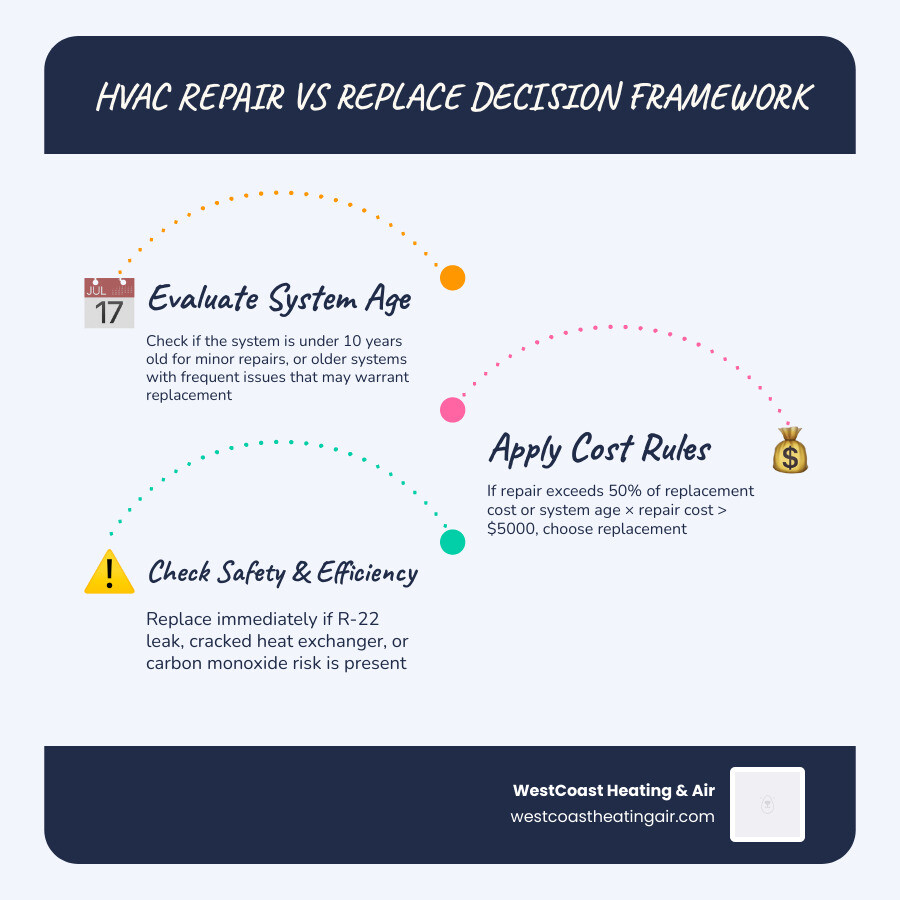
This is the simplest financial baseline used in the industry. If the cost of a single repair exceeds 50% of the cost of a brand-new system, you should almost always choose replacement.
Sinking half the value of a new, warrantied system into an aging unit that could suffer another major component failure next month is rarely a smart investment. When you upgrade, you are not just paying for a working system; you are buying years of worry-free operation covered by a manufacturer’s warranty. You can explore how these financial balances translate to daily comfort in our guide Comparing the Cost and Comfort of Modern HVAC Systems.
The Frequency Rule (The “Repair Spiral”)
If you have had three or more major repairs within the last three years, your system is likely trapped in a repair spiral. In older units, components do not wear out in isolation. A failing blower motor can cause the system to overheat, putting extra strain on the compressor, which eventually leads to a system-wide failure. If you find yourself calling us out to your home in Spanaway or Roy multiple times a season, those individual repair bills will quickly add up to more than the down payment on a highly efficient new system.
Applying the $5,000 Rule to the Cost of Repairing Old HVAC vs Buying New System
The $5,000 rule is a highly reliable, age-adjusted formula that removes the guesswork from the repair-versus-replace debate.
To use this rule, you simply multiply the age of your system (in years) by the estimated repair quote (in dollars).
- If the resulting number is under $5,000, a repair is generally the more cost-effective path.
- If the result is over $5,000, you should direct those funds toward buying a new system.
Let’s look at how this math works in two real-world scenarios:
- Scenario A (Repair Recommended): You have an 8-year-old heat pump in Orting that needs a new fan motor. The repair quote is relatively minor.
$$text{8 years} times text{Minor Repair Cost} = text{Well under $5,000}$$
Because the system is still in the middle of its useful life and the repair is straightforward, fixing it is the smart financial move. - Scenario B (Replacement Recommended): You have a 14-year-old air conditioner in Tumwater that has a failed compressor. Because the compressor is a major component, the repair quote is substantial.
$$text{14 years} times text{Major Repair Cost} = text{Significantly over $5,000}$$
Even though the repair might get the system running for another season, the math clearly signals that you are better off replacing the unit.
How Component Severity Affects the Cost of Repairing Old HVAC vs Buying New System
Not all repairs are created equal. Some parts are quick and inexpensive to swap out, while others require dismantling the entire system and reclaiming refrigerant. Understanding which category your repair falls into is critical when evaluating your options.
| Component | Repair Severity | Typical Decision Path |
|---|---|---|
| Capacitor / Contactor | Minor | Always Repair (unless the system is over 20 years old) |
| Flame Sensor / Igniter | Minor | Always Repair |
| Condensate Drain Line | Minor | Always Repair |
| Thermostat | Minor to Moderate | Repair or Upgrade |
| Blower Motor | Moderate | Repair if system is under 12 years; Replace if older |
| Evaporator Coil | Major | Replace System (especially if on an older refrigerant) |
| Compressor | Major | Replace System if out of warranty |
| Heat Exchanger | Critical | Replace System Immediately due to safety hazards |
Minor repairs are almost always worth doing because they extend the life of your existing investment without breaking the bank. However, if a major component like a compressor or evaporator coil fails on a system that is past its tenth birthday, the labor and parts required make replacement the far superior financial choice.
Efficiency and Environmental Factors in the Repair vs. Replace Decision
When comparing the cost of repairing old HVAC vs buying new system, you cannot just look at the upfront price tag. You must also calculate the hidden cost of continuing to run an inefficient unit.
Older heating and cooling systems are notorious energy hogs. A system installed 12 to 15 years ago might have been rated at 10 to 13 SEER (Seasonal Energy Efficiency Ratio). Modern systems, by contrast, start at 14.3 SEER2 and can reach well over 20 SEER2. Upgrading from an old, degraded system to a modern, high-efficiency model can reduce your monthly heating and cooling costs by 20% to 40%.
For homeowners with gas furnaces, the efficiency gap is just as wide. Older furnaces often operate at around 80% AFUE (Annual Fuel Utilization Efficiency), meaning 20 cents of every dollar spent on gas is wasted up the chimney. Modern condensing furnaces achieve up to 98% AFUE.
Additionally, many homeowners in Puyallup and Tacoma are choosing to transition away from gas entirely. To understand this shift, read our analysis on Why Your Old Gas Furnace is Feeling the Heat from Modern Heat Pumps.
The Refrigerant Phase-Out Factor
Environmental regulations also play a massive role in the viability of repairing older air conditioners and heat pumps:
- R-22 (Freon): Completely phased out by the EPA. If your system was installed before 2010, it likely uses R-22. Because this refrigerant is no longer manufactured or imported, recharging a leaking R-22 system is incredibly expensive. Sinking money into repairing a leaking R-22 coil is a temporary, highly expensive band-aid.
- R-410A (Puron): Currently undergoing its own phase-out in favor of newer, more environmentally friendly refrigerants like R-454B. While R-410A remains available for repairs, its cost will steadily rise over the coming decade.
If your system has a refrigerant leak and uses an outdated gas, replacing the system with modern equipment is the only practical, long-term solution. You can learn more about the environmental and performance perks of these modern systems by reading about the Advantages of Upgrading to a High Efficiency Heat Pump.
Safety Red Flags and Warranty Status
While financial calculations are helpful, some situations bypass the math entirely. Safety must always come first in your home.
Critical Safety Red Flags
If our technicians discover any of the following safety hazards during an inspection, we will recommend immediate replacement for the protection of your household:
- Cracked Heat Exchanger: The heat exchanger is the metal barrier that keeps toxic combustion gases, including carbon monoxide (CO), separate from the air circulating through your home’s vents. If this metal cracks, carbon monoxide can escape directly into your living spaces. Because a cracked heat exchanger cannot be safely patched or welded, replacing the furnace is the only safe option.
- Persistent Electrical Hazards: Repeatedly tripped circuit breakers, melted wiring harnesses, or burning odors from your HVAC unit are severe fire risks that indicate systemic electrical failure.
Checking Your Warranty Status
Before making any repair-or-replace decision, always check your system’s warranty. Most major HVAC manufacturers offer a 5- to 10-year parts warranty if the system was registered properly at installation.
If your system is still under warranty, the manufacturer will cover the cost of the replacement part, leaving you responsible only for the labor. In this scenario, repairing the system is almost always the best choice. However, once the warranty expires, you bear the full cost of both parts and labor, making a complete system replacement much more attractive.
If you do decide to replace, you can prepare yourself by reading our detailed guide on What to Expect During an HVAC Replacement.
Maximizing Value with Incentives and Financing in Washington
One of the most common reasons homeowners hesitate to buy a new HVAC system is the upfront cost. However, in 2026, there are more financial incentives, tax credits, and utility rebates available to Washington homeowners than ever before. These programs can significantly lower the net cost of upgrading to a high-efficiency system.
- Federal Tax Credits (Inflation Reduction Act): Under the Energy Efficient Home Improvement Credit (Section 25C), homeowners can claim a federal tax credit of 30% of the project cost, up to $2,000 for qualifying high-efficiency heat pumps. For high-efficiency central ACs and gas furnaces, credits of up to $600 are available. For a deep dive into these savings, check out our overview of Inflation Reduction Act Benefits for Washington Homeowners.
- Local Utility Rebates: Local utility providers in our service areas offer generous cash-back incentives for upgrading to energy-efficient systems. If you live in Tacoma, you can take advantage of Tacoma Public Utilities Efficiency Incentives That Put Money Back in Your Pocket. Similar programs are offered by Puget Sound Energy (PSE) for homeowners in Puyallup, Sumner, and Orting. You can read more about how these programs work in our guide to Utility Rebates for High Efficiency Heating: A Federal Overview.
- Flexible Financing: To help fit a new system comfortably into your household budget, we offer a variety of customized payment plans. Exploring our Financing options can make a high-efficiency upgrade affordable right away, allowing your monthly energy savings to help pay for the new system over time.
Frequently Asked Questions about HVAC Replacement
Should I replace my furnace and air conditioner at the same time?
Yes, in most cases, replacing both units simultaneously is highly recommended. Your furnace and air conditioner share the same blower motor and duct system. If you pair a brand-new, high-efficiency AC with an old, inefficient furnace blower, the new system will not be able to reach its rated efficiency.
Additionally, replacing both units at the same time saves you thousands of dollars in labor costs compared to scheduling two separate installations years apart. To explore your options for upgrading your heating system alongside your cooling, read our guide on Furnace System Upgrades.
Does a new HVAC system increase home resale value in Puyallup?
Absolutely. Modern homebuyers in Pierce and Thurston counties prioritize energy efficiency and low maintenance costs. An old, failing HVAC system can be a major red flag during a home inspection, often forcing sellers to drop their asking price or pay for an emergency replacement under pressure.
A new, warrantied system with high-efficiency ratings is a major selling point that increases buyer confidence and boosts resale value. Learn more about how your cooling system impacts your home’s marketability in our article Why Your Old AC is Killing Your Resale Price.
What are the best high-efficiency heating options for Pacific Northwest winters?
For our mild but damp winters, hybrid heating systems and high-efficiency heat pumps are incredibly effective. A heat pump extracts heat from the outdoor air and transfers it indoors, operating with extreme efficiency down to freezing temperatures.
For the coldest winter nights in Western Washington, a hybrid system (which pairs an electric heat pump with a high-efficiency gas furnace backup) offers the perfect balance of comfort and energy savings. You can compare the top heating solutions for our region in our comprehensive guide to The Best High Efficiency Heating Options for Your Home.
Conclusion
Deciding between repairing your old HVAC system or investing in a new one is a major decision, but you do not have to make it alone. By evaluating your system’s age, applying the $5,000 and 50% rules, and considering the long-term energy savings of modern technology, you can make a choice that protects both your family’s comfort and your hard-earned savings.
At WestCoast Heating & Air, we have spent over 20 years serving families across Puyallup, Tacoma, University Place, Sumner, Steilacoom, Spanaway, Roy, Orting, Tumwater, and SeaTac. Our approach is built on customized system design, thorough customer education, and a complete commitment to quality. We never push unnecessary replacements, and we never recommend band-aid repairs on systems that are unsafe or financially unviable.
If you are trying to figure out the best path forward for your home’s heating and cooling, let our family-owned team help. Contact WestCoast Heating & Air today to schedule a professional, honest evaluation of your home comfort system.