
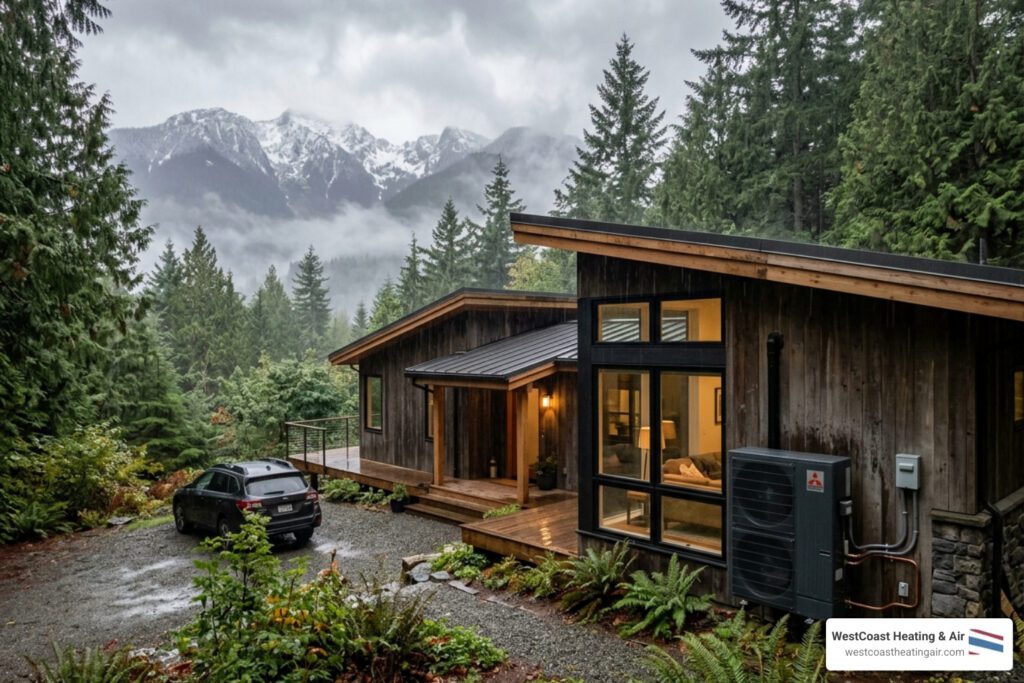
Understanding How Western Washington Climate Affects Your HVAC System
How Western Washington climate affects your HVAC system comes down to one relentless force: persistent moisture, combined with mild but unpredictable temperature swings that most HVAC systems simply were not designed to handle.
Here is a quick summary of the key ways the local climate impacts your home comfort equipment:
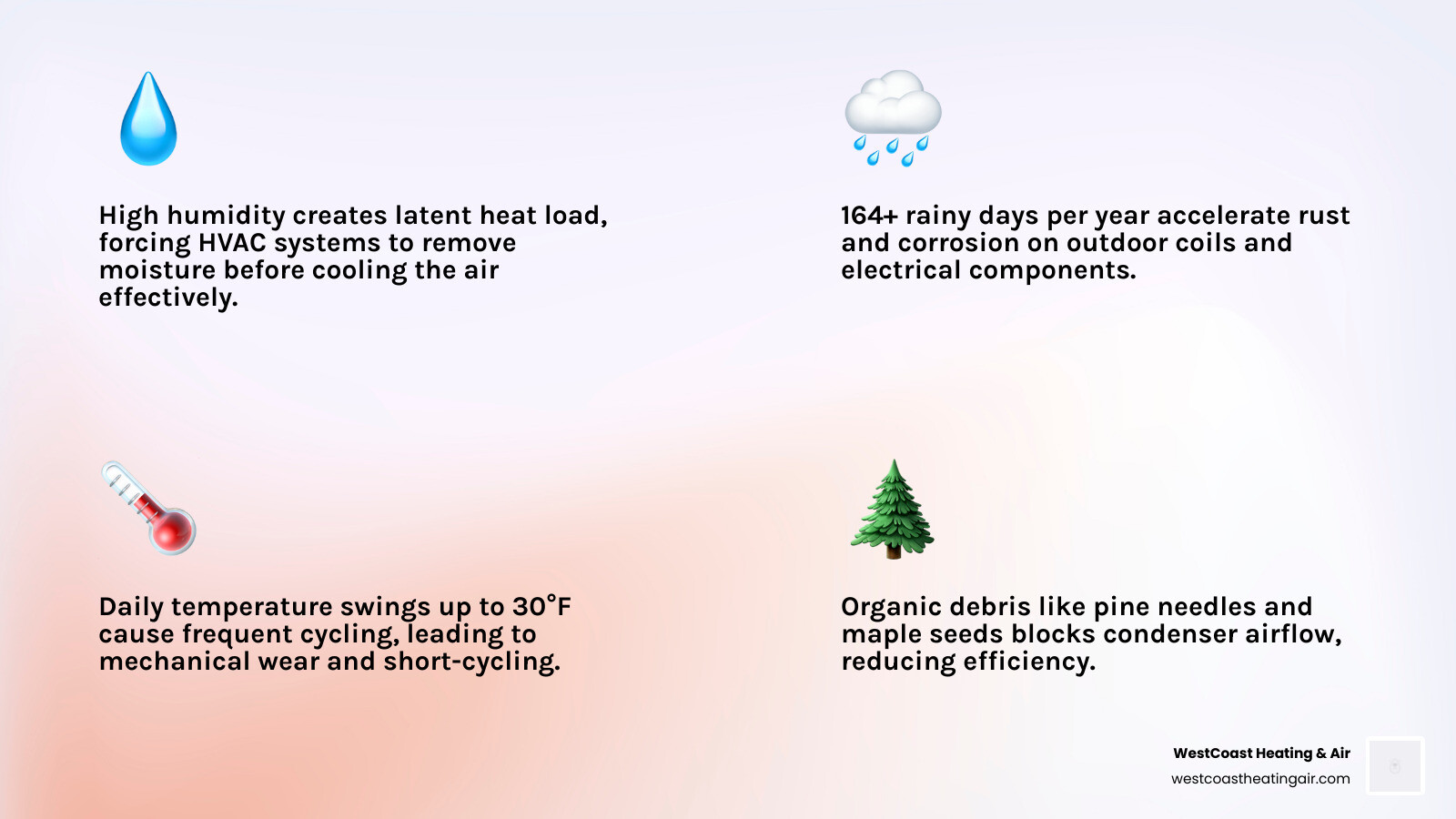
- High humidity forces your system to work harder to remove moisture from the air before it can effectively change the temperature — a process known as latent heat load
- 164+ rainy days per year expose outdoor units to constant moisture, accelerating rust and corrosion on coils and electrical components
- Daily temperature swings of up to 30°F cause repeated heating and cooling cycles that add mechanical wear over time
- Mild winters (with a design heating temperature of just 22°F in Seattle) mean systems sized for harsher climates will short-cycle and fail to manage humidity properly
- Annual wildfire smoke events clog standard filters rapidly, sometimes within three weeks during summer months
- Organic debris — pine needles, moss, maple seeds — blocks condenser airflow in ways homeowners in drier climates rarely experience
The result? Even a well-built HVAC system can underperform, wear out faster, and drive up energy bills if it is not properly matched to Western Washington’s specific marine climate conditions.
I’m Michael Smith, owner of WestCoast Heating & Air in Puyallup, and after 30 years at Boeing followed by years of hands-on HVAC work across the South Sound, I have seen how how western washington climate affects your hvac system in ways that catch homeowners off guard every season. In this guide, I will walk you through exactly what is happening to your equipment — and what you can do about it.
Humidity and latent heat: how Western Washington climate affects your HVAC system
In Western Washington, we live in a “Marine” climate (technically classified as Köppen Cfb). This means our biggest challenge isn’t extreme heat or a deep arctic freeze—it’s moisture. When the air is saturated with water vapor, your HVAC system has to deal with “latent heat.” This is the energy required to wring the water out of the air before the actual temperature can drop.
If your system is oversized—a common mistake in our region—it will “short-cycle.” It turns on, cools the air quickly, and shuts off before it has a chance to dehumidify. This leaves you feeling “clammy” even if the thermostat says 70 degrees. To stay comfortable in places like Spanaway or Sumner, your indoor humidity should stay between 30-50%. Anything higher encourages mold growth and dust mites. For more on surviving those humid spikes, check out The Spanaway Guide To Not Melting This Summer.
Geography and the Cascade effect
Our geography plays a massive role in how your equipment performs. If you live in University Place or Steilacoom, your outdoor unit is fighting salt-air corrosion from the Puget Sound. Salt is a brutal catalyst for rust, eating away at aluminum fins and copper coils faster than in inland areas like Orting.
Furthermore, the “Cascade effect” creates microclimates. While the East side of the mountains deals with semi-arid heat, we deal with the rain shadow and damp lowlands. In the South Sound, we often experience 30°F temperature swings in a single day. Your system might be heating at 6:00 AM and cooling by 2:00 PM. This constant mode-switching adds roughly 8–12% more mechanical strain on your compressor compared to systems in more stable climates.
Why Heat Pumps are the Gold Standard for the Puget Sound

In May 2026, we are seeing more homeowners than ever switch to heat pumps. Why? Because they don’t “create” heat through combustion; they move it. In a mild climate like ours, there is plenty of ambient heat in the air even when it feels chilly to us.
Heat pumps are incredibly efficient here because they solve the humidity problem. Modern inverter technology allows the system to run at lower speeds for longer periods, which is exactly what you need to pull moisture out of the air. You can learn more about these advantages in our guide: Dont Let The Rain Dampen Your Comfort With Pnw Heat Pump Benefits.
| Feature | Heat Pump | Gas Furnace |
|---|---|---|
| Energy Source | Electricity (High Efficiency) | Natural Gas/Propane |
| Function | Heats and Cools | Heating Only (Requires AC) |
| Humidity Control | Excellent (Variable Speed) | Limited |
| Lifespan in WA | 10-12 Years (Year-round use) | 15-20 Years |
| Ideal Temp Range | 25°F to 100°F+ | Any Temperature |
Ductless mini-splits for older Western Washington homes
Many homes in Tacoma and SeaTac were built before 1940 and lack the ductwork needed for central air. For these residents, ductless mini-splits are a game changer. By replacing old electric baseboard heaters with a ductless system, homeowners often see energy savings of 25-40%. These systems provide “zoned comfort,” allowing you to heat the living room while keeping the bedrooms cool, which is perfect for our moderate summers.
Why mild winters favor heat transfer over combustion
The “design heating temperature” for the Seattle-Tacoma area is approximately 22°F. This means that 99% of the time, our temperatures stay above that mark. Standard furnaces are often overkill for these conditions. A heat pump can extract enough heat from 35-degree rainy air to keep your home perfectly toasty. While they do enter a “defrost cycle” to melt ice off the outdoor coils when it’s damp and cold, modern units handle this seamlessly without losing indoor comfort.
Common Weather-Related Challenges for Local Homeowners
Rain doesn’t just make things wet; it changes the chemistry of your HVAC system’s environment. Constant moisture leads to biological growth. We often see moss and algae growing inside the dark, damp cabinets of outdoor units in Puyallup and Roy. This growth traps moisture against metal parts, leading to premature rust. For a deeper look at this, read How Does Rain Affect The Hvac Equipment.
Seasonal debris: how Western Washington climate affects your HVAC system maintenance
Our “Evergreen State” title comes with a price for HVAC owners. “Helicopter” maple seeds, pine needles, and heavy wet leaves are notorious for clogging the delicate fins of your outdoor condenser. When these fins are blocked, the system can’t “breathe,” causing the compressor to overheat. We recommend a strict 2-foot clearance rule: keep all vegetation, woodpiles, and shrubs at least two feet away from your unit to ensure proper airflow.
Wildfire smoke and indoor air quality
Over the last few years, wildfire smoke has become an unfortunate summer staple in Western Washington. This fine particulate matter (PM2.5) is dangerous to breathe and brutal on your HVAC system. During smoke events, a standard filter can clog in just a few weeks. We now recommend upgrading to MERV-13 filters or HEPA filtration systems to scrub the air. If you see your filter turning grey or ash-colored, change it immediately to prevent the blower motor from burning out.
Essential Seasonal Maintenance for a Damp Climate
Because heat pumps in our region work year-round—heating in the winter and cooling in the summer—they need more frequent attention than a standalone AC unit. We recommend professional maintenance twice a year: once in the spring and once in the fall.
Critical maintenance for our climate includes:
- Cleaning the coils: Removing the “gunk” and moss that traps moisture.
- Clearing condensate drains: In damp weather, algae or “slime” can clog your drain lines, leading to water damage inside your home.
- Checking refrigerant levels: Proper levels are essential for efficient heat transfer in 40-degree rain.
Check out our Washington Spring Hvac Maintenance Tips For Local Homeowners for a full checklist.
Preparing for the October rainy season
October is the “sweet spot” for HVAC prep in the South Sound. Before the first frost hits, you should perform a “test fire” of your heating system. Switch your thermostat to heat mode and listen for any unusual grinding or squealing noises. This is also the time to calibrate your thermostat and ensure your home envelope is sealed. You can find our complete winter readiness guide here: The Pnw Guide To Not Freezing In The Winter.
Smart technology and efficiency upgrades
A smart thermostat is one of the best investments for a Western Washington home. Many models now feature weather-responsive programming. If the forecast calls for a humid 60-degree day, the thermostat can adjust the system’s cycle to prioritize dehumidification. Additionally, sealing air leaks around windows and doors can reduce your heating load by up to 20%, making your HVAC system’s job much easier.
Frequently Asked Questions about PNW HVAC
Why does my heat pump struggle when it is 45 degrees and raining?
This is the “latent heat” challenge. When the air is 45 degrees and 90% humidity, it is physically harder for the heat pump to extract heat because it has to deal with the moisture first. You might also notice the unit steaming—this is likely just a normal defrost cycle!
How often should I change my filters during wildfire season?
During active smoke events, you should check your filter every week. If you live in a high-debris area like Orting or have pets in Puyallup, you should be changing your filters every 30 to 60 days regardless of the smoke.
Is air conditioning necessary in the Puget Sound area?
While we used to say “no,” the 2021 heat dome (where temperatures hit 108°F) changed the conversation. Today, 87% of homes in our region utilize some form of cooling. A heat pump is often the best solution because it provides that “free” air conditioning as a byproduct of having a high-efficiency heating system.
Conclusion
At WestCoast Heating & Air, we understand that a “one-size-fits-all” approach doesn’t work for how western washington climate affects your hvac system. Whether you are in University Place, Tacoma, or right here in Puyallup, your home has unique needs based on its age, location, and exposure to the elements.
As a local, family-owned company with over 20 years of experience, we specialize in customized system designs that tackle our region’s humidity and temperature swings head-on. Don’t wait for a breakdown during a November rainstorm or a July heatwave. Schedule your regional comfort assessment today and let us ensure your home stays a sanctuary of comfort all year long.